
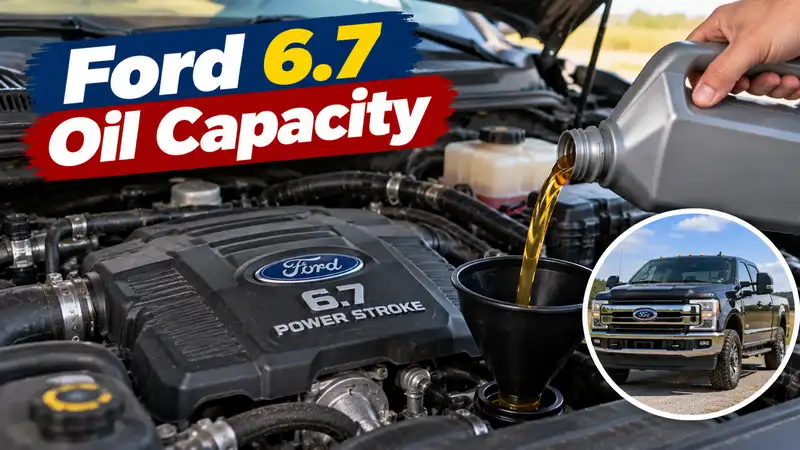
The Ford 6.7 oil capacity is an important specification for anyone maintaining a Super Duty pickup equipped with the 6.7L Power Stroke diesel engine. Using the correct amount of engine oil matters because the lubrication system has to maintain the right oil level across the engine, turbocharger, bearings, valvetrain, and other moving components.
The exact capacity can vary depending on the 6.7L Power Stroke generation, model year, oil pan configuration, and whether the oil filter is replaced. That is why simply memorizing one number for every Ford 6.7 diesel can lead to an incorrect fill.
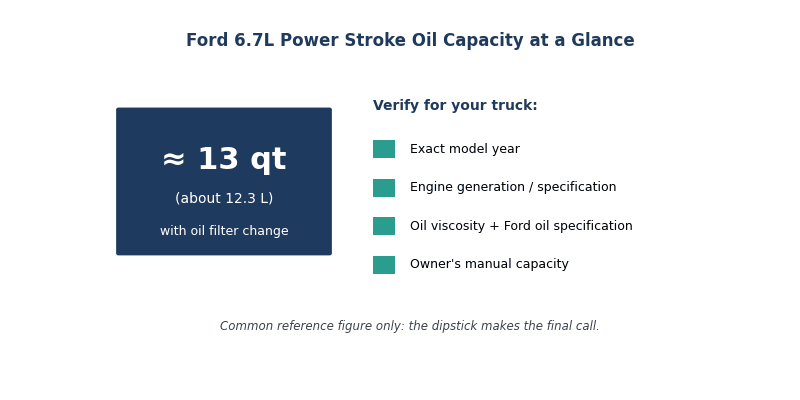
For many 6.7L Power Stroke applications, the commonly specified oil capacity is around 13 quarts (12.3 liters) with a filter change, but the exact specification should always be confirmed for the specific truck and model year before filling the engine.
Getting the quantity right is only part of the job. Oil viscosity, specification, filter quality, drain procedure, dipstick reading, and post-service inspection all affect proper maintenance.
Ford 6.7 Oil Capacity By Model Year And Engine Generation
Ford has used the 6.7L Power Stroke diesel across multiple generations of Super Duty trucks. Although the engine displacement remains 6.7 liters, Ford has made substantial changes to the engine and supporting systems over the years.
That means oil capacity should not be treated as a universal specification simply because two trucks both have a 6.7L Power Stroke.
The engine was introduced for the 2011 model year, and later generations received significant revisions. Ford introduced major updates to the Power Stroke platform for the 2020 model year, including changes associated with the third-generation 6.7L engine.
Common 6.7L Power Stroke Oil Capacity
A frequently listed capacity for the Ford 6.7L Power Stroke is approximately 13 quarts with an oil filter change.
However, the safest approach is to treat that figure as a starting reference rather than blindly pouring all 13 quarts into every truck.
The owner’s manual for the exact vehicle should take priority because Ford can specify different capacities for different configurations and model years.
| Ford 6.7L Power Stroke Application | Commonly Referenced Capacity* | Approximate Liters |
|---|---|---|
| Earlier 6.7L Power Stroke applications | About 13 qt | About 12.3 L |
| Later 6.7L Power Stroke applications | Around 13 qt in many applications | Around 12.3 L |
| Oil Filter Replacement | Included in typical service capacity | — |
*Always verify the exact capacity and oil specification in the owner’s manual for the specific model year and engine configuration.
The reason for emphasizing verification is simple: the difference between an approximate capacity and an exact service specification can matter when an engine holds more than three gallons of oil.
Why The Oil Filter Changes The Fill Quantity
The oil filter retains a certain amount of oil after installation.
When the filter is replaced, some of that oil is no longer in the engine’s lubrication system. The replacement filter will need to fill before the system reaches its normal operating condition.
This is why manufacturers commonly provide an oil-change capacity that assumes the filter has also been replaced.
If you drain the oil but do not replace the filter, the amount required may not be identical to a full oil-and-filter service.
For routine maintenance, replacing the filter at the same time as the oil is generally the appropriate approach unless the manufacturer specifies otherwise.
The Oil Capacity Is Not The Same As The Engine’s Total Oil Volume
Another useful distinction is between oil capacity and the amount of oil physically present in every part of the lubrication system.
When the engine is running, oil circulates through galleries, bearings, the valvetrain, turbocharger lubrication system, filter, and other passages.
After the engine is shut down and allowed to sit, some of that oil drains back into the oil pan.
The dipstick is designed to give you a practical measurement of the engine’s oil level under a specified checking procedure.
That is why the dipstick should be used as the final confirmation after an oil change rather than assuming that the exact number poured into the engine automatically means the level is correct.
Why You Should Not Rely On A Generic 6.7 Diesel Number
Online discussions often refer to the Ford 6.7 as if every model year has exactly the same specifications.
That approach can be risky.
A 2011 Super Duty and a much newer Super Duty may share the 6.7L displacement while having meaningful differences in engine hardware, emissions systems, lubrication components, calibration, and service requirements.
The same principle applies to oil viscosity.
An oil that meets the required specification for one model year should not automatically be assumed to be the correct choice for another.
Before purchasing oil, verify three things:
- The exact model year.
- The engine specification.
- The oil viscosity and performance specification required by Ford.
What Oil Does The Ford 6.7 Power Stroke Need?
Choosing the correct oil for the 6.7L Power Stroke is just as important as putting the correct quantity into the engine.
Diesel engines place substantial demands on engine oil because the lubricant must handle high temperatures, combustion byproducts, turbocharger temperatures, soot-related contamination, and extended operating loads.
The oil also needs to work correctly with the engine’s emissions-control equipment.
Common Oil Viscosity Used In The 6.7 Power Stroke
Ford has specified different oil viscosities depending on model year, operating conditions, and engine generation.
5W-30 has been specified for certain later 6.7L Power Stroke applications, while earlier engines have commonly used 10W-30 under normal conditions.
Some model years and operating conditions may allow additional viscosities.
This is why simply buying whichever diesel oil is available is not the best maintenance strategy.
The viscosity printed on the bottle is only one part of the specification.
The oil should also meet the performance requirements stated by Ford for that specific engine.
Why Viscosity Matters
The two numbers in an oil grade describe its viscosity behavior at different temperatures.
For example, in 5W-30, the “5W” relates to cold-temperature viscosity behavior, while “30” describes the oil’s viscosity classification at operating temperature.
A lower winter rating generally indicates better cold-flow performance compared with a higher winter rating.
That does not mean 5W-30 is universally better than 10W-30.
The correct viscosity depends on the engine design and Ford’s requirements for the specific application.
Using the wrong viscosity can affect lubrication characteristics, especially during cold starts or high-temperature operation.
Oil Specification Matters Beyond Viscosity
Two oils can have the same viscosity and still have different additive packages and performance characteristics.
Modern diesel engine oils are designed to manage issues such as soot, oxidation, wear, deposits, and compatibility with emissions-control systems.
For that reason, the oil should meet the required Ford specification and applicable industry standards.
Do not choose oil based only on a statement such as “diesel compatible.”
Look for the specification required by the vehicle manufacturer.
What About Synthetic Oil?
Many 6.7L Power Stroke owners choose full-synthetic diesel engine oil because of its performance characteristics and availability.
However, the important point is not simply whether an oil is synthetic.
The oil still needs to meet the required viscosity and specification for the particular engine.
A premium oil that does not meet the required specification is not automatically a better choice than a correctly specified oil.
The manufacturer’s requirements should come first.
Oil Choice For Severe Service
The 6.7L Power Stroke is frequently used in conditions that place greater demands on the engine.
Examples include:
- Heavy towing
- Frequent hauling
- Long periods of idling
- Extreme temperatures
- Construction use
- Commercial operation
- Frequent short trips
- Dusty environments
These conditions can affect maintenance requirements.
A truck that regularly tows heavy loads may accumulate engine hours and thermal stress differently from a lightly used truck that spends most of its time on highways.
That is one reason maintenance should be based on the manufacturer’s recommended schedule and the actual way the truck is used.
How To Change Oil In A Ford 6.7 Power Stroke
Changing the oil on a 6.7L Power Stroke requires more preparation than simply draining the old oil and pouring in a new supply.
The engine holds a substantial volume of lubricant, so you need a drain container large enough to safely collect the used oil.
You should also have the correct oil filter, appropriate engine oil, gloves, basic tools, and a safe work area.
What You Need For The Job
| Item | Purpose |
|---|---|
| Correct diesel engine oil | Refill the lubrication system |
| Correct oil filter | Remove contaminants from circulating oil |
| Large drain pan | Collect used oil |
| Ratchet/socket | Remove drain plug where applicable |
| Oil-filter tool | Assist with filter removal if necessary |
| Funnel | Reduce spills during filling |
| Gloves | Protect hands from used oil |
| Shop towels | Clean spills and components |
| Vehicle ramps or lift equipment | Provide safe access when required |
Never rely on an ordinary jack alone to support a vehicle while working underneath it.
If the truck needs to be raised, use equipment designed to safely support its weight and follow proper lifting-point procedures.
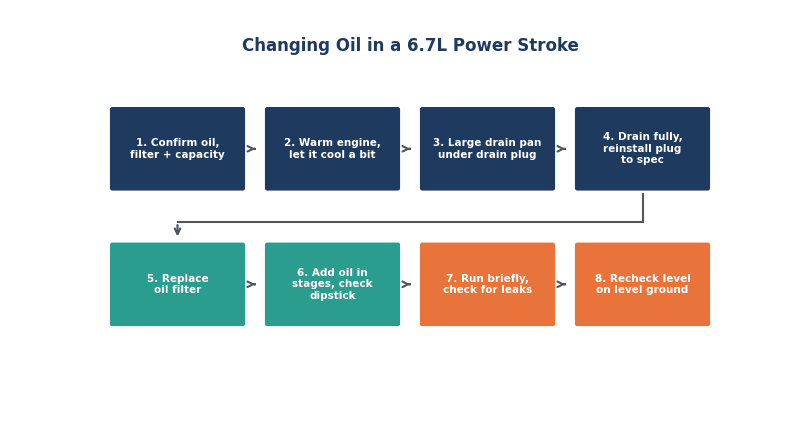
Step 1: Confirm The Correct Oil And Filter
Before draining anything, verify the oil specification, viscosity, filter application, and expected capacity for the exact truck.
This is especially important if the vehicle has been modified or has an unusual service history.
A correct oil filter should be designed for the specific engine.
Avoid choosing a filter solely because it physically fits.
Filter bypass characteristics, filtration performance, sealing dimensions, and construction can differ between applications.
Step 2: Warm The Engine Carefully
Warm oil generally flows more easily than cold oil.
A short drive can bring the engine closer to normal operating temperature and help the used lubricant drain more effectively.
However, hot oil can cause burns.
Allow enough time for the hottest components to cool to a manageable temperature before working around the drain plug and filter.
The goal is to make the oil fluid enough to drain well without creating unnecessary burn risk.
Step 3: Position The Drain Pan Correctly
Place a large drain pan under the oil-drain location before removing the plug.
Remember that oil can initially come out at an angle rather than falling straight down.
A common mistake is positioning a small pan directly under the drain hole without accounting for the initial stream.
Because the 6.7L Power Stroke holds a large volume of oil, an undersized container can overflow quickly.
Step 4: Remove The Drain Plug Carefully
Use the correct tool and remove the drain plug carefully.
Keep pressure on the plug while loosening it so you can control the final threads.
Once the plug is loose enough to remove by hand, position yourself so that you can quickly move away from the draining oil.
Inspect the plug and sealing surface for damage.
If the drain-plug gasket or sealing washer is designed to be replaced during service, install a new one as specified.
Step 5: Let The Oil Drain Completely
Allow sufficient time for the old oil to drain.
Do not rush this step.
Used oil can continue to drain after the initial flow slows considerably.
Once drainage has largely stopped, reinstall the drain plug using the correct tightening procedure and torque specification for the vehicle.
Do not guess the torque if the manufacturer’s specification is available.
Overtightening can damage threads or the oil pan.
Under-tightening can lead to leakage.
Step 6: Replace The Oil Filter
Remove the old filter using the appropriate method.
Before installing the new filter, inspect the old filter and sealing area.
Make sure the old filter gasket has not remained stuck to the mounting surface if the application uses a conventional spin-on design.
A new filter gasket should be lubricated according to the filter manufacturer’s instructions where applicable.
Do not use excessive force during installation.
The correct installation method and tightening specification should be followed.
Step 7: Add The New Oil Gradually
This is where knowing the Ford 6.7 oil capacity becomes useful.
For many 6.7L Power Stroke applications, the service fill is approximately 13 quarts, but do not automatically pour the entire amount into the engine without verifying your exact model-year specification.
A practical approach is to add most of the specified capacity first.
Then wait briefly for the oil to settle and check the dipstick using the manufacturer’s procedure.
If the level is below the full mark, add small amounts until the level reaches the appropriate range.
This reduces the risk of overfilling.
Step 8: Start The Engine And Check For Leaks
Start the engine and allow it to run briefly.
Watch for oil-pressure indications and inspect around the filter and drain plug for leaks.
Do not crawl under a running vehicle unless you are using appropriate professional procedures and equipment.
Shut the engine off and allow the oil to settle.
Then recheck the level according to Ford’s recommended checking procedure.
Step 9: Recheck The Oil Level
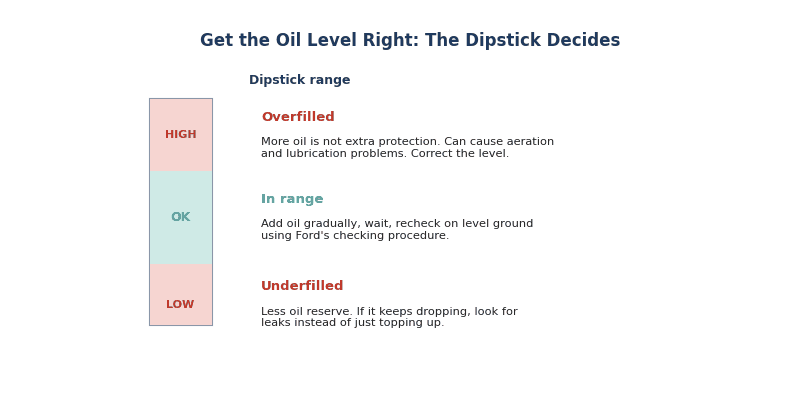
The dipstick is the final authority for the actual oil level after service.
Park the truck on a level surface and follow the manufacturer’s specified waiting period and checking procedure.
Remove the dipstick, wipe it clean, reinstall it fully, and remove it again for the reading if that is the procedure specified for the vehicle.
The oil should fall within the designated range.
If it is low, add oil gradually.
If it is above the maximum mark, do not simply assume that the excess is harmless.
An overfilled crankcase can create its own problems.
How Much Oil Should You Actually Add?
The phrase “13 quarts” can create confusion because the actual amount you pour may vary slightly during a real oil service.
Some old oil remains in passages and components even after draining.
The vehicle may also be positioned slightly differently, affecting how much oil drains from the pan.
That is why the capacity specification should be combined with the dipstick reading.
Starting With The Published Capacity
Suppose your exact vehicle documentation specifies approximately 13 quarts with a filter change.
You can use that specification to plan the service and purchase enough oil.
But instead of treating the number as a command to pour every drop into the engine immediately, add the oil progressively.
This is especially sensible when performing an oil change on a vehicle for the first time.
Once the oil level has stabilized, compare the dipstick reading with the specified range.
Why Overfilling Is A Problem
Adding too much oil does not provide extra protection.
An excessively high oil level can allow rotating engine components to interact with the oil in ways the lubrication system was not designed for.
That can contribute to aeration or other lubrication problems.
The exact consequences depend on how far the engine is overfilled and the engine’s design.
The correct oil level is therefore neither the maximum possible amount nor the largest amount that can physically fit in the crankcase.
It is the manufacturer’s specified operating range.
Why Underfilling Is Also Dangerous
Too little oil can reduce the amount of lubricant available to the engine.
Oil level can fall because of leaks, consumption, or incorrect filling.
If the oil level becomes dangerously low, the lubrication system may not operate as intended under all conditions.
Heavy acceleration, cornering, steep grades, and other conditions can change oil movement inside the engine.
The correct level provides the lubrication system with the oil reserve it was designed to have.
Common Ford 6.7 Oil Change Mistakes
A diesel engine oil change can look straightforward, but several small mistakes can create larger problems.
Mistake 1: Using The Wrong Oil Specification
Choosing oil because it is marketed as “heavy-duty diesel oil” is not enough.
Check the required viscosity and manufacturer specification.
A diesel label alone does not guarantee compatibility with every Power Stroke application.
Mistake 2: Guessing The Capacity
The Ford 6.7 oil capacity is commonly listed around 13 quarts for many applications, but exact specifications should be verified by model year.
Using a generic internet number without checking the vehicle’s documentation can result in an incorrect fill.
Mistake 3: Forgetting The Filter
Replacing oil without replacing the filter defeats part of the purpose of routine oil service.
The filter captures contaminants from the lubrication system.
A new filter also changes the amount of oil required to fill the system compared with simply draining and refilling.
Mistake 4: Overfilling Because The Engine Is Large
A larger engine does not mean that more oil is always better.
The lubrication system is designed around a specific oil volume and operating range.
Follow the manufacturer’s capacity and dipstick procedure.
Mistake 5: Checking The Oil On Uneven Ground
A sloped parking area can affect the dipstick reading.
For the most reliable measurement, check the level on a level surface using the manufacturer’s specified procedure.
Mistake 6: Ignoring Oil Leaks
If the oil level keeps dropping after an oil change, do not simply add oil repeatedly without finding the cause.
Inspect around the oil filter, drain plug, oil pan, turbocharger oil lines where applicable, and other areas identified by the vehicle’s service information.
Mistake 7: Resetting The Maintenance Indicator Without Doing The Service
The oil-life or maintenance reminder is a service-management tool.
Resetting it does not change the condition of the oil.
The reminder should be reset after the appropriate maintenance has actually been completed.
How Often Should You Change Oil In A Ford 6.7?
Oil-change intervals vary with model year, operating conditions, mileage, engine hours, and the manufacturer’s maintenance schedule.
Do not use a single interval for every 6.7L Power Stroke.
Heavy towing, extended idling, commercial operation, dusty environments, frequent short trips, and other severe-use conditions can affect maintenance requirements.
Many newer Ford vehicles use an intelligent oil-life monitoring system, while the owner’s manual provides additional service information.
The correct interval should therefore be taken from the maintenance schedule for the specific truck.
Why Engine Hours Matter For Diesel Trucks
Mileage does not tell the entire story with a heavy-duty diesel.
A truck that travels long highway distances can accumulate substantial mileage while spending relatively little time idling.
Another truck might accumulate fewer miles but spend hundreds of hours operating at low vehicle speed or stationary idle.
Both vehicles experience engine operation differently.
This is particularly relevant for work trucks.
If your Super Duty is used commercially, review both mileage and engine-hour information where available and follow the applicable severe-service recommendations.
Oil Level Should Be Checked Between Changes
Even when an engine is maintained perfectly, oil level should not be ignored between service intervals.
Check the oil periodically according to the manufacturer’s recommended procedure.
A gradual decline can indicate normal oil consumption, while a sudden drop can suggest a leak or another problem.
If the level repeatedly falls below the recommended range, investigate rather than simply treating oil additions as normal maintenance.
Oil Filter Quality And Why It Matters
The filter is an essential part of the lubrication system.
Engine oil circulates through the engine thousands of times, carrying contaminants toward the filter.
A quality filter must provide appropriate filtration while maintaining adequate oil flow.
It also needs to withstand the pressure and temperature conditions of the application.
A filter that physically fits the engine is not necessarily the correct filter.
When purchasing a replacement, use the vehicle’s exact application and a reputable manufacturer.
Avoid selecting a filter solely because it is the cheapest option available.
What Happens If The Filter Is Installed Incorrectly?
An incorrectly installed filter can leak oil or create other lubrication problems.
With a spin-on filter, the sealing gasket must seat correctly.
With cartridge-style systems, the filter element and seals must be positioned exactly as specified.
Double-gasket situations can be particularly dangerous on designs where the old gasket remains attached to the mounting surface.
A proper inspection before starting the engine can prevent this type of mistake.
How To Check For Oil-Related Problems
The oil level is only one piece of information.
Pay attention to:
- Oil-pressure warning lights
- New engine noises
- Excessive oil consumption
- Oil leaks
- Unusual exhaust smoke
- Changes in engine operation
- Oil contamination
- Repeated low oil levels
A warning light related to oil pressure should not be treated the same way as a routine maintenance reminder.
Oil pressure and oil level are related but not identical.
An engine can have an adequate dipstick level and still experience an oil-pressure problem.
If the oil-pressure warning appears while the engine is operating, stop the engine when it is safe and investigate the cause.
A Practical Ford 6.7 Oil Change Reference
| Service Item | Practical Guidance |
|---|---|
| Engine | 6.7L Power Stroke diesel |
| Common service capacity | Approximately 13 quarts with filter on many applications |
| Exact capacity | Verify model year and vehicle documentation |
| Oil filter | Replace during normal oil service |
| Oil viscosity | Depends on model year and operating conditions |
| Oil specification | Follow Ford’s required specification |
| Final oil-level check | Use the dipstick and manufacturer’s procedure |
| Work surface | Level and stable |
| Drain container | Large enough for the complete oil volume |
| After service | Check leaks and oil level |
| Maintenance interval | Follow the exact maintenance schedule |
This table is intended as a practical reference rather than a replacement for the factory maintenance information.
A Useful Way To Think About Ford 6.7 Oil Capacity
The most important insight is that oil capacity is not simply a number to memorize.
It is part of a larger lubrication system.
The engine needs enough oil to maintain circulation and reserve capacity without being overfilled.
The filter needs to be correctly serviced.
The oil needs to meet the appropriate viscosity and performance requirements.
The final level needs to be confirmed with the dipstick.
And the oil-change interval needs to match how the truck is actually used.
This becomes especially important with a heavy-duty diesel because these engines are frequently subjected to towing, high loads, long operating periods, and substantial engine hours.
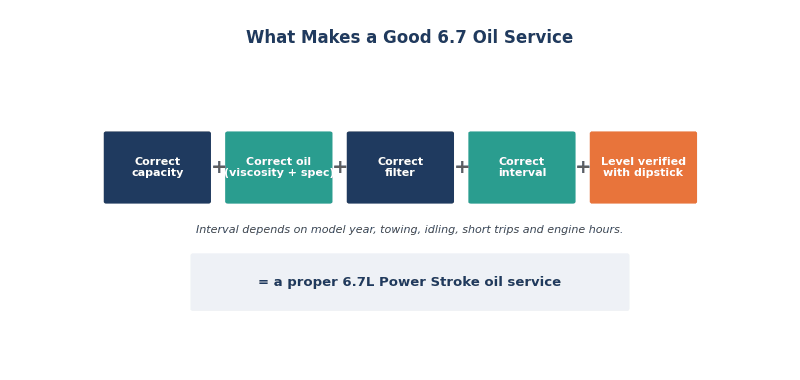
A good maintenance routine therefore combines correct capacity + correct oil + correct filter + correct interval + correct level verification.
Final Thoughts
The Ford 6.7 oil capacity is commonly around 13 quarts with an oil filter change on many 6.7L Power Stroke applications, but the exact specification should always be verified for the specific model year and configuration.
The number alone is not enough.
Use the correct diesel engine oil viscosity and specification, install the correct filter, drain the old oil properly, add the new oil gradually, and use the dipstick to confirm the final level.
Avoid overfilling simply because the engine is large, and do not assume that a low level is normal without investigating repeated oil loss.
The 6.7L Power Stroke is a sophisticated heavy-duty diesel, and proper lubrication is fundamental to its long-term operation. A careful oil service is inexpensive compared with the consequences of running the engine with the wrong oil level, incorrect lubricant, or an unresolved oil-pressure problem.
The best practice is simple: verify the specification for your exact truck, fill carefully, check the level, inspect for leaks, and follow the manufacturer’s maintenance schedule.
What is the Ford 6.7 oil capacity?
Many Ford 6.7L Power Stroke applications have a service capacity of approximately 13 quarts with an oil filter change. However, the exact capacity can vary by model year and configuration, so the owner’s manual or Ford service information for the specific truck should be used as the final reference.
Does the Ford 6.7 Power Stroke take 13 quarts of oil?
Approximately 13 quarts is a commonly referenced service-fill amount for many 6.7L Power Stroke engines when the filter is replaced. It is still important to verify the exact specification for the truck because Ford has produced multiple generations of the 6.7L engine.
What oil does a Ford 6.7 Power Stroke take?
The required oil viscosity and specification depend on the model year and engine generation. Different 6.7L Power Stroke applications have used different viscosity recommendations, including 10W-30 and 5W-30. Always check the exact Ford specification for the vehicle rather than choosing oil based only on the fact that it is marketed for diesel engines.
How often should I change the oil in a 6.7 Power Stroke?
The correct interval depends on the specific model year, maintenance schedule, operating conditions, mileage, and engine hours. Heavy towing, extended idling, commercial use, short trips, and severe operating conditions can affect maintenance requirements. Follow the maintenance schedule provided for the exact truck.
Should I change the oil filter every time I change the oil?
For normal routine maintenance, replacing the oil filter at the same time as the engine oil is the appropriate approach. The filter removes contaminants from the circulating lubricant, and the published oil capacity commonly assumes that a filter change is being performed.
What happens if I overfill my Ford 6.7 with oil?
Overfilling can cause the oil level to exceed the engine’s designed operating range and may contribute to oil aeration or other lubrication problems depending on how severe the overfill is. If the oil is above the specified maximum level, do not assume the excess is harmless. Correct the level according to the manufacturer’s service procedure.