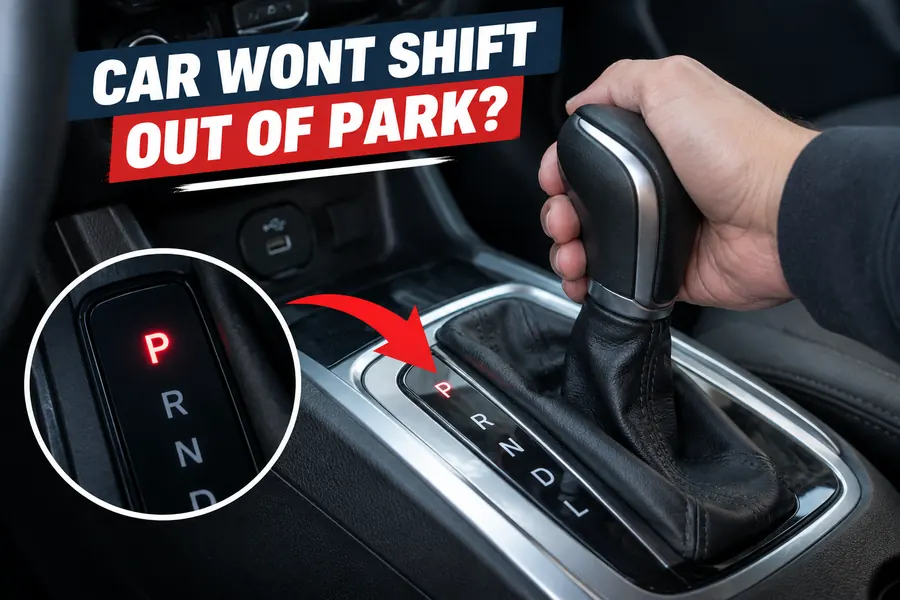
The automatic transmission’s Park position is designed to keep the vehicle from moving when it is parked. A brake-transmission shift interlock adds another layer of protection by preventing the selector from leaving Park unless the required conditions are met.
That safety feature is useful, but it can also leave you wondering what has gone wrong when the gear selector suddenly refuses to move. In many cases, the transmission itself is not damaged. A failed brake-light switch, weak battery, blown fuse, shift-lock solenoid, damaged wiring, or excessive pressure on the parking mechanism can prevent the selector from releasing.
Modern vehicles can also use electronic shifters, push-button selectors, and computer-controlled transmission systems, so the cause varies considerably between models.
The good news is that several checks can be performed before assuming an expensive transmission repair is necessary. The key is to determine whether the problem is caused by the shift interlock system, electrical power, selector mechanism, or the transmission’s parking mechanism.
Why A Car Gets Stuck In Park
The first thing to know is that a vehicle being stuck in Park does not automatically mean the automatic transmission has failed.
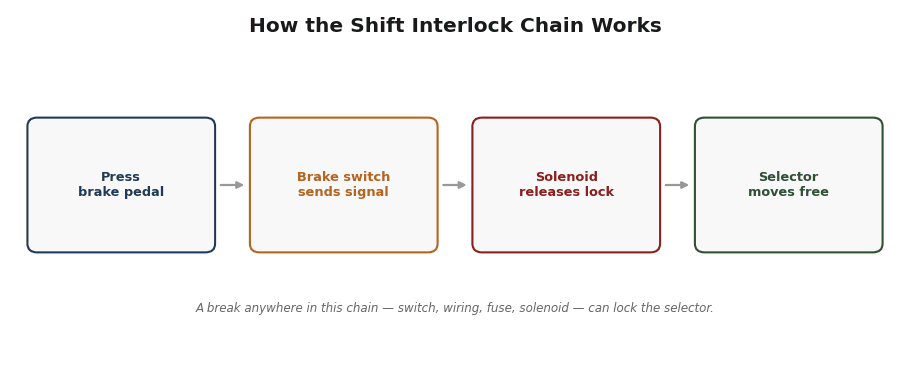
Modern automatic vehicles use a brake-transmission shift interlock system, commonly called BTSI. Its purpose is to prevent the gear selector from being moved out of Park unless the brake pedal is depressed.
NHTSA identifies this system as an important rollaway-prevention feature, and federal safety requirements include brake-transmission shift interlock for applicable automatic-transmission vehicles.
When you press the brake pedal, the vehicle needs to recognize that input before it releases the shift lock.
That simple sequence involves several components.
Depending on the vehicle, the system can include the brake-pedal switch, brake-light circuit, fuse, wiring, body control module, shift-lock solenoid, transmission range information, ignition or power status, and the mechanical selector itself.
If one part of that chain fails, the selector may remain locked in Park.
The Brake Pedal Is More Important Than It Looks
The brake pedal is not only used to slow the vehicle.
Its electrical signal is also used by other systems. When you press the pedal, a brake switch or brake-position sensor tells the vehicle that the brake is being applied.
The shift interlock uses that information to decide whether the selector can be released.
Ford describes its shift interlock solenoid as a component that prevents an automatic transmission from being shifted without the brake being applied.
This is why checking the brake lights is one of the quickest first tests.
If the brake lights do not illuminate when you press the pedal, the vehicle may not be receiving the signal required to release the shifter.
The Shift Lock Solenoid Holds The Selector In Place
The shift-lock solenoid is an electrically controlled locking mechanism.
When the vehicle sees the correct conditions, the solenoid releases the selector. If the required signal is missing, the lock remains engaged.
The component may be located within or around the center-console shifter assembly, depending on the vehicle design.
Toyota, for example, lists a shift-lock solenoid as an electrical component in the shifter system that controls the shift-lock function.
A failed solenoid can therefore produce a very specific symptom: the car starts normally, the brake pedal feels normal, but the gear selector refuses to leave Park.
Park Can Become Loaded On A Hill
There is another mechanical possibility that is easy to overlook.
An automatic transmission has a parking mechanism that locks the drivetrain when Park is selected. Toyota describes the parking lock pawl as a transmission component that engages the parking mechanism and holds the transmission in Park.
If the vehicle is parked on an incline without properly using the parking brake, the vehicle’s weight can place substantial force against the parking mechanism.
That can make the selector difficult to move out of Park.
This situation is sometimes described as the transmission being “stuck” in Park, even though the electrical shift interlock may be functioning correctly.
The important distinction is that the selector may be mechanically loaded rather than electronically locked.
Common Reasons A Car Won’t Shift Out Of Park
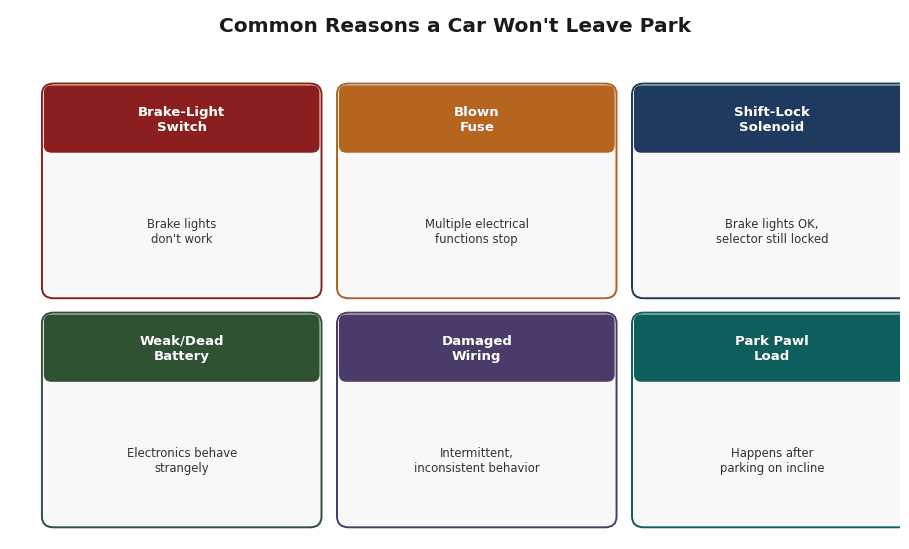
| Possible Cause | Common Clue |
|---|---|
| Brake-Light Switch Failure | Brake lights do not work |
| Blown Fuse | Multiple related electrical functions may stop |
| Failed Shift-Lock Solenoid | Brake lights work but selector remains locked |
| Weak Battery | Electrical systems behave strangely |
| Dead Battery | Selector may remain locked without power |
| Damaged Wiring | Intermittent or inconsistent operation |
| Park Pawl Load | Usually happens after parking on an incline |
| Shifter Assembly Problem | Selector feels physically abnormal |
| Ignition/Power Problem | Vehicle does not recognize correct key/ignition state |
| Transmission Range Sensor Fault | Gear position may display incorrectly |
| Control Module Fault | Multiple electronic symptoms may appear |
| Broken Shift Cable | Selector movement does not correspond correctly |
The exact cause depends on the vehicle.
That is why forcing the shifter is almost always the wrong first move.
How To Diagnose A Shifter Stuck In Park
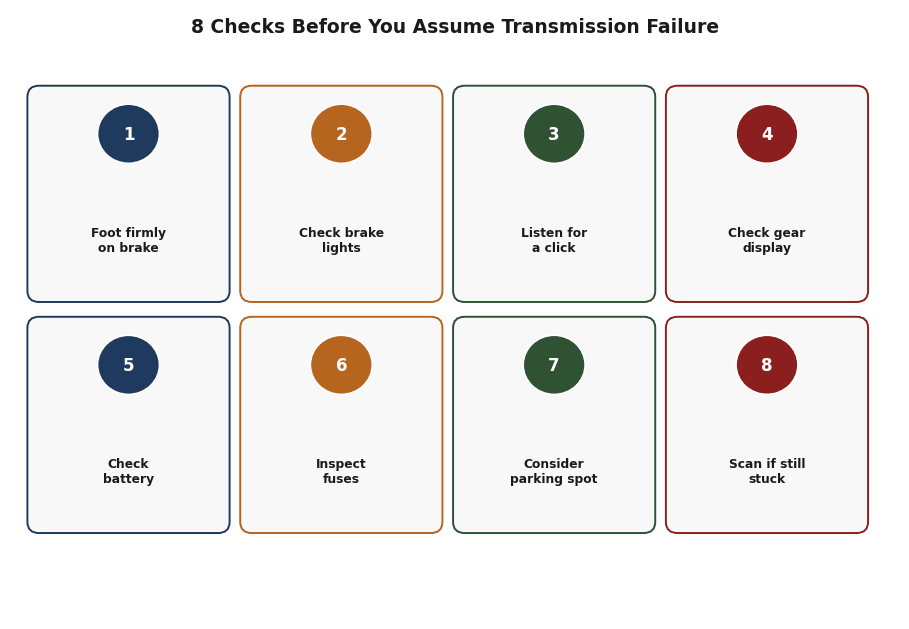
A logical diagnosis starts with the simplest external checks and moves toward the more complicated components.
You do not need to remove the transmission or dismantle the center console immediately.
In many cases, the first few observations can narrow the problem considerably.
Step 1: Keep Your Foot Firmly On The Brake
Sit in the driver’s seat and press the brake pedal firmly.
Make sure the ignition is in the correct position for your vehicle.
On some vehicles, the engine needs to be running before the selector can be moved. Others allow shifting with the ignition switched on.
Do not rely on a generic sequence because push-button-start systems can behave differently from traditional key ignition systems.
If the selector still does not move, keep the brake pressed while performing the next checks.
Step 2: Check The Brake Lights
This is one of the most useful basic tests.
With the vehicle safely parked, have another person look at the rear brake lights while you press the brake pedal.
If the brake lights do not come on, the problem may involve the brake switch, fuse, wiring, bulb or LED assembly, power supply, or control module.
A brake-light problem is especially relevant because the shift interlock may depend on the same brake input.
NHTSA documentation includes examples of vehicles where a brake-light or brake-switch fault can be associated with difficulty shifting out of Park.
If the brake lights work normally, continue with the other checks.
Step 3: Listen For A Click
Many vehicles make a faint click from the shifter area when the brake pedal is pressed.
That sound can come from the shift-lock solenoid releasing.
It is not a universal diagnostic test because vehicle designs differ, but it can provide a useful clue.
If you hear a click but the selector remains physically stuck, there may be a mechanical issue within the shifter assembly or excessive load on the parking mechanism.
If there is no click, the solenoid may not be receiving power or the solenoid itself may have failed.
However, silence alone does not prove the solenoid is defective.
Step 4: Check The Instrument Cluster
Look at the transmission-position display.
Does it correctly show P?
Does the display change when you move the selector?
Are there warning messages such as “Shift System Fault,” “Transmission Fault,” “Service Transmission,” or another message?
If the dashboard does not correctly recognize the selected gear, the problem may involve the range sensor, selector electronics, transmission control module, or communication between modules.
Modern vehicles can use electronic gear selectors that do not mechanically connect the driver’s hand directly to the transmission.
Step 5: Check The Battery
A weak or dead battery can cause unexpected behavior in electronically controlled vehicles.
If the engine does not crank normally, interior electronics are dim, the instrument cluster behaves strangely, or the vehicle recently required a jump-start, battery voltage should be considered.
The shift lock may require electrical power to operate.
A dead battery can therefore leave the vehicle in Park even when the mechanical transmission itself is fine.
Do not immediately replace the battery based only on the stuck shifter.
Test the battery and charging system if electrical power is suspected.
Step 6: Inspect Relevant Fuses
The shift interlock, brake-light circuit, body-control electronics, and other related systems may be protected by fuses.
A blown fuse can interrupt the signal needed to release the selector.
Use the vehicle’s fuse diagram to identify the correct circuit.
Never replace a fuse with one of a higher amperage rating.
If the replacement fuse blows again, there may be a short circuit or another electrical problem that requires diagnosis.
Repeatedly installing new fuses without finding the reason for the failure can create a more serious electrical issue.
Step 7: Consider Where The Vehicle Was Parked
Think about what happened immediately before the problem.
Was the vehicle parked on a steep hill?
Was the parking brake applied?
Did the vehicle roll slightly after selecting Park?
Was the transmission selector difficult to move when parking?
If the answer is yes, the parking pawl may be loaded by the vehicle’s weight.
That can make the selector feel unusually resistant.
This is different from a failed brake interlock.
Step 8: Scan The Vehicle If Basic Checks Do Not Help
If the brake lights work, the battery is healthy, the fuses are intact, and the selector still will not release, diagnostic scanning becomes much more useful.
A professional scan tool can communicate with transmission, body, and other control modules depending on the vehicle.
A basic OBD reader may not access every module.
Do not clear codes before recording them.
The codes may provide clues about the brake switch, transmission range sensor, shift-lock circuit, communication system, or another component.
The Most Common Causes In Detail
A stuck shifter is usually easier to diagnose once you understand what each component does.
The following problems cover many of the common reasons an automatic vehicle refuses to leave Park.
Bad Brake-Light Switch
The brake-light switch is one of the first components worth checking.
It is commonly mounted near the brake pedal and detects when the pedal is pressed.
Older systems may use a relatively simple switch, while newer vehicles can use more sophisticated brake-pedal position sensing.
If the switch fails, the vehicle may not recognize that the brake has been applied.
That can prevent the shift interlock from releasing.
Possible clues include brake lights that do not work, cruise control problems, an illuminated warning light, or a shifter that remains locked in Park.
Some vehicles may have redundant brake signals, so brake lights working does not always eliminate the switch as a possibility.
Testing the actual signal is more reliable than guessing.
Blown Shift-Interlock Fuse
Electrical protection devices exist to prevent wiring damage if a circuit experiences excessive current.
If the fuse supplying the shift-lock or brake-light circuit fails, the selector may remain locked.
The fuse location varies significantly.
Always use the vehicle-specific fuse chart.
A fuse that looks intact should still be tested if necessary because visual inspection is not always enough.
If a replacement fuse immediately blows, stop replacing fuses and investigate the circuit.
There is likely an underlying electrical problem.
Failed Shift-Lock Solenoid
The solenoid physically releases the lock when the appropriate signal is received.
If the solenoid fails internally, the selector can remain locked even when the brake pedal and brake lights work correctly.
A technician can test whether the solenoid receives power and whether it operates correctly.
Ford’s parts documentation specifically identifies the shift-interlock solenoid as the component responsible for preventing the automatic transmission from being shifted without the brake being applied.
Depending on the vehicle, replacing the solenoid may require partial or complete removal of the shifter assembly.
Low Or Dead Battery
Electrical power is essential for many modern shift systems.
If the battery is completely dead, the selector may remain locked because the release mechanism cannot operate.
Some vehicles provide a mechanical emergency release for exactly this reason.
However, the location and procedure vary.
Do not assume that connecting jumper cables will automatically solve the shifter problem.
If the battery is severely discharged, the vehicle may require proper charging or replacement before its electronic systems operate normally.
Damaged Wiring Or Connector
Wiring problems can be more difficult to diagnose than component failures.
A wire can break internally while appearing normal from the outside.
A connector can develop corrosion.
A terminal can become loose.
Water can enter an electrical connection.
Rodent damage can also affect wiring around the engine compartment or cabin.
Intermittent problems are particularly important because the shifter may work normally one day and remain locked the next.
A technician may need to perform voltage and continuity tests while operating the brake pedal and selector.
Parking Pawl Under Load
The parking pawl is part of the transmission’s mechanical parking system.
When Park is selected, it engages the transmission’s parking mechanism.
If the vehicle’s weight is resting heavily against that mechanism, the selector can become difficult to release.
This commonly occurs when a vehicle is parked on an incline and the parking brake is not used properly.
The correct long-term parking habit is to stop completely, apply the parking brake, and then place the transmission in Park.
Ford’s owner guidance also instructs drivers to apply the parking brake and leave an automatic transmission in Park when parking.
Faulty Transmission Range Sensor
The transmission range sensor tells the vehicle which gear position has been selected.
Depending on the vehicle, it may be integrated into the transmission or selector system.
If the sensor produces an incorrect signal, the vehicle may not correctly recognize Park or another gear position.
Symptoms can include:
- Incorrect gear display
- No-start condition
- Gear selection problems
- Warning messages
- Transmission-related fault codes
This requires proper testing because similar symptoms can come from wiring or control-module communication problems.
Electronic Shifter Failure
Newer vehicles increasingly use electronic gear selectors.
Instead of a conventional mechanical linkage running directly from the cabin selector to the transmission, the driver’s input may be interpreted electronically.
This allows manufacturers to use compact selectors, rotary controls, buttons, or unusual shifter designs.
The benefit is packaging and electronic integration.
The downside is that a simple selector problem can involve multiple electrical components.
If the selector display does not respond, diagnosis may need to involve the body-control module, transmission-control module, selector assembly, wiring, and software.
How To Get A Car Out Of Park Safely
If the vehicle is stuck and you need to move it, many manufacturers provide a shift-lock release or manual override.
The exact location varies.
It may be a small covered slot beside the selector, a button underneath a removable trim piece, or another mechanism specified in the owner’s manual.
The emergency release is intended to allow the vehicle to be moved when the normal interlock cannot operate.
Use The Parking Brake First
Before using a manual shift-lock release, secure the vehicle.
Set the parking brake firmly.
If the vehicle is on an incline, use wheel chocks if available and appropriate.
The reason is simple: once the selector leaves Park, the transmission’s parking mechanism may no longer hold the vehicle.
NHTSA documentation specifically warns that using an emergency shift-lock procedure can place the vehicle in a condition where it may roll, and recommends fully applying the parking brake and using wheel chocks where appropriate.
Do not treat the emergency release as a repair.
It is a way to move the vehicle safely enough to facilitate service or towing.
Locate The Shift-Lock Release
Look around the gear selector for a small labeled cover or slot.
Common markings include:
SHIFT LOCK
SHIFT LOCK RELEASE
LOCK RELEASE
The location is vehicle-specific.
Your owner’s manual should show the exact procedure.
For example, a Toyota service document instructs certain models with a stuck selector to apply the parking brake, remove the appropriate key component, remove the cover from the shift-lock release slot, insert the key, press the release mechanism, and move the selector to Neutral.
That procedure is not universal.
Do not insert a screwdriver or key into an unidentified opening simply because it looks similar.
Move The Selector To Neutral
If the manufacturer’s emergency procedure allows it, moving the selector into Neutral can make towing or repositioning possible.
Keep the parking brake applied until you are ready to control the vehicle’s movement.
Once in Neutral, the vehicle can roll freely.
The person moving the vehicle needs to remain aware that the transmission is no longer mechanically holding it in Park.
If the engine can be started and the vehicle operates normally after being moved, it still needs diagnosis before regular use.
Do Not Force The Shifter
The selector should not require excessive force.
If you have to pull violently, strike the selector, or use a long tool for leverage, stop.
The shift mechanism can be damaged.
Breaking a plastic selector component or internal linkage can turn a simple electrical problem into a more expensive repair.
The emergency release is designed to bypass the lock.
It is not designed to overcome a mechanically damaged transmission by brute force.
How To Fix A Car That Won’t Shift Out Of Park
The correct repair depends on the failed component.
A brake switch is handled differently from a transmission parking mechanism, and an electronic selector requires a different approach from a conventional floor shifter.
Replace A Failed Brake Switch
If testing confirms that the brake switch is not producing the correct signal, replacement may restore normal shift-interlock operation.
The switch location and adjustment procedure vary by vehicle.
After replacement, verify the brake lights and confirm that the selector releases normally.
Do not consider the repair complete until the brake-light system has been checked.
Repair Or Replace A Shift-Lock Solenoid
A failed solenoid may be replaceable separately, although some manufacturers integrate it into the complete shifter assembly.
The technician should first confirm that the solenoid is receiving the correct voltage and control signal.
If power is present but the solenoid does not operate, the solenoid or assembly may be defective.
If power is absent, replacing the solenoid may accomplish nothing.
The circuit must be diagnosed first.
Repair Wiring And Connectors
If the issue is a damaged wire or connector, repair the circuit properly.
A good repair should restore electrical continuity and protect the connection against vibration, moisture, and future damage.
Loose wires should not simply be taped together.
The repair should follow appropriate automotive wiring practices.
Replace A Fuse Only After Finding The Cause
If a fuse has failed, replace it with the correct specification.
But if it fails again, do not keep replacing it.
Repeated fuse failure indicates that the circuit may have an electrical short or another fault.
A technician should identify the cause before the vehicle is returned to normal use.
Repair The Shifter Assembly
Mechanical damage inside the selector assembly can prevent movement even when the electrical interlock works correctly.
Broken springs, worn components, damaged buttons, spilled liquids, and foreign objects can interfere with the mechanism.
A selector that feels physically different from normal deserves inspection.
For example, if the release button suddenly feels loose or remains depressed, the issue may be mechanical rather than electronic.
Address Transmission Parking Mechanism Problems
If the problem originates inside the transmission’s parking mechanism, the repair becomes more involved.
The parking pawl, linkage, selector mechanism, or related components may need inspection.
Do not attempt to dismantle the transmission simply because the vehicle is stuck in Park.
First determine whether the problem is actually inside the transmission.
Many stuck-in-Park complaints are caused by the shift interlock or its electrical inputs rather than internal transmission damage.
Why A Car Gets Stuck In Park On A Hill
Parking position has a surprisingly large effect on the transmission’s mechanical load.
When a vehicle is stopped on a slope and the transmission is placed in Park, the vehicle can roll slightly until the parking mechanism takes the load.
If the parking brake is not applied first, the weight of the vehicle can be transferred through the parking mechanism.
This can create a strong mechanical load.
When the driver later tries to move the selector out of Park, the mechanism may resist.
The Better Parking Sequence
A good general habit for an automatic vehicle is:
- Stop the vehicle completely.
- Keep your foot firmly on the brake.
- Apply the parking brake.
- Select Park.
- Release the service brake.
- Turn the vehicle off according to the manufacturer’s procedure.
The exact procedure can vary, particularly with electronic parking brakes and modern push-button systems.
The main principle is to use the parking brake to hold the vehicle rather than allowing the transmission’s parking mechanism to carry the entire weight of the vehicle.
Why This Matters More On Steep Slopes
On a level surface, the parking mechanism may experience relatively little load.
On a steep incline, the vehicle’s weight creates greater force against the parking lock.
That can make the selector noticeably harder to release.
If the problem only happens in certain parking locations, this pattern is an important diagnostic clue.
It points more toward parking-mechanism load than a random electrical failure.
What If The Brake Lights Work But The Car Still Won’t Shift?
This situation narrows the possibilities but does not identify the exact fault.
If the brake lights operate correctly, the brake switch is at least producing some usable signal.
However, the shift-interlock system may receive a separate signal, or the vehicle may process brake information through a control module.
The shift-lock solenoid could still be faulty.
A fuse, wiring problem, selector fault, communication problem, or control-module issue could also be involved.
Listen For The Shift-Lock Solenoid
With the ignition in the correct position, press the brake pedal and listen near the selector.
A faint click may indicate that the locking mechanism is being commanded.
If there is a click but no movement, investigate the mechanical selector and parking mechanism.
If there is no click, electrical diagnosis becomes more important.
This is only a clue.
A quiet solenoid does not automatically prove that the solenoid has failed.
Check The Selector Release Button
The selector’s mechanical release button can also fail.
If the button feels unusually stiff, loose, stuck, or different from normal, the problem may be inside the shifter.
Spilled drinks, dirt, broken plastic, and worn components can interfere with the release mechanism.
Do not spray random lubricants into the shifter.
Some modern selectors contain electronics that can be damaged by inappropriate fluids.
What If The Car Is Completely Dead?
A dead battery creates a different situation.
The engine will not start, the instrument cluster may be dark, and the electronic shift lock may not release normally.
Some vehicles provide an emergency shift-lock release specifically for this circumstance.
Others may require battery power to operate the selector.
If the vehicle needs to be moved for towing, follow the manufacturer’s emergency procedure.
Do not guess.
A vehicle that has been moved into Neutral can roll unexpectedly.
NHTSA’s guidance on brake-shift interlock procedures emphasizes that the vehicle can move freely once taken out of Park and that the parking brake should be fully applied before performing the release procedure.
If the battery is merely weak, supplying the correct external power may restore normal operation.
If the battery is completely discharged or damaged, it should be tested and handled appropriately.
When You Should Not Try To Fix It Yourself
Some stuck-in-Park situations are reasonable for basic troubleshooting.
Others require professional help.
If the vehicle has a transmission warning, severe electrical problems, a burning smell, smoke, damaged wiring, fluid leaks, or unexplained mechanical noises, stop troubleshooting and arrange professional inspection.
Likewise, if the vehicle is on a steep incline and you cannot secure it safely, do not attempt an emergency shift release.
Vehicle movement is the major hazard.
A car that suddenly rolls can cause injury or property damage even if the engine is switched off.
Avoid Working Under An Unsecured Vehicle
Do not crawl under a vehicle that is only being held by the transmission’s Park mechanism.
If the vehicle needs to be raised, use appropriate lifting equipment and support stands.
Never rely on a jack alone.
A stuck selector does not justify taking unnecessary risks underneath the vehicle.
Be Careful Around The Transmission
Automatic transmissions contain moving parts, electrical components, fluid, and precise mechanical mechanisms.
Do not attempt to manipulate transmission linkages while the engine is running unless the manufacturer’s service procedure specifically requires it and the technician has the appropriate training.
Keep clear of rotating components.
The safest DIY work is limited to basic observation, checking the brake lights, inspecting accessible fuses, checking battery condition, and following the manufacturer’s documented emergency release procedure.
How Much Does It Cost To Fix A Car Stuck In Park?
Repair costs vary significantly because the symptom can come from a simple electrical component or a transmission-related mechanical problem.
A brake-light switch is generally much less expensive to repair than a damaged transmission parking mechanism.
Likewise, a fuse or loose connector can be inexpensive compared with a complete electronic shifter assembly.
| Repair | Relative Cost |
|---|---|
| Fuse Replacement | Low |
| Brake Switch | Low |
| Simple Wiring Repair | Low To Moderate |
| Shift-Lock Solenoid | Moderate |
| Battery Replacement | Moderate |
| Shifter Assembly | Moderate To High |
| Range Sensor | Moderate To High |
| Control Module Diagnosis/Repair | Moderate To High |
| Transmission Parking Mechanism | Potentially High |
| Internal Transmission Repair | High |
These categories are only general.
Labor rates vary by location, vehicle, shop, and model.
Parts can also differ dramatically between an inexpensive economy vehicle and a luxury vehicle with an electronic selector.
The important financial lesson is to diagnose the cause before authorizing major transmission work.
A Simple Diagnostic Decision Guide
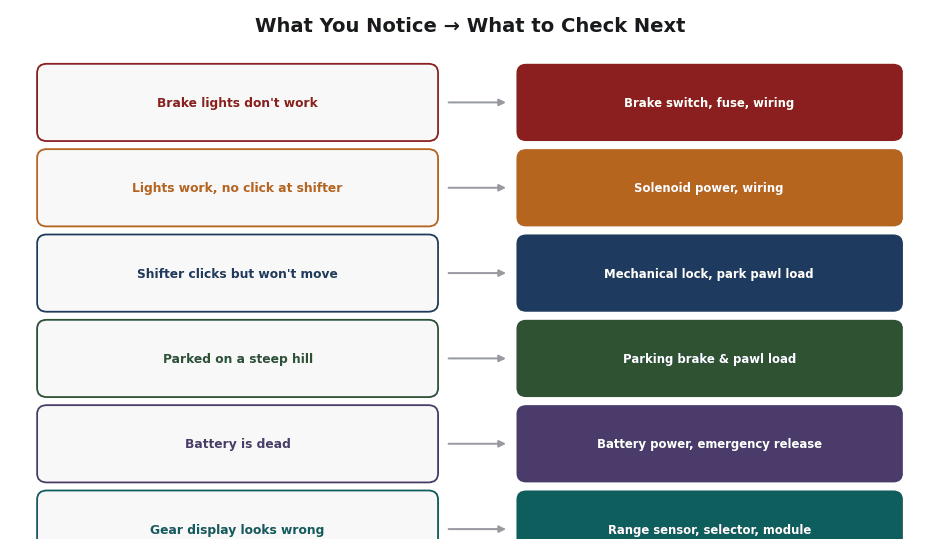
The symptoms can be organized into a useful decision tree.
| What You Notice | What To Check Next |
|---|---|
| Brake Lights Do Not Work | Brake Switch, Fuse, Wiring |
| Brake Lights Work, No Shifter Click | Solenoid Power, Wiring, Control Signal |
| Shifter Clicks But Won’t Move | Mechanical Lock, Parking Pawl Load |
| Car Parked On Steep Hill | Parking Brake And Pawl Load |
| Battery Is Dead | Battery Power And Emergency Release |
| Gear Display Is Incorrect | Range Sensor, Selector, Module |
| Selector Feels Physically Broken | Shifter Assembly |
| Multiple Warning Lights | Battery, Communication, Control Modules |
| Selector Works After Emergency Release | Diagnose Shift-Interlock System |
| Problem Returns Intermittently | Wiring, Switch, Sensor Or Module |
This approach prevents the most common mistake: replacing an expensive component before confirming that it is actually responsible.
Frequently Asked Questions
Why Won’t My Car Shift Out Of Park?
The most common possibilities include a failed brake-light switch, blown fuse, shift-lock solenoid problem, low battery voltage, wiring fault, or mechanical load on the transmission’s parking mechanism. The exact cause depends on the vehicle. Start by checking whether the brake lights illuminate when the pedal is pressed and whether the vehicle correctly recognizes the brake input.
Can A Dead Battery Keep A Car Stuck In Park?
Yes, many modern vehicles use an electrically controlled shift-interlock system, so a dead battery can prevent the normal release mechanism from operating. Some vehicles have a manual shift-lock release that allows the selector to be moved to Neutral for towing or repositioning. The location and procedure are vehicle-specific, so the owner’s manual should be followed.
Why Won’t My Car Shift Out Of Park Even Though The Brake Lights Work?
Working brake lights do not completely eliminate an interlock problem. The shift-lock solenoid, wiring, control module, selector assembly, or transmission-range information could still be faulty. A clicking sound from the shifter when the brake pedal is pressed can provide a useful clue, but proper electrical testing is needed to identify the failed component.
How Do I Get My Car Out Of Park When The Battery Is Dead?
Many vehicles have an emergency shift-lock release located near the gear selector. Before using it, fully apply the parking brake and make sure the vehicle cannot roll. The exact procedure varies by model. Manufacturer procedures commonly require accessing a marked shift-lock release slot and manually releasing the lock before moving the selector to Neutral.
Can Parking On A Hill Make A Car Stuck In Park?
Yes. If the vehicle’s weight rests against the transmission’s parking mechanism, the selector can become difficult to release. This is more likely when the vehicle is parked on a slope without properly applying the parking brake. Applying the parking brake before selecting Park helps keep the vehicle’s weight from being concentrated on the transmission parking mechanism.
Is It Safe To Force The Gear Shifter Out Of Park?
No. Excessive force can damage the selector, shift cable, interlock mechanism, or other components. If the normal release does not work, use the vehicle’s documented emergency shift-lock procedure instead. Keep the parking brake applied and prevent the vehicle from rolling before moving the selector out of Park.
Final Thoughts
A car that will not shift out of Park can make a relatively small problem feel like a major transmission failure.
In many cases, however, the transmission itself is not the first thing that should be blamed.
The brake-transmission shift interlock is designed to prevent the vehicle from accidentally leaving Park without the brake being applied. NHTSA identifies this system as an important rollaway-prevention feature, while manufacturers such as Ford document the role of the shift-interlock solenoid in controlling selector movement.
Start with the simple checks.
Press the brake pedal firmly.
Check the brake lights.
Listen for the shift-lock mechanism.
Look at the gear-position display.
Check battery power and relevant fuses.
Think about whether the vehicle was parked on a steep incline.
If those checks do not reveal the problem, diagnostic scanning and electrical testing can prevent unnecessary parts replacement.
Most importantly, never treat the emergency shift-lock release as a permanent repair. It is intended to help move or tow the vehicle when the normal interlock cannot operate.
Once the vehicle has been moved safely, the underlying problem should still be diagnosed.
A brake switch, fuse, wiring connection, shift-lock solenoid, selector assembly, or parking mechanism can all produce similar symptoms. Identifying which part of the system has actually failed is what turns a frustrating stuck shifter into a straightforward repair.