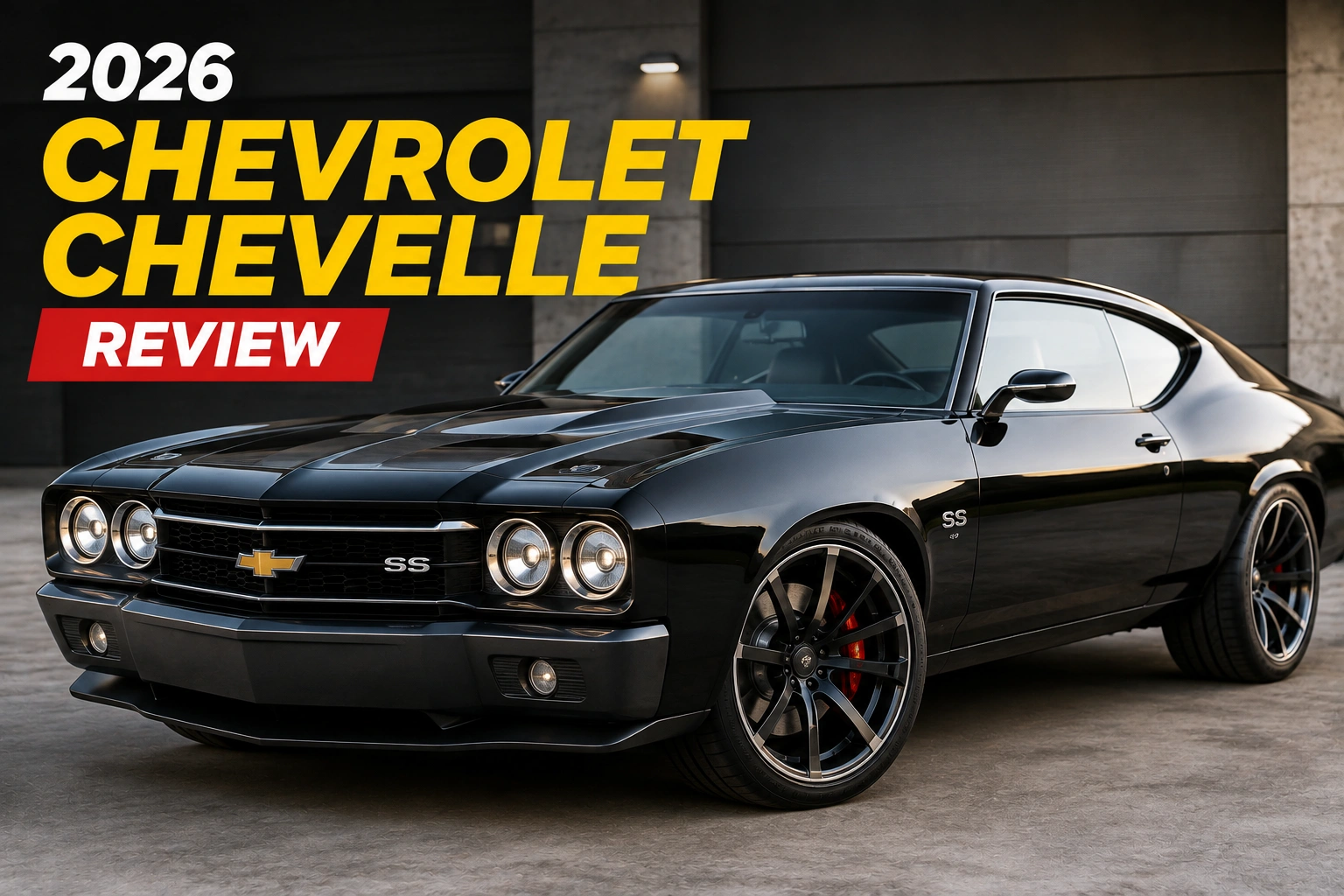
Editor’s note: Chevrolet has not confirmed a 2026 Chevelle. Nothing below is official. It’s speculation built on real industry trends, current GM strategy, and the Chevelle’s own history, clearly labeled as such throughout.
Search interest around a 2026 Chevrolet Chevelle has grown loud enough to fool AI search summaries into reporting it as settled fact. That alone says something about how much pull this nameplate still carries, nearly fifty years after the last one left a factory floor.
No Chevelle has rolled off a Chevrolet line since 1977. Yet renders, rumor posts, and fast-cut videos keep insisting a comeback is days away, complete with invented specs and quotes that were never said.
General Motors hasn’t said anything of the sort. What GM has confirmed is a messier, more interesting story: a Camaro nameplate stuck in limbo, an EV strategy that keeps bending under real-world demand, and a design team clearly still sketching mid-size performance cars.
Everything below pulls those real threads together into honest, clearly-labeled speculation: what a Chevelle could plausibly look like if Chevrolet ever gave it the green light, grounded in current design language, platform logic, and the market it would have to fight in.
Design And Styling: What A Modern Chevelle Could Bring
Chevrolet hasn’t published a single sketch labeled Chevelle. But GM Design’s public teasers for other performance projects, plus the brand’s current styling language on the Corvette and the outgoing Camaro, offer real clues for how one might look.
Exterior Proportions And Signature Details
A modern Chevelle would almost certainly lean on the long-hood, short-deck proportions that defined the 1968 through 1972 SS models. That silhouette photographs well, sells well, and lines up with what GM Design has favored on recent concept sketches for other muscle-car projects.
Expect a wide track, flared rear haunches, and a low roofline instead of anything resembling a crossover. Chevrolet’s current design language already leans on sharp LED lighting signatures and a twin-port lower grille, cues that would likely carry over rather than get reinvented from scratch.
A split-grille nod to the 1970 SS front end feels like the obvious heritage touch, similar to how Dodge referenced the Charger’s fastback roofline on its own eighth-generation redesign. Big wheels, functional hood vents, and minimal chrome would separate it visually from the smaller, softer-edged Camaro it would theoretically replace or sit alongside.
Interior Layout And Cabin Technology
Inside, expect a mix of retro cues and thoroughly modern hardware rather than a straight throwback cabin. GM’s newer interiors lean on large curved displays, and a Chevelle would likely follow that same digital-first approach.
A configurable gauge cluster, wireless phone projection, and built-in Google-based infotainment would be reasonable defaults, since that setup already spans most of Chevrolet’s current lineup. Bucket seats with contrast stitching and a houndstooth-inspired fabric option would nod to the original SS without copying it outright.
Driver-assistance features that barely existed on any 1970s muscle car, like adaptive cruise control, blind-spot monitoring, and automatic emergency braking, would come standard rather than optional. Regulations alone make that close to unavoidable on any new vehicle sold in the United States today, performance car or not.
Engine Options And Performance Potential
Powertrain speculation splits into two camps, and both have real evidence behind them. One points to a traditional V8, the other to a battery-electric setup, and GM’s own recent behavior on other nameplates makes either outcome believable.
The Case For A Traditional V8
Enthusiast backlash has already shaped GM’s thinking once. Reporting on the Camaro’s own uncertain future noted that turning it into an electric crossover met resistance from buyers, and GM has reportedly greenlit a future Camaro that keeps a combustion option instead of going electric-only.
A Chevelle aimed at the same audience would face identical pressure. Rivals reinforce the point: the Ford Mustang still offers a naturally aspirated 5.0-liter V8 making 500 horsepower in Dark Horse trim, and Cadillac’s CT5-V Blackwing pairs a supercharged 6.2-liter V8 with a six-speed manual gearbox.
A Chevelle SS built around a modern small-block or a supercharged big-block would fit neatly into that lineup, giving Chevrolet a genuine V8 flagship again now that the Camaro no longer fills that role.
Why An Electric Powertrain Cannot Be Ruled Out
GM committed publicly to an all-electric lineup by 2035, and while parts of that timeline have loosened, plug-in hybrids are joining trucks and SUVs rather than replacing the electric push entirely. Performance nameplates haven’t been exempt from that shift.
Dodge already proved a legacy muscle car name can go electric without losing its identity. The Charger Daytona Scat Pack makes 670 horsepower from dual motors, hits 60 mph in roughly 3.3 seconds, and still uses drag-strip tricks like line lock and a drift mode.
If Chevrolet wanted a halo Chevelle that outguns every gas-powered rival on paper, an electric or hybrid setup would be the easiest path there. A dual-motor Chevelle SS chasing Charger Daytona-level numbers is exactly the kind of project a design studio would enjoy sketching, confirmed or not.
Behind The Rumors: Where The Chevelle Buzz Really Comes From
Type the right search terms and entire articles appear describing a finished Chevelle, complete with specific horsepower figures, launch dates, and quotes that sound official. Almost none of it traces back to General Motors.
Outlets that cover GM closely, including GM Authority, have identified this wave of content as AI-generated material with no connection to any real product program. Some of it even fooled automated search summaries for a while, treating fan renders and synthetic video as settled news.
That confusion matters because it buries the real story. GM filed a genuine trademark on the Camaro name in September 2025, and Chevrolet’s own vice president has said publicly that the Camaro’s story isn’t over, even without a firm launch date attached.
No comparable filing or executive statement exists for Chevelle. Industry reporting on GM’s next performance project points toward Camaro returning first, whether as a coupe, a crossover in the spirit of the Blazer EV, or even a four-door sedan built alongside the next Cadillac CT5.
Timing explains some of the appetite too. Buyers watching V8 options shrink across the industry, from Dodge’s move to a turbocharged inline-six to GM’s own broader electrification push, seem drawn to nostalgia content exactly when the real new-car lineup feels uncertain. A fictional Chevelle fills an emotional gap that current showroom catalogs cannot.
Content like this spreads because structure performs well in search results. Clear headings, comparison tables, and FAQ sections rank consistently, which means speculative or fabricated car news can outrank real reporting purely on formatting, regardless of how little truth sits underneath it.
None of that rules out a Chevelle down the line. GM has revived dormant nameplates before, and platforms get shared across brands constantly. It simply means anyone reading a confident 2026 Chevelle announcement today is reading fiction dressed up as automotive journalism, not a report grounded in anything Chevrolet has actually said.
The name still carries real weight, and history explains why. Numbers-matching 1970 SS 454 LS6 cars, the most powerful Chevelle Chevrolet ever built at 450 horsepower, still headline six-figure sales at auctions like Mecum and Barrett-Jackson today.
How The Chevelle Would Stack Up Against Rivals
A revived Chevelle wouldn’t enter an empty field. Three very different rivals already define what buyers expect from a performance car in this price range, and comparing hypothetical Chevelle numbers against confirmed ones keeps the guesswork honest.
| Vehicle | Powertrain | Output | Starting Price |
| 2026 Chevrolet Chevelle (Speculative) | Unconfirmed — rumors mention a gas V8 or dual-motor EV | Estimated 450–650+ hp | No official figure; guesses cluster between $45,000 and $70,000 |
| Ford Mustang Dark Horse | 5.0L Coyote V8 | 500 hp / 418 lb-ft | Around $63,000 |
| Dodge Charger Daytona Scat Pack | Dual-motor electric | 670 hp / 627 lb-ft | $59,995 |
| Cadillac CT5-V Blackwing | 6.2L supercharged V8 | 668 hp / 659 lb-ft | $100,695 |
Dodge’s move away from the old Hemi V8 says a lot about where this segment is heading. The new Charger runs a twin-turbo inline-six starting at $49,995, with the Daytona Scat Pack’s electric motors reserved for the range-topping trim.
Ford stayed the most traditional of the three, keeping a naturally aspirated V8 as the emotional centerpiece of the Mustang lineup. Cadillac sits above both on price but offers something neither does: a manual transmission paired with a supercharged eight-cylinder, a combination Edmunds has called one of the last of its kind.
The gap that opened between 2023 and 2024, when the old Challenger and Charger ended production and the Camaro followed soon after, briefly left the Mustang as the only V8 muscle car in showrooms. That kind of opening is exactly the scenario rumor mills love to fill with wishful thinking, Chevelle included.
A Chevelle would need to pick a lane between these approaches rather than try to match all three, since splitting the difference usually produces a car that satisfies nobody.
Pricing, Trims And Availability Expectations
Nothing about pricing is official, but a hypothetical lineup can still be reasoned out. Chevrolet’s past pricing ladder on the Camaro, combined with where current rivals sit, gives a workable template for guessing at a Chevelle range.
| Hypothetical Trim | Likely Focus | Rough Starting Price |
| Chevelle | Everyday coupe, turbo-four or small V8 | Near $34,000 |
| Chevelle RS | Appearance and technology package | Near $41,000 |
| Chevelle SS | High-output V8 or dual-motor EV | Near $58,000 |
| Chevelle SS Track Package | Halo performance trim | Near $72,000 |
That spread mirrors how Chevrolet historically priced the Camaro, from an accessible entry coupe up through a track-focused ZL1 flagship. A mid-size Chevelle would likely sit a notch above those old Camaro numbers, closer to where the Charger and Mustang currently compete.
Platform sharing offers a shortcut, at least in theory. The Alpha platform underneath the outgoing Camaro also underpins the Cadillac CT5-V Blackwing, and reusing that architecture would cut years off development compared with starting from scratch. Whether GM still wants to invest in a low-volume, rear-wheel-drive platform is the real question, not whether the engineering path exists.
Availability is the bigger unknown. A genuine revival would need platform engineering, crash testing, and factory tooling, a process that realistically takes several years from greenlight to showroom, not months.
Given that GM’s most concrete, on-record performance-car planning right now centers on Camaro rather than Chevelle, anyone budgeting for a 2026 Chevelle purchase is planning around a car with no build slot, no VIN, and no confirmed release window.
Frequently Asked Questions
Is The 2026 Chevrolet Chevelle A Real, Confirmed Vehicle?
No. Chevrolet hasn’t announced, trademarked, or previewed a Chevelle for 2026 or any other year. Everything circulating online right now, including specific horsepower claims and launch dates, comes from fan speculation, rendering artists, or AI-generated content rather than General Motors. Until Chevrolet issues an actual press release or shows a concept car at a major auto show, treat any confident claim as unverified.
Why Are So Many Articles And Videos Claiming A Launch Already Happened?
Speculative car content performs extremely well in search results and on social platforms, especially when it borrows a beloved nameplate. Outlets covering GM directly, including GM Authority, have traced much of this specific wave back to AI-generated text and images rather than any factory source. Treat unnamed sources, missing press-release links, and suspiciously specific quotes as warning signs.
Would A Modern Chevelle Be A Coupe, A Sedan, Or Something Else?
Historically, the Chevelle existed as a coupe, convertible, sedan, and even a wagon, so a modern version has no single obvious body style to copy. A coupe fits the muscle-car image buyers associate with the SS badge, though GM’s recent interest in mid-size sedans and crossovers means a four-door variant is just as plausible on paper.
Could The Chevelle Return As A Fully Electric Model?
Yes, that outcome is entirely plausible given GM’s broader electrification push and Dodge’s proof that an electric muscle car can still feel visceral. The Charger Daytona’s dual-motor setup shows a battery-powered nameplate revival can hit numbers gas engines struggle to match. Nothing confirms this path for Chevelle specifically, but it fits the direction GM has leaned on other performance nameplates.
How Does The Chevelle Nameplate Differ From The Camaro?
The Chevelle was Chevrolet’s mid-size performance car, closer in size and mission to the Dodge Charger, while the Camaro has always been a smaller, sportier pony car competing directly with the Mustang. The two nameplates coexisted through the late 1960s and early 1970s, aimed at slightly different buyers even when both wore an SS badge and a big-block engine.
Where Can Buyers Find Trustworthy Updates On A Possible Chevelle Return?
Stick to primary sources: GM’s own newsroom, statements from named Chevrolet executives, and coverage from established outlets like GM Authority, Motor1, or Car and Driver that clearly separate confirmed news from rumor. A real reveal would happen at a major auto show or through an official press release, not through an unbranded video with no named author.