
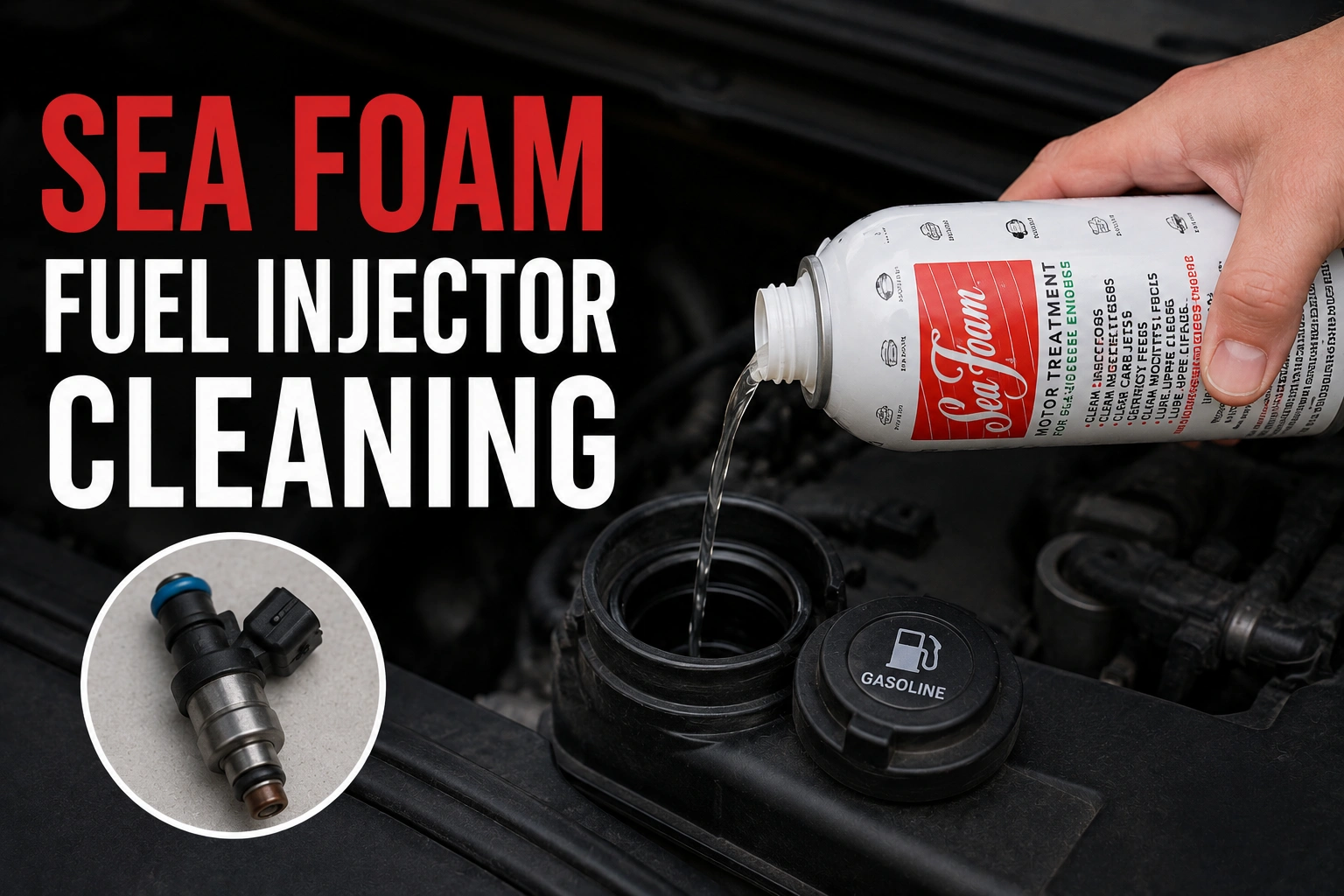
Fuel injectors do one of the hardest jobs in an engine, spraying a precise mist of fuel dozens of times each second, every time the engine runs. Carbon, varnish, and gum build up on those tiny nozzles over the years, and few drivers notice until the engine starts running rough.
Sea Foam has been a fixture on auto parts store shelves for decades, promising to clean injectors, intake valves, and the fuel system with nothing more than a can poured into a tank or vacuum line.
The product works, though not always in the way people assume, and knowing exactly how it cleans, where it works best, and where its limits sit separates a useful maintenance habit from a wasted trip to the parts store.
From the classic fuel tank pour to the smoky vacuum line trick old mechanics still swear by, a few methods exist, each suited to a different kind of buildup and a different level of patience.
What Sea Foam Does Inside A Fuel System
Sea Foam Motor Treatment is a petroleum-based cleaner built around naphtha and alcohol, two solvents that dissolve gum, varnish, and light carbon buildup wherever fuel or oil travels through an engine.
Unlike a dedicated shop chemical, it moves through three separate systems: the fuel system, the engine oil, and the intake tract. That range is exactly why so many owners keep a can in the garage.
Poured into a gas tank, it rides along with regular fuel through the lines, filter, and injectors, softening deposits along the way. Added to oil before a change, it works on sludge and varnish coating the crankcase.
Sprayed or poured into the intake, it goes straight to the back of the intake valves and the tops of the pistons, areas that ordinary fuel additives rarely reach.
What Is Actually Inside The Can
Sea Foam lists its formula as pale oil, naphtha, and isopropyl alcohol on its safety documentation, a mix the company markets as free of harsh detergents or abrasive chemicals.
That formulation is part of why the product has stayed popular with owners of older carbureted engines and modern fuel-injected ones alike, since it will not eat away at rubber seals, plastic components, or fuel system linings.
The naphtha portion acts as the main solvent, breaking down sticky residue so it can be carried away in the fuel or oil stream rather than scraped or scrubbed loose.
Alcohol in the mix helps absorb small amounts of moisture that collect in a fuel tank over time, which is part of why Sea Foam also gets used as a fuel stabilizer for equipment that sits idle for months.
Why Modern GDI Engines Need It More
Older port-injected engines sprayed fuel directly onto the back of the intake valves, and that constant washing kept carbon deposits from building up too badly.
Gasoline direct injection, now standard on most new vehicles, sprays fuel straight into the cylinder instead, which means the intake valves never get that natural fuel bath.
Oil vapor from the crankcase ventilation system settles on those dry valves instead, baking into a hard carbon crust that restricts airflow and disrupts how evenly each cylinder breathes.
That difference is a big reason intake valve cleaning has become a bigger topic in the last decade, and why treatments aimed at the intake tract, not just the fuel tank, matter more on newer vehicles than they did on older ones.
Signs Your Injectors Need Cleaning
Dirty injectors rarely fail all at once. The symptoms build slowly, and most drivers chalk them up to old age or bad gas long before they suspect the injectors themselves.
A rough or uneven idle is often the first clue, especially once the engine has been running for a few minutes and should have settled down.
Hesitation or a slight stumble when pressing the accelerator points to fuel not atomizing correctly, since a clogged nozzle sprays an uneven pattern instead of a fine, consistent mist.
Fuel economy that quietly drops over several months, without any change in driving habits, often traces back to injectors working harder to deliver the same amount of fuel through a partially blocked nozzle.
A check engine light with a lean-running code is another common flag, since a restricted injector can throw off the air-to-fuel ratio the engine’s computer is constantly trying to balance.
| Symptom | Likely Cause |
| Rough or uneven idle | Uneven fuel spray from a partially clogged injector |
| Hesitation on acceleration | Poor atomization disrupting the air-fuel mix |
| Declining fuel economy | Injector compensating for a restricted nozzle |
| Hard starting | Fuel dribbling instead of spraying cleanly |
| Lean-running check engine code | Reduced fuel delivery through a blocked passage |
None of these symptoms confirm dirty injectors on their own, since worn spark plugs, a failing sensor, or a weak fuel pump can mimic the same complaints. Ruling those out first saves time before reaching for a can of cleaner.
How To Clean Injectors With Sea Foam: Three Proven Methods
Sea Foam works through three distinct methods, and each one targets a different part of the fuel and intake system. Picking the right one depends on the symptoms showing up and how thorough the cleaning needs to be.
The Fuel Tank Method
Pouring Sea Foam into the gas tank is the simplest method and the one most owners start with. The general guideline is about one ounce of Sea Foam for every gallon of fuel in the tank.
For most passenger vehicles with a 12 to 16 gallon tank, that works out to one full 16 ounce can. Adding it when the tank is closer to empty maximizes the concentration before fresh fuel dilutes it.
Once poured in, filling up with fresh gasoline right away helps the two mix thoroughly rather than sitting layered at the bottom of the tank.
From there, the treated fuel does the work over normal driving, passing through the fuel lines, filter, and injectors on every trip until the tank runs low again.
This method treats the entire fuel system gradually and is the safest starting point for anyone trying Sea Foam for the first time.
The Vacuum Line Or Intake Method
Old-timers call this the Italian tune-up, and it targets carbon sitting on the intake valves and piston tops rather than the injectors themselves.
With the engine warmed to normal operating temperature, a vacuum line feeding the intake, commonly the brake booster hose or a PCV line, gets disconnected and Sea Foam is introduced slowly while the engine idles.
The engine often stumbles or nearly stalls as it works through the liquid, which is expected rather than a sign something has gone wrong.
After roughly a third to half a can has gone in, many people let the engine sit off for five to fifteen minutes before restarting, which may take a couple of tries.
Driving it right after, ideally through a few higher-rpm pulls, burns off the loosened carbon and produces a noticeable cloud of white smoke from the tailpipe. That smoke is completely normal and means the treatment is doing its job.
The Direct Injector Or Filter Method
This method skips the fuel tank almost entirely and gets a much more concentrated dose directly to the injectors, which is why professional shops lean on a version of it.
Shop equipment connects a canister of cleaner straight to the fuel rail, running the engine on the concentrated mixture instead of tank fuel, which delivers a stronger clean than diluted fuel ever could.
Diesel owners have a simpler at-home version: fill the fuel filter housing with straight Sea Foam instead of diesel fuel before reinstalling it during a routine filter change.
Idling the engine for a couple of minutes circulates the concentrated treatment through the injectors, and letting the vehicle sit for around fifteen minutes afterward gives it time to work before a normal drive.
This approach delivers a stronger dose than the tank method, though it demands more effort and is generally reserved for injectors already showing symptoms.
Sea Foam Versus Other Injector Cleaners And Professional Service
Sea Foam is not the only additive on the shelf, and it is worth knowing where it sits compared to other cleaners before deciding it is the right tool for the job.
Many premium fuel system cleaners, including several well-known brand-name treatments, rely on polyetheramine, usually shortened to PEA, as their main active ingredient. PEA is generally considered more aggressive at breaking down stubborn injector and intake valve deposits than the naphtha-and-alcohol formula Sea Foam uses.
That does not make Sea Foam a weaker product overall, since it was never built to be a single-purpose injector cleaner. Its strength is versatility across the fuel system, oil system, and intake tract in one bottle.
For injectors that are only mildly dirty, either type of cleaner used regularly tends to help. For injectors already causing real drivability problems, like a persistent misfire or a noticeable loss of power, an additive alone rarely solves it.
| Cleaning Option | Best For | Limitation |
| Sea Foam | Routine maintenance across fuel, oil, and intake | Milder cleaning power than PEA-based products |
| PEA-Based Cleaners | Stubborn injector and valve deposits | Does not touch the oil system or intake tract |
| Professional Ultrasonic Cleaning | Injectors already causing misfires or power loss | Requires removing the injectors from the engine |
A shop cleaning removes the injectors entirely, runs them through an ultrasonic bath, then flow-tests each one to confirm the spray pattern is even. That level of service costs meaningfully more than a bottle of additive, but it also reaches deposits no fuel-tank treatment ever will.
Safety, Frequency And Maintenance Tips
Sea Foam is straightforward to use, though a few precautions make the process safer, and knowing how often to treat a vehicle keeps injectors clean without overdoing it.
Safety Precautions To Keep In Mind
The vacuum line method produces a heavy cloud of white smoke, so it should only be done outdoors or in a garage with the door wide open, never in a closed space.
Sea Foam is flammable, so keeping it away from open flames, lit cigarettes, or anything sparking nearby matters during the entire process, not just while pouring it.
Letting the engine bay cool slightly before disconnecting a vacuum line avoids burns from hot components sitting close to the hose fittings.
Gloves and eye protection are worth wearing any time a liquid this concentrated is being poured near a running engine, since splashes happen more often than expected.
A stalled or rough-running engine mid-treatment is normal, but if the vehicle refuses to restart after several attempts, giving it extra time to sit usually resolves the issue rather than something being wrong mechanically.
How Often To Treat Your Fuel System
For daily-driven vehicles, adding Sea Foam to the fuel tank every three thousand to five thousand miles, roughly in line with an oil change, keeps light deposits from building into bigger problems.
Vehicles running on lower-quality fuel or sitting unused for long stretches benefit from more frequent treatment, since both situations encourage gum and varnish to form faster.
The vacuum line method is more intensive and does not need to happen nearly as often. Once or twice a year is plenty for most gasoline engines, particularly GDI models prone to intake valve buildup.
Overdoing any method will not damage a healthy engine, since Sea Foam is formulated to be forgiving, but there is little benefit to treating a fuel system that is already running clean.
| Product Name | Compatible Tundra Years | Bed / Configuration | Bed Rails | Tonneau Cover | Height | Width / Length Adjustment | Load Capacity | Material | Weight | Best For | CTA |
| POFENZE Adjustable Truck Bed Rack | 2014–2026* | Full-size Tundra setups with factory rail configuration | Required for stated setup | Not compatible according to source listing | 22.5″ | Width 47.5–64.5″; length 53–61.7″ | 500 lb dynamic / 1,000 lb static | Carbon steel | 110 lb | Rooftop tents and overland gear | [🛒 Check Price On Amazon] |
| CLAMBER Overland Truck Bed Rack | 2007–2026* | Rail and non-rail configurations | Flexible mounting | Not compatible | 13.6″ | Width 60.7–64.5″ | 400 lb dynamic / 800 lb static | Carbon steel | 117.9 lb | Versatile accessory-heavy builds | [🛒 Check Price On Amazon] |
| longsun Full-Size Truck Bed Rack | 2007–2026* | Tundras without factory bed rails | Not required | Check configuration before purchase | 14.5–17.4″ | Width 52.5–64.4″ | 500 lb dynamic / 900 lb static | Carbon steel | 125 lb | No-rail Tundras | [🛒 Check Price On Amazon] |
| EYOUHZ Adjustable Truck Bed Rack With LED Lights | 2007–2026* | Bed-rail mounting | Required | Not compatible | 14.5–17.3″ | Width 46.4–73″; adjustable bar spacing | 500 lb dynamic / 1,000 lb static | Carbon steel | 73 lb | Low-profile overland builds | [🛒 Check Price On Amazon] |
| OBNAUX Adjustable Overland Truck Bed Rack With LED Lights | 2022–2025* | Third-generation Tundra | Required | Not compatible | 19.2–22.3″ | Width 55.8–62.76″; length 53–59″ | 500 lb dynamic / 1,000 lb static | Carbon steel | 129 lb | 2022–2025 overland setups | [🛒 Check Price On Amazon] |
| AUXPACBO 800-LB Extendable Aluminum Bed Rack | 2007–2025* | Full-size Tundra setups using U-bolt mounting | Vehicle-specific | Not compatible | 17.75–27.5″ | Length 41.75–52.5″ | 800 lb road / 600 lb off-road | Aluminum | 70 lb | Lightweight heavy-load applications | [🛒 Check Price On Amazon] |
Frequently Asked Questions
Does Sea Foam Actually Clean Fuel Injectors?
Yes, though the naphtha and alcohol in its formula work by dissolving light gum, varnish, and carbon rather than through a more aggressive detergent action. It works best as regular maintenance rather than a fix for injectors already causing serious performance problems.
How Much Sea Foam Should Go In A Full Tank?
The common guideline is about one ounce per gallon of fuel, which usually means one full sixteen-ounce can for a tank between twelve and sixteen gallons. Adding it when the tank is low, then filling up right after, gives the best concentration.
Is The White Smoke From The Vacuum Line Method Dangerous?
No, the smoke is a normal result of carbon deposits and residual oil burning off inside the intake and combustion chambers. It should still only be done outdoors or with a garage door fully open, since the smoke can be heavy.
Can Sea Foam Damage An Engine If Too Much Is Used?
Sea Foam is formulated to be safe even in higher concentrations, and the company states that adding more to fuel improves cleaning rather than causing harm. Extremely large amounts poured too quickly through a vacuum line can stall the engine temporarily, though this typically resolves on its own.
Does Sea Foam Work On Diesel Injectors Too?
Yes, Sea Foam markets specific guidance for diesel engines, including priming a fuel filter with straight Sea Foam during a filter change for a concentrated dose. Regular tank treatment every few thousand miles is a common recommendation for diesel owners as well.
Should Sea Foam Replace A Professional Injector Cleaning Service?
Not if the injectors are already causing misfires, rough running, or a noticeable loss of power, since those symptoms usually need ultrasonic cleaning and flow testing to fully resolve. Sea Foam works better as ongoing prevention than as a repair for injectors already in trouble.