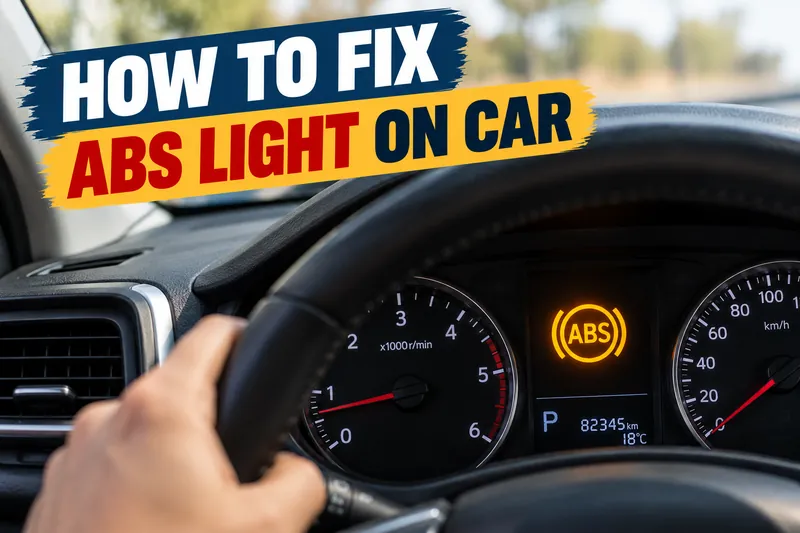
The ABS warning light is one of the most important indicators on a car’s dashboard because it is connected to a braking safety system rather than a routine maintenance function. ABS stands for anti-lock braking system, which helps prevent the wheels from locking during hard braking and allows the driver to maintain steering control while braking heavily.
When the ABS light stays illuminated after the vehicle starts, the system has detected a fault or has disabled part of its normal operation. That does not always mean the entire ABS system needs replacement.
A damaged wheel-speed sensor, broken wiring, low brake fluid, a blown fuse, a weak battery, a problem with the reluctor ring, or a fault inside the ABS control module can all trigger the warning.
Learning how to fix ABS light on car therefore starts with diagnosis rather than immediately replacing parts. The correct repair depends on the fault code and the symptoms accompanying the warning.
There is also an important safety distinction: a car can sometimes retain normal hydraulic braking while the ABS function is unavailable. That does not make the warning harmless. The vehicle may behave differently during emergency braking, particularly on wet, icy, gravel, or uneven surfaces.
What The ABS Light Means And Why It Comes On
The anti-lock braking system uses electronic sensors and hydraulic control components to monitor wheel behavior during braking.
Wheel-speed sensors continuously provide information about how quickly each wheel is rotating. The ABS control module compares those signals and looks for a wheel that is slowing down much faster than the others during braking.
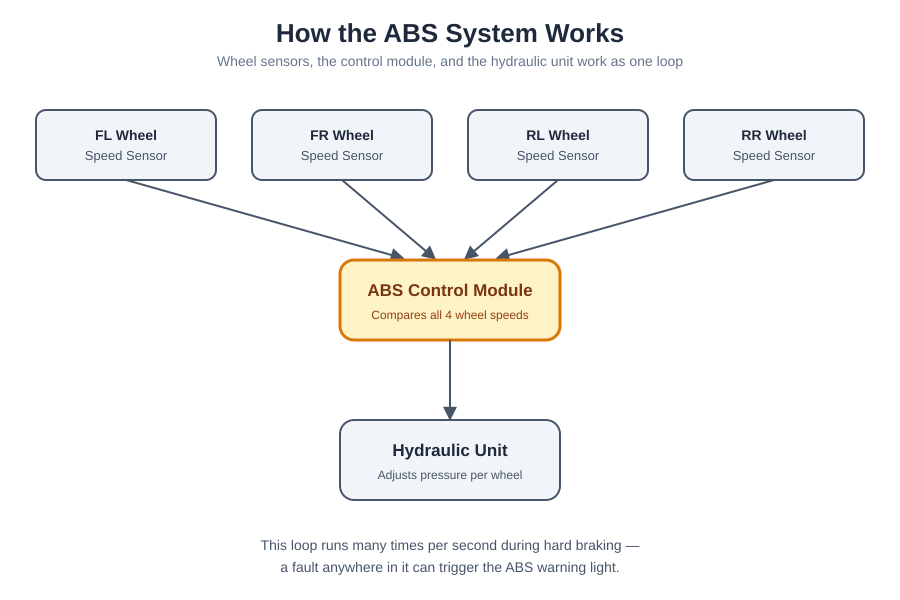
If the system detects an impending wheel lock, it can control hydraulic pressure to that wheel through the ABS hydraulic unit. The pressure can be reduced and reapplied rapidly, helping the tire maintain useful contact with the road.
The system therefore depends on several components working together. A problem in one part can disable ABS operation and illuminate the dashboard warning.
ABS Warning Light Versus Brake Warning Light
Many vehicles have both an ABS warning light and a separate red brake-system warning light.
The ABS light is commonly represented by the letters ABS inside a circle or a similar symbol. A red brake warning light may use an exclamation mark inside a circle or another manufacturer-specific design.
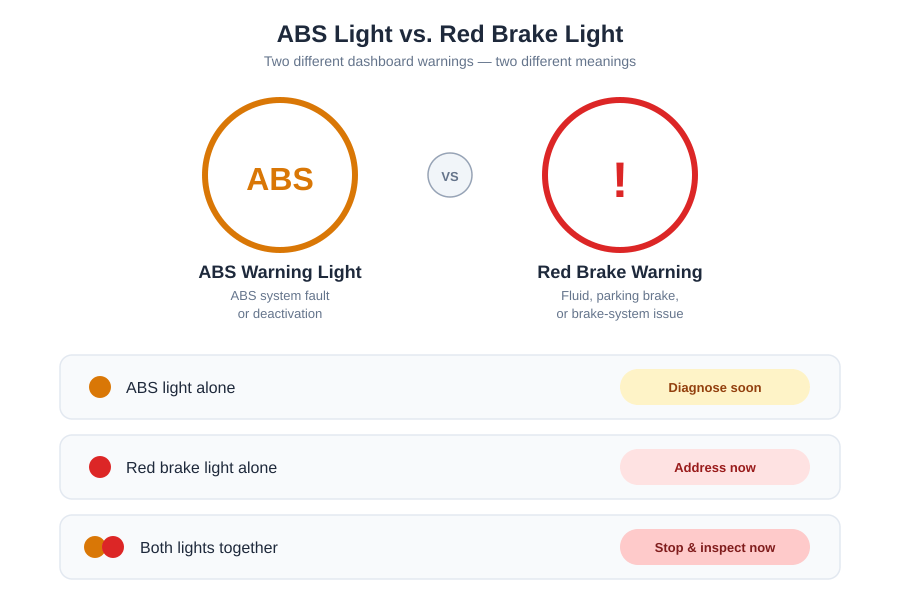
These lights do not necessarily mean the same thing.
| Dashboard Warning | General Meaning |
|---|---|
| ABS light | ABS system fault or deactivation |
| Red brake warning | Parking brake, brake-fluid, or brake-system warning |
| ABS + red brake light | Potentially more serious braking-system issue |
| Traction-control light + ABS | Possible wheel-speed sensor or shared system fault |
| Stability-control light + ABS | ABS/wheel-speed information may be unavailable |
The owner’s manual should always take priority because symbols and system strategies vary between manufacturers.
If the red brake warning light is also illuminated, especially if the brake pedal feels abnormal, the situation deserves greater urgency.
Why The ABS Light May Come On During Startup
It is normal for the ABS warning light to illuminate briefly when the ignition is switched on.
The vehicle performs a system check before or during startup. The warning should normally turn off after the system completes its initial checks if no fault is detected.
A light that remains illuminated after startup indicates that the system has identified a problem or has disabled ABS functionality.
A warning that appears only occasionally can be more difficult to diagnose. Intermittent faults may be caused by damaged sensor wiring, loose electrical connections, wheel-bearing movement, low voltage, or a sensor signal that becomes unreliable only under certain conditions.
The fact that the vehicle still stops normally does not prove that the ABS system is functioning.
What Happens When ABS Is Disabled?
When the ABS system detects a fault, conventional hydraulic braking may remain available depending on the vehicle and the nature of the failure.
The driver may still be able to stop the vehicle normally under ordinary conditions. However, the anti-lock function may not be available during hard braking.
That means a wheel can potentially lock more easily on a slippery surface.
Some vehicles may also disable or limit traction control and electronic stability control because these systems rely on wheel-speed information from the ABS sensors.
This is why an ABS light can sometimes appear together with traction-control or stability-control warnings.
Common Causes Of An ABS Warning Light
There is no single repair for an ABS light.
The most common causes involve wheel-speed sensors and their wiring, but brake-fluid level, electrical supply, wheel bearings, reluctor rings, hydraulic components, and control modules can also be responsible.
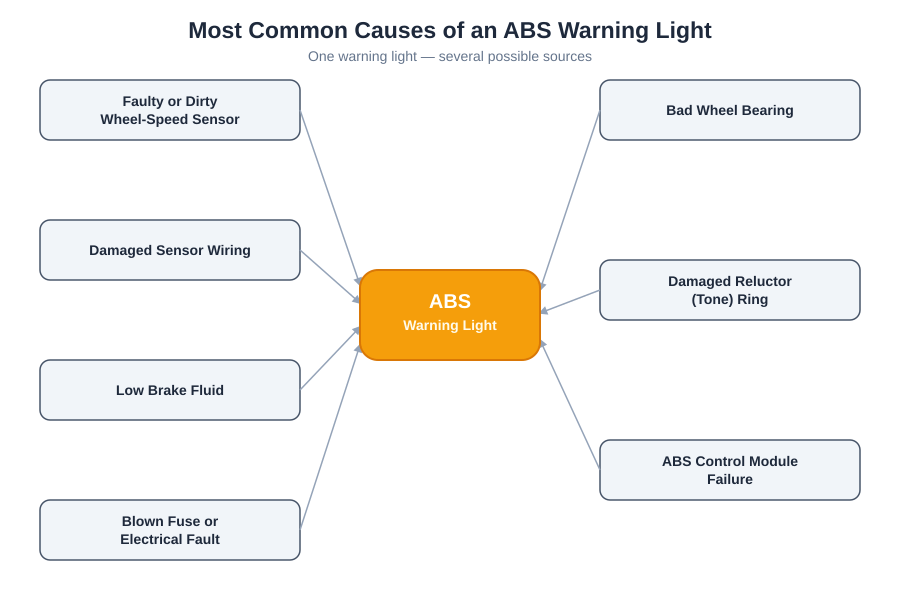
A proper diagnosis should identify the specific fault before parts are replaced.
Faulty Or Dirty Wheel-Speed Sensor
Wheel-speed sensors are among the most common causes of an ABS warning.
Each sensor monitors wheel rotation and sends information to the ABS control module.
Depending on the vehicle, the sensor may be magnetic, Hall-effect, or another electronic design. Some systems read a tone ring or encoder integrated into the wheel hub or bearing.
A sensor can fail internally, become contaminated, develop damaged wiring, or lose a reliable signal because of excessive air gap.
Dirt or metallic debris can also interfere with certain sensor designs.
The correct repair may be as simple as cleaning a sensor or repairing wiring, but a failed sensor may need replacement.
Do not automatically replace a sensor just because an ABS code mentions that wheel. The code may indicate a signal problem rather than proving that the sensor itself is defective.
Damaged ABS Sensor Wiring
The sensor itself can be perfectly functional while its wiring is damaged.
ABS sensor cables are routed near wheels and suspension components where they are exposed to water, dirt, road salt, vibration, and movement.
A wire can become stretched, rubbed against a tire, damaged by suspension movement, or broken internally while appearing normal from the outside.
Look for:
- Broken insulation
- Exposed wires
- Corrosion
- Loose connectors
- Wiring pulled tight
- Connector damage
- Evidence of rubbing against the tire
- Previous repair work
A wiring fault can produce an intermittent ABS light that disappears and returns as the suspension moves.
Low Brake Fluid
Low brake fluid can trigger a brake warning and, on some vehicles, can be associated with ABS-related warnings.
The brake-fluid reservoir should be checked according to the manufacturer’s procedure.
Do not simply keep adding fluid without investigating why the level is low.
Brake fluid can fall as brake-pad friction material wears, but a significant or sudden loss can indicate a leak.
If the brake pedal feels soft or sinks unusually far, the vehicle should not be treated as safe simply because the ABS light is the only dashboard message you noticed.
Blown Fuse Or Electrical Supply Problem
The ABS system requires electrical power.
A blown fuse, damaged power supply circuit, poor ground connection, or wiring problem can prevent the ABS module from operating correctly.
A weak battery or low system voltage can also trigger multiple warning lights on some vehicles.
If the ABS light appeared after a battery replacement, jump-start, or electrical repair, checking the vehicle’s power supply is worthwhile.
However, a blown fuse should not simply be replaced repeatedly. If a replacement fuse blows again, there is likely an underlying electrical fault that needs diagnosis.
Bad Wheel Bearing
A wheel bearing problem can interfere with ABS operation because some vehicles incorporate the wheel-speed sensing ring or encoder into the hub or bearing assembly.
Excessive bearing play can also change the relationship between the sensor and its target.
A worn bearing may produce a humming, growling, or rumbling noise that changes with vehicle speed or cornering.
Some vehicles use a separate reluctor ring, while others integrate the magnetic encoder into the bearing seal.
The correct repair depends on the vehicle’s design.
Damaged ABS Reluctor Ring Or Tone Ring
The reluctor ring, sometimes called a tone ring, provides the pattern that a wheel-speed sensor reads.
If the ring is cracked, corroded, damaged, missing teeth, or contaminated, the sensor may produce an incorrect signal.
A common clue is an ABS light that appears after the vehicle begins moving rather than immediately after startup.
The system may perform its initial electronic check successfully but detect an inconsistent wheel-speed signal once the wheels begin rotating.
This is an important diagnostic clue because replacing the sensor without inspecting the ring may not solve the problem.
ABS Control Module Failure
The ABS control module receives sensor information and controls the hydraulic unit.
Electronic failures, internal circuit problems, communication faults, corrosion, or hydraulic-unit issues can cause an ABS warning.
Control-module problems are generally less common than wheel-speed sensor issues, so the module should not be condemned before simpler causes have been tested.
Depending on the vehicle, the module may be integrated with the hydraulic control unit.
Some modules can be repaired or rebuilt, while others require replacement and programming.
Low Voltage And Battery Problems
Modern vehicles contain numerous electronic control modules.
If battery voltage drops significantly during startup or the charging system is not operating correctly, some modules can record communication or voltage-related faults.
If the ABS warning appeared together with battery, traction-control, stability-control, or multiple unrelated dashboard lights, check the vehicle’s electrical system.
The battery should be tested under load, and charging voltage should be verified with the engine running according to the vehicle’s specifications.
Do not assume every warning light means that several separate components failed simultaneously. A single low-voltage event can sometimes generate multiple fault codes.
How To Diagnose The ABS Light Step By Step
The most effective way to repair an ABS warning is to diagnose the system before replacing components.
An ordinary engine-code scanner may not be able to communicate with the ABS module. Many basic OBD-II readers can retrieve engine and emissions codes but cannot access manufacturer-specific ABS fault information.
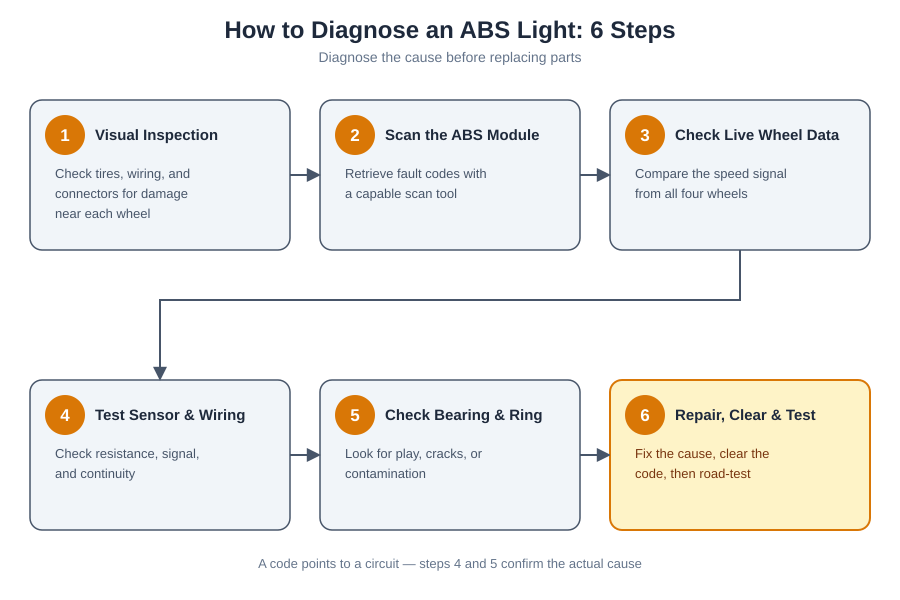
A scan tool capable of communicating with the vehicle’s ABS module is therefore often necessary.
Start With A Visual Inspection
Before connecting diagnostic equipment, inspect the vehicle.
Check the tires, visible sensor wiring, connectors, brake components, and wheel areas.
Look for recent repairs. If the ABS light appeared immediately after brake work, suspension work, wheel-bearing replacement, or tire service, that timing is useful.
A sensor wire may have been stretched or disconnected during suspension work. A connector may not have been fully seated after brake repairs.
Inspecting the wiring near each wheel can reveal obvious problems without replacing anything.
Never work underneath a vehicle supported only by a jack. Use properly rated stands and follow safe lifting procedures.
Scan The ABS Control Module
This is one of the most important steps.
Connect a suitable scan tool and retrieve the ABS diagnostic trouble codes.
The code can indicate the affected wheel or circuit.
For example, a code may identify a right-front wheel-speed sensor circuit, but the next step is determining why that signal is missing.
Possible causes include:
- Sensor failure
- Broken wiring
- Poor connector contact
- Damaged tone ring
- Excessive wheel-bearing play
- Incorrect sensor installation
- Sensor contamination
- ABS module fault
The code narrows the search; it does not always identify the failed part.
Check Live Wheel-Speed Data
A scan tool with live-data capability can be extremely useful.
During a controlled road test or while the vehicle is safely lifted according to proper service procedures, compare the reported speed of each wheel.
All four wheel-speed signals should generally behave consistently under normal conditions.
If one wheel suddenly reads zero while the others continue reporting speed, that points toward a problem in that wheel’s sensor circuit or signal source.
If a wheel reports an implausible speed, the sensor, wiring, encoder, bearing, or related components should be investigated.
Live data can prevent unnecessary sensor replacement.
Test The Sensor And Wiring
The correct electrical test depends on the sensor type.
Some passive magnetic sensors can be tested for resistance and AC signal generation. Active sensors may require a power supply and should be tested using the manufacturer’s specified procedures.
This distinction matters because applying the wrong test method to an active sensor can produce misleading results or potentially damage the circuit.
A professional technician will use wiring diagrams, manufacturer specifications, and appropriate test equipment.
Check connector terminals for corrosion or poor contact.
Wiring should be inspected for continuity and unwanted resistance, but testing should follow the manufacturer’s circuit procedure rather than relying on a generic resistance number.
Inspect The Wheel Bearing And Reluctor
If the sensor and wiring appear normal, inspect the mechanical components that generate the wheel-speed signal.
Check for wheel-bearing play and abnormal noise.
Inspect the reluctor ring for cracks, corrosion, missing teeth, deformation, or contamination.
On vehicles with magnetic encoder rings integrated into the wheel bearing, incorrect bearing installation can also affect the ABS signal.
This is one reason a wheel bearing replacement can occasionally be followed by an ABS warning.
Clear The Code Only After The Cause Is Corrected
Once the fault has been repaired, the diagnostic trouble code can be cleared using an appropriate scan tool.
Some ABS systems may automatically turn off the warning after several successful drive cycles if the fault is no longer present. Others may require a scan tool or a specific initialization procedure.
Clearing a code without repairing the cause is not a real fix.
If the warning returns, retrieve the code again and continue diagnosis.
How To Fix The Most Common ABS Problems
Once diagnosis identifies the cause, the repair is usually more straightforward.
The correct repair can range from reconnecting a sensor plug to replacing a wheel hub, repairing wiring, correcting low brake fluid, or servicing the ABS hydraulic unit.
Replacing A Faulty Wheel-Speed Sensor
If testing confirms that the sensor has failed, replacement is usually the appropriate repair.
The sensor must be installed correctly, with the correct mounting position and sensor-to-target relationship.
The mounting area should be clean enough to allow the sensor to sit at the specified position.
A sensor that is incorrectly installed can produce an incorrect signal even if the new component is electrically functional.
After replacement, scan the ABS module and clear the stored fault if required.
Then perform the manufacturer’s recommended road test and verify that the warning does not return.
Repairing ABS Sensor Wiring
A broken wire does not necessarily require sensor replacement.
If the sensor tests correctly but the circuit has an open, short, or high resistance, the wiring can sometimes be repaired.
The repair should be made using an appropriate automotive wiring method and protected from moisture, heat, suspension movement, and abrasion.
Avoid creating a repair that leaves the wire stretched or positioned where it can rub against the wheel or suspension.
After repair, verify the signal under conditions where the original fault occurred.
Replacing A Damaged Wheel Bearing
If the wheel bearing is worn and its encoder or sensor target is damaged, bearing replacement may be required.
Use the correct bearing orientation when the bearing contains an integrated magnetic encoder.
Some replacement bearings have an encoder on only one side. Installing the component backward can prevent the ABS sensor from reading the signal correctly.
After installation, verify wheel-speed data before considering the repair complete.
Fixing Low Brake Fluid
If the brake-fluid level is low, identify the reason.
Inspect the brake system for leaks and check the condition of the brake pads and related components.
Use only the brake-fluid type specified by the manufacturer.
Do not mix fluids casually because different brake-fluid specifications have different properties and compatibility requirements.
If a leak is found, repairing the leak is more important than repeatedly topping up the reservoir.
Repairing An ABS Module
ABS module repair is more complicated.
Depending on the vehicle, the module may require replacement, coding, programming, calibration, or bleeding of the hydraulic system.
Some modules can be professionally rebuilt.
If module replacement is necessary, verify compatibility using the vehicle identification information and manufacturer part number.
After installation, the vehicle may require calibration procedures for the ABS, steering-angle sensor, yaw-rate sensor, or other stability-control components.
ABS Light Diagnosis By Symptoms
The warning light itself provides limited information. Other symptoms can help narrow the problem.
| ABS Light Behavior | Other Symptoms | Possible Direction |
|---|---|---|
| Light appears immediately at startup | No other symptoms | Sensor, module, fuse, wiring |
| Light appears after driving begins | One wheel-speed signal issue, reluctor | |
| ABS + traction-control light | Wheel-speed information or stability system | |
| ABS + red brake light | Brake system needs urgent attention | |
| ABS after wheel-bearing repair | Encoder, bearing installation, sensor | |
| ABS after battery replacement | Low voltage or stored fault | |
| ABS + humming wheel noise | Wheel bearing | |
| ABS + speedometer issue | Wheel-speed signal problem | |
| ABS + intermittent warning | Wiring, sensor, bearing movement | |
| ABS + multiple warning lights | Electrical or network communication issue |
These patterns help direct the diagnosis but should not be treated as definitive proof.
ABS Light And Traction Control Light Together
The traction-control and stability-control systems commonly use wheel-speed information from ABS sensors.
If the vehicle loses a reliable wheel-speed signal, it may disable related functions.
As a result, several warning lights can appear together.
This does not necessarily mean that three separate systems have failed.
A single faulty wheel-speed sensor can affect ABS, traction control, and electronic stability control because those systems share information.
ABS Light And Speedometer Problems
On some vehicles, a wheel-speed sensor signal also contributes to vehicle-speed information.
If the ABS warning appears together with an inaccurate speedometer, transmission behavior changes, or cruise-control problems, a wheel-speed signal issue becomes more relevant.
The exact architecture varies by vehicle.
A scan tool can reveal which wheel-speed sensors are reporting and whether the vehicle’s control modules are communicating correctly.
How Much Does It Cost To Fix An ABS Light?
The repair price depends almost entirely on the cause and vehicle.
A simple wiring repair or sensor replacement can be considerably less expensive than replacing a wheel hub, hydraulic ABS assembly, or electronic control module.
Labor costs also vary because some sensors are easy to access while others require substantial disassembly.
| Possible Repair | Relative Complexity |
|---|---|
| Clean/reconnect sensor | Low |
| Repair damaged wiring | Low to moderate |
| Replace wheel-speed sensor | Low to moderate |
| Replace wheel bearing/hub | Moderate |
| Repair hydraulic issue | Moderate to high |
| Replace/program ABS module | High |
| Diagnose intermittent electrical fault | Variable |
Online price estimates should therefore be treated cautiously until the fault code and affected component are known.
The diagnostic process is often more valuable than guessing a repair price from the dashboard symbol alone.
Can You Turn Off The ABS Light Yourself?
You can clear some ABS fault codes with a compatible scan tool, but clearing the light is not the same as repairing the system.
If the underlying fault remains, the warning will usually return.
Disconnecting the battery is also not a reliable repair. It may clear certain temporary electronic states, but many modern vehicles retain diagnostic information or immediately detect the fault again.
More importantly, disconnecting the battery does nothing to repair a broken sensor, damaged wire, worn bearing, or hydraulic problem.
The goal should be to restore the ABS system, not simply make the dashboard look normal.
Is It Safe To Drive With The ABS Light On?
This depends on the vehicle and the exact fault.
If the ABS light is on but the normal brake pedal feels firm and the red brake warning is not illuminated, conventional braking may still function. However, ABS may not be available.
The vehicle can therefore behave differently during emergency braking.
If the ABS light is accompanied by a red brake warning, abnormal pedal feel, reduced braking performance, fluid leakage, or another serious symptom, do not continue driving normally.
Braking safety takes priority over reaching a repair shop.
Final Thoughts
Learning how to fix the ABS light on a car starts with recognizing that the warning is a symptom, not a diagnosis.
The most common causes include faulty wheel-speed sensors, damaged wiring, wheel-bearing problems, damaged reluctor rings, low brake fluid, electrical faults, and ABS control-module problems. A low battery or charging-system issue can also create multiple warning lights on some vehicles.
The best repair strategy is therefore systematic.
Begin with a visual inspection and check the brake-fluid level. Then use a scan tool capable of communicating with the ABS module. Retrieve the fault codes and examine live wheel-speed data where appropriate. Inspect the affected sensor, wiring, wheel bearing, and reluctor or encoder ring before replacing components.
One of the most important diagnostic lessons is that an ABS code does not automatically mean the sensor is bad. The code may identify a wheel or circuit where the system has detected an abnormal signal. The actual cause could be wiring, a bearing, a damaged tone ring, installation error, or the control module.
After the repair, clear the appropriate fault codes and verify the system during a controlled road test according to the vehicle manufacturer’s procedure.
Do not treat an ABS warning as an ordinary service reminder. The car may still stop, but the anti-lock function and potentially the traction and stability systems may be unavailable.
If the ABS light appears together with a red brake warning, abnormal braking, a soft pedal, fluid leakage, or another serious symptom, stop driving and arrange professional assistance.
A warning light is useful because it gives you an opportunity to address a problem before it becomes more serious. The key is to respond to it with proper diagnosis rather than simply trying to make the light disappear.
Can I Fix An ABS Light Without Replacing Anything?
Yes, depending on the cause. A loose connector, damaged wiring, contaminated sensor, low brake fluid, blown fuse, or electrical connection problem may be repairable without replacing the ABS module or other major components. Proper diagnosis should come before replacing parts.
Can A Bad Wheel-Speed Sensor Cause The ABS Light To Come On?
Yes. A faulty wheel-speed sensor is one of the common causes of an ABS warning. However, the sensor should be tested before replacement because wiring damage, a damaged reluctor ring, wheel-bearing problems, or connector faults can produce similar symptoms.
Will Disconnecting The Battery Turn Off The ABS Light?
Disconnecting the battery is not a dependable way to repair or permanently clear an ABS warning. The underlying fault may remain stored or be detected again as soon as the vehicle performs its system checks.
Can I Drive With The ABS Light On?
The vehicle may retain conventional braking, depending on the fault, but the anti-lock function may be unavailable. If the ABS light appears with a red brake warning, abnormal brake-pedal feel, fluid leakage, or reduced braking performance, stop driving and have the braking system inspected.
Why Are My ABS And Traction Control Lights On Together?
These systems commonly share wheel-speed information. A faulty wheel-speed sensor, damaged wiring, reluctor problem, or related ABS fault can therefore trigger both warnings. One underlying fault can disable multiple electronic braking and stability functions.
How Do I Reset The ABS Light After Repair?
Some vehicles will turn the warning off after the fault is corrected and several successful drive cycles are completed. Others require an ABS-capable scan tool to clear the stored code or perform a calibration procedure. Follow the manufacturer’s service procedure rather than relying on battery disconnection.