Cadillac only needed two engine families to cover the entire first-generation SRX lineup. By the time the nameplate retired in 2016, three different V6 displacements and one V8 had passed through its engine bay.
A 2005 SRX and a 2015 SRX barely share a bolt pattern, let alone an engine layout. The first generation bolted its engine lengthwise like a traditional rear-wheel-drive car. The second generation flipped everything sideways onto a front-wheel-drive-based platform instead.
That single architectural shift changes more than most owners realize. It even changes how cylinder numbering gets read from one generation to the next.
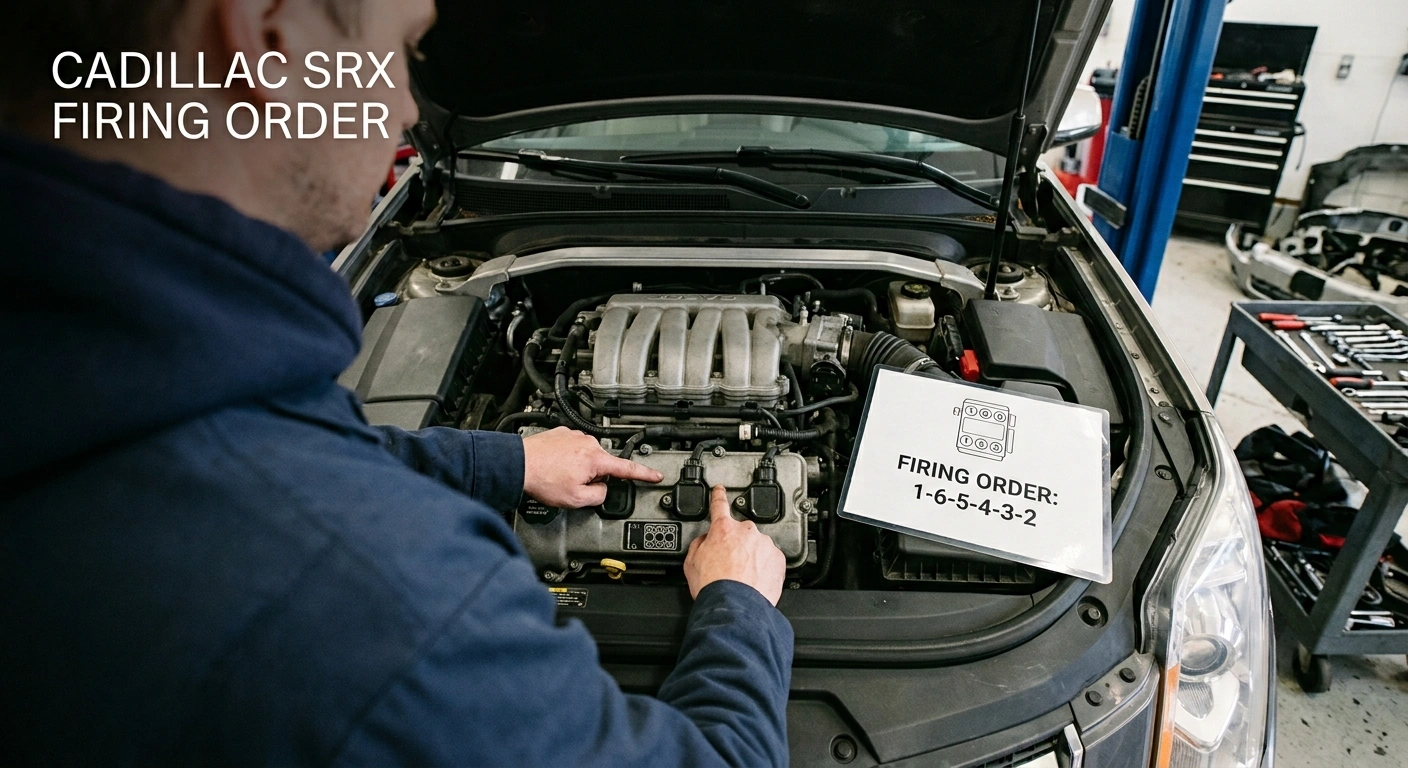
Every firing sequence, cylinder position, and diagnostic shortcut for both eras of this Cadillac crossover gets laid out here in plain, practical terms.
Firing Order Basics And Why The SRX Is A Special Case
Firing order describes the exact sequence in which an engine ignites fuel inside each cylinder. It sounds like a small detail, yet it shapes how smooth, quiet, and durable an engine turns out to be.
Most SUVs and crossovers stick with one engine family for their entire production run. The SRX took a very different path across its twelve model years.
What Firing Order Actually Controls Inside An Engine
Every cylinder in an engine fires at a specific moment relative to the others. That moment gets timed against crankshaft rotation, not against the cylinder numbers themselves.
A six-cylinder engine completes one firing event every 120 degrees of crankshaft rotation. An eight-cylinder engine fires every 90 degrees instead, packing more combustion events into the same single rotation.
Engineers choose the exact firing sequence to keep these events spaced evenly around the crankshaft. Uneven spacing creates vibration, rough idle, and extra wear on bearings and mounts over time.
None of this happens through spark plug wires anymore on an SRX. A computer-controlled ignition system fires each cylinder individually, using sensor data rather than a distributor to keep the sequence accurate.
Firing order still matters just as much under this setup. It tells a technician exactly which coil, plug, or injector to check when a specific cylinder starts acting up.
Why Two SRX Generations Tell Two Different Stories
First-generation SRX models, built from 2004 through 2009, used the rear-wheel-drive-based Sigma platform shared with the Cadillac CTS and STS. The engine sat lengthwise under the hood, just like it would in a traditional sedan.
Second-generation models, sold from 2010 through 2016, switched to the Theta Premium platform instead. This platform started life as a front-wheel-drive design, so the engine sits sideways across the engine bay rather than facing front to back.
That single change affects far more than which way the belts spin. Cylinder bank orientation, which side counts as “front,” and even how a diagnostic sheet gets read all shift between the two generations.
Owners searching for a firing order diagram often grab the wrong one simply because they assume both generations work identically. They don’t, and knowing why saves a lot of confusion during a repair.
Every Engine Cadillac Put Into The SRX And Its Firing Order
Four distinct engines served across the SRX’s lifespan, and every single one shares a trait worth noting upfront. Regardless of cylinder count or displacement, none of them needed a unique or unusual firing order.
That consistency traces back to GM reusing proven architecture across multiple vehicle lines rather than engineering something new for a single crossover model.
First Generation V6 And Northstar V8 Firing Order
The standard engine for 2004 through 2009 was the 3.6-liter LY7, part of GM’s High Feature V6 family also found in the Cadillac CTS and STS of the same era. Its firing order runs 1-2-3-4-5-6.
Cylinder numbering follows the same pattern used across this entire engine family. Cylinders one, three, and five sit on one bank running front to back, while two, four, and six occupy the opposite bank in the same order.
Buyers wanting more power could step up to the 4.6-liter Northstar V8, badged LH2, producing 320 horsepower. This version of the Northstar was specifically re-engineered in 2004 for longitudinal, rear-wheel-drive-style mounting, unlike earlier transverse Northstar V8s used in front-wheel-drive Cadillacs.
Its firing order is 1-2-7-3-4-5-6-8, a sequence that looks unusual at first glance but has remained consistent across nearly every Northstar application since the engine’s 1993 debut. Cylinders one, three, five, and seven sit on one bank, with two, four, six, and eight on the other.
This Northstar V8 represents the final chapter of Cadillac’s sophisticated dual-overhead-cam V8 approach in this particular model. Every V8 that followed in later Cadillac performance cars switched to simpler pushrod LS-based architecture instead.
Second Generation V6 Firing Order Across Three Displacements
Cadillac dropped the V8 entirely for the second-generation SRX, leaving V6 power as the only option from 2010 onward. Three different displacements filled that role at various points, and all three share an identical 1-2-3-4-5-6 firing order.
The 2010 and 2011 model years offered a turbocharged 2.8-liter V6, internally coded LAU, producing around 300 horsepower. Fewer than one in ten SRX buyers chose this option, and GM discontinued it after just two model years due to weak demand.
A naturally aspirated 3.0-liter V6, coded LF1, served as the standard engine alongside the turbo option and continued as the sole engine once the turbo disappeared. It produced 265 horsepower and shares its basic architecture with the larger 3.6-liter engine, essentially built on a shorter stroke.
For 2012 through 2016, Cadillac replaced the 3.0-liter entirely with a 3.6-liter LFX V6, producing roughly 308 horsepower. This became the only engine offered through the SRX’s final model year before the XT5 took over in 2016.
Here’s how the complete engine lineup breaks down by generation:
| Generation | Model Years | Engine | Displacement | Firing Order |
| First Gen | 2004-2009 | LY7 V6 | 3.6L | 1-2-3-4-5-6 |
| First Gen | 2004-2009 | LH2 Northstar V8 | 4.6L | 1-2-7-3-4-5-6-8 |
| Second Gen | 2010-2011 | LAU Turbo V6 | 2.8L | 1-2-3-4-5-6 |
| Second Gen | 2010-2011 | LF1 V6 | 3.0L | 1-2-3-4-5-6 |
| Second Gen | 2012-2016 | LFX V6 | 3.6L | 1-2-3-4-5-6 |
Longitudinal Versus Transverse Layouts Explained
Knowing a firing order number means little without knowing how to physically locate each cylinder. This is precisely where the SRX trips people up more than most vehicles.
The next two sections break down exactly how orientation flips between the SRX’s two very different chassis designs.
How The First Generation Layout Reads Front To Back
A longitudinally mounted engine sits with its crankshaft running parallel to the length of the vehicle. Picture standing at the front bumper looking straight back toward the windshield.
Cylinder one starts near the front of the engine, closest to the radiator and drive belt. Numbering then continues rearward along each bank toward the firewall and transmission.
On the 3.6-liter V6, this places cylinders one, three, and five on the passenger-side bank and two, four, and six on the driver’s side, both running front to rear. The Northstar V8 follows the identical front-to-rear logic across four cylinders per bank instead of three.
This layout matches what most people picture when they think about engine cylinders. It’s the same basic front-to-back logic used in the Cadillac CTS and STS, since all three models shared this Sigma platform architecture during the same period.
How The Second Generation Layout Reads Side To Side
Everything changes once the Theta Premium platform enters the picture. A transversely mounted engine sits sideways, with its crankshaft running perpendicular to the vehicle’s length rather than parallel to it.
What used to be the “front” of the engine, nearest the drive belt, now faces one side of the engine bay rather than the radiator. On most transverse applications, that front end points toward the passenger side of the car.
Cylinder banks that ran front-to-back on a first-generation SRX now effectively run side-to-side across the engine bay on a second-generation model. The firing order sequence itself, still 1-2-3-4-5-6, never changes, only the physical map of where each numbered cylinder actually sits.
This distinction explains why printed diagrams for one generation almost never transfer cleanly to the other. A mechanic pulling the wrong reference sheet can spend far longer finding cylinder two than the actual repair would have taken.
Owners chasing a specific cylinder for a plug or coil replacement benefit most from a diagram matched to their exact generation and engine code, not just their vehicle name.
Using Firing Order To Solve Real SRX Problems
None of this stays theoretical once a check engine light shows up or the engine starts running rough. Firing order and cylinder position knowledge turns a vague dashboard warning into a specific, targeted fix.
The sections below walk through how that process plays out for SRX owners specifically.
Tracking Down A Misfire By Generation And Engine
A rough idle or hesitation almost always traces back to one or two cylinders underperforming rather than the whole engine failing evenly. Pulling stored codes with a scan tool is the fastest way to narrow things down.
Misfire codes follow a simple pattern: P0301 means cylinder one, P0302 means cylinder two, and so on through the highest cylinder number for that engine. These numbers refer to physical cylinder position, not the order cylinders actually fire in.
Once a code identifies the affected cylinder, matching it against the correct generation-specific diagram points straight to the right coil, plug, or injector. Swapping a suspect coil with a known-good one from another cylinder remains one of the simplest confirmation tests available.
If the misfire code follows the coil to its new position, the coil was the problem all along. If the code stays with the original cylinder instead, something else, like a plug, injector, or a compression issue, deserves a closer look.
Direct-injected engines like the LFX and LF1 face an additional wrinkle worth mentioning. Carbon buildup on intake valves can mimic an ignition-related misfire, since fuel no longer washes over the valves the way it does on older port-injected designs.
Maintenance Habits That Prevent Ignition Trouble
Extended-life spark plugs on every SRX engine typically last well beyond 60,000 miles under normal conditions. Replacing them proactively before symptoms appear costs far less than diagnosing a mystery misfire down the road.
Torque specifications matter more than most people assume, especially on the Northstar V8. Overtightened spark plugs threaded into aluminum cylinder heads have caused enough thread damage over the years to become a well-known concern among long-term Northstar owners.
Timing chain wear deserves attention on the 3.6-liter V6 engines used across both SRX generations. A stretched chain won’t change the programmed firing order, but it can throw cam and crank sensor timing out of sync enough to trigger rough running or stored codes.
Keeping oil changes current matters more on these engines than on many competitors, since both the Northstar and the High Feature V6 family have documented histories of oil consumption when maintenance gets neglected. Clean oil protects the timing components that keep firing order execution accurate in the first place.
A quick reference for common ignition-related symptoms:
| Symptom | Likely Cause | Applies To |
| Rough idle, specific cylinder code | Failing ignition coil or plug | All SRX engines |
| Misfire after cold start only | Carbon buildup on intake valves | LF1, LFX, direct-injected engines |
| Clunk or rattle at startup | Stretched timing chain | 3.6L V6, both generations |
| Oil consumption between changes | Worn valve seals or piston rings | Northstar V8, high-mileage V6 |
Frequently Asked Questions
What is the firing order of a Cadillac SRX 3.6 V6?
Every 3.6-liter V6 used in the SRX, including the first-generation LY7 and second-generation LFX, fires in a 1-2-3-4-5-6 sequence. The physical location of each cylinder differs between generations, but the sequence itself stays the same.
What is the firing order of the first-generation SRX’s Northstar V8?
The 4.6-liter Northstar V8, coded LH2, uses a 1-2-7-3-4-5-6-8 firing order. This sequence has remained consistent across nearly every Northstar-powered Cadillac since the engine line debuted in the early 1990s.
Did the second-generation SRX ever offer a V8?
No, Cadillac dropped V8 power entirely for the 2010 redesign. Every second-generation SRX, regardless of trim or model year, relies on some version of the High Feature V6 instead.
Is the firing order different between the 2.8 turbo and 3.0 V6?
No, both the turbocharged LAU and naturally aspirated LF1 share the identical 1-2-3-4-5-6 firing order. Turbocharging changes airflow and boost pressure, not the underlying combustion sequence.
Why does cylinder numbering seem different between SRX generations?
The first generation mounts its engine longitudinally, like a rear-wheel-drive car, while the second generation mounts it transversely on a front-wheel-drive-based platform. That orientation change shifts which physical side of the engine bay corresponds to which cylinder bank.
Which cylinder is number one on a first-generation SRX?
Cylinder one sits at the front of the engine, nearest the radiator, on the passenger-side bank for the V6 and V8 alike. Numbering then continues rearward toward the firewall on each bank.
How do I identify cylinder banks on a transverse SRX engine?
Second-generation models mount the engine sideways, so the drive-belt end typically faces the passenger side of the car rather than the radiator. A diagram specific to that model year removes any guesswork, since orientation can be confusing to judge by eye alone.
Can I use a first-generation SRX firing order diagram for a second-generation model?
The firing order number itself still applies, but the physical cylinder map does not transfer directly. Longitudinal and transverse mounting positions place the same numbered cylinders in different physical locations.
Does the Northstar V8 use spark plug wires?
No, the Northstar switched to coil-on-plug ignition around 2000, well before the SRX launched. Every SRX engine across both generations uses individual coils rather than a distributor and plug wires.
What causes a misfire on a second-generation SRX 3.6?
Failing ignition coils, worn spark plugs, and carbon buildup on intake valves rank among the most common causes on the direct-injected LFX engine. A scan tool reading the specific cylinder code narrows the search considerably before any parts get replaced.
Is the 3.0L SRX engine related to the 3.6L engine?
Yes, the 3.0-liter LF1 shares its core architecture with the 3.6-liter LFX, essentially built on a shorter stroke to reduce displacement. This relationship is why both engines share the same firing order and much of the same internal design.
Why was the 2.8 turbo V6 discontinued?
Weak sales drove the decision, with fewer than ten percent of SRX buyers choosing the turbocharged option during its two-year run. GM pulled it from the SRX lineup after 2011, though the same engine continued briefly in the related Saab 9-4X.
Does firing order affect fuel economy?
Only indirectly, since a properly firing engine burns fuel completely and runs efficiently, while a misfire wastes unburned fuel out the exhaust. Firing order itself is a fixed design constant rather than something that degrades or changes with wear.
Where can I confirm the exact firing order for my specific SRX?
A factory service manual matched to the exact model year and engine code remains the most reliable source. Most auto parts stores can also pull a firing order reference for free once given the vehicle’s VIN.
Two platforms, two mounting orientations, and four distinct engines still boil down to a short list of numbers once the confusion gets cleared away. Every V6 across both SRX generations fires 1-2-3-4-5-6, while the first-generation Northstar V8 fires 1-2-7-3-4-5-6-8.
The real skill lies in matching that number to the correct physical cylinder map for the specific generation sitting in the driveway. Get that part right, and every misfire code turns into a five-minute inspection instead of a guessing game.