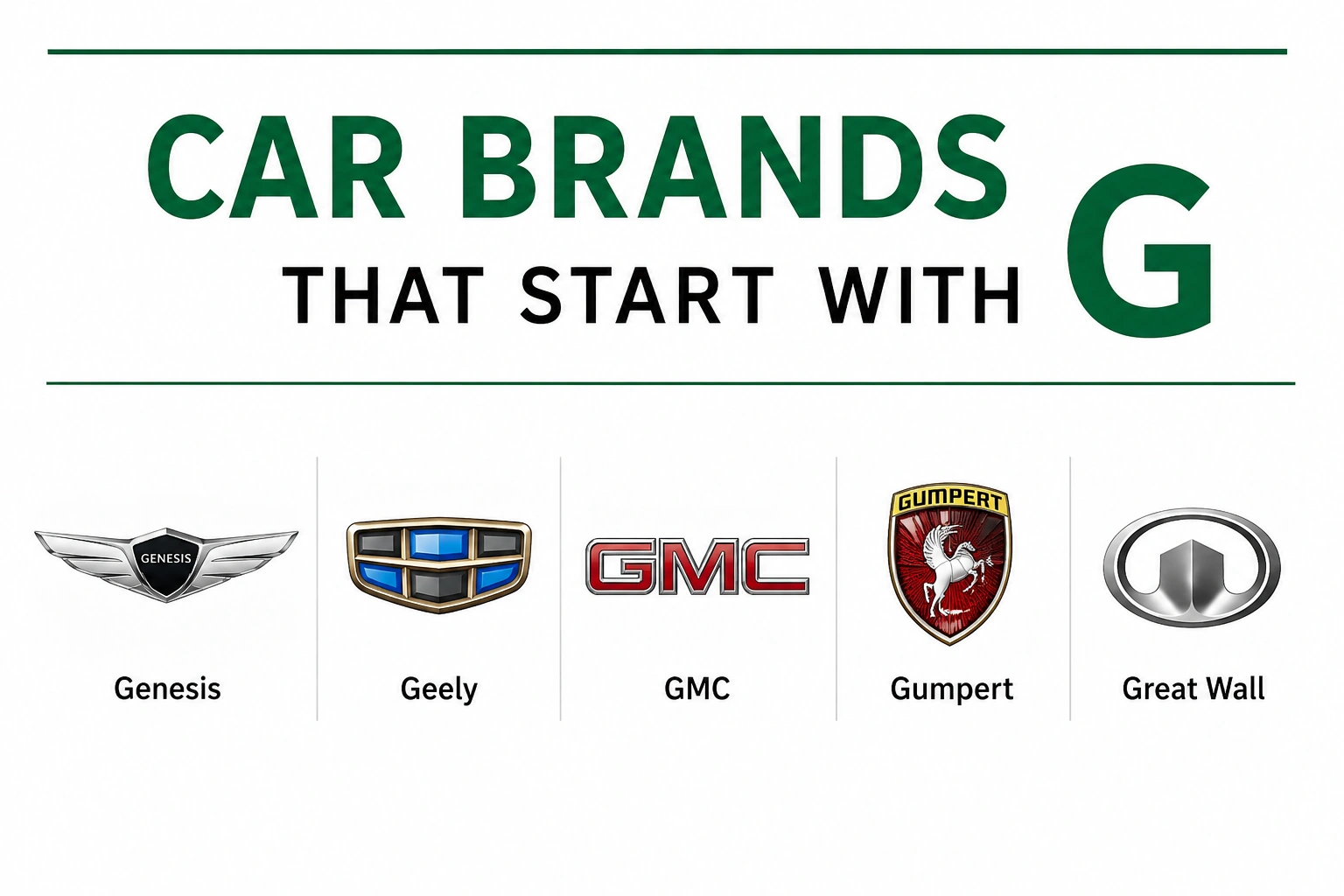
G is the letter of contrasts in the automotive world. Genesis spent under a decade building a luxury brand that now genuinely competes with Mercedes-Benz and Lexus on refinement and value.
GMC has been quietly turning Chevrolet’s bones into six-figure electric Hummers and Denali-badged trucks that outsell entire brands. Meanwhile, a tiny Yorkshire workshop called Ginetta has been hand-building lightweight British sports cars since 1958, largely unnoticed outside motorsport circles, and a Russian factory called GAZ has been producing the same basic sedan shape in one form or another since the Soviet era.
Add in the Chinese giants — Geely and Great Wall Motors — both now exporting EVs across Europe and Asia at a pace that’s reshaping entire markets, and G turns out to be one of the more genuinely diverse letters in the alphabet.
This guide covers every notable G-brand and G-model worth knowing in 2026, from six-figure electric SUVs to rally-bred hot hatches and the cars that quietly define entire categories.
Car Brands That Start With G
1. Genesis
Genesis is the most remarkable brand-building success story of the past decade. Founded in 2015 as Hyundai Motor Group’s standalone luxury division — building on the legacy of the Hyundai Genesis and Equus sedans — the brand has gone from a near-unknown name to a genuine cross-shop alternative to BMW, Mercedes-Benz, Audi, and Lexus in under ten years. Its design language, centred on the “Two Lines” lighting signature and “Athletic Elegance” philosophy, has earned international design awards including multiple Red Dot honours through 2024 and 2025.
What makes Genesis distinctive in 2026 is the breadth and coherence of its lineup — quick sedans, SUVs, coupes, and full battery-electric variants all built on shared design language, paired with genuinely competitive pricing against established luxury rivals and a 10-year/100,000-mile powertrain warranty that significantly undercuts the ownership cost of comparable German vehicles.
Key Models (2026):
- G70 — Compact luxury sedan; from $43,450; 2.5L turbo (300 hp) or available 3.3L twin-turbo V6 (365 hp); RWD or AWD
- G80 — Midsize luxury sedan; from $58,450 (2.5L) to $79,845 (3.5T Sport Prestige); 27-inch dashboard display; IIHS-tested
- G90 — Flagship full-size luxury sedan; from $92,700; competes directly with Mercedes S-Class and BMW 7 Series at a significant discount
- GV60 — Compact electric crossover; from $52,525; built on Hyundai E-GMP platform; GV60 Magma performance variant unveiled 2024
- GV70 / Electrified GV70 — Compact luxury SUV; GV70 from $48,985 (refreshed 2026, up to $3,235 price increase); Electrified GV70 from $64,380–$76,845; 236 miles EV range, 91 MPGe combined
- GV80 / GV80 Coupe — Midsize luxury SUV; GV80 from $57,700 (new RWD base trim at $59,195); GV80 Coupe from $81,850; KBB reliability rating of 5/5
- GV90 — Upcoming full-size flagship electric SUV; expected 2026; will feature rear-hinged coach doors with no central B-pillar — a genuinely unusual design choice for a production SUV
Brand facts:
- Founded: 2015, Seoul, South Korea
- Parent: Hyundai Motor Group
- Known for: Athletic Elegance design philosophy; Two Lines lighting signature; strong value vs. German rivals
- Warranty: 10-year/100,000-mile powertrain (significantly longer than German competitors’ 4-year/50,000-mile)
2. GMC
GMC (originally General Motors Truck Company) traces its roots to 1900 as the Grabowsky Motor Vehicle Company, later becoming Rapid Motor Vehicle Company before General Motors combined it with Reliance Motor Car Company in 1911 to form GMC. For over a century, GMC has positioned itself as General Motors’ “Professional Grade” truck and SUV division — mechanically related to Chevrolet equivalents but distinguished by upscale trim, Denali luxury branding, and increasingly, its own dedicated electric vehicle lineup built on GM’s Ultium platform.
GMC’s 2026 lineup represents one of the most aggressive electrification pushes of any traditional truck brand, with the Hummer EV nameplate — revived from its gas-guzzling military origins — now exclusively electric and producing genuinely staggering numbers.
Key Models (2025/2026):
- Sierra 1500 — Full-size pickup; GMC’s most popular model; available with Denali ultra-luxury trim
- Sierra EV — Electric pickup on Ultium platform; Elevation, Denali, and AT4 trims; up to 645 hp / 765 lb-ft (Elevation Extended Range)
- Hummer EV SUV — From $96,600 (2X trim); 20-module 170 kWh battery; up to 12,000 lbs towing (2X); 13.4-inch infotainment with split-view; updated Super Cruise with Google Maps integration for 2026
- Hummer EV Pickup — Electric pickup variant; shares Ultium platform and extreme off-road packages with the SUV
- Yukon / Yukon Denali — Full-size SUV; Denali trim represents GMC’s luxury positioning at scale
- Terrain — Compact SUV
- Canyon — Midsize pickup; AT4X off-road variant
Brand facts:
- Founded: 1911 (from 1900-era predecessor companies), Detroit, Michigan, USA
- Parent: General Motors
- Known for: “Professional Grade” positioning; Denali luxury sub-brand; Hummer EV revival
- Notable: Shares GM’s Ultium EV platform with Chevrolet and Cadillac
3. Geely
Geely Auto Group is one of China’s largest privately-owned automakers, founded in 1986 (entering automobile production in 1997) and headquartered in Hangzhou. Geely’s global significance expanded enormously through acquisitions — it owns Volvo Cars outright, holds significant stakes in Mercedes-Benz Group and Aston Martin, and owns Lotus Cars, Polestar (majority), Proton (Malaysia), and the London Electric Vehicle Company (maker of London’s iconic black cabs). Few automotive groups anywhere in the world have a portfolio this diverse spanning budget Chinese EVs to British sports car heritage and Scandinavian premium safety branding.
Geely’s own-brand vehicles, sold under the Geely and Geely Galaxy names, have expanded rapidly across Eastern Europe, the Middle East, Latin America, and increasingly Western Europe, with the Galaxy sub-brand specifically targeting electrified and hybrid models.
Key Models (2025/2026):
- Geely Galaxy E8 — Electric sedan; competes in the midsize EV segment with aggressive pricing for export markets
- Geely Galaxy L7 / L6 — Plug-in hybrid SUVs; strong sales in Chinese domestic market
- Geely Galaxy Starshine 8 — Long-range hybrid SUV announced for international export; competitive range claims against established rivals
- Geely Monjaro / Okavango — SUVs sold under Geely branding in Russia, Eastern Europe, and parts of Asia
Brand facts:
- Founded: 1986 (automotive production from 1997), Hangzhou, China
- Ownership stakes: Volvo Cars (100%), Polestar (majority), Lotus, Proton, significant Mercedes-Benz and Aston Martin shareholdings, LEVC (London Taxi)
- Known for: Aggressive global expansion via acquisition; rapidly growing EV/PHEV export lineup
4. Great Wall Motors (GWM)
Great Wall Motors is one of China’s largest SUV and pickup truck manufacturers, founded in 1984 and based in Baoding, Hebei province. GWM operates several distinct sub-brands targeting different segments — Haval for mainstream SUVs, Tank for rugged off-roaders, Ora for affordable EVs, and Wey for premium models — giving the parent company a portfolio breadth that mirrors how Volkswagen Group uses Skoda, SEAT, and Audi to address different price points.
GWM has expanded aggressively into export markets including Australia, the Middle East, Africa, Southeast Asia, and increasingly Europe and Latin America, with the Haval H6 being one of its best-selling models globally.
Key Models (2025/2026):
- Haval H6 — Compact SUV; all-new generation; 2.0L turbo (235 hp) with world-first 9-speed DCT; 10.25-inch digital cluster; 6-year/200,000 km warranty; one of GWM’s best-selling global exports
- Tank 300 / Tank 500 — Rugged body-on-frame SUVs; positioned against Toyota Land Cruiser and Jeep Wrangler in export markets
- Ora 03 / Ora 07 — Affordable electric hatchbacks/sedans with retro-inspired styling
- Wey — Premium sub-brand; plug-in hybrid SUVs for higher-margin export markets
Brand facts:
- Founded: 1984, Baoding, Hebei, China
- Sub-brands: Haval, Tank, Ora, Wey
- Known for: Pickup truck heritage; aggressive SUV export expansion; world-first 9-speed DCT on Haval H6
5. Ginetta
Ginetta is a small but fiercely independent British sports car manufacturer founded in 1958 by the four Walklett brothers in Suffolk, England. For over six decades, Ginetta has occupied a unique niche: building lightweight, front-engine, rear-wheel-drive sports and racing cars in relatively tiny numbers, with a model numbering system that has now passed G60 across its history. After a turbulent period following the founders’ retirement in 1989 — including near-collapse during the 1990s recessions — Ginetta was purchased out of administration in 2005 by Yorkshire businessman Lawrence Tomlinson and relocated to Leeds, where it has rebuilt itself primarily as a motorsport supplier.
Ginetta produces roughly 150 race cars annually across its G40, G50, G55, and G56 model lines, supplying spec series including British GT and the SVRA (Sportscar Vintage Racing Association) in the US for 2026. The company has periodically attempted road-car comebacks, most notably with the G40R and G60 grand tourer.
Key Models:
- Ginetta G40 — Entry-level sports car; 2.0L Mazda MZR engine (road version); 795 kg; 0–60 mph in 5.8 seconds; originally priced from £29,950; available in road (G40R) and race specifications
- Ginetta G56 GTA/GT4 — Current spec racing car; 6.2L GM LS3 V8; 500 hp; spec series car for British GT and SVRA Trans Am championships into 2026
- Ginetta G60 — Road-going grand tourer; very limited production
Brand facts:
- Founded: 1958, Suffolk, England (relocated to Leeds, 2005)
- Current owner: LNT Group (Lawrence Tomlinson)
- Production: ~150 cars/year, primarily racing specification
- Known for: British GT and SVRA spec racing cars; periodic road car revivals
6. Geo
Geo was a marque created by General Motors in 1989 to sell rebadged vehicles developed in partnership with Japanese manufacturers — primarily Suzuki, Isuzu, and Toyota — through Chevrolet dealerships, aimed at buyers seeking small, fuel-efficient cars during a period when GM’s own small-car offerings were considered uncompetitive. The brand existed until 1997, when all Geo models were absorbed back into the Chevrolet lineup (the Geo Prizm became the Chevrolet Prizm, the Geo Tracker became the Chevrolet Tracker, and so on).
Notable Models:
- Geo Metro — Subcompact; based on Suzuki Sprint/Swift; renowned for exceptional fuel economy for its era
- Geo Prizm — Compact sedan; joint venture product with Toyota, mechanically related to the Corolla
- Geo Tracker — Compact SUV; based on the Suzuki Vitara/Sidekick
Brand facts:
- Founded: 1989, USA
- Defunct: 1997 (absorbed into Chevrolet)
- Known for: Badge-engineered Japanese partnerships sold through Chevy dealers
7. GAZ
GAZ (Gorkovsky Avtomobilny Zavod, or Gorky Automobile Plant) is one of Russia’s oldest and largest automotive manufacturers, founded in 1929 in Nizhny Novgorod (then Gorky) with significant early technical assistance from Ford Motor Company. GAZ is best known for the long-running Volga sedan line, which served as the standard vehicle for Soviet officials, taxi fleets, and middle-class buyers for decades, and for GAZelle light commercial vans that remain ubiquitous across Russia and former Soviet states.
GAZ’s passenger car ambitions have waned considerably since the Soviet era — the Volga sedan line effectively ended in the mid-2000s after a brief Chrysler-partnership-based revival (the GAZ-3105, based loosely on Audi 100 underpinnings) failed to gain traction. GAZ today focuses primarily on commercial vans, trucks, and buses.
Notable Historic Models:
- GAZ Volga (multiple generations) — Soviet-era executive sedan; symbol of Soviet middle-class and official transport for decades
- GAZ-3105 — 1990s flagship sedan; shared some underpinnings concepts with Audi 100; limited production 1992–1996
- GAZelle — Light commercial van; remains in widespread production and use across Russia and CIS countries
Brand facts:
- Founded: 1929, Nizhny Novgorod (Gorky), Russia
- Status: Active; focus shifted to commercial vehicles
- Known for: Volga sedan heritage; GAZelle commercial vans
8. Gillet
Gillet Automobiles is a small Belgian sports car manufacturer founded by Tony Gillet in 1992, known for the Gillet Vertigo — a lightweight, track-focused sports car that has competed at Le Mans-style endurance events and built a reputation in continental European track-day circles. Production remains extremely limited, with the company operating as a boutique manufacturer for enthusiasts rather than a volume producer.
Brand facts:
- Founded: 1992, Belgium
- Founder: Tony Gillet
- Status: Active, ultra-low volume
- Known for: Gillet Vertigo lightweight track car
9. Glas
Glas was a German automobile manufacturer based in Dingolfing, Bavaria, active from the 1950s through the mid-1960s, known for the quirky Goggomobil microcar (which motorised post-war Germany in a similar role to the Fiat 500 in Italy) and the more conventional Glas GT coupe, which was notable for using one of the first production overhead-camshaft engines driven by a timing belt — a technology that would later become an industry standard. BMW acquired Glas in 1966, primarily to gain access to its Dingolfing factory (which remains a major BMW production site today) and its engineering patents, before phasing out the Glas brand entirely by 1968.
Brand facts:
- Founded: 1950s, Dingolfing, Germany
- Defunct: 1966 (acquired by BMW); brand phased out by 1968
- Legacy: Dingolfing factory remains a major BMW plant; timing belt OHC technology pioneered
10. GTA Motor
GTA Motor is a Spanish sports car manufacturer that produced the GTA Spano, a carbon-fibre supercar powered by a 8.3-litre V10 engine producing over 820 hp, with production beginning around 2014. The company represents the extreme boutique end of the supercar market — extraordinarily limited production numbers, hand-built construction, and a price point that places it among the most expensive cars ever produced in Spain.
Brand facts:
- Founded: Spain, production from ~2014
- Known for: GTA Spano (820+ hp V10 carbon-fibre supercar)
- Status: Ultra-low volume / boutique
Car Models That Start With G
1. Mercedes-Benz G-Class (G-Wagen)
The Mercedes-Benz G-Class is one of the longest-running and most recognisable vehicle shapes in the world — a genuinely military-derived, body-on-frame SUV that has been in continuous production since 1979 with an exterior silhouette that remains instantly identifiable across all that time. Originally developed for military and government use, it has become a paradoxical status symbol: a vehicle engineered for extreme off-road capability that is now equally at home outside luxury hotels as on unpaved military supply roads.
- Engines: Wide range depending on market and trim, including AMG twin-turbo V8 variants (G63) producing over 600 hp
- Drivetrain: Permanent AWD with three locking differentials (front, centre, rear) — a genuinely rare specification in any production vehicle
- Body: Ladder-frame chassis; largely unchanged silhouette since 1979 despite a full technical redesign in 2018
- Electric variant (G 580 / EQG): All-electric G-Class introduced, using four individual motors for tank-turn capability — the vehicle can rotate close to its own axis at low speed
- Status: Production continues at Magna Steyr in Graz, Austria — the same facility that has built every G-Class since 1979
2. Toyota GR Corolla
The Toyota GR Corolla is a rally-bred hot hatch developed by Toyota’s GAZOO Racing (GR) division, transferring technology from Toyota’s World Rally Championship program into a street-legal compact hatchback. It represents one of the most distinctive performance compacts on sale, combining a relatively small-displacement turbocharged engine with genuine all-wheel-drive rally hardware.
- Engine: 1.6L turbocharged 3-cylinder (G16E-GTS) — an unusually small displacement for the power output achieved
- Drivetrain: GR-FOUR all-wheel drive system, adapted from Toyota’s WRC program; driver-selectable torque distribution
- Trims: GR Corolla and GR Corolla Premium Plus (2025+)
- Design: Bulged hood with functional vents, flared fenders, color-keyed roof spoiler with integrated brake light, triple exhaust outlets
- Transmission: 6-speed manual standard; 8-speed automatic available
- Character: Combines everyday hatchback usability with genuine rally-derived performance hardware — a rare combination at this price point
3. Jeep Grand Cherokee
The Jeep Grand Cherokee is one of the most commercially important SUVs in Stellantis’s North American portfolio, combining genuine off-road capability (inherited from Jeep’s broader brand identity) with a more refined, family-oriented package than the Wrangler. It has been in production since 1992 across multiple generations and remains one of Jeep’s best-selling models.
- Engines: Range typically includes turbocharged 4-cylinder, V6, and plug-in hybrid 4xe variants
- Drivetrain: 4WD/AWD systems including Quadra-Trac and Quadra-Drive depending on trim
- 4xe (PHEV): Combines turbocharged engine with electric motors for plug-in hybrid capability; allows limited electric-only driving range
- Seating: Available in both two-row (Grand Cherokee) and three-row (Grand Cherokee L) configurations
- Off-road: Selec-Terrain traction management system; available air suspension for increased ground clearance
4. Volkswagen Golf
The Volkswagen Golf is one of the best-selling cars in automotive history, with the GTI performance variant having effectively created the modern “hot hatch” category when it launched in 1976. Now in its eighth generation, the Golf remains a benchmark for compact car refinement, with the GTI and even more powerful Golf R variants continuing to be held up as reference points for how a performance compact should drive.
- Standard Golf: Efficient turbocharged 4-cylinder engines; available in hatchback configurations
- GTI: Turbocharged 4-cylinder (typically around 241 hp); front-wheel drive; widely regarded as the benchmark hot hatch
- Golf R: AWD performance flagship; significantly higher power output than the GTI; competes with the Honda Civic Type R and Toyota GR Corolla
- Legacy: The GTI nameplate has been used continuously since 1976, longer than almost any other performance badge in the industry
Kia EV9 / Genesis GV-Series Context (Grand SUVs)
While not a single model, the “Grand” naming convention appears across multiple G-brand SUVs worth noting collectively — Hyundai Grand Santa Fe, and various “Grand” trims across manufacturers signal extended-length or three-row variants of existing SUV platforms, typically adding a third row of seating and increased cargo capacity over the standard-length version.
5. GAC Group Models (GS8, Empow, Aion)
GAC Group (Guangzhou Automobile Group) is a major Chinese state-owned automaker whose GS8 SUV and Aion electric sub-brand have begun appearing in export markets across the Middle East, Southeast Asia, and increasingly Europe and Latin America. The GAC Aion brand specifically focuses on electric vehicles and has expanded rapidly in markets where Chinese EV brands are gaining traction against established manufacturers.
- GAC GS8 — Midsize SUV; available with turbocharged petrol or hybrid powertrains depending on market
- GAC Aion Y / Aion V — Electric crossovers; competitive pricing in export markets against BYD and other Chinese EV rivals
Complete Reference Table
| Brand / Model | Type | Country | Status | Price (approx.) | Notable Feature |
| Genesis | Luxury (full lineup) | South Korea | Active | From $43,450 (G70) | 10-yr/100k warranty; Athletic Elegance design |
| GMC | Trucks / SUVs / EVs | USA | Active | From ~$96,600 (Hummer EV SUV) | Denali luxury sub-brand; Ultium EVs |
| Geely | Mass market / EV | China | Active | Varies | Owns Volvo, Polestar, Lotus, LEVC |
| Great Wall Motors (GWM) | SUVs / pickups | China | Active | Varies | Haval, Tank, Ora, Wey sub-brands |
| Ginetta | British sports/race cars | UK | Active (low volume) | From £29,950 (G40, historic) | British GT and SVRA spec series |
| Geo | Badge-engineered (historic) | USA | Defunct (1997) | — | Absorbed into Chevrolet |
| GAZ | Russian automaker | Russia | Active (commercial focus) | Varies | Volga heritage; GAZelle vans |
| Gillet | Belgian sports car | Belgium | Active (ultra-low volume) | Varies | Gillet Vertigo track car |
| Glas | German automaker (historic) | Germany | Defunct (1966/1968) | — | Pioneered timing belt OHC; BMW acquired |
| GTA Motor | Spanish supercar | Spain | Active (boutique) | Ultra-high | GTA Spano, 820+ hp V10 |
| Mercedes-Benz G-Class | Luxury off-road SUV | Germany | Active | Varies (high) | 3 locking diffs; electric G 580 variant |
| Toyota GR Corolla | Performance hot hatch | Japan | Active | Varies | WRC-derived GR-FOUR AWD |
| Jeep Grand Cherokee | Midsize/3-row SUV | USA | Active | Varies | 4xe PHEV available |
| Volkswagen Golf (GTI/R) | Compact hatchback | Germany | Active | Varies | GTI created hot hatch category (1976) |
| GAC Aion / GS8 | EV / SUV (export) | China | Active | Varies | Expanding export EV brand |
Frequently Asked Questions
What car brands start with the letter G?
Major active brands starting with G include Genesis (South Korea), GMC (USA), Geely (China), Great Wall Motors / GWM (China), Ginetta (UK), GAZ (Russia), Gillet (Belgium), and GTA Motor (Spain). Notable defunct brands include Geo (USA, absorbed into Chevrolet in 1997) and Glas (Germany, acquired by BMW in 1966). GAC Group is a major Chinese state-owned automaker expanding into export markets under its GAC and Aion sub-brands.
Is Genesis owned by Hyundai?
Yes. Genesis was established in 2015 as a standalone luxury division of Hyundai Motor Group, building on the legacy of the earlier Hyundai Genesis and Equus sedans. While it operates with its own dealerships, design language, and branding entirely separate from Hyundai, it remains part of the Hyundai Motor Group corporate structure alongside Hyundai and Kia. Genesis vehicles share underlying platforms and powertrain technology with Hyundai and Kia equivalents but receive distinct tuning, materials, and styling.
How powerful is the GMC Hummer EV?
The GMC Hummer EV SUV’s entry-level 2X trim starts at $96,600 and uses a 170 kWh battery pack across 20 modules. The Sierra EV, which shares the Ultium platform, offers up to 645 hp and 765 lb-ft of torque in its Elevation Extended Range configuration. Towing capacity on the Hummer EV SUV 2X reaches up to 12,000 lbs — a figure that rivals or exceeds many gasoline-powered full-size trucks, though real-world electric range decreases significantly when towing near maximum capacity.
What companies does Geely own?
Geely’s portfolio is one of the most extensive in the global automotive industry. The company owns Volvo Cars outright, holds a majority stake in Polestar, owns Lotus Cars, owns Proton (Malaysia’s national carmaker), owns the London Electric Vehicle Company (maker of London’s iconic black cabs), and holds significant shareholdings in both Mercedes-Benz Group and Aston Martin. Geely’s own-brand vehicles, including the Geely Galaxy sub-brand focused on electrified models, are expanding into export markets across Eastern Europe, the Middle East, and increasingly Western Europe and Latin America.
Is the Mercedes G-Class available as an electric vehicle?
Yes. Mercedes-Benz introduced the G 580 (also referred to as the EQG in some markets), an all-electric version of the G-Class, using four individual electric motors — one at each wheel. This configuration enables a unique capability called “tank turn,” where the vehicle can rotate close to its own axis at very low speeds by spinning the wheels on each side in opposite directions, something impossible with a conventional drivetrain. The electric G-Class retains the iconic body-on-frame construction and boxy silhouette that has defined the G-Class since 1979, alongside the AMG-powered V8 G63 and other conventional powertrain variants which continue in production.
What happened to the Geo brand?
Geo was created by General Motors in 1989 as a way to sell rebadged vehicles developed with Japanese partners — primarily Suzuki, Isuzu, and Toyota — through Chevrolet dealerships, targeting buyers who wanted small, fuel-efficient cars. The brand existed for less than a decade before General Motors discontinued it in 1997, folding all Geo models directly back into the Chevrolet lineup. The Geo Prizm became the Chevrolet Prizm, the Geo Tracker became the Chevrolet Tracker, and the Geo Metro’s role was eventually filled by other Chevrolet small-car offerings.
Which G-brand SUV has the most off-road capability?
The Mercedes-Benz G-Class and GWM’s Tank 300/500 both represent serious off-road engineering at very different price points. The G-Class features three locking differentials (front, centre, and rear) — a specification matched by very few production vehicles regardless of price — combined with a ladder-frame chassis and portal axle heritage from its military origins. The GWM Tank series, sold primarily in export markets, targets a similar body-on-frame, off-road-focused niche at a significantly lower price point, positioned against vehicles like the Toyota Land Cruiser and Jeep Wrangler in markets where GWM has established distribution.