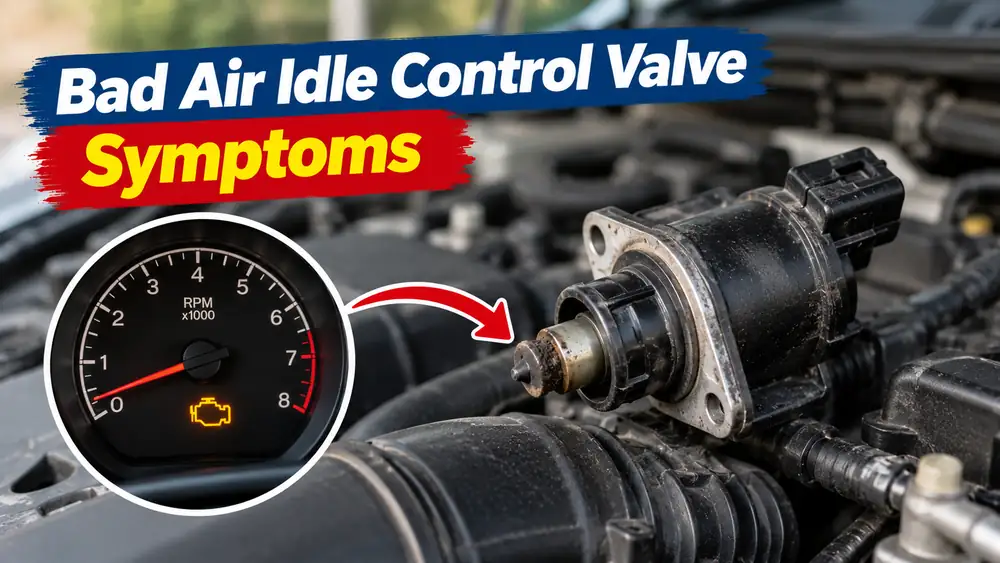
The bad air idle control valve symptoms can be easy to confuse with other engine problems because the idle air control system directly affects the amount of air entering the engine when the accelerator is released.
When that airflow is incorrect, the engine may idle too high, stall at stops, surge up and down, hesitate after starting, or struggle to maintain a steady idle when electrical or climate-control loads are added.
A traditional idle air control valve, commonly called an IAC valve or idle control valve, is designed to regulate bypass air around the throttle plate on many older fuel-injected engines. The engine computer adjusts this airflow to maintain the desired idle speed under changing conditions.
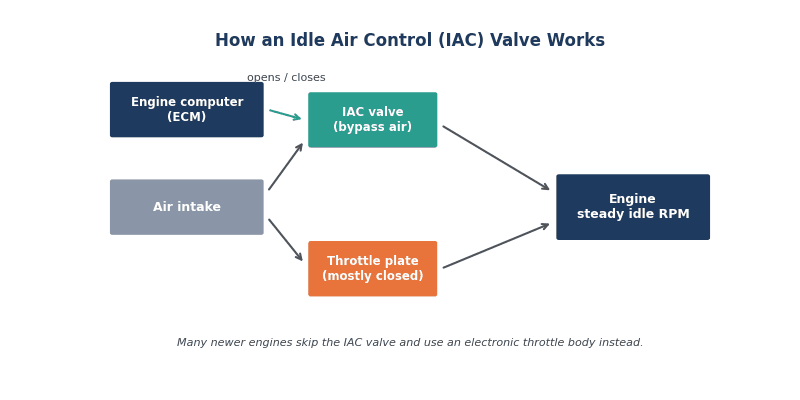
However, not every modern vehicle uses a separate IAC valve. Many newer engines control idle speed electronically through the throttle body itself.
That distinction matters when diagnosing an idle problem. Replacing an IAC valve that the vehicle does not even use will not solve the problem.
The symptoms, diagnostic trouble codes, engine design, vacuum system, throttle body, wiring, and actual idle behavior all need to be considered together.
Bad Air Idle Control Valve Symptoms You Should Know
The idle air control valve has a relatively simple job, but its effect on engine operation can be significant. At idle, the throttle plate is mostly closed, so the engine still needs a controlled amount of air to continue running.
On engines equipped with a traditional IAC system, the valve provides a controlled air path around the throttle plate. The engine control module can open or close the valve to adjust idle speed.
If the valve becomes dirty, sticks, fails electrically, or develops an internal mechanical problem, the amount of bypass air may no longer match what the engine computer expects.
That can create several recognizable symptoms.
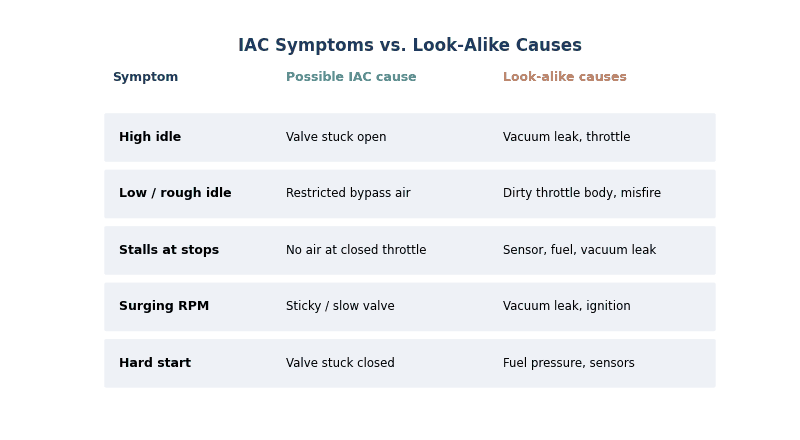
| Symptom | Possible IAC-Related Cause | Other Possible Causes |
|---|---|---|
| High Idle | Valve stuck open | Vacuum leak, throttle problem |
| Low Idle | Insufficient bypass air | Dirty throttle body, fuel issue |
| Stalling At Idle | Valve fails to supply air | Vacuum leak, sensor problem |
| Surging Idle | Valve sticks or responds inconsistently | Vacuum leak, ignition problem |
| Rough Idle | Incorrect idle airflow | Misfire, injector issue |
| Difficult Starting | Incorrect bypass airflow | Fuel pressure, sensor, ignition |
| Idle Changes With A/C | Poor idle compensation | Electrical or A/C load issue |
| Check Engine Light | Control or airflow fault | Multiple engine faults |
No single symptom proves that the IAC valve has failed.
That is one of the most important points when troubleshooting idle problems. A vacuum leak, dirty throttle body, faulty mass airflow sensor, exhaust leak, ignition misfire, fuel-delivery problem, or sensor failure can create very similar behavior.
High Engine Idle
A high idle is one of the classic signs associated with an idle air control problem.
If the engine receives more air than the computer expects when the throttle is closed, engine speed can rise.
A valve stuck partially open may allow too much bypass air into the intake.
For example, an engine that normally idles around 650–800 RPM may suddenly remain at a much higher speed after startup.
The exact normal idle speed varies by engine, temperature, calibration, and operating conditions, so the number itself should not be used as a universal diagnostic threshold.
A high idle can also be caused by a vacuum leak.
That is why checking the intake system is important before replacing an IAC valve.
A cracked vacuum hose can allow unmetered air into the engine, creating a high or unstable idle even when the IAC valve is operating correctly.
Low Or Rough Idle
A dirty or restricted IAC passage can prevent enough air from reaching the engine at idle.
The result may be a low idle speed, shaking, or an engine that feels as though it is about to stall.
Carbon deposits can accumulate around the valve and its air passage over time.
The buildup can interfere with the valve’s movement or reduce the available airflow.
A dirty throttle body can create a similar problem.
This is why cleaning the throttle body and inspecting the IAC passage can be useful during diagnosis, but the correct procedure depends on the specific engine.
Some valves can be cleaned safely, while others should not be exposed to certain solvents or submerged in cleaner.
Engine Stalls When You Stop
An engine that starts normally but stalls when the accelerator is released can have an idle-air problem.
During acceleration, the throttle is open and the engine receives plenty of air.
When the throttle closes, the engine becomes dependent on the idle-control strategy to maintain sufficient airflow.
If the IAC valve fails to provide the required air, engine speed can drop rapidly.
This can be especially noticeable when approaching a stoplight or shifting into Drive.
However, stalling can have many other causes.
A failing crankshaft position sensor, dirty throttle body, weak fuel pump, vacuum leak, ignition problem, EGR issue, or incorrect sensor signal can all produce similar symptoms.
The pattern of the stall is therefore more useful than the stall itself.
Idle Surges Up And Down
An engine that repeatedly rises and falls in RPM may have an idle-control problem.
The computer attempts to maintain the target idle speed.
If airflow changes unpredictably because the IAC valve sticks, reacts slowly, or becomes contaminated, the engine speed can rise above the target.
The computer then reduces airflow.
RPM drops too far.
The computer compensates again.
This repeated correction can produce an oscillating or “hunting” idle.
Vacuum leaks can create a similar pattern because the computer constantly adjusts fuel and airflow to compensate for unexpected intake air.
An engine with an ignition misfire may also produce an uneven idle that looks like an idle-control problem.
Difficult Starting Or Starting And Immediately Stalling
An idle air control problem can make starting difficult, particularly when the engine needs additional air during startup.
The computer may command the valve to provide a specific amount of bypass airflow.
If the valve is stuck closed or heavily restricted, the engine may start and then immediately struggle to remain running.
Some vehicles are more noticeable when cold because the engine’s airflow requirements are different during warm-up.
However, difficult starting is not enough to diagnose an IAC valve.
Fuel pressure, injector operation, ignition spark, coolant-temperature information, crankshaft position signals, and intake-air measurements should also be considered.
Idle Changes When Electrical Loads Are Added
The engine needs to compensate for additional loads.
Turning on the headlights, rear defroster, blower motor, or air conditioning can increase the demand placed on the engine.
The engine computer may adjust idle speed to prevent the RPM from dropping too far.
If the idle control system is unable to respond properly, the engine may stumble or stall when a major load is introduced.
A healthy charging system also matters.
A weak alternator or poor electrical connection can create low-voltage conditions that affect engine operation.
Therefore, an idle problem that appears primarily when the A/C or electrical accessories are switched on should not automatically be blamed on the IAC valve.
What Causes An Idle Air Control Valve To Go Bad?
An IAC valve can fail in several ways.
Some problems are caused by contamination rather than electrical failure. Others involve a damaged motor, failed winding, stuck pintle, wiring issue, connector corrosion, or mechanical wear.
The valve’s location also exposes it to air, oil vapor, carbon deposits, and other contaminants from the intake system.
Carbon And Sludge Buildup
Carbon deposits are among the most common reasons an idle-control valve may become restricted or sticky.
The engine’s intake system can accumulate deposits over time, especially when oil vapor from the crankcase ventilation system enters the intake.
The deposits can collect around the throttle plate and idle-air passage.
A valve that previously moved smoothly may begin sticking.
The engine computer can command a particular position, but the valve may not respond correctly.
Cleaning can sometimes restore operation if contamination is the problem.
However, cleaning does not repair a failed electrical motor or damaged internal component.
Electrical Failure
Traditional IAC valves commonly use an electrically controlled motor or solenoid mechanism.
An open circuit, short circuit, damaged winding, poor ground, or wiring problem can prevent the valve from responding properly.
A scan tool may reveal a related trouble code, but electrical testing should still be performed.
The technician may check resistance, voltage supply, wiring continuity, connector condition, and command response depending on the system.
A replacement valve should not be installed simply because an electrical code appears.
The code could identify the circuit rather than the component itself.
Vacuum Leaks
A vacuum leak is one of the most important alternative causes of an idle problem.
Air entering the engine through an unintended opening bypasses the normal airflow measurement and control strategy.
Common leak locations include:
- Vacuum hoses
- Intake manifold gaskets
- Throttle-body gaskets
- PCV hoses
- Brake-booster hoses
- EVAP-related components
- Cracked intake tubing
A vacuum leak can cause high idle, lean fuel-trim readings, rough running, hesitation, and sometimes stalling.
Because these symptoms overlap with IAC failure, checking for unwanted air is an important part of the diagnosis.
Throttle Body Contamination
The throttle body controls airflow into the engine.
On an older engine with a separate IAC valve, the idle-control passage may bypass the mostly closed throttle plate.
If the throttle body becomes heavily contaminated, airflow can be affected.
Carbon around the throttle plate can also change the effective airflow at closed throttle.
Some vehicles require an idle relearn procedure after throttle-body cleaning or replacement.
That procedure varies by manufacturer.
PCV System Problems
The positive crankcase ventilation system controls vapors leaving the engine crankcase.
A failed or incorrectly functioning PCV valve, hose, or related component can introduce unintended airflow into the intake system.
This can affect idle quality.
A cracked PCV hose can act like a vacuum leak.
Because PCV components are often inexpensive and accessible, they are worth inspecting when diagnosing unexplained idle problems.
Sensor Problems
The engine control module depends on sensor information to calculate airflow, fuel delivery, ignition timing, and idle control.
A faulty throttle-position sensor, mass airflow sensor, manifold absolute pressure sensor, engine coolant temperature sensor, or crankshaft position sensor can create symptoms that resemble IAC failure.
This is why the diagnostic process should examine the complete engine-management system.
Replacing the idle valve without checking sensor data can result in unnecessary parts replacement.
How To Diagnose A Bad Idle Air Control Valve
Good diagnosis starts with identifying how the engine is behaving.
The goal is not simply to find a component that could cause the symptom. The goal is to determine whether that component is actually responsible.
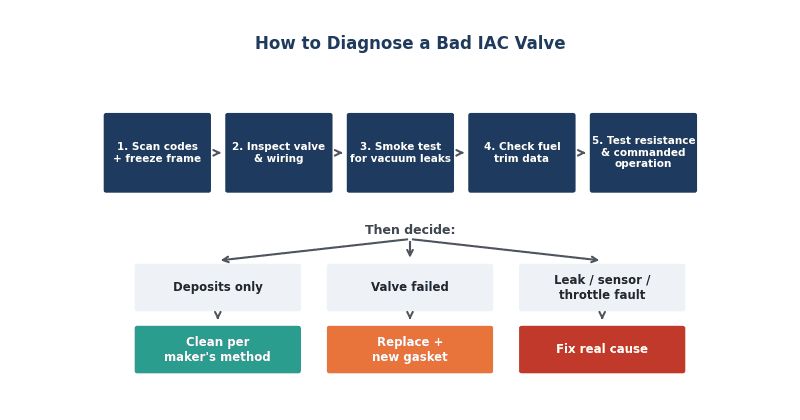
A technician should first establish the engine’s normal idle behavior, inspect the intake system, scan for fault codes, and then perform component-specific testing.
Check For Diagnostic Trouble Codes
Connect a compatible scan tool and retrieve stored and pending codes.
Some vehicles may store specific IAC-related codes, while others may detect idle-speed performance problems rather than directly identifying the valve.
The exact code definitions depend on the vehicle.
Codes can be valuable clues, but they should not be treated as proof.
A code related to idle airflow may be caused by a vacuum leak or throttle problem rather than the IAC valve itself.
Freeze-frame data can also help show engine temperature, RPM, load, fuel trims, and other conditions present when the fault was recorded.
Inspect The Valve And Connector
If the vehicle has a separate IAC valve, inspect its electrical connector and wiring.
Look for:
- Broken wires
- Corrosion
- Loose terminals
- Damaged insulation
- Oil contamination
- Signs of overheating
A connector problem can produce intermittent symptoms that appear to come and go.
Inspect the valve itself for heavy carbon deposits or physical damage.
The intake passage should also be checked for restrictions.
Test Electrical Resistance
Some IAC valves can be tested with a digital multimeter.
The technician measures resistance across specified terminals and compares the result with manufacturer service specifications.
The correct resistance varies by design.
There is no universal resistance number that can be applied to every IAC valve.
An open circuit or a resistance measurement outside the manufacturer’s specification can indicate a problem, but a normal resistance reading does not necessarily prove the valve is mechanically healthy.
The valve could still stick under operating conditions.
Check Commanded Operation
A capable scan tool may allow the technician to command the idle-control system through different positions or monitor its response.
If the computer commands a change and the engine RPM does not respond as expected, further testing can identify whether the problem is the valve, wiring, airflow system, or another component.
This type of test is often more informative than simply removing the valve and looking at it.
Check For Vacuum Leaks
A smoke test can be particularly useful for finding small intake leaks.
Smoke is introduced into the intake system, and the technician watches for smoke escaping from hoses, gaskets, or other components.
A smoke test can reveal leaks that are difficult to find visually.
Unmetered air can create many of the same symptoms associated with a faulty IAC valve, so eliminating vacuum leaks from the diagnosis is important.
Inspect Fuel Trim Data
Fuel-trim data can provide useful information about the engine’s air-fuel balance.
Positive long-term and short-term fuel trims can suggest that the engine control system is adding fuel to compensate for a lean condition.
A vacuum leak can cause this behavior.
However, fuel-trim readings must be interpreted in context.
A lean condition can also result from low fuel pressure, injector problems, incorrect airflow measurement, exhaust leaks near oxygen sensors, or other faults.
Fuel trims are diagnostic evidence, not a standalone verdict.
How To Fix A Bad Idle Air Control Valve
The correct repair depends on the cause.
If contamination is restricting the valve, cleaning may help.
If the valve has an internal electrical or mechanical failure, replacement may be necessary.
If the actual cause is a vacuum leak, replacing the IAC valve will not solve the problem.
Cleaning The IAC Valve
Some traditional IAC valves can be cleaned using an appropriate throttle-body or intake-system cleaner.
The exact procedure should follow the vehicle manufacturer’s service instructions.
The valve should not automatically be sprayed with any solvent simply because it appears dirty.
Some electrical components can be damaged by excessive solvent or incorrect cleaning methods.
If the valve contains an electronic motor or delicate internal components, avoid forcing the mechanism.
The objective is to remove deposits without damaging the valve.
If cleaning does not restore correct operation, further testing may be required.
Replacing The IAC Valve
When the valve itself has failed, replacement is usually straightforward compared with many other engine repairs.
The basic procedure may involve:
- Disconnecting the battery when required by the manufacturer’s procedure.
- Disconnecting the IAC electrical connector.
- Removing mounting screws or bolts.
- Removing the old gasket if applicable.
- Cleaning the mounting surface.
- Installing the correct replacement gasket.
- Installing the replacement valve.
- Reconnecting the electrical connector.
- Starting the engine and checking idle operation.
- Performing any required idle relearn procedure.
The actual procedure varies significantly between vehicles.
Some valves are mounted directly to the throttle body, while others are attached to a separate intake passage.
Replacing The Gasket
A gasket or O-ring is often used between the valve and its mounting surface.
A damaged or improperly installed seal can create a vacuum leak.
That means installing the correct gasket is not a minor detail.
A new valve with a leaking gasket can still produce poor idle behavior.
The mounting surfaces should be clean and free from old gasket material without damaging the sealing surface.
Idle Relearn After Repair
Some vehicles require an idle relearn after the IAC valve or throttle body has been replaced or cleaned.
The engine computer may need to relearn the amount of airflow required to maintain the correct idle speed.
The procedure can vary from a specific series of ignition cycles and idle periods to a scan-tool procedure.
Not every vehicle requires a manual relearn.
The manufacturer’s service procedure should be followed.
IAC Valve Problems In Older And Newer Vehicles
One of the most important details when researching idle-control problems is vehicle age.
Older fuel-injected vehicles commonly use a dedicated idle air control valve.
Many newer vehicles instead use an electronically controlled throttle body.
In those systems, the throttle plate itself is controlled by an electric motor, allowing the engine computer to manage airflow without a separate traditional IAC valve.
Traditional IAC Systems
A traditional IAC system allows air to bypass the closed throttle plate.
The engine computer controls the valve according to engine temperature, load, and operating conditions.
When the engine is cold, more airflow may be required.
When accessories are switched on, the computer can adjust the valve to maintain stable idle speed.
This design was widely used on fuel-injected engines before electronic throttle control became common.
Because the valve is separate, it can often be removed, cleaned, tested, or replaced independently.
Electronic Throttle Control
Electronic throttle systems use an electric motor to control the throttle plate.
There may be no separate IAC valve to replace.
Idle speed is managed by slightly adjusting throttle opening.
As a result, a rough or unstable idle on a modern vehicle may require inspection of the throttle body, throttle-position sensors, airflow measurement, vacuum system, software, and other components.
This is an important reason why searching for an “IAC valve location” without identifying the engine can lead to incorrect repairs.
A vehicle may simply not have one.
How Much Does IAC Valve Replacement Cost?
The cost depends on the vehicle and whether the repair involves only the valve or additional diagnosis and cleaning.
A traditional IAC valve may be relatively inexpensive, but labor, access, diagnosis, and related repairs can increase the final bill.
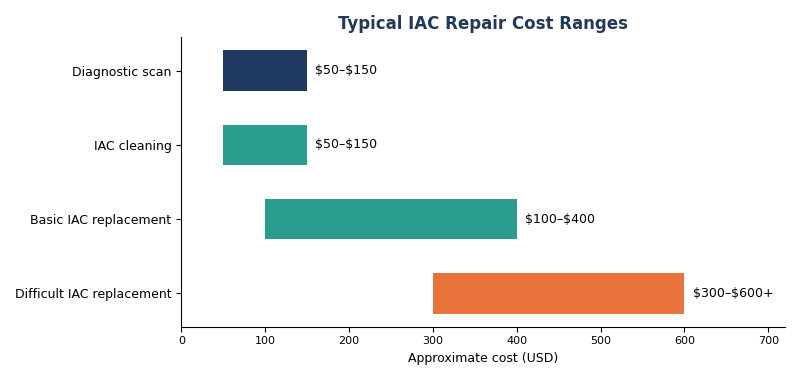
| Repair | Typical Cost Range |
|---|---|
| Diagnostic Scan | About $50–$150 |
| IAC Cleaning | About $50–$150 |
| Basic IAC Replacement | About $100–$400 |
| More Difficult IAC Replacement | About $300–$600+ |
| Vacuum Leak Repair | Varies Widely |
| Throttle Body Replacement | Often Several Hundred Dollars |
| Electronic Throttle Diagnosis | Depends On Vehicle |
These are broad estimates rather than fixed prices. Parts quality, vehicle design, local labor rates, and dealership versus independent-shop pricing can significantly change the total.
A simple four-cylinder engine with an easily accessible IAC valve can be much cheaper to repair than a vehicle where access is restricted.
Why Diagnosis Can Save Money
Suppose a vehicle has a high idle.
Replacing the IAC valve may seem like the obvious solution.
But if the real cause is a cracked vacuum hose, the replacement valve will not fix the problem.
The owner then pays for a part and still has the original fault.
A short diagnostic inspection can therefore be more valuable than immediately purchasing replacement components.
The same principle applies to throttle bodies, airflow sensors, fuel injectors, and ignition components.
A symptom identifies a problem with engine operation.
Testing identifies the cause.
Can You Drive With A Bad Idle Air Control Valve?
A vehicle with a faulty IAC system may still drive normally at higher speeds because the throttle is open and the engine receives plenty of air.
The problem can become more serious when the accelerator is released.
If the engine stalls at intersections, while parking, or when shifting into gear, the vehicle can become difficult to control.
An engine that repeatedly stalls should not be treated as a minor inconvenience.
The vehicle may also have trouble maintaining idle when the A/C, headlights, or other loads are applied.
If the engine stalls repeatedly, diagnosis should be performed before normal driving continues.
When Immediate Inspection Is Important
Have the vehicle inspected promptly if:
- The engine stalls frequently.
- RPM suddenly rises to an unusually high level.
- The engine surges continuously.
- The check-engine light is flashing.
- The engine has severe misfires.
- The vehicle stalls when shifted into Drive or Reverse.
- You smell raw fuel.
- The engine cannot maintain a stable idle.
- Several warning lights appear simultaneously.
A simple idle-control problem may be inexpensive.
A similar symptom caused by a fuel, ignition, or engine-management problem may require more extensive diagnosis.
Common Mistakes When Diagnosing IAC Problems
The most common mistake is replacing the valve without checking for vacuum leaks.
A vacuum leak can create nearly identical symptoms and is often easier and cheaper to repair.
Another mistake is assuming that every vehicle has a separate IAC valve.
Many newer engines use electronic throttle control.
A third mistake is treating a diagnostic code as a parts-ordering instruction.
A code is evidence that the control system detected something abnormal. It does not always identify the failed component.
Another mistake is replacing parts without checking the electrical circuit.
A damaged connector or wire can prevent a good valve from operating.
Finally, some owners clean the throttle body or IAC valve aggressively and damage the component.
Cleaning procedures should follow manufacturer guidance.
Final Thoughts
The most recognizable bad air idle control valve symptoms include high idle, low or rough idle, engine stalling, idle surging, difficult starting, and poor idle compensation when electrical or A/C loads are added.
However, these symptoms are not exclusive to the IAC valve.
Vacuum leaks, throttle-body deposits, sensor problems, fuel-delivery issues, ignition faults, PCV problems, and electronic throttle-control faults can all create similar behavior.
The best diagnostic approach starts with the actual symptoms and then works through the engine’s airflow, electrical, fuel, ignition, and control systems.
For vehicles with a traditional IAC valve, inspection may include checking the valve for contamination, testing its electrical circuit, checking for vacuum leaks, examining fuel-trim data, and verifying commanded operation.
Cleaning may solve a contamination problem, while a failed valve requires replacement.
For newer vehicles, first confirm whether a separate IAC valve exists at all. Electronic throttle control has replaced traditional idle-air valves in many applications, so the diagnostic process can be completely different.
The key insight is that idle speed is the result of several systems working together. The IAC valve is one part of that system, not an automatic explanation for every rough or unstable idle.
A proper diagnosis can prevent unnecessary parts replacement and help identify the actual cause before a small idle problem turns into a larger engine-management issue.
FAQs
What Are The Most Common Bad Air Idle Control Valve Symptoms?
Common symptoms include an unusually high or low idle, rough running at idle, engine stalling when the accelerator is released, RPM surging, difficult starting, and poor idle stability when the A/C or electrical accessories are switched on. Similar symptoms can also come from vacuum leaks, throttle-body problems, sensors, ignition faults, or fuel-system issues.
Can A Bad IAC Valve Cause A Car To Stall?
Yes. A faulty idle air control valve may fail to provide the correct amount of bypass air when the throttle is closed. The engine can then drop below its required idle speed and stall. However, stalling has many possible causes, so an IAC valve should be tested rather than replaced solely because the engine stalls.
How Do I Know If My IAC Valve Is Bad?
Diagnosis can involve scanning for trouble codes, inspecting the valve and wiring, checking for vacuum leaks, measuring electrical resistance where applicable, monitoring engine data, and testing commanded valve operation. A dirty valve may respond to proper cleaning, while an electrically or mechanically failed valve generally requires replacement.
Can A Bad IAC Valve Cause High Idle?
Yes. If an IAC valve becomes stuck open or allows excessive bypass airflow, engine speed can remain higher than normal when the throttle is closed. A vacuum leak can produce the same symptom, so the intake system should also be inspected before replacing the valve.
Can You Clean An Idle Air Control Valve Instead Of Replacing It?
Sometimes. If carbon or other deposits are preventing the valve from moving correctly, appropriate cleaning may restore operation. However, cleaning cannot repair a failed electrical motor, damaged winding, broken component, or severe mechanical defect. The correct cleaning method depends on the specific valve design.
Do Modern Cars Still Have Idle Air Control Valves?
Some do, but many newer vehicles use electronic throttle control instead of a separate traditional IAC valve. In those vehicles, the engine computer controls the throttle plate itself to regulate idle airflow. Before purchasing an IAC valve, confirm that the specific engine actually uses one.