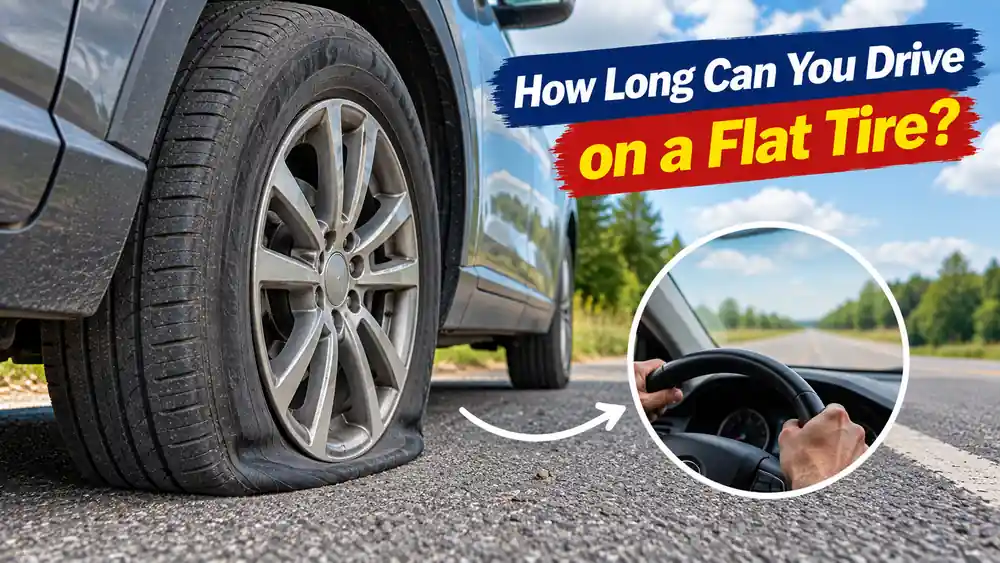
A flat tire is more than an inconvenience. It changes the way a vehicle contacts the road, reduces steering control, increases the chance of tire damage, and can create additional problems for the wheel and suspension.
That is why the answer to how long can you drive on a flat tire is usually much shorter than many drivers expect: with a conventional tire that has lost most or all of its air, the safest distance is essentially zero.
A tire is engineered to carry the vehicle’s weight through its inflated structure. When air pressure disappears, the sidewalls and internal components are forced to carry loads they were never designed to handle without proper inflation. Even traveling a short distance can destroy a tire that might otherwise have been repairable.
There are exceptions. Run-flat tires are specifically designed to provide limited mobility after pressure loss, but their speed and distance limits vary by tire and manufacturer. A properly inflated temporary spare is another option, although it also has restrictions.
The right response depends on the type of tire, amount of pressure remaining, location of the damage, road conditions, and whether the vehicle can be moved safely out of traffic.
How Long Can You Drive On A Flat Tire?
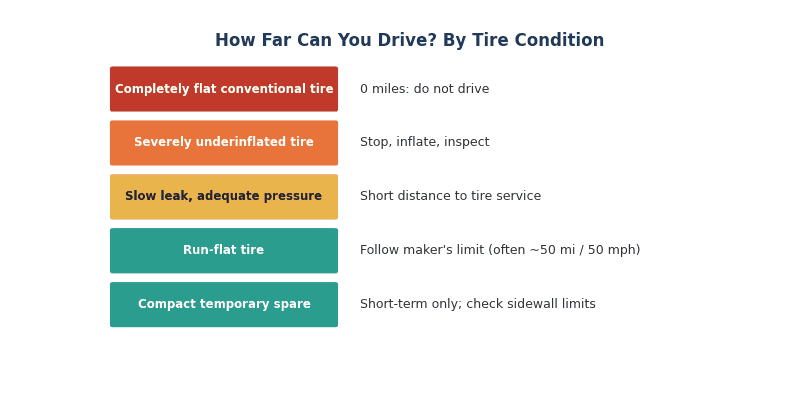
For a standard passenger-car tire that is completely flat, you should not continue driving. There is no reliable “safe number of miles” that applies to every flat tire because damage can begin immediately and the risk changes with vehicle weight, speed, tire construction, road surface, and the amount of remaining air pressure.
Even driving a few hundred yards can turn a repairable puncture into an irreparable tire.
The situation is different if the tire is only slightly underinflated. A tire that has lost a few PSI is not necessarily a completely flat tire, but it should still be inflated to the vehicle manufacturer’s recommended pressure as soon as possible.
| Tire Condition | Recommended Action | Typical Safe Driving Distance |
|---|---|---|
| Completely Flat Conventional Tire | Do Not Drive | 0 miles |
| Severely Underinflated Tire | Stop And Inflate/Inspect | As Little As Possible |
| Slow Leak With Adequate Pressure | Drive Carefully To Tire Service If Safe | Short Distance Only |
| Run-Flat Tire | Follow Tire Manufacturer’s Limit | Often Limited To A Specified Distance |
| Temporary Spare | Use Only Within Its Limits | Depends On Spare And Vehicle |
| Full-Size Spare | Suitable Replacement | Follow Vehicle Instructions |
These figures should not be interpreted as permission to drive a damaged tire. The central principle is simple: air pressure supports the tire’s structure, and driving without adequate pressure creates heat and mechanical stress.
Why A Flat Tire Becomes Dangerous So Quickly
A pneumatic tire is not simply a rubber tube wrapped around a wheel. It contains multiple layers of rubber, steel or textile reinforcement, bead components, sidewall material, and tread structures designed to work together under inflation pressure.
When the tire is inflated, the internal air pressure supports much of the vehicle’s weight and helps maintain the tire’s intended shape.
When pressure falls dramatically, the sidewall flexes much more than normal.
That flexing generates heat. Continued movement increases the heat and mechanical stress, particularly at higher speeds.
The internal structure can become damaged even if the outside of the tire does not initially look destroyed.
This is why reinflating a tire after driving on it while flat does not necessarily make it safe. Internal damage may not be visible from the outside.
Is It Ever Okay To Drive A Few Feet?
There is an important distinction between moving a vehicle to a safer position and driving on a flat tire to reach a repair shop.
If your vehicle is stopped in an unsafe location, moving it a very short distance to a safer place may sometimes be necessary. The decision depends on traffic, road conditions, visibility, vehicle control, and the severity of the tire problem.
That is not the same as driving several miles on the flat tire.
If the tire is completely deflated, every rotation can increase damage. If you can safely stop in a protected location, that is generally preferable to continuing.
On a busy highway, for example, remaining directly in a traffic lane can create an immediate collision hazard. Getting the vehicle away from moving traffic may be more important than protecting the tire.
Safety should come before saving the tire.
What Happens Inside The Tire When You Drive Flat?
The sidewall is forced to bend much more than it normally would.
That repeated bending creates heat and stress in the tire’s internal structure.
The sidewall can develop internal separations, and the tire’s belts or reinforcing materials can be damaged. In severe cases, the tire can begin to break apart.
The longer the vehicle travels, the greater the opportunity for this damage to occur.
Speed also matters. A tire rotating hundreds of times per minute experiences repeated flexing. At highway speed, the amount of mechanical movement occurring in a short period is substantial.
This is one reason a short trip at low speed is not equivalent to a long highway drive.
Neither is recommended for a conventional flat tire, but the consequences can develop much faster at higher speeds.
What Happens If You Drive On A Flat Tire?
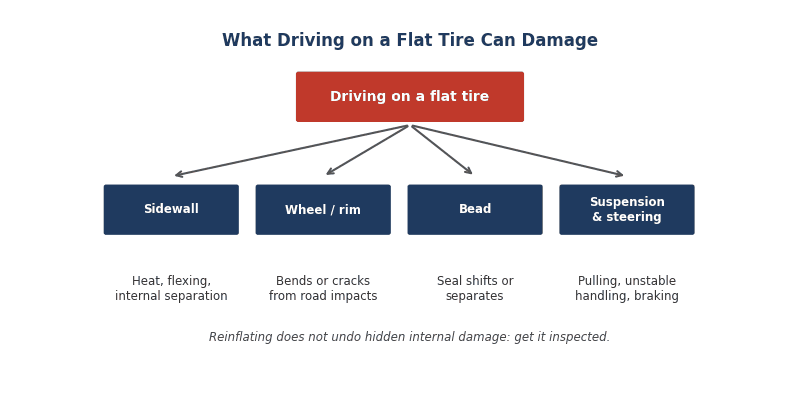
Driving on a flat tire can damage much more than the tire itself.
The wheel can contact the road directly or become exposed to impacts that the inflated tire would normally absorb. The vehicle can also become more difficult to steer and control.
If the tire has separated from the bead or is severely damaged, the vehicle’s handling can change dramatically.
The first priority should therefore be stopping safely rather than trying to estimate how many miles remain.
Tire Sidewall Damage
The sidewall is one of the most vulnerable areas when a tire is driven without sufficient inflation.
When the tire loses pressure, the sidewall flexes excessively and may become pinched between the road and wheel.
This can create internal structural damage.
A tire with sidewall damage generally cannot be safely repaired using an ordinary tread puncture repair.
Even if the outside looks acceptable after reinflation, the internal structure may have suffered damage.
For this reason, a tire that has been driven while significantly underinflated should be inspected by a qualified tire professional before being returned to normal service.
Wheel And Rim Damage
The wheel normally sits inside the tire and is protected from many road impacts by the tire’s air-filled structure.
When the tire is flat, that protection is reduced.
Potholes, road debris, curbs, and uneven pavement can transfer much greater forces directly to the wheel.
A bent wheel can cause vibration, air leakage, poor tire sealing, or alignment problems.
Alloy wheels can also crack under severe impact.
A damaged rim can sometimes be repaired depending on the material, location, and severity of the damage, but replacement may be required in some cases.
Suspension And Steering Stress
A severely deflated tire changes the effective shape and behavior of the wheel assembly.
The vehicle may pull toward the damaged side, steering response can change, and the suspension may experience unusual loads.
The effects are particularly noticeable on vehicles with low-profile tires because there is less sidewall available to absorb impacts.
A flat tire can also make braking behavior less predictable.
Electronic stability and traction-control systems are designed around tires maintaining predictable contact with the road. A severely damaged or deflated tire can alter those assumptions.
Tire Bead Damage
The bead is the part of the tire that seals against the wheel.
Driving on a flat tire can cause the bead to shift, become damaged, or separate from the wheel.
If the bead has been damaged, simply adding air may not restore a reliable seal.
A tire professional should inspect the bead and wheel seating area before the tire is considered serviceable.
This is another reason not to assume that a tire is fine just because it holds air again.
Can You Drive On A Flat Tire To A Tire Shop?
For a conventional tire, driving to a tire shop while it is completely flat is generally not recommended.
The safer options are usually a properly inflated spare, a suitable tire-inflation and repair solution when appropriate, roadside assistance, or towing.
There is an important difference between a tire with a small puncture that still has adequate pressure and a tire that has completely collapsed.
If a tire has a slow leak and still maintains enough pressure to support the vehicle, the situation may be less urgent than a completely deflated tire. However, it still needs prompt attention.
When A Tire Can Be Temporarily Inflated
A portable air compressor can be useful if the tire has simply lost air and there is no obvious severe damage.
Inflating the tire to the vehicle manufacturer’s recommended pressure can allow the driver to move to a safe location or, in some situations, reach a nearby tire professional.
But inflation is not a substitute for inspection.
If the tire has a large puncture, damaged sidewall, exposed cords, a separated tread, or another serious defect, adding air may not make it safe.
The tire should not be inflated beyond the vehicle manufacturer’s recommended cold inflation pressure simply to make it drivable.
The correct pressure is normally listed on the driver’s door-jamb label or in the owner’s manual.
When A Tire Plug Or Repair Kit Can Help
Some punctures in the tread area can be repaired, depending on their size, location, and the tire manufacturer’s repair guidelines.
A temporary tire repair kit can be useful in an emergency, but not every puncture is repairable.
Damage near the sidewall or shoulder is generally treated differently from a simple tread puncture.
A repair should also be performed correctly. A temporary plug inserted from outside the tire may not be considered a permanent repair under all circumstances.
Many tire professionals use an internal repair method involving appropriate inspection and repair materials.
If a tire has been driven while flat, the technician must also determine whether internal damage occurred before repairing the puncture.
When You Should Not Try To Repair The Tire Yourself
Do not rely on a plug or inflation kit when the tire has obvious structural damage.
Examples include:
- Sidewall cuts
- Large punctures
- Exposed cords
- Bulges
- Severe tread separation
- Bead damage
- A visibly collapsed or shredded tire
- Damage caused by driving while completely flat
In these cases, replacement or professional inspection is generally more appropriate.
A tire repair kit is an emergency tool, not a universal solution.
Run-Flat Tires Are Different
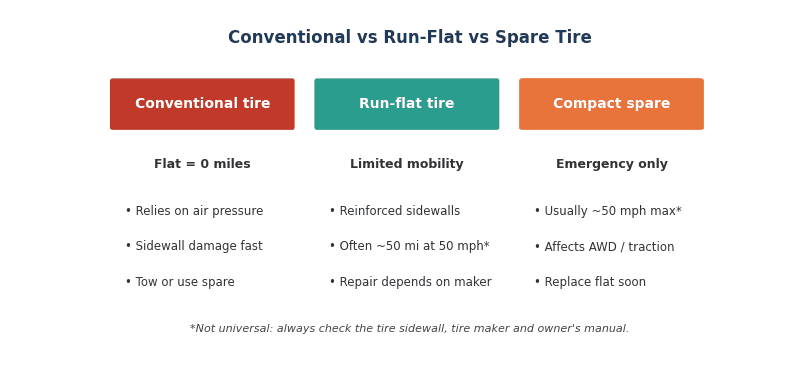
Run-flat tires are specifically designed to provide limited mobility after a significant loss of inflation pressure.
Their reinforced construction allows the vehicle to continue moving for a limited distance at a limited speed.
But run-flat technology does not mean you can drive indefinitely with no air.
The exact limits depend on the tire manufacturer, tire model, vehicle, load, temperature, and road conditions.
Many run-flat systems use a guideline around 50 miles at a maximum of 50 mph, but this should never be treated as a universal rule. Some tires and vehicle manufacturers specify different limits.
Always check the tire manufacturer’s documentation and the vehicle owner’s manual.
How Run-Flat Tires Work
A run-flat tire typically uses reinforced sidewalls or another specialized construction that allows the tire to support the vehicle after pressure loss.
A conventional tire depends heavily on inflation pressure to maintain its shape.
A run-flat tire is engineered to tolerate the additional load when pressure is lost.
That does not eliminate heat generation or structural stress.
The tire is still operating outside its normal inflated condition.
The limited-distance restriction exists because the tire’s construction has a finite ability to withstand these conditions.
Continuing beyond the manufacturer’s specified distance can increase the chance of permanent damage.
Why Run-Flat Distance Limits Matter
The stated distance is not a target.
If the manufacturer says a run-flat tire can travel a limited distance after pressure loss, that is an emergency-mobility specification rather than an invitation to continue driving normally.
The goal is to reach a safe location or tire service facility.
Speed should also remain within the manufacturer’s limit.
Higher speeds generate more heat and can increase stress on the tire.
Heavy vehicle loads, high ambient temperatures, rough roads, and aggressive driving can also affect how the tire behaves.
The safest approach is to reduce speed, avoid unnecessary travel, and have the tire inspected or replaced as soon as possible.
Can You Repair A Run-Flat Tire?
Sometimes, but not always.
Some run-flat tires can be repaired if the puncture is in an acceptable area and the tire has not been driven beyond the manufacturer’s permitted run-flat distance or speed.
Other manufacturers may recommend replacement after significant pressure loss.
The reason is simple: the internal structure may have experienced damage that cannot be reliably identified from an external inspection.
The tire manufacturer’s repair policy should therefore be followed.
If there is uncertainty about how far the tire was driven while flat, tell the tire technician. That information can affect the safety assessment.
How Long Can You Drive On A Spare Tire?
A spare tire is different from a flat conventional tire because it is designed to support the vehicle.
However, not all spare tires are the same.
A full-size spare may have characteristics similar to the vehicle’s regular tires, while a temporary compact spare is designed specifically for limited emergency use.
The compact spare commonly has a speed restriction and should not be treated as a permanent replacement.
| Spare Type | Typical Use | Important Limitation |
|---|---|---|
| Full-Size Matching Spare | Normal Replacement | Still Check Pressure And Compatibility |
| Full-Size Non-Matching Spare | Temporary Or Emergency Use | Differences In Size May Matter |
| Compact Temporary Spare | Emergency Mobility | Usually Has Speed And Distance Restrictions |
| Run-Flat Tire | Limited Mobility After Pressure Loss | Follow Manufacturer’s Limits |
The markings on the spare tire itself can provide important information.
The vehicle owner’s manual may also specify maximum speed, recommended inflation pressure, and whether the temporary spare should be installed on a particular axle.
Temporary Spare Speed Restrictions
Many compact spare tires have a maximum speed of approximately 50 mph, but the actual limit depends on the tire.
The sidewall marking and owner’s manual should be treated as the authority.
A temporary spare is smaller and may have a different tread design and handling characteristics from the normal tires.
It may also alter the operation of systems such as traction control and all-wheel drive.
For an AWD vehicle, the difference in tire circumference can be particularly important.
Some manufacturers recommend specific procedures when a spare is used on an AWD vehicle.
How Far Can You Drive On A Donut Spare?
There is no universal mileage limit for every compact spare.
Some manufacturers recommend using the temporary spare only long enough to reach a tire repair or replacement facility.
The safest approach is to treat it as a short-term emergency solution rather than normal equipment.
Do not use a compact spare for extended highway travel simply because it still feels stable.
Its smaller size, different construction, and reduced operating capacity are intended to get you out of trouble, not replace a normal tire permanently.
What To Do When You Get A Flat Tire
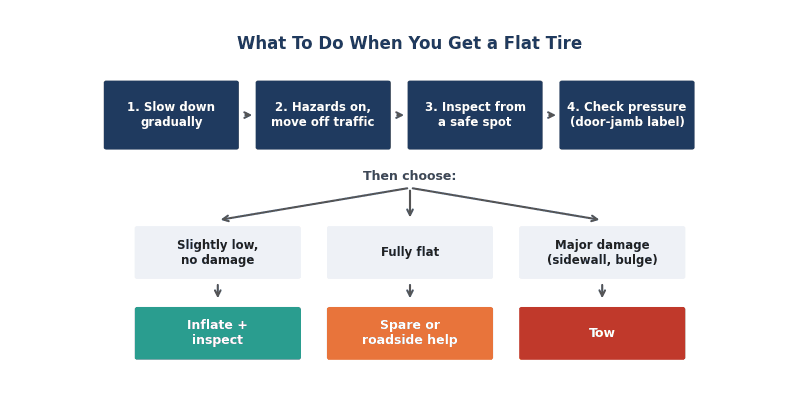
Knowing what to do immediately is more useful than memorizing a mileage number.
The first objective is to control the vehicle and get away from moving traffic.
Slow Down Gradually
If you notice a tire suddenly losing pressure while driving, avoid hard braking or abrupt steering.
Grip the steering wheel firmly and gradually reduce speed.
A sudden steering input can make the vehicle less stable, particularly if the tire has suffered a rapid failure.
Turn on the hazard warning lights when appropriate and look for a safe location away from traffic.
The safest stopping point is generally a firm, stable area that provides separation from moving vehicles.
On a highway, the shoulder may be the only available option.
Once stopped, keep away from traffic as much as possible.
Check The Tire From A Safe Location
Do not immediately kneel beside a tire next to fast-moving traffic.
First make sure you and your passengers are in a reasonably safe position.
If conditions allow, visually inspect the tire.
Look for:
- Complete deflation
- A visible nail or screw
- Sidewall damage
- A large cut
- A bulge
- Tread separation
- Debris stuck in the tire
- Damage to the wheel
Do not remove a nail or screw simply because you see it.
A small puncture may continue to leak faster after the object is removed.
Check The Tire Pressure
If you have a tire-pressure gauge, measure the pressure.
A tire-pressure monitoring system can also provide information, but it should not replace a physical inspection.
The recommended tire pressure is normally found on the driver’s door-jamb label rather than on the tire sidewall.
The sidewall pressure is generally related to the tire’s maximum permitted inflation pressure, not necessarily the vehicle’s recommended operating pressure.
This distinction is important.
Decide Between Inflation, Spare, Repair And Towing
The next step depends on what you find.
If the tire is slightly low and there is no visible damage, inflation and immediate inspection may be appropriate.
If the tire is completely flat, installing a suitable spare or calling roadside assistance is generally safer than driving on it.
If the tire has major structural damage, towing is usually the better option.
If you are on a high-speed roadway with no safe place to work, roadside assistance may be preferable to changing the tire yourself.
Why Tire Pressure Matters So Much
Tire pressure affects more than whether the tire looks full.
Correct inflation helps the tire maintain its designed shape, manage heat, carry the vehicle’s load, and maintain predictable contact with the road.
Underinflation increases sidewall flex.
That additional flex generates heat and can accelerate tire wear.
Overinflation creates a different set of problems by reducing the tire’s ability to absorb road irregularities and potentially changing the contact patch.
The correct pressure is therefore a balance specified by the vehicle manufacturer.
Underinflation Versus A Completely Flat Tire
These terms should not be treated as identical.
A tire at 28 PSI when the manufacturer recommends 35 PSI is underinflated.
A tire at 0 PSI is flat.
Both conditions are undesirable, but the severity is very different.
A moderately underinflated tire may still maintain enough structural support to drive carefully to an air source or tire service facility, depending on the amount of pressure and the distance involved.
A completely flat tire is a different situation.
The sidewall is carrying far more of the load, and internal damage can occur quickly.
Tire Pressure Monitoring Systems Are Helpful But Limited
TPMS systems are valuable because they can warn drivers about pressure loss.
However, TPMS is not a replacement for checking tire pressure manually.
Some systems alert only after pressure has fallen by a certain percentage.
A slow leak can therefore exist before a warning appears.
Temperature changes also affect tire pressure. Pressure generally decreases as temperature falls and increases as temperature rises.
Drivers should check tire pressure when the tires are cold and follow the vehicle manufacturer’s recommended values.
Factors That Determine How Quickly A Flat Tire Gets Damaged
There is no universal mileage threshold because tire damage depends on several variables.
Vehicle Weight
A heavily loaded SUV places more force on its tires than a lightly loaded compact car.
When a tire is flat, that load is concentrated through a structure that is already operating outside its intended conditions.
Passenger weight and cargo can therefore influence how quickly damage develops.
Vehicle Speed
Speed increases the number of tire rotations and the rate at which the sidewall flexes.
A tire traveling at highway speed experiences repeated deformation much more rapidly than one moving at walking pace.
This is why a flat tire should never be driven at normal highway speeds.
Road Surface
Smooth pavement is less punishing than potholes, broken pavement, gravel, or debris.
A flat tire has very little ability to absorb impacts.
Road irregularities can transfer force directly to the wheel and tire structure.
Tire Construction
Low-profile performance tires, standard touring tires, light-truck tires, reinforced tires, and run-flat tires can behave very differently after pressure loss.
The tire’s load rating and construction are important considerations.
This is another reason why generic statements such as “you can drive a mile on a flat tire” are unreliable.
Can A Flat Tire Be Repaired Or Does It Need Replacement?
A puncture does not automatically mean the tire must be replaced.
A repair may be possible if the damage is in the repairable tread area, is within acceptable size limits, and the tire has not suffered internal structural damage.
However, a tire driven while flat may require replacement even if the original puncture was small.
The technician needs to inspect the inside of the tire.
This is because internal damage can occur when the sidewall is repeatedly compressed and flexed.
A tire that has been driven significantly underinflated can develop damage that cannot be seen from the outside.
Tread Puncture
A small puncture in the central tread area is generally more repairable than damage near the shoulder or sidewall.
The exact repairability depends on puncture size, location, tire condition, speed rating, manufacturer’s guidelines, and whether the tire has been driven underinflated.
A professional tire inspection should determine whether repair is appropriate.
Sidewall Puncture
Sidewall punctures are generally not treated like ordinary tread punctures.
The sidewall flexes substantially during normal operation, making permanent repair more difficult and potentially unsafe.
A tire with a significant sidewall cut, puncture, bulge, or exposed internal cords will generally require replacement rather than a conventional tread repair.
The Most Important Mistake To Avoid
The biggest mistake is assuming that because the tire still looks round, it is safe to drive.
A tire can lose enough pressure to suffer internal damage without completely collapsing.
Similarly, a tire can look acceptable after being reinflated even though the internal structure has been compromised.
If a tire was driven for a significant distance while severely underinflated, tell the tire technician.
That information is important.
The technician may inspect the inner liner for abrasion, exposed cords, deformation, or other evidence of damage.
A proper inspection is much more reliable than judging the tire from the outside.
Final Thoughts
So, how long can you drive on a flat tire? With a conventional tire that has completely lost its air pressure, the practical answer is you should not drive it. Even a short distance can cause internal sidewall damage, tread separation, bead damage, wheel damage, or loss of vehicle control.
If you need to move the vehicle a very short distance to escape an immediate traffic hazard, that is an emergency safety decision rather than a recommended driving distance.
Run-flat tires are different because they are specifically engineered for limited mobility after pressure loss. Even then, the manufacturer’s speed and distance limits must be followed. A temporary spare is another option, but it also has specific restrictions.
The safest approach after a flat is to slow down smoothly, move to a secure location, inspect the tire without placing yourself in danger, and choose the appropriate solution: inflation, professional repair, a suitable spare, roadside assistance, or towing.
One final point deserves emphasis: a tire that has been driven while flat should be professionally inspected before being put back into regular service. Reinflating it does not automatically undo internal damage.
A tire is a critical safety component. Saving the cost of a tow or replacement tire is not worth creating a situation where the tire fails again at speed.
FAQs
How Long Can You Drive On A Completely Flat Tire?
A conventional tire that is completely flat should generally not be driven. The safest distance is effectively zero because the sidewall and internal structure can be damaged as soon as the vehicle moves. If the vehicle is in an unsafe location, moving it a very short distance to a safer position may be necessary, but that is different from driving to a repair shop.
Can You Drive 1 Mile On A Flat Tire?
It is not recommended. One mile may be enough to cause significant internal tire damage, particularly at higher speeds or with a heavy vehicle. Even if the tire originally had a repairable puncture, driving on it without adequate pressure can turn it into a replacement-only tire.
Can You Drive On A Flat Tire To The Tire Shop?
With a conventional flat tire, using a spare, roadside assistance, or towing is generally safer than driving the flat tire to the shop. If the tire still contains sufficient pressure and has only a slow leak, carefully reaching a nearby tire professional may be possible in some circumstances, but the tire should be inspected promptly.
How Far Can You Drive On A Run-Flat Tire?
The distance depends on the specific run-flat tire and vehicle. Many run-flat systems provide limited mobility at a restricted speed, but the commonly cited 50-mile/50-mph guideline is not universal. Check the tire manufacturer’s instructions and the vehicle owner’s manual for the exact limit.
Can A Tire Be Repaired After Driving Flat?
Sometimes, but not always. A small tread puncture may be repairable if the tire has not suffered internal damage. If the tire was driven while completely or severely deflated, a technician should inspect the inside for structural damage before deciding whether repair is safe.
Does Driving On A Flat Tire Ruin The Rim?
It can. When there is little or no air pressure, the tire provides much less protection for the wheel. Road impacts can bend, crack, or otherwise damage the rim, particularly on potholes or rough surfaces. A damaged wheel should be inspected before another tire is installed and used normally.