
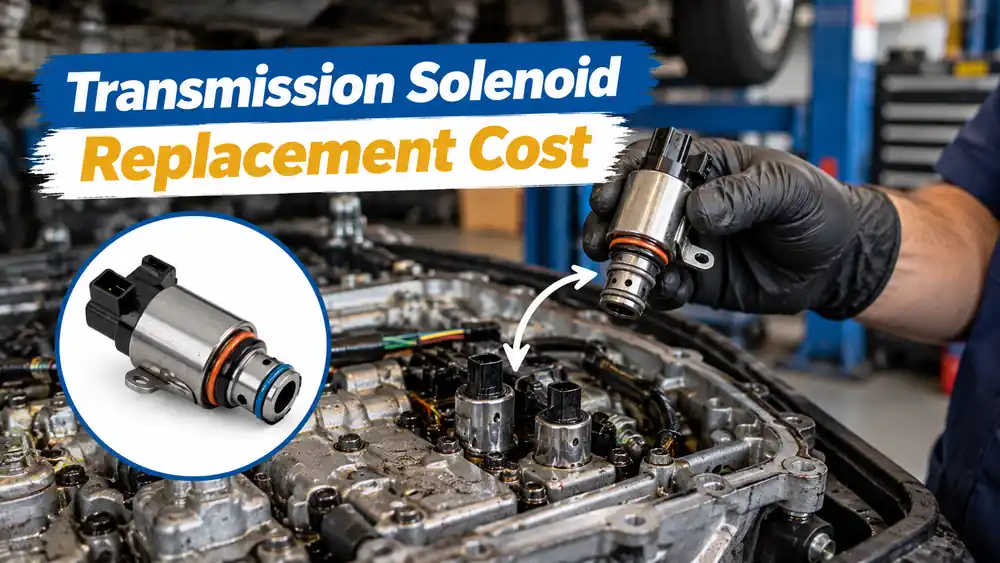
Transmission solenoid replacement cost can vary much more than the price of the solenoid itself. A single shift solenoid may be relatively inexpensive, but reaching it can require removing the transmission pan, valve body, electrical connectors, fluid, filter, or even the transmission itself on certain designs. Current published repair estimates put common solenoid or solenoid-pack repairs anywhere from roughly $250 to $1,200, while more involved valve-body work can move into the $1,500–$2,500+ range.
The final bill depends on the vehicle, transmission design, number of solenoids being replaced, labor rate, diagnostic work, fluid requirements, and whether the valve body has also developed wear. A diagnostic trouble code by itself does not always prove that the solenoid is the failed component.
That distinction matters because transmission problems can produce similar symptoms. Harsh shifting, delayed engagement, slipping, limp mode, or an illuminated check-engine light may result from low fluid, wiring problems, pressure issues, valve-body wear, sensor faults, or internal clutch damage.
Knowing how the repair is diagnosed and priced can help you evaluate an estimate before authorizing expensive transmission work.
Transmission Solenoid Replacement Cost And What You Actually Pay For
The biggest mistake when researching transmission solenoid replacement cost is looking only at the price of the replacement part. The solenoid might be inexpensive, but the labor required to reach and correctly install it can represent a large portion of the final bill.
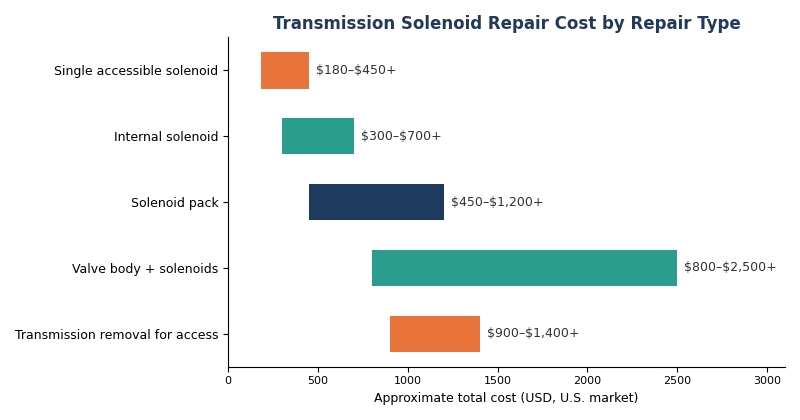
Published 2026 pricing shows a broad range. Some repair estimates put a single external or relatively accessible solenoid repair around $180–$450, while internal solenoid work commonly falls around $330–$700. Solenoid packs can reach roughly $600–$1,500, depending on the transmission and whether the valve body or integrated electronic components are involved.
These are broad U.S. market ranges rather than a guaranteed price for a particular vehicle. Dealer rates, independent-shop labor rates, regional parts prices, transmission design, taxes, and additional repairs can move the final invoice considerably.
| Repair Type | Typical Parts Cost | Typical Labor/Service | Approximate Total |
|---|---|---|---|
| Single Accessible Solenoid | $30–$150 | $150–$400 | $180–$450 |
| Internal Solenoid | $40–$300+ | $250–$550+ | $300–$700+ |
| Solenoid Pack | $120–$500+ | $180–$600 | $450–$1,200+ |
| Valve Body With Solenoids | $400–$1,000+ | $400–$1,100+ | $800–$2,500+ |
| Transmission Removal For Solenoid Access | Varies | Several Hours | $900–$1,400+ |
| Full Transmission Replacement | Much Higher | Much Higher | Several Thousand Dollars |
Current repair-industry estimates also show why there is no single universal number. One 2026 source puts a general transmission solenoid replacement range at $250–$1,200, while another breaks individual external solenoids into approximately $250–$500 and valve-body-with-solenoid repairs into approximately $700–$1,800.
The Solenoid Itself Is Often Not The Expensive Part
A transmission solenoid is essentially an electronically controlled valve. It receives commands from the transmission control system and regulates transmission fluid flow or pressure to control particular hydraulic functions.
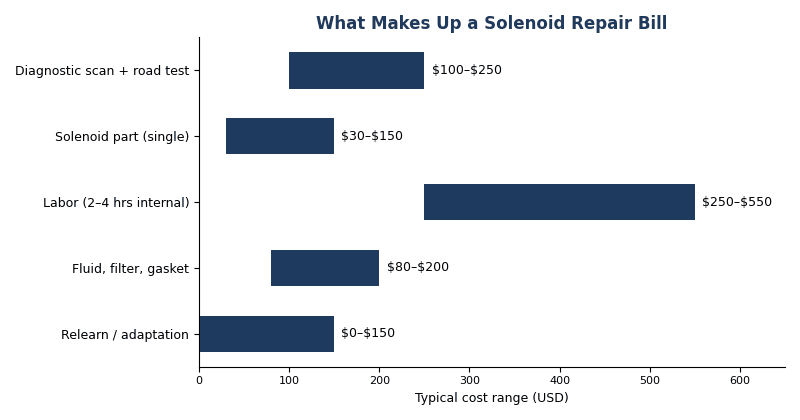
Because of that basic design, the replacement component itself can sometimes be surprisingly affordable. Some individual solenoids are available for tens of dollars, while complete solenoid packs can cost several hundred dollars. Current published examples show individual solenoids commonly ranging from approximately $30 to $150, with complete packs and integrated assemblies costing considerably more.
The expensive part can be gaining access.
If the solenoid is externally accessible, replacement may be comparatively straightforward. If it sits inside the transmission near the valve body, the technician may need to remove the pan, drain fluid, remove the filter, disconnect electrical connectors, and carefully remove the valve body.
Some transmissions combine multiple solenoids into a single assembly. In those cases, replacing one defective component may not be possible or economically sensible. The manufacturer or parts supplier may require replacement of the complete solenoid pack.
This is why two vehicles with the same basic symptom can receive completely different repair estimates.
Diagnosis Should Be Part Of The Cost Calculation
A proper diagnosis is one of the most important parts of transmission repair.
A technician should not simply see a transmission-related trouble code and immediately replace a solenoid. The code may identify a circuit or performance problem without proving that the physical solenoid itself is defective.
Diagnosis may involve scanning the transmission control module, checking live data, inspecting wiring and connectors, checking fluid level and condition, testing electrical resistance, examining pressure behavior, and performing a road test.
A current transmission repair-cost guide places diagnostic scan and road-test costs around $100–$250 in the U.S. market, although actual prices vary significantly by shop and vehicle.
Paying for accurate diagnosis can actually save money. Replacing a functioning solenoid does nothing to correct a wiring fault, hydraulic problem, or worn valve body.
Fluid, Filter And Gasket Costs Can Add To The Invoice
Solenoid replacement frequently involves opening the transmission.
Once the pan is removed, some transmission fluid is lost. Depending on the design, the filter and pan gasket may also need replacement.
A current 2026 cost breakdown puts transmission fluid, filter, and gasket expenses around $80–$200 at an independent shop for solenoid-pack work, although individual vehicles can fall outside that range.
This is why a quote that initially sounds like “$100 for the solenoid” can become a several-hundred-dollar repair.
The fluid specification is particularly important. Automatic transmissions are sensitive to the correct fluid formulation, and using an incorrect fluid can cause shift-quality or durability problems.
The technician should identify the exact fluid specification for the transmission rather than simply adding a generic automatic transmission fluid.
What Causes A Transmission Solenoid To Fail?
Solenoids operate in a demanding environment. They are exposed to transmission fluid, temperature changes, hydraulic pressure, electrical switching, and contaminants.
A solenoid can develop an electrical fault, become contaminated, stick mechanically, or fail because of another transmission problem.
The important point is that solenoid failure is not always an isolated event.
Dirty Or Contaminated Transmission Fluid
Transmission fluid performs several jobs simultaneously. It lubricates components, transfers hydraulic pressure, controls clutch application, and carries heat away from internal components.
As fluid ages, it can accumulate contaminants and wear material.
Those particles can interfere with the small passages and moving components associated with solenoids and valve bodies.
A sticking solenoid may therefore be the visible part of a larger fluid or hydraulic problem.
If a technician finds substantial debris in the transmission pan, that finding deserves attention rather than simply installing another solenoid and returning the vehicle to service.
The condition of the fluid and pan can provide valuable clues about what is happening inside the transmission.
Electrical Problems Can Mimic Solenoid Failure
A transmission solenoid depends on an electrical circuit.
That circuit includes wiring, connectors, power supply, grounds, and the transmission control module.
A damaged wire or corroded connector can create a fault that looks like a failed solenoid when the solenoid itself is functioning correctly.
This is why a good diagnostic process includes electrical testing.
Replacing the solenoid without checking its circuit can lead to a repeat fault and another repair bill.
On some vehicles, the transmission wiring harness is exposed to heat, vibration, fluid contamination, and movement. These conditions can eventually damage connectors or wiring insulation.
Valve Body Wear
The valve body is often described as the hydraulic control center of an automatic transmission.
It contains passages, valves, springs, check balls, and solenoids that direct transmission fluid to the appropriate hydraulic circuits.
When the valve body develops wear, fluid can leak internally through worn passages or valves may fail to move correctly.
The symptoms can resemble solenoid problems.
Harsh shifts, delayed engagement, slipping, shift flares, or incorrect gear changes may occur.
A valve-body problem can therefore make a solenoid look guilty even when replacing the solenoid alone will not solve the underlying problem.
Current repair estimates place valve-body replacement broadly around $400–$1,500 installed, with higher totals possible depending on the vehicle and whether solenoids are included.
Normal Wear And High Heat
Transmission fluid operates under substantial thermal stress.
Repeated high temperatures accelerate fluid degradation, particularly when the vehicle regularly operates under heavy loads, towing conditions, severe traffic, or inadequate cooling.
Solenoids themselves contain electrical components and moving mechanisms that can eventually wear.
That does not mean every high-mileage transmission needs solenoid replacement. Preventive replacement is generally not justified simply because the vehicle has reached a particular mileage.
Instead, symptoms, diagnostic data, fluid condition, and manufacturer service information should guide the decision.
Internal Transmission Damage
One of the most important distinctions is whether the solenoid is actually the root cause.
A transmission with worn clutch packs, damaged bands, excessive internal leakage, or other mechanical problems can produce shift-related symptoms that overlap with solenoid failure.
If a transmission is slipping because of worn friction material, replacing a solenoid may not restore normal operation.
This is why a competent diagnosis should determine whether the problem is electrical, hydraulic, mechanical, or a combination of these.
Symptoms Of A Bad Transmission Solenoid
A failed transmission solenoid can cause several noticeable problems, but none of these symptoms automatically proves that the solenoid is defective.
The transmission control module may detect abnormal gear ratios, pressure behavior, electrical resistance, or shift performance and store a diagnostic trouble code.
Delayed Gear Engagement
Delayed engagement occurs when the transmission takes longer than expected to engage Drive or Reverse after the selector is moved.
The delay may last only a moment, or it may become increasingly noticeable.
A solenoid or valve-body problem can interfere with hydraulic pressure reaching the correct clutch circuit.
However, low fluid, worn internal components, and other hydraulic problems can also cause delayed engagement.
If the vehicle repeatedly pauses before engaging a gear, followed by a noticeable clunk or sudden movement, it deserves prompt diagnosis.
Continued operation can potentially make an underlying transmission problem worse.
Harsh Or Jerky Shifting
A transmission solenoid controls fluid flow and pressure, so a problem with solenoid operation can affect shift timing and clutch engagement.
The result may be a shift that feels unusually firm, abrupt, or delayed.
But harsh shifting can have many causes.
Incorrect fluid level, contaminated fluid, pressure problems, valve-body wear, sensor faults, adaptive-learning issues, or internal mechanical problems can create similar behavior.
That is why a diagnostic scan should be combined with physical inspection and transmission-specific testing.
Transmission Stuck In One Gear
Some vehicles enter a protective operating strategy commonly called limp mode when the transmission control system detects a serious fault.
The vehicle may remain in one gear or limit available gear changes.
A solenoid fault can trigger this condition, particularly when the control module detects a problem that could cause transmission damage.
However, limp mode is not synonymous with “bad solenoid.”
The control module may activate the strategy because of many different electrical, hydraulic, or mechanical faults.
A diagnostic scan is therefore essential.
Check Engine Or Transmission Warning Light
Modern vehicles can monitor transmission operation electronically.
When the control system detects an abnormal condition, it can store a diagnostic trouble code and illuminate the check-engine light or a dedicated transmission warning indicator, depending on the vehicle.
Common solenoid-related diagnostic codes can involve shift solenoid circuits, pressure control solenoids, gear-ratio errors, or performance conditions.
The exact code matters.
A code indicating an electrical circuit fault requires a different diagnostic approach from one indicating an incorrect gear ratio.
The code should be treated as a diagnostic clue rather than a complete diagnosis.
Transmission Slipping
Slipping occurs when engine speed increases without the corresponding transfer of power through the transmission.
Solenoid problems can contribute to incorrect hydraulic pressure or clutch application.
But slipping is also one of the most concerning transmission symptoms because it can indicate worn friction material or broader internal damage.
If the transmission is already suffering mechanical wear, replacing a solenoid may not restore full functionality.
This is one of the situations where spending money on diagnosis before approving repairs is particularly important.
How Mechanics Diagnose A Transmission Solenoid Problem
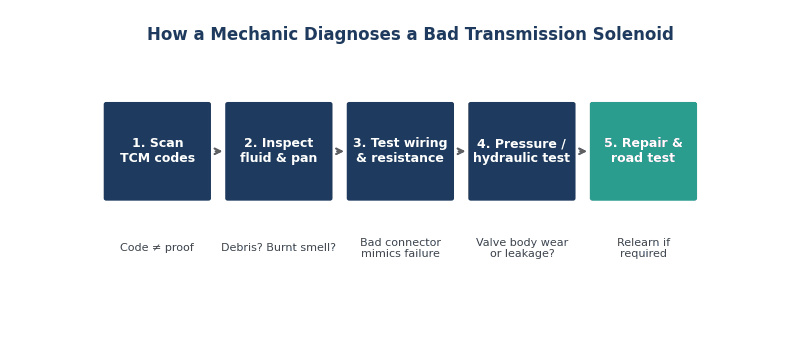
Diagnosis usually begins with the vehicle’s symptoms and stored fault information.
A professional technician can connect a scan tool to retrieve transmission-related codes and inspect available live data.
The next steps depend on the specific transmission.
Scan For Transmission Codes
The first step is often an electronic scan.
The technician may look for codes related to shift solenoids, pressure control, gear ratios, transmission temperature, electrical circuits, or communication with the transmission control module.
A code can identify which circuit or function the computer considers abnormal.
It does not necessarily identify the failed physical component.
That distinction prevents unnecessary parts replacement.
For example, an electrical code may be caused by an open circuit, short circuit, damaged connector, failed solenoid coil, or control-module problem.
Testing must narrow those possibilities.
Inspect The Fluid And Transmission Pan
If the transmission design allows access through the pan, the technician may inspect fluid condition and the material collected inside.
A small amount of fine debris may occur with normal wear, but excessive metal or friction material can indicate a more serious internal issue.
The fluid can also provide clues.
Dark or burnt-smelling fluid does not automatically prove that the transmission needs replacement, but it should prompt additional inspection.
If significant debris is present, simply replacing a solenoid without investigating why the debris exists may be a poor repair strategy.
Check Solenoid Resistance And Wiring
Electrical testing can determine whether the solenoid circuit is operating within the manufacturer’s specified range.
The technician may check resistance across the solenoid terminals, inspect voltage supply, verify grounds, and test continuity through the wiring harness.
Connector condition matters as well.
A corroded or loose connector can create intermittent electrical problems that resemble an internal transmission fault.
Testing the circuit before replacing the part can prevent unnecessary labor.
Perform Pressure And Hydraulic Tests When Needed
Some transmission problems require hydraulic testing.
The technician can compare actual pressure behavior with manufacturer specifications under particular operating conditions.
Pressure testing can help distinguish a solenoid-control issue from a broader hydraulic problem.
It can also provide clues about valve-body wear or internal leakage.
The exact procedure varies considerably between transmissions, which is why generic diagnostic instructions are not appropriate for every vehicle.
Verify The Repair With A Road Test
After replacement, the vehicle should normally be tested under controlled conditions.
The technician may check shift quality, engagement time, gear selection, transmission temperature, and scan-tool data.
Some vehicles also require transmission adaptive-learning procedures or module programming after certain components are replaced.
Current industry estimates note that a transmission control module relearn or adaptation reset can add cost in some repairs, with published figures reaching approximately $150 depending on the shop and vehicle.
The exact procedure should follow manufacturer service information.
Transmission Solenoid Replacement Process
The physical replacement procedure depends heavily on transmission design.
There is no single universal procedure that applies to every automatic transmission.
External Solenoid Replacement
An externally accessible solenoid is generally the simplest scenario.
The technician may disconnect the electrical connector, remove retaining hardware, replace the solenoid, reconnect the wiring, and verify operation.
Depending on its location, the transmission may not need to be opened extensively.
This type of repair can result in a relatively low bill because labor time is limited.
Published 2026 estimates place some external solenoid jobs around $150–$350 all-in, although individual vehicles can cost more or less.
The exact location matters more than the word “solenoid.”
Internal Solenoid Replacement
Many automatic transmissions place solenoids inside the transmission near the valve body.
The technician may need to:
- Raise and secure the vehicle.
- Drain transmission fluid.
- Remove the transmission pan.
- Remove or work around the filter.
- Disconnect electrical connectors.
- Remove the necessary valve-body components.
- Replace the defective solenoid.
- Reassemble the components correctly.
- Install required seals or gaskets.
- Refill with the specified fluid.
- Clear codes and perform required relearn procedures.
- Road-test the vehicle.
Published estimates commonly place this type of work around 2–4 labor hours, although the actual time depends heavily on the vehicle.
The risk of mistakes is also greater because valve bodies contain precision components and small passages.
Solenoid Pack Replacement
Some transmissions use a solenoid pack instead of making every solenoid individually replaceable.
In that situation, the technician replaces the complete assembly.
This can increase the parts cost substantially.
Current published estimates place complete solenoid-pack replacement at roughly $450–$1,200 for many vehicles, with some applications exceeding that range.
The advantage is that several aging solenoids can be addressed simultaneously when the assembly is designed to be replaced as a unit.
The disadvantage is obvious: you pay for the complete assembly even if only one component appears to have failed.
Valve Body Replacement
If testing identifies valve-body wear along with solenoid problems, a valve-body repair or replacement may be more appropriate.
The valve body may be replaced with a new or remanufactured assembly, depending on the application.
Published 2026 estimates put complete valve-body replacement broadly around $400–$1,500 installed, although more complicated applications can exceed that figure.
A quality remanufactured valve body can sometimes provide a less expensive alternative to a new OEM assembly.
However, the quality of the remanufacturing process matters. A cheap assembly with poor calibration or questionable components can create additional problems.
Factors That Change Transmission Solenoid Replacement Cost
The same repair can have very different prices depending on the vehicle.
Several factors have an especially strong influence on the final invoice.
| Cost Factor | Why It Matters |
|---|---|
| Vehicle Make And Model | Parts and labor procedures differ |
| Transmission Design | Determines accessibility |
| Single Solenoid Or Pack | Changes parts cost |
| Valve Body Condition | May require additional work |
| Labor Rate | Dealer and independent rates vary |
| Fluid Type | Some transmissions require expensive specialty fluid |
| Filter And Gasket | Often replaced during pan removal |
| Programming | Some vehicles require relearn or adaptation |
| Diagnosis | Complex faults take more testing |
| Internal Damage | Can turn a solenoid repair into major transmission work |
Vehicle Make And Model
Parts availability is a major factor.
A common domestic automatic transmission may have widely available aftermarket solenoids and replacement parts.
A newer European transmission may use an integrated mechatronic assembly that costs considerably more.
The word “solenoid” therefore does not tell you the expected price by itself.
The exact transmission code is often more useful.
Labor Rates
Labor rates can vary significantly by location and shop type.
Dealerships commonly have higher posted labor rates than independent repair facilities.
That does not mean an independent shop is automatically better or that a dealer is automatically more expensive after all factors are considered.
The important point is to compare the actual scope of work.
A quote for $900 that includes a complete solenoid pack, fluid, filter, programming, and warranty is not directly comparable with a $500 quote that includes only parts and basic labor.
Transmission Accessibility
Access is one of the biggest cost drivers.
An external solenoid can sometimes be replaced quickly.
An internal solenoid may require pan and valve-body removal.
A solenoid located in a difficult transaxle or integrated into a larger assembly can require substantially more labor.
Current published estimates describe some internal or transmission-out jobs reaching 6–10 labor hours, which can push an otherwise inexpensive component into a four-figure repair.
Fluid And Filter Requirements
Fluid quantity and specification also affect the bill.
Some repairs lose only the fluid contained in the pan.
Others require a larger refill.
The correct fluid should always be used.
Transmission fluid is not simply a generic lubricant. Its friction characteristics influence clutch engagement and hydraulic operation.
Using an incorrect fluid to save a small amount of money can create much more expensive problems.
Should You Replace One Solenoid Or The Whole Pack?
This depends on the transmission design and diagnostic evidence.
If individual solenoids are serviceable and testing confirms that one has failed, replacing that component may be appropriate.
If the manufacturer supplies the solenoids as an integrated pack, replacing the complete assembly may be unavoidable.
There is also a practical consideration.
If several solenoids have similar mileage and the transmission already requires significant labor to access them, replacing an entire pack can sometimes make more sense than paying the same access labor again later.
However, replacing every component “just in case” is not automatically good repair practice.
The decision should be based on manufacturer procedures, failure patterns for the specific transmission, part availability, and the condition of the rest of the assembly.
When A Single Solenoid Makes Sense
A single solenoid replacement can make sense when:
- Diagnostic testing clearly identifies one failed solenoid.
- Other solenoids test correctly.
- The transmission has no evidence of serious internal wear.
- The solenoids are individually serviceable.
- The valve body is in good condition.
- The replacement part is available separately.
This approach keeps the repair focused.
When A Solenoid Pack Makes More Sense
A complete pack can be more appropriate when:
- The manufacturer specifies pack replacement.
- Multiple solenoids have failed.
- The assembly has known reliability issues.
- Access labor is substantial.
- The existing solenoids have high mileage.
- The complete assembly has better warranty coverage.
The goal is not simply to minimize today’s bill.
A slightly more expensive repair may be financially sensible if it substantially reduces the chance of paying the same access labor again shortly afterward.
Is It Safe To Drive With A Bad Transmission Solenoid?
It depends on the symptoms and severity of the fault.
A vehicle that has occasional harsh shifting may still move normally, but continued operation can potentially increase wear if the transmission is not applying clutches correctly.
A vehicle stuck in limp mode, slipping severely, refusing to engage, or producing loud mechanical noises should not be treated as a normal driving situation.
Transmission faults can become more expensive when ignored.
For example, a hydraulic control problem may initially cause incorrect clutch pressure. Continued operation under those conditions can contribute to accelerated friction-material wear.
The safest approach is to have the problem diagnosed promptly rather than assuming a solenoid code is harmless.
When Towing Is The Better Choice
Consider towing the vehicle rather than driving it when:
- The transmission will not engage Drive or Reverse.
- The transmission is slipping severely.
- The vehicle repeatedly loses the selected gear.
- Fluid is leaking heavily.
- The transmission is producing unusual grinding or mechanical noises.
- The vehicle cannot maintain safe movement.
- The vehicle is stuck in a condition that makes normal traffic unsafe.
A tow bill is generally far less significant than turning a manageable transmission-control problem into major internal damage.
How To Avoid Overpaying For Solenoid Replacement
The best way to control the repair bill is not necessarily to find the cheapest solenoid.
It is to make sure the diagnosis is correct and the estimate clearly identifies what is being replaced.
Ask the repair shop for a written breakdown.
A useful estimate should identify:
- Diagnostic charge.
- Exact transmission fault code.
- Solenoid or assembly being replaced.
- Parts brand or OEM status.
- Labor hours.
- Labor rate.
- Transmission fluid quantity and specification.
- Filter and gasket cost.
- Programming or relearn charges.
- Warranty.
- Any additional damage discovered during inspection.
This makes competing estimates easier to compare.
Be Careful With Extremely Cheap Quotes
A very low estimate can be attractive, but it may leave out important work.
For example, one shop may quote only the solenoid while another includes the fluid, filter, gasket, diagnostic scan, adaptation procedure, and road test.
The second quote may look much higher even though the actual difference is smaller.
Ask, “What exactly is included in this price?”
That single question can prevent many misunderstandings.
Consider A Transmission Specialist
General repair shops can perform many transmission-related repairs, but complicated valve-body and electronic transmission faults may benefit from a technician who specializes in automatic transmissions.
A specialist may have access to transmission-specific scan data, pressure-testing equipment, service information, and known failure patterns.
That can be particularly valuable when the problem is not a straightforward solenoid failure.
Get A Second Opinion For Large Estimates
If a solenoid repair suddenly becomes a $2,000 or $3,000 transmission recommendation, a second opinion can be worthwhile.
That does not mean the first diagnosis is wrong.
It simply gives you another assessment before authorizing a major repair.
The second shop should receive the diagnostic codes and symptoms, but ideally it should perform its own inspection rather than simply agreeing with the first estimate.
Transmission Solenoid Replacement Vs Transmission Replacement
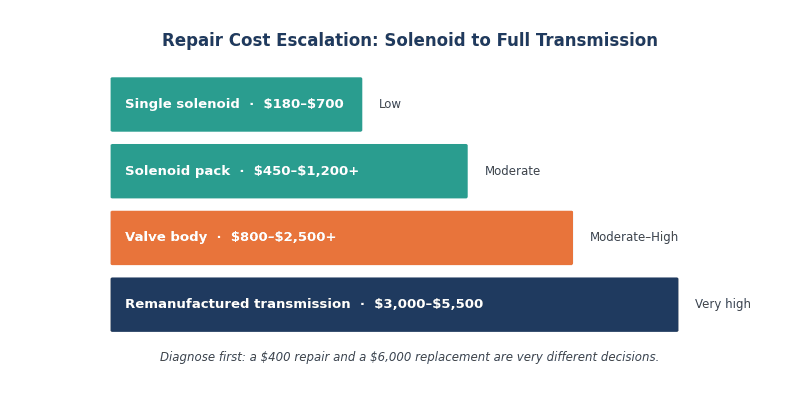
A failed solenoid does not automatically mean the entire transmission needs replacement.
This distinction can save thousands of dollars.
A transmission solenoid is a control component. If the transmission’s mechanical components remain healthy, replacing the defective solenoid or valve body may restore normal operation.
A transmission replacement becomes more relevant when the unit has severe internal mechanical damage, extensive clutch wear, damaged hard parts, contamination, or other problems that make targeted repair uneconomical.
| Repair | Typical Scope | Relative Cost |
|---|---|---|
| Single Solenoid | Replace Individual Component | Low |
| Solenoid Pack | Replace Multiple Solenoids | Moderate |
| Valve Body | Replace Hydraulic Control Assembly | Moderate To High |
| Rebuild | Internal Components Serviced | High |
| Remanufactured Transmission | Entire Unit Replaced | Very High |
| New Transmission | Complete New Unit | Highest |
Current published 2026 transmission-repair estimates show full transmission replacement reaching several thousand dollars, with some estimates placing remanufactured installed units around $3,000–$5,500 and broader replacement costs reaching considerably higher depending on the vehicle.
That is why accurate diagnosis matters so much.
A $400 solenoid repair and a $6,000 transmission replacement are completely different decisions.
Final Thoughts On Transmission Solenoid Replacement Cost
The transmission solenoid replacement cost can reasonably range from a few hundred dollars for a straightforward repair to more than $1,000 when a solenoid pack, valve body, programming, or difficult access is involved. Current published estimates place common single-solenoid repairs around $250–$700, solenoid-pack work around $450–$1,200+, and valve-body repairs broadly around $800–$2,500+, depending heavily on the vehicle and scope of work.
The part price is only one piece of the calculation. Labor access, diagnostic testing, fluid, filter, gaskets, programming, and related valve-body problems can all affect the final bill.
The most important step is confirming that the solenoid is actually the cause. A transmission code can point technicians toward a particular circuit or function, but electrical faults, hydraulic problems, valve-body wear, fluid issues, and internal transmission damage can create similar symptoms.
Before approving the repair, ask for the exact diagnosis and a complete written estimate. If the proposed repair involves a valve body or the entire transmission, consider obtaining another professional opinion, particularly when the vehicle is otherwise in good condition.
A relatively inexpensive solenoid should not be allowed to become an unnecessarily expensive repair. At the same time, replacing only the solenoid when the valve body or transmission has significant underlying damage can waste money. The right repair is the one supported by testing and the condition of the transmission.
FAQs
How Much Does Transmission Solenoid Replacement Cost?
A typical transmission solenoid repair can range from roughly $250 to $1,200, depending on whether an individual solenoid, solenoid pack, or more complicated assembly is involved. Some simple repairs can cost less, while valve-body or difficult-access repairs can exceed $1,200.
How Much Does A Transmission Solenoid Cost By Itself?
Individual solenoids can sometimes cost approximately $30–$150, although some specialized components cost more. Complete solenoid packs and integrated assemblies can reach several hundred dollars. The component price does not include diagnosis, labor, fluid, gaskets, filters, or programming.
Can A Bad Transmission Solenoid Cause Slipping?
Yes, a malfunctioning solenoid can contribute to incorrect hydraulic pressure or clutch application and may produce slipping or abnormal gear changes. However, worn clutch packs, low fluid, valve-body problems, and other internal faults can also cause slipping. A proper diagnosis is necessary before replacing the solenoid.
How Long Does It Take To Replace A Transmission Solenoid?
A relatively accessible repair may take around one to two hours, while internal solenoid work commonly takes approximately two to four hours. Some transmissions require considerably more labor because the solenoid or related assembly is difficult to access.
Can I Drive With A Bad Transmission Solenoid?
It may be possible to drive a vehicle with a minor solenoid fault, but continued operation is not advisable without diagnosis. Harsh shifting, slipping, delayed engagement, or limp mode can indicate a condition that may worsen transmission damage. If the vehicle cannot safely engage or maintain gears, having it towed is the safer option.
Does A Bad Solenoid Mean I Need A New Transmission?
No. A defective solenoid can sometimes be repaired without replacing the entire transmission. However, if inspection reveals severe valve-body wear, clutch damage, contaminated fluid, damaged internal components, or other major problems, a larger repair may be necessary. The appropriate repair depends on what diagnostic testing finds.