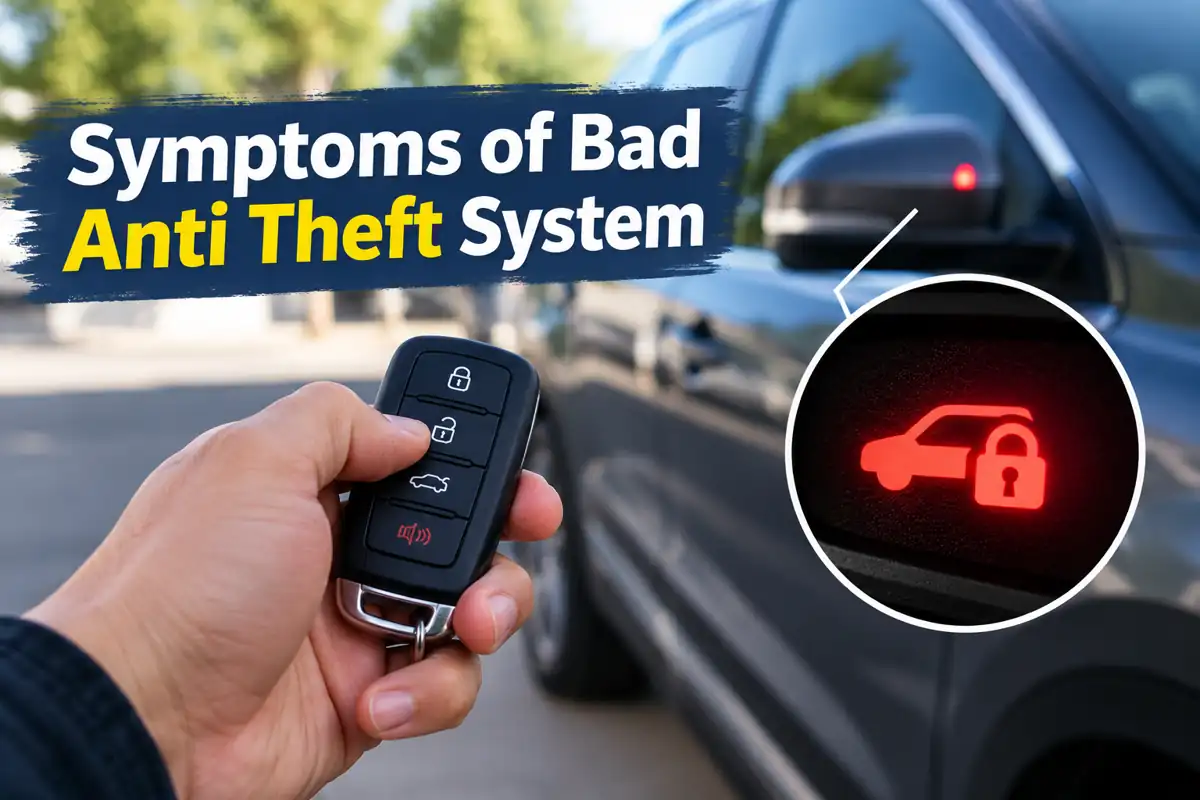
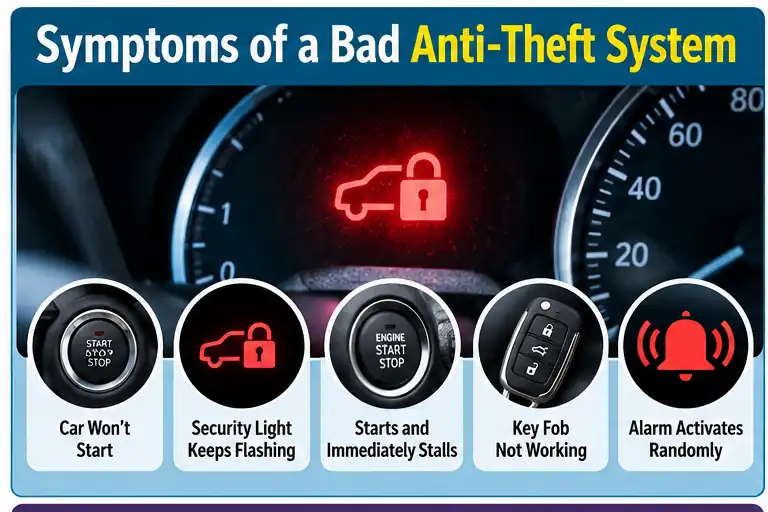
A vehicle’s anti-theft system is designed to prevent unauthorized starting, but when the system itself develops a fault, it can create confusing electrical and starting problems. Common symptoms of a bad anti-theft system include a car that suddenly refuses to start, a security light that keeps flashing, an engine that starts and immediately stalls, or a key fob that no longer communicates properly with the vehicle.
In some cases, the problem may appear to be a weak battery, bad starter, ignition problem, or fuel issue when the immobilizer is actually preventing normal operation.
Modern vehicles use several components to perform this security function, including transponder keys, immobilizer modules, body control modules, ignition switches, antenna rings, door-lock sensors, and electronic control units. A failure in any part of this chain can cause the vehicle to behave differently than expected.
Knowing the warning signs can help you avoid replacing expensive parts unnecessarily. A proper diagnosis begins by separating a genuine anti-theft fault from ordinary starting or electrical problems.
What An Anti-Theft System Does And Why It Can Fail
The anti-theft system is more than a flashing security indicator on the dashboard. In many vehicles, it is an electronic authorization system that determines whether the engine control system should allow the engine to start. Depending on the vehicle, the system may include an immobilizer, key transponder, security module, body control module, ignition switch, keyless-entry receiver, and other related components.
When you insert a programmed key or press the start button, the vehicle checks whether the correct security credentials are present. A transponder inside the key can communicate with an antenna located around the ignition cylinder or inside the vehicle. If the code is recognized, the immobilizer allows normal starting.
If the code cannot be verified, the vehicle may disable fuel delivery, ignition, starter operation, or some combination of these functions.
The exact strategy varies considerably between manufacturers and model years. Some systems allow the starter motor to operate but prevent the engine from running. Others may prevent cranking altogether. This difference is important because the same symptom—“the car won’t start”—can have completely different causes.
How The Immobilizer And Security System Work
A typical immobilizer system involves several stages that need to work together. The vehicle first identifies the key or key fob. The security module then verifies the electronic identification against stored information. If authorization is successful, a message is passed to the appropriate control module allowing the engine to operate.
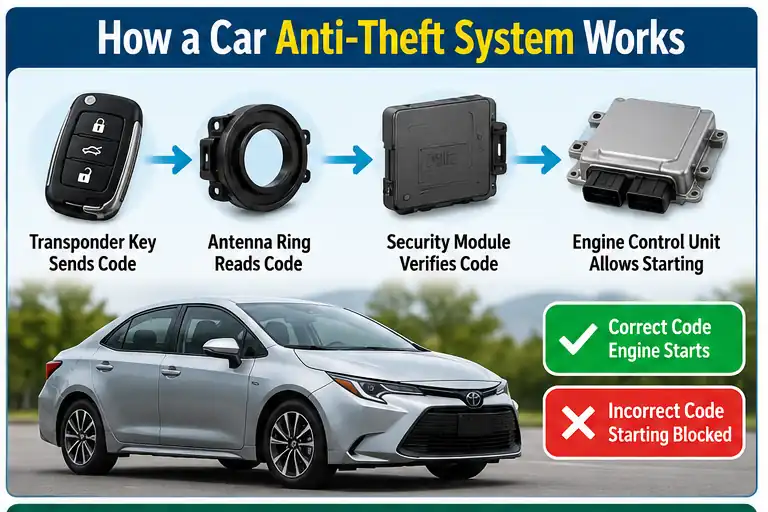
The process happens quickly, so the driver normally notices nothing. Problems become obvious when communication is interrupted. A damaged transponder key, weak key-fob battery, failed immobilizer antenna, wiring problem, low vehicle voltage, or module communication fault can interfere with authorization.
The important point is that the key itself does not always contain a conventional battery-powered transmitter. Many traditional transponder keys can be recognized through passive communication with the vehicle. This is why replacing a key-fob battery does not necessarily solve every immobilizer problem.
Push-button-start vehicles can be more complicated because they may use several antennas and electronic control units to determine whether the authorized key is inside the cabin. A fault in one component can cause a warning even when the key appears to be working normally for locking and unlocking the doors.
The Most Common Symptoms Of A Bad Anti-Theft System
The symptoms can vary by vehicle, but several signs appear repeatedly across different makes and models.
| Symptom | Possible Anti-Theft Connection | Other Possible Causes |
|---|---|---|
| Engine Will Not Start | Immobilizer blocking authorization | Battery, starter, fuel, ignition |
| Security Light Keeps Flashing | Security system not recognizing key | Normal armed-state operation on some vehicles |
| Engine Starts And Stalls | Immobilizer disables engine operation | Fuel pressure, ignition, sensor problem |
| Key Fob Stops Working | Communication or battery problem | Dead fob battery, damaged buttons |
| Alarm Activates Randomly | Faulty sensor or control module | Door switch, hood switch, wiring |
| No Crank With Security Warning | Starter authorization may be blocked | Starter relay, ignition switch, battery |
| Spare Key Works Normally | Original key may have a programming or transponder problem | Mechanical key damage |
| Security Light Stays On | System may detect an authorization fault | Normal behavior varies by model |
One of the most useful clues is whether the vehicle behaves differently with a second programmed key. If the spare key starts the vehicle normally while the original does not, attention should shift toward the original key, transponder, or programming rather than immediately replacing vehicle components.
Normal Security Light Behavior Versus A Fault
A security indicator does not automatically mean the anti-theft system is defective. Many vehicles intentionally flash the security light after the vehicle has been locked. This indicates that the theft-deterrent system is armed.
The important detail is when and how the light behaves.
A light that flashes periodically while the vehicle is parked may be completely normal. A security light that remains illuminated while the ignition is switched on, flashes rapidly during an attempted start, or appears together with a no-start condition may indicate a problem.
Because manufacturers use different indicator strategies, the owner’s manual is the best reference for interpreting the exact warning pattern. Some vehicles display a key symbol, padlock symbol, red security lamp, or immobilizer warning message rather than a traditional anti-theft indicator.
Major Symptoms That Point Toward An Anti-Theft Fault
Not every starting problem is caused by the immobilizer. However, certain combinations of symptoms make an anti-theft problem considerably more likely. The key is to look at the complete pattern rather than one warning light by itself.
The Car Cranks But Will Not Start
A vehicle that cranks normally but refuses to run can sometimes have an immobilizer problem. The starter motor may turn the engine because the theft-deterrent system does not necessarily control starter operation on every vehicle.
Instead, the immobilizer may prevent the engine control module from enabling fuel injection or ignition. This can make the problem look like a fuel-system failure.
If the security light is flashing abnormally at the same time, the anti-theft system deserves attention. However, a crank-no-start condition can also result from a failed fuel pump, crankshaft position sensor, ignition problem, poor fuel pressure, or other engine-management faults.
That is why replacing an immobilizer component based solely on a crank-no-start condition is not a good diagnostic strategy.
The Engine Starts And Immediately Dies
An engine that fires for a second and then shuts off can be a particularly useful clue. On some older immobilizer systems, the engine may start briefly before the control system recognizes that authorization has failed.
The system can then disable the required engine functions, causing the engine to stall.
This symptom is not exclusive to an anti-theft fault. A severe fuel-delivery problem, air-metering issue, ignition fault, or sensor failure can create similar behavior. The security indicator and scan-tool information should therefore be considered alongside the starting symptom.
If the engine repeatedly starts and stops at nearly the same interval while a security warning is displayed, an immobilizer-related problem becomes more plausible.
The Starter Does Not Operate
Some anti-theft systems can prevent the starter from being activated. In this situation, turning the key or pressing the start button may produce no crank response.
You may hear a click, or there may be complete silence.
Before blaming the immobilizer, check the battery condition and electrical connections. A weak battery can produce strange electronic behavior, including security warnings, communication errors, and starting failures. Corroded battery terminals can cause similar symptoms.
If the battery voltage and starting circuit are healthy and the security indicator is abnormal, the immobilizer or related authorization system should be investigated.
The Security Light Remains On Or Flashes Abnormally
The security indicator is one of the easiest clues to notice. A warning that remains illuminated after the vehicle has been started may indicate that the system has detected a fault, although the exact meaning depends on the manufacturer.
A flashing security light during an attempted start can indicate that the key has not been authenticated.
However, indicator behavior varies widely. Some vehicles intentionally display a security warning for a short period during normal operation. Others use different flash patterns to identify specific problems.
The best approach is to compare the observed behavior with the manufacturer’s instructions rather than assuming every illuminated security symbol represents the same failure.
The Key Fob Suddenly Stops Communicating
A key fob that suddenly stops locking or unlocking the vehicle may have a simple battery problem. That should be checked first.
But if the key fob has a fresh battery and still behaves inconsistently, there may be a communication problem involving the fob, receiver, antenna, body control module, or wiring.
Physical damage is another overlooked cause. A key fob that has been dropped, exposed to moisture, or damaged around its buttons may stop transmitting correctly.
If the vehicle has a conventional metal key with an embedded transponder, the remote-locking function and immobilizer function may also be separate. A vehicle can sometimes recognize the transponder while the remote buttons do not work.
The Alarm Activates Without An Obvious Reason
A malfunctioning theft-deterrent system may trigger the alarm unexpectedly. The vehicle may honk, flash the lights, or activate the alarm shortly after being locked.
The problem does not necessarily mean the main anti-theft module has failed.
Door-ajar switches, hood-latch sensors, trunk switches, interior motion sensors, tilt sensors, wiring connections, and low battery voltage can all create false alarm events.
A useful diagnostic clue is whether the alarm activates under a consistent condition. For example, if it happens only after heavy rain, after opening a particular door, or when the vehicle battery is weak, the triggering component may be easier to identify.
The Vehicle Does Not Recognize The Key
Modern vehicles may display messages such as “No Key Detected,” “Key Not Recognized,” or a similar warning.
This can happen because of a dead key-fob battery, interference, damaged key electronics, a weak vehicle battery, antenna failure, or a communication problem.
Many vehicles have an emergency key-detection procedure. The key may need to be placed in a specific location, such as near the start button, steering column, center console, or designated backup area.
The exact procedure differs by vehicle, so checking the owner’s manual is important before assuming that the immobilizer itself has failed.
Causes Behind Anti-Theft System Problems And How To Diagnose Them
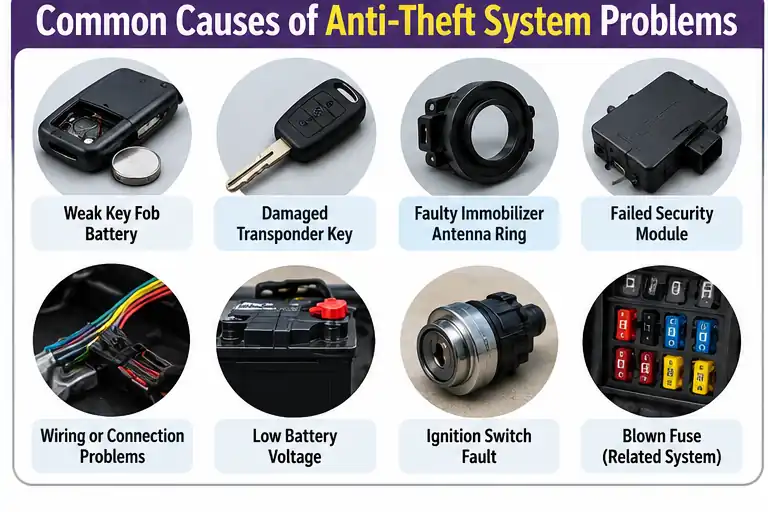
A good diagnosis starts with simple causes and moves toward more complicated electrical or module-related faults. This prevents unnecessary parts replacement.
Weak Vehicle Battery Or Low System Voltage
Low voltage is one of the most overlooked causes of unusual electronic behavior. Modern vehicles contain multiple control modules that need stable voltage to communicate correctly.
When the battery becomes severely discharged, modules can reset, communication can become unreliable, and warning lights can appear unexpectedly.
A vehicle may even display an anti-theft warning when the underlying problem is simply insufficient electrical power.
Check battery voltage with a suitable multimeter and inspect the terminals for corrosion or looseness. If the battery has recently gone completely flat, consider whether the security problem appeared immediately afterward.
A battery problem should be addressed before diagnosing complicated immobilizer faults.
Damaged Or Unprogrammed Key
A key can physically fit the ignition while still failing the electronic authorization process.
This is particularly important with replacement keys. Cutting the metal portion of a key does not automatically mean the vehicle will recognize it. Depending on the vehicle, the transponder may need to be programmed to the immobilizer system.
If the original key works and a replacement key does not, programming becomes an important area to investigate.
A damaged transponder can also cause intermittent problems. Dropping the key repeatedly or exposing it to moisture can damage internal components.
Faulty Immobilizer Antenna
Many vehicles use an antenna around the ignition cylinder to communicate with the transponder in a traditional key.
If the antenna fails, the vehicle may not receive the key’s identification even though the key itself is perfectly functional.
This can create a confusing situation because the mechanical portion of the key works normally. The key turns, doors may unlock, and other functions can appear normal, but the engine will not start.
Push-button systems can use multiple antennas instead of a single ignition-cylinder antenna, making diagnosis more involved.
Wiring And Connector Problems
Electrical connectors are critical to immobilizer communication. Loose terminals, corrosion, damaged wires, water intrusion, or poor connections can interrupt communication between modules.
This becomes especially important in vehicles that have experienced previous electrical repairs, aftermarket alarm installation, stereo modifications, remote-start installation, or water leaks.
An aftermarket security or remote-start system can sometimes interfere with factory starting authorization if incorrectly installed.
A visual inspection of relevant connectors and wiring can reveal obvious problems, but hidden electrical faults may require proper circuit testing.
Body Control Module Or Security Module Fault
The body control module often manages several functions related to vehicle access and security. Depending on the vehicle, it may communicate with the immobilizer, keyless-entry system, alarm, lighting, door locks, and other systems.
A module fault can therefore produce several symptoms simultaneously.
However, module replacement should not be the first step. Many apparent module failures are actually caused by low voltage, poor grounds, wiring problems, communication faults, or programming issues.
A professional diagnostic scan can help determine whether modules are communicating properly and whether immobilizer-related trouble codes are stored.
Lost Key Programming Or Module Synchronization
Some vehicles require specific programming procedures after replacing a key, immobilizer module, body control module, engine computer, or related component.
If programming is incomplete, the vehicle may recognize that a key is present but still refuse to authorize engine operation.
This is one reason generic key-cutting services may not be enough for certain vehicles.
Depending on the manufacturer, programming may require factory-level diagnostic equipment, a security access procedure, or specialized locksmith equipment.
Aftermarket Remote Start Or Alarm Problems
Aftermarket electronics can complicate an otherwise straightforward immobilizer system.
Remote-start kits, aftermarket alarms, keyless-entry systems, and other accessories sometimes interface directly with ignition or security circuits. If installation quality is poor or a component fails, the vehicle may develop unusual starting or alarm behavior.
When troubleshooting begins, determine whether the vehicle has non-factory security equipment.
If the symptoms started after an aftermarket installation, repair, or electrical modification, that history is highly relevant.
Practical Diagnosis And Repair Steps
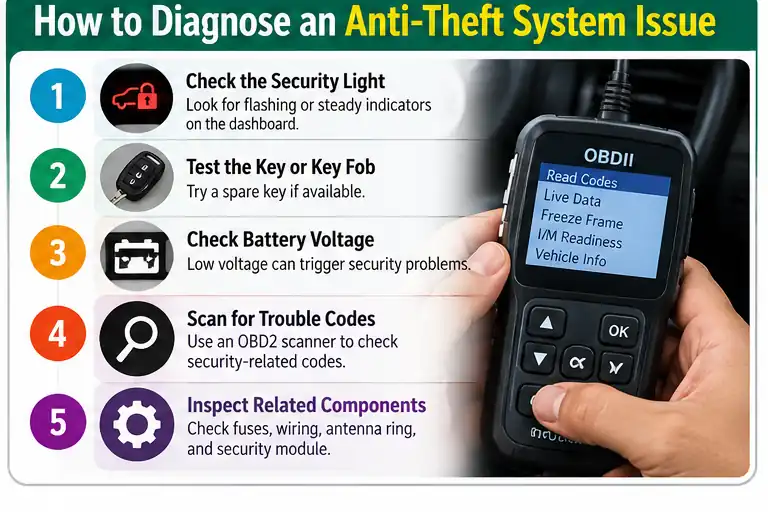
Once the symptoms have been identified, the next step is to determine whether the security system is actually responsible. A systematic process is more reliable than repeatedly trying random fixes.
Start With The Battery And Basic Electrical System
Check the vehicle battery before investigating expensive electronic components.
Inspect the battery terminals, ground connections, and visible wiring. A loose negative cable can create strange electrical problems that look much more complicated than they actually are.
If the battery is weak, charge or replace it as appropriate and then retest the vehicle.
If the anti-theft warning disappears after stable voltage is restored, the battery condition may have contributed to the problem.
Try The Spare Programmed Key
If a spare key is available, use it.
This is one of the simplest tests you can perform because it separates some key-related faults from vehicle-side problems.
If one key starts the vehicle while another does not, investigate the affected key before replacing immobilizer components.
If neither key works and the security warning remains active, the problem may be elsewhere in the vehicle.
Do not repeatedly attempt programming procedures without checking the manufacturer’s procedure. Some vehicles have specific requirements for adding keys, and incorrect attempts can create additional complications.
Observe The Security Indicator Carefully
Note what the security light does before, during, and after the starting attempt.
Record whether it:
- Remains off
- Flashes normally while parked
- Stays illuminated with ignition on
- Flashes rapidly during starting
- Turns off after the engine starts
- Appears together with a warning message
This information can be more useful than simply saying “the anti-theft light is on.”
A diagnostic technician can use the exact behavior to narrow down the possible fault.
Check The Key-Fob Battery
For push-button vehicles, install the correct battery in the key fob if the battery is weak.
Make sure the battery is installed in the correct orientation and that the contacts are clean.
If the vehicle still cannot detect the key, consult the owner’s manual for the emergency key-detection procedure. Many manufacturers provide a backup method specifically for situations involving a weak key-fob battery.
This is a simple step that can prevent an unnecessary service visit.
Scan The Vehicle For Diagnostic Trouble Codes
A capable scan tool can provide valuable information from the body control module, immobilizer system, engine control module, and other electronic systems.
A basic code reader may only communicate with the engine computer and miss security-related information stored elsewhere.
For immobilizer problems, a scanner capable of accessing manufacturer-specific modules can be much more useful.
Codes should not be treated as automatic proof that a particular component has failed. A code usually identifies a system or condition that requires further testing.
Check For Recent Repairs Or Electrical Changes
Ask what happened before the problem appeared.
Was the battery recently replaced? Was the vehicle jump-started? Was a key lost? Was a remote starter installed? Did the vehicle experience water intrusion? Was the ignition switch repaired?
These details can dramatically narrow the diagnostic path.
For example, an anti-theft problem that appears immediately after replacing a control module may involve programming or synchronization rather than a defective module.
When Professional Diagnosis Is Necessary
Some immobilizer repairs require specialized equipment and security credentials. This is particularly true when a key needs programming, a module needs replacement, or a security system requires initialization.
A qualified automotive locksmith may be able to diagnose and program keys for many vehicles. A dealership or qualified repair facility may be necessary when manufacturer-specific programming or module configuration is required.
Professional diagnosis is especially appropriate when the vehicle is completely immobilized, multiple control modules report communication errors, or there is evidence of wiring or module damage.
Anti-Theft Symptoms Compared With Other Starting Problems
One of the biggest mistakes is assuming that every no-start condition is an immobilizer problem. The table below shows how several common faults can overlap.
| Problem | Cranks? | Security Warning? | Common Clue |
|---|---|---|---|
| Weak Battery | Sometimes Slowly | Possible | Dim lights, clicking, low voltage |
| Bad Starter | No | Usually No | Single click or no starter operation |
| Fuel Pump Failure | Yes | Usually No | Cranks normally but does not run |
| Ignition Failure | Yes | Usually No | No spark or ignition-related fault |
| Immobilizer Fault | Yes Or No | Often | Key/security warning or unusual security light |
| Crankshaft Sensor Failure | Yes | Usually No | Cranks without starting |
| Key Recognition Problem | Yes Or No | Often | Key-not-detected message |
| Alarm/Security Module Fault | Depends | Often | Random alarm or authorization problem |
This comparison shows why diagnosis should not be based on one symptom.
A vehicle that refuses to start with a flashing security indicator deserves immobilizer testing. A vehicle that refuses to start with no security warning should still be diagnosed normally rather than automatically blaming the anti-theft system.
Can You Reset A Bad Anti-Theft System?
Sometimes a temporary reset can restore normal operation, but a reset is not a universal repair.
Some vehicles may recover after locking and unlocking the vehicle, cycling the ignition, reconnecting a properly charged battery, or using a manufacturer-specific key recognition procedure.
However, these methods depend entirely on the vehicle.
Disconnecting the battery is sometimes suggested as a universal anti-theft reset. It is not. Battery disconnection can erase certain learned settings, reset clocks and radio settings, and create additional electronic issues without correcting the underlying security fault.
If the problem is caused by a damaged key, failed antenna, programming error, wiring problem, or module fault, a reset will not repair the defective component.
The better approach is to identify why authorization is failing.
How To Prevent Future Anti-Theft Problems
Good maintenance can reduce some security-system problems, even though electronic components can still fail unexpectedly.
Keep the key fob away from excessive moisture and physical impact. If the vehicle uses a conventional transponder key, avoid damaging the key housing because the transponder is often located inside it.
Replace key-fob batteries when they become weak rather than waiting until the remote stops functioning completely.
Keep the vehicle battery in good condition as well. Repeated low-voltage events can cause confusing electronic behavior and can make diagnosis more difficult.
If aftermarket remote-start or alarm equipment is installed, use a reputable installer familiar with the specific vehicle. Poorly integrated accessories can interfere with factory security circuits.
Finally, keep at least one working spare key available. Losing the only programmed key can turn a relatively simple key replacement into a much more complicated and expensive service.
Final Thoughts
The symptoms of a bad anti-theft system can look remarkably similar to ordinary starting and electrical failures. A flashing security indicator, no-crank condition, crank-no-start problem, engine that starts and stalls, key-not-detected message, or unexplained alarm activity can all point toward a security-related issue, but none of these symptoms should be treated as automatic proof of an immobilizer failure.
Start with the simple possibilities: battery voltage, battery terminals, key-fob condition, spare-key operation, and recent electrical work. Then move toward diagnostic scanning and system-specific testing.
The most important diagnostic principle is to avoid replacing expensive electronic components based solely on symptoms. Immobilizer systems involve several interconnected parts, and a fault in one area can make another component appear responsible.
A proper diagnosis identifies where authorization is being lost and verifies the cause before parts are replaced. That approach saves money, reduces unnecessary repairs, and gives you a much better chance of restoring reliable vehicle operation.
FAQs
What Are The Most Common Symptoms Of A Bad Anti-Theft System?
Common signs include a flashing or continuously illuminated security light, a vehicle that will not start, an engine that starts and immediately stalls, a key-not-detected message, an unresponsive key fob, or an alarm that activates unexpectedly. The exact symptoms vary by vehicle because manufacturers use different immobilizer designs.
Can A Bad Anti-Theft System Prevent A Car From Starting?
Yes. Depending on the vehicle, the immobilizer may prevent starter operation or allow the engine to crank while disabling fuel injection or ignition authorization. However, many other faults can also cause a no-start condition, so the security warning and diagnostic information should be checked before blaming the immobilizer.
Will Changing The Key Fob Battery Fix An Anti-Theft Problem?
It can fix a key-fob communication problem when the old battery is weak, particularly on push-button-start vehicles. However, the immobilizer transponder and remote-control system may operate differently. A new fob battery will not repair a damaged transponder, failed antenna, wiring fault, or programming problem.
Why Does My Car Start And Then Shut Off With The Security Light On?
Some immobilizer systems allow the engine to start briefly before disabling engine operation when key authorization fails. A security-related fault is one possibility, but fuel, ignition, sensor, and engine-control problems can create the same symptom. A scan tool and security-light behavior can help separate these possibilities.
Can A Weak Car Battery Trigger The Anti-Theft System?
Yes. Low vehicle voltage can cause control modules to reset or communicate incorrectly. This may result in unusual security warnings, key-recognition problems, or other electronic symptoms. Checking battery condition and electrical connections is therefore a sensible first diagnostic step.
Do I Need A Dealership To Fix An Anti-Theft System?
Not always. A qualified automotive locksmith can handle many key and immobilizer problems, while an independent repair shop with appropriate diagnostic equipment can diagnose numerous security-system faults. Certain vehicles require manufacturer-specific programming or security access, in which case dealership-level equipment or a specialist may be necessary.