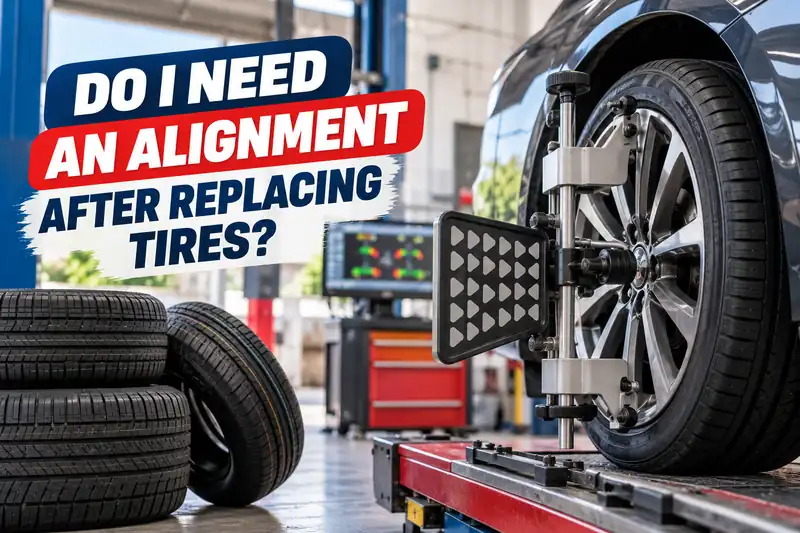
Tires are one of the most important parts of a vehicle because they provide the contact between the car and the road. When a new set is installed, many drivers wonder, do I need an alignment after replacing tires, or is installing and balancing the tires enough?
The answer depends on the condition of the vehicle’s suspension, steering geometry, old tires, and the way the new tires are wearing.
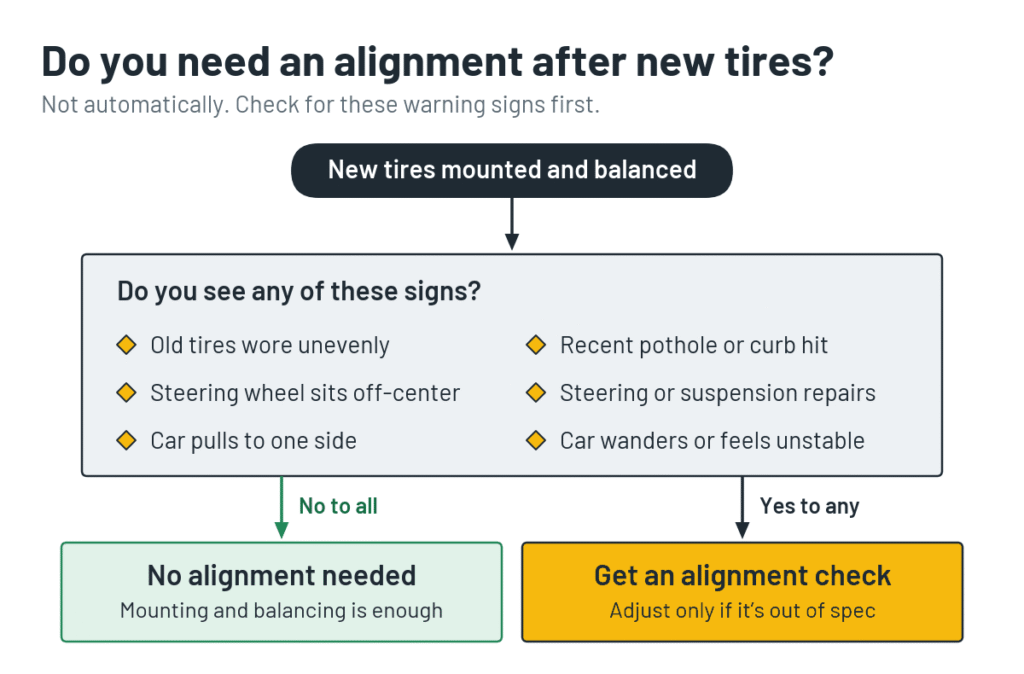
Installing new tires does not automatically change the wheel alignment. However, new tires can make an existing alignment problem much easier to notice because their tread is fresh and evenly shaped. If the previous tires had uneven wear, the vehicle pulled to one side, the steering wheel was off-center, or the car recently hit a pothole, an alignment check becomes much more important.
A proper approach is to separate tire installation, wheel balancing, and wheel alignment into three different services. They work together, but they solve different problems.
Do You Need An Alignment After Replacing Tires?
In many cases, you do not automatically need a wheel alignment simply because the tires have been replaced. A tire replacement normally involves removing the old tire from the wheel, mounting the new tire, inflating it to the correct pressure, and balancing the wheel and tire assembly.
None of those steps inherently changes the suspension geometry.
Wheel alignment is concerned with the angles at which the wheels contact the road and relate to the vehicle’s body. The primary alignment angles commonly discussed are toe, camber, and caster, although the exact specifications and available adjustments vary by vehicle.
A tire shop may recommend an alignment with a new set of tires because new tires represent a significant investment. If the suspension geometry is incorrect, uneven tread wear can damage the new tires prematurely.
That recommendation does not necessarily mean an alignment is mandatory every time tires are installed. The better question is whether there are signs that the vehicle’s alignment is outside the manufacturer’s specifications.
Tire Replacement And Wheel Alignment Are Different Services
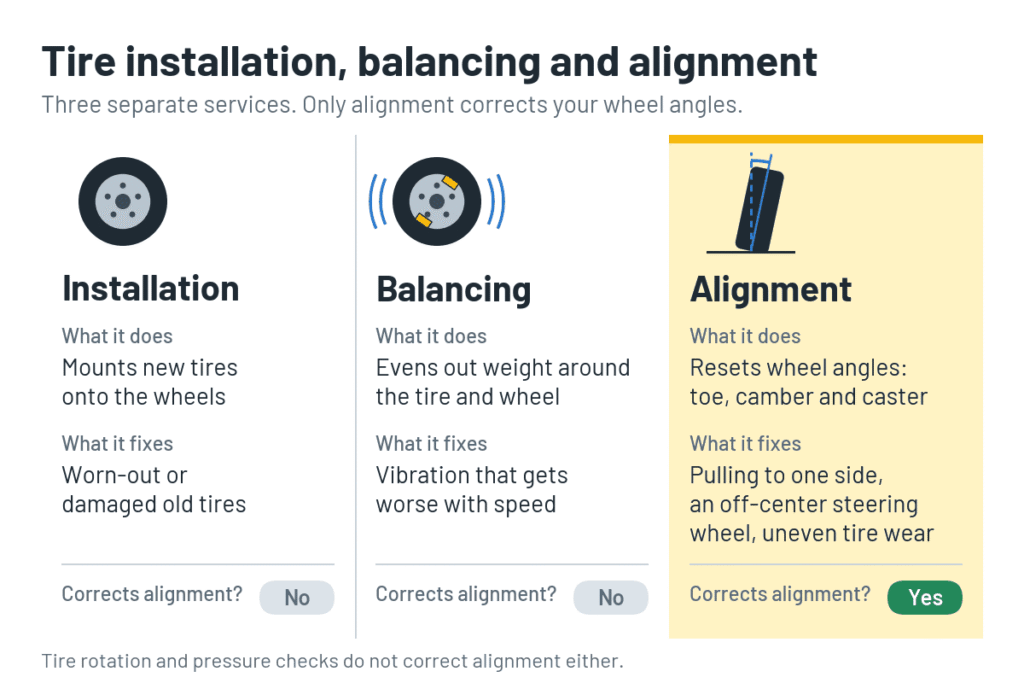
It helps to separate the three jobs because they are often confused.
| Service | Main Purpose | Does It Correct Alignment? |
|---|---|---|
| Tire Installation | Mounts new tires onto wheels | No |
| Wheel Balancing | Corrects weight imbalance in wheel/tire assembly | No |
| Wheel Alignment | Adjusts wheel and suspension geometry | Yes |
| Tire Rotation | Moves tires to different positions | No |
| Tire Pressure Adjustment | Sets inflation pressure correctly | No |
A vehicle can have perfectly balanced tires but poor alignment. It can also have correct alignment but an unbalanced wheel.
For example, an unbalanced tire may cause vibration at certain speeds. An alignment problem may instead cause the vehicle to pull, leave an off-center steering wheel, or wear tread unevenly.
Replacing tires does not automatically correct either problem.
Why New Tires Can Make An Alignment Problem More Noticeable
Old tires often develop irregular wear gradually.
Suppose the front tires have been driven for many thousands of miles while the toe setting has been slightly outside specification. The tread may develop feathering or a worn inner or outer shoulder.
When those tires are replaced, the new tread starts with a clean surface.
If the alignment problem remains, the fresh tread can begin wearing incorrectly from the beginning.
This is one reason alignment inspection makes sense when replacing tires, especially if the old set showed abnormal wear.
The important distinction is between an alignment inspection and an alignment adjustment.
An inspection can determine whether the angles are within specification. An adjustment is performed only when measurements indicate that correction is needed and the vehicle design allows it.
When An Alignment Check Makes Sense
An alignment check is particularly worthwhile when one or more of the following applies:
- The old tires had uneven tread wear.
- The steering wheel was not centered while driving straight.
- The vehicle pulled consistently to one side.
- The vehicle recently struck a pothole.
- The vehicle hit a curb.
- Steering or suspension components were replaced.
- The vehicle has been lowered or modified.
- A suspension component was bent or damaged.
- The new tires have a significantly different tread design.
- The vehicle feels unstable or wanders.
- One tire is wearing faster than its counterpart on the same axle.
A check can also be sensible simply because the vehicle has accumulated substantial mileage since its last alignment.
However, mileage alone does not prove that an alignment is necessary. Alignment can change because of impacts, worn components, suspension work, or gradual changes in certain components rather than because the odometer reached a particular number.
Signs Your Car Needs An Alignment After New Tires
The condition of the old tires provides some of the best clues.
A new tire installation is an excellent opportunity to inspect the tread because the removed tires show how the vehicle was interacting with the road over time.
Uneven Tire Wear Is A Major Clue
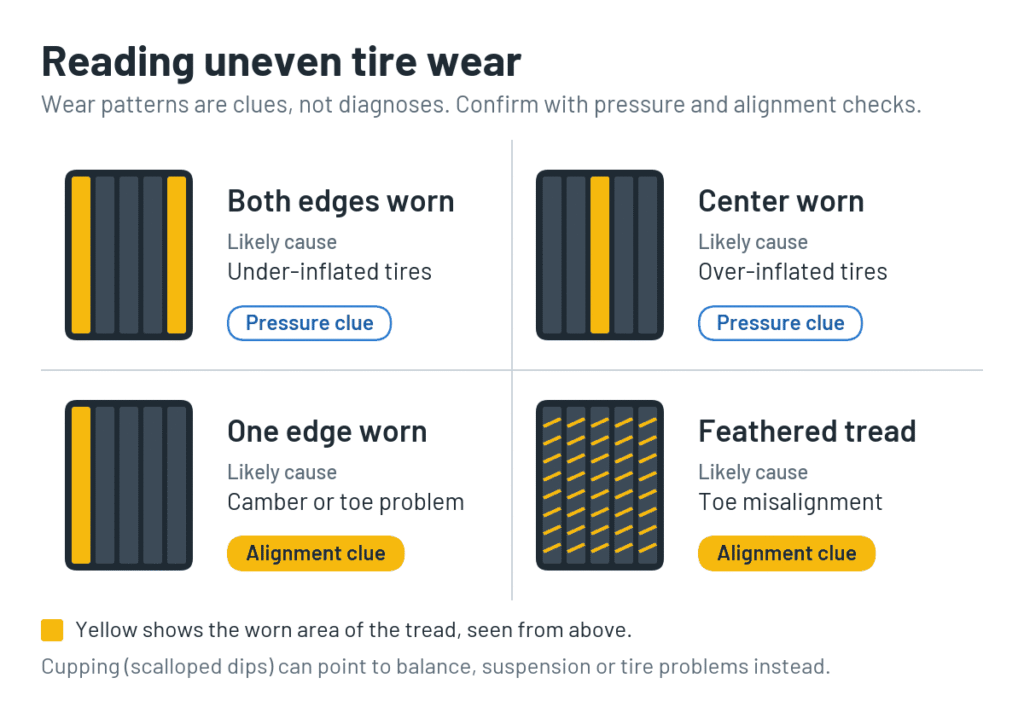
Tire wear patterns can provide valuable information about suspension geometry, inflation, wheel balance, suspension components, and driving conditions.
For example, excessive wear on one shoulder can be associated with alignment or inflation issues, although the exact cause depends on the complete wear pattern.
Feathered tread blocks can indicate a toe-related condition, while certain forms of cupping or scalloping can be associated with wheel balance, suspension condition, or tire-related problems.
The table below provides general guidance:
| Tire Wear Pattern | Possible Cause |
|---|---|
| One-sided shoulder wear | Alignment or inflation issue |
| Inner-edge wear | Possible excessive negative camber or toe condition |
| Outer-edge wear | Possible excessive positive camber or underinflation |
| Feathered tread | Often associated with toe misalignment |
| Cupping/scalloping | Balance, suspension, tire, or related issue |
| Center tread wear | Possible overinflation |
| Both shoulders worn | Possible underinflation |
| One tire significantly different | Alignment, pressure, suspension, or tire issue |
These patterns are clues, not automatic diagnoses.
Tire wear should always be considered alongside inflation pressure, suspension condition, road conditions, vehicle loading, tire construction, and manufacturer recommendations.
The Steering Wheel Is Off-Center
A steering wheel that sits noticeably left or right while the vehicle travels straight is another reason to have the alignment checked.
The steering wheel and front wheels are connected through the steering system, but the exact relationship depends on the vehicle’s steering geometry and alignment procedure.
If the steering wheel was already off-center before replacing the tires, installing new tires will not normally correct it.
A technician should check the alignment rather than simply moving the steering wheel or changing its position mechanically.
Correct alignment involves setting the appropriate steering and suspension angles according to the manufacturer’s specifications.
The Vehicle Pulls To One Side
A consistent pull can be caused by alignment, but alignment is not the only possibility.
Tire pressure differences can create noticeable handling differences. Tire construction and wear can also influence how a vehicle tracks.
Roads themselves are not perfectly flat. Many roads have a slight crown to help water drain, and that can affect how a vehicle feels.
Tire conicity or radial force variation can also contribute to a vehicle pulling, even when alignment measurements are within specification.
This is an important diagnostic point because immediately performing an alignment does not guarantee that every pulling complaint will disappear.
A technician should evaluate the tires, pressures, alignment measurements, and suspension condition together.
The Vehicle Wanders Or Feels Unstable
A vehicle that requires frequent steering corrections may need more than an alignment.
Loose steering or suspension components can affect wheel control and alignment stability.
Worn tie-rod ends, ball joints, control-arm bushings, wheel bearings, and other components can allow wheel angles to change under load.
Attempting to align a vehicle with severely worn components may produce poor or temporary results.
A proper alignment begins with checking whether the suspension and steering components are mechanically sound.
New Tires Develop Uneven Wear Quickly
If the new tires begin developing unusual wear shortly after installation, do not assume that the tires themselves are defective.
Check:
- Tire pressure.
- Wheel alignment.
- Wheel balance.
- Suspension condition.
- Tire installation position.
- Vehicle loading.
- Driving conditions.
If the vehicle has incorrect toe or camber, even a premium tire can wear prematurely.
This is particularly important because alignment problems can cost much more over time through premature tire replacement than the original alignment service.
What Happens During A Wheel Alignment?
A modern wheel alignment is more than simply “straightening the wheels.”
The technician measures the vehicle’s wheel angles and compares them with the specifications provided for that particular vehicle.
The exact procedure varies between cars, but a typical alignment service can involve inspecting the suspension, mounting measurement equipment to the wheels, compensating for wheel runout when required, measuring alignment angles, making permitted adjustments, and confirming the final readings.
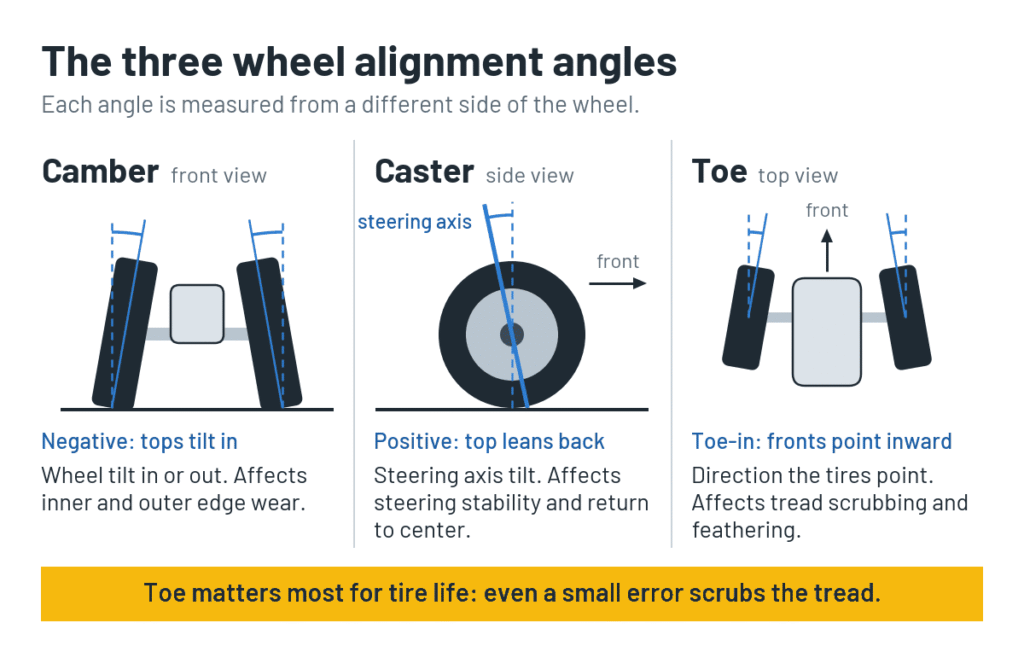
Camber, Caster And Toe Explained
The three terms most commonly associated with alignment are camber, caster, and toe.
Camber describes the inward or outward tilt of the wheel when viewed from the front of the vehicle.
Negative camber means the top of the wheel tilts inward toward the vehicle. Positive camber means the top tilts outward.
A certain amount of camber may be intentionally designed into a vehicle, so “zero camber” is not automatically the correct target.
Caster describes the steering-axis angle when viewed from the side of the vehicle. Caster contributes to steering stability, steering effort, and the vehicle’s tendency to return toward center after a turn.
Toe describes whether the fronts of the tires point slightly toward or away from each other when viewed from above.
Toe is particularly important for tire wear because even a relatively small error can cause the tread to scrub across the road.
Why Toe Is Particularly Important For Tire Life
Toe deserves special attention because it directly influences how the tires travel relative to the road surface.
Imagine both front tires pointing slightly inward when the vehicle is traveling forward. Each tire is trying to follow a slightly different direction while being forced along the same path.
The result can be continuous tread scrubbing.
The driver may not immediately notice a severe handling problem, but the tire tread can gradually develop feathering and accelerated wear.
This is one reason a vehicle can feel relatively normal while still destroying a new set of tires faster than expected.
Four-Wheel Alignment Versus Front-End Alignment
The term “wheel alignment” does not always mean the same procedure on every vehicle.
A modern vehicle may require measurement of all four wheels, even if only the front wheels have adjustable alignment angles.
The rear wheels establish a reference for the vehicle’s thrust direction. If the rear alignment is incorrect, simply adjusting the front wheels may not produce the correct overall result.
A four-wheel alignment can therefore provide a more complete picture.
Whether adjustments are available at each corner depends on the suspension design.
Some vehicles offer multiple adjustment points, while others have limited factory adjustment. If measurements are outside specification because a component is bent or worn, replacing the damaged part may be necessary rather than simply adjusting the alignment.
Should You Get An Alignment Before Or After New Tires?
There is a practical reason many shops recommend checking alignment around the time of tire replacement.
New tires provide a fresh starting point.
If the old tires have uneven wear, an alignment check before or during installation can identify a condition that might otherwise damage the new tires.
In most cases, the sequence is less important than ensuring that the alignment is correct before the vehicle accumulates significant mileage on the new tires.
Alignment Before Tire Installation
Checking alignment before installing the new tires can reveal suspension geometry problems while the old tires are still available for inspection.
The technician can examine the removed tires for wear patterns and compare those observations with alignment measurements.
If the alignment is significantly incorrect, correcting it before fitting the new tires means the fresh tread starts with the proper geometry.
This approach can be particularly useful when the old tires have obvious shoulder wear or feathering.
Alignment After Tire Installation
Performing the alignment after the new tires are installed is also common.
The technician can measure the vehicle with the actual tire and wheel combination that will remain on the car.
New tires also eliminate the possibility that unusual wear or deformation in the old tires is influencing how the vehicle feels during the road test.
The key point is not whether the alignment happens before or after the tire mounting in every case. The important factor is that the vehicle’s alignment is checked and corrected when there is evidence that it is outside specification.
Does Mounting New Tires Change Alignment?
Normally, simply mounting a tire onto a wheel does not change the suspension alignment.
The tire bead is installed onto the wheel, inflated, and balanced.
The wheel itself remains attached to the same hub or mounting surface.
However, there are exceptions worth considering.
If a wheel is damaged, improperly mounted, has debris between the mounting surfaces, or there is a mechanical problem with the wheel or hub, the vehicle can behave differently.
Also, replacing worn tires removes the wear characteristics of the previous set, which may make an existing alignment issue more noticeable.
That is different from the tire installation physically changing the alignment angles.
Alignment, Balancing And Tire Rotation: What Each Service Does
These three services are often mentioned together, but they solve different problems.
Wheel Balancing
Balancing corrects uneven weight distribution in the wheel and tire assembly.
A wheel may be perfectly aligned with the vehicle but still vibrate because the tire and wheel combination is not balanced correctly.
Balancing problems commonly become noticeable as speed increases.
If a new tire produces a vibration immediately after installation, wheel balance, tire mounting, wheel condition, and tire uniformity should be checked.
An alignment generally will not correct a simple imbalance.
Tire Rotation
Rotation moves tires between designated positions according to the vehicle and tire manufacturer’s recommendations.
It helps manage tread wear across the vehicle.
Front and rear tires can experience different loads and steering forces, so rotation may help distribute wear more evenly when the tire and vehicle design permit rotation.
However, rotation does not correct alignment.
If one tire has already developed severe uneven wear, moving it to another position does not repair the underlying cause.
Tire Pressure
Correct inflation pressure is another essential part of tire maintenance.
Always use the vehicle manufacturer’s recommended cold inflation pressure rather than automatically using the maximum pressure printed on the tire sidewall.
The sidewall figure generally relates to the tire’s maximum rated inflation, not necessarily the vehicle’s recommended operating pressure.
Incorrect inflation can influence handling and wear, and it can sometimes mimic symptoms that drivers associate with alignment.
How Much Does A Wheel Alignment Cost?
Wheel alignment pricing varies according to location, vehicle type, shop equipment, suspension design, and whether additional repairs are required.
A basic alignment service at an independent repair facility may cost considerably less than a specialized dealership service, while performance vehicles or vehicles requiring additional adjustment can cost more.
The alignment price should also be considered separately from tire installation.
| Service | Main Purpose | Typical Pricing Factors |
|---|---|---|
| Tire Mounting | Installs tire onto wheel | Tire size, wheel type, shop labor |
| Tire Balancing | Corrects wheel/tire imbalance | Wheel size and service method |
| Alignment Check | Measures wheel geometry | Equipment and inspection time |
| Alignment Adjustment | Corrects adjustable angles | Vehicle design and labor |
| Suspension Repair | Restores worn/damaged components | Parts and labor |
Some shops advertise inexpensive alignment specials, but the details can differ.
Before approving the work, ask whether the price includes measurement, adjustment, a final measurement, and a printout of the alignment results.
What A Good Alignment Report Shows
A useful alignment report generally shows measured values and manufacturer specifications.
The report can include readings for:
- Camber
- Caster
- Toe
- Total toe
- Steering angle
- Thrust angle
- Other vehicle-specific measurements
Seeing the numbers can be helpful because it provides evidence of what was measured rather than simply stating that an alignment was performed.
Not every vehicle allows adjustment of every angle.
If a measurement remains outside specification after available adjustments, the technician should investigate the reason rather than simply forcing an adjustment that the vehicle was not designed to accept.
Situations Where An Alignment May Not Be Necessary
Replacing tires alone does not create an automatic requirement for alignment.
An alignment may not be necessary when:
- The old tires wore evenly.
- The steering wheel was centered.
- The vehicle tracked normally.
- There have been no significant pothole or curb impacts.
- No steering or suspension components were replaced.
- There are no handling concerns.
- The alignment was recently measured and remains within specification.
- The new tires are being installed on an otherwise healthy vehicle.
Even in these circumstances, an inspection can still be useful if the shop offers it as part of the tire installation service.
The distinction is important: checking alignment and paying for an alignment are not necessarily the same thing.
A measurement may confirm that no adjustment is needed.
When New Tires Should Prompt More Investigation
There are circumstances where new tires should make you more attentive to alignment.
If the old tires showed significant inner-edge wear, for example, the new tires should not simply be installed and forgotten.
Likewise, if the vehicle has recently undergone suspension modifications or repairs, alignment should be verified.
Lowering springs, replacement control arms, adjustable suspension components, and accident repairs can all change wheel geometry.
Vehicles that frequently encounter poor road surfaces may also experience alignment changes or suspension damage.
What If The Alignment Is Within Specification But The Car Still Pulls?
This is an important diagnostic situation.
A vehicle can pull even when alignment readings appear acceptable.
Potential factors include tire conicity, radial force variation, pressure differences, road crown, brake drag, worn components, or differences between tires.
A qualified technician may perform a road test and compare tire positions or use other diagnostic methods to identify whether the tire itself is contributing to the pull.
This is why an alignment machine is a diagnostic tool, not an automatic solution to every steering complaint.
Final Thoughts
So, do I need an alignment after replacing tires? Not automatically.
Replacing tires does not normally change the vehicle’s alignment angles. However, new tires make the condition of the suspension and wheel geometry more important because you want the fresh tread to wear evenly for as long as possible.
An alignment check is particularly worthwhile when the old tires showed uneven wear, the steering wheel was off-center, the vehicle pulled to one side, the car recently struck a pothole or curb, or suspension and steering components have been replaced.
It is also important to keep alignment separate from balancing. Balancing addresses vibration caused by uneven weight distribution, while alignment addresses the relationship between the wheels and suspension geometry.
The smartest approach is to inspect rather than automatically purchase every recommended service. Ask the technician to show you the tire wear, provide alignment measurements when an adjustment is recommended, and explain what is outside the manufacturer’s specifications.
If the alignment is already within specification and the vehicle tracks correctly, replacing tires does not by itself create a reason to adjust it.
On the other hand, if the old tires reveal a pattern of abnormal wear, correcting the underlying alignment problem before it damages the new tires can protect a much larger investment. The goal is not simply to make the wheels “straight.” It is to ensure that the suspension, steering geometry, tires, and road contact are working together as the manufacturer intended.
Can new tires affect wheel alignment?
New tires normally do not change the actual suspension alignment angles. However, they can make an existing alignment problem more noticeable because their tread starts evenly and has not developed the wear characteristics of the old tires. If the previous tires were worn unevenly, checking alignment before putting significant mileage on the new set is sensible.
How do I know if I need an alignment after getting new tires?
Look for an off-center steering wheel, consistent pulling, wandering, uneven tread wear on the previous tires, or a recent impact with a pothole or curb. If none of these conditions exist and the vehicle recently had its alignment checked, an adjustment may not be necessary. An inspection can confirm whether the measurements remain within specification.
Do tire shops automatically align a car when installing new tires?
No. Tire installation and wheel alignment are separate services. Some tire shops may recommend or package an alignment with tire installation, but mounting new tires does not automatically perform an alignment. Ask whether the quoted price includes an alignment inspection, actual adjustment, or both.
Does wheel balancing replace the need for an alignment?
No. Balancing and alignment address different problems. Balancing corrects uneven weight distribution in the wheel and tire assembly and is primarily associated with vibration. Alignment corrects adjustable wheel and suspension geometry. A vehicle can have balanced wheels and incorrect alignment at the same time.
Can bad alignment ruin new tires?
Yes. Alignment that is outside the manufacturer’s specifications can contribute to uneven or accelerated tread wear. Toe errors can cause tread scrubbing and feathering, while certain camber conditions can contribute to shoulder wear. Tire pressure, suspension condition, and other factors can also cause abnormal wear, so the exact cause should be diagnosed rather than assumed.
Should I get a four-wheel alignment after replacing tires?
It depends on the vehicle and its suspension design. Many modern vehicles benefit from measuring all four wheels because the rear axle establishes an important reference for the vehicle’s overall geometry. Whether adjustments are possible at all four corners depends on the specific suspension. A qualified technician should follow the manufacturer’s alignment specifications.