Gasoline is one of those products that looks almost identical no matter where it is purchased. The pump may show the same 87, 89, or 93 octane number, yet the fuel can differ in ways that are not immediately visible. Detergent additives, fuel handling, storage, contamination control, and the quality standards followed by the retailer can all influence what eventually reaches the engine.
That does not mean every inexpensive gas station sells poor fuel, or that every premium-branded station automatically provides superior gasoline. In the United States, all gasoline must satisfy federal requirements, including minimum detergent requirements. The more useful question is whether a fuel goes beyond those minimum requirements with a stronger, independently recognized detergent standard.
AAA testing found that non-TOP TIER gasoline produced substantially more engine deposits than TOP TIER gasoline under controlled testing. The result does not prove that every non-TOP TIER station causes engine problems, but it does provide a meaningful reason to pay attention to detergent quality when choosing fuel.
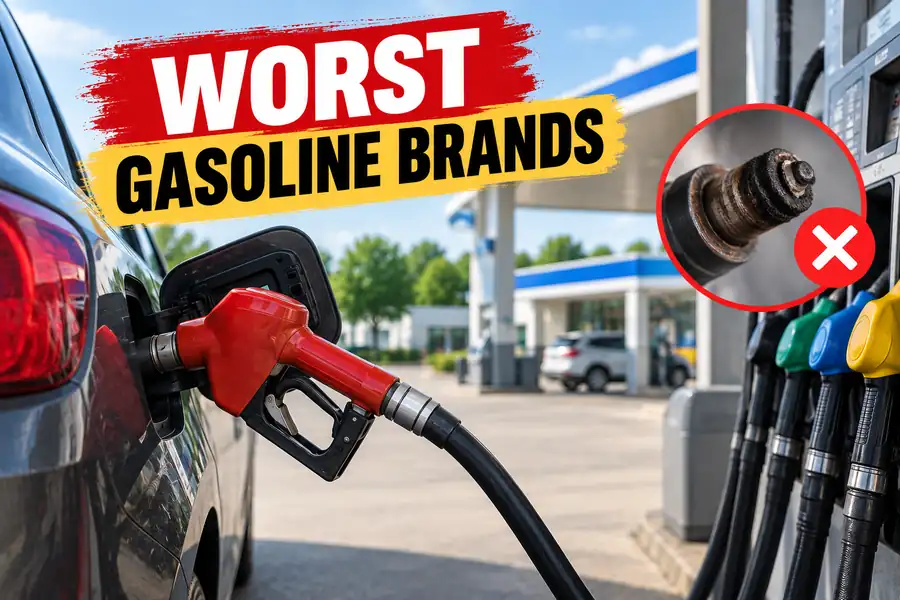
For that reason, there is no scientifically reliable universal list of “worst gasoline brands.” Fuel quality can vary by location, supplier, formulation, storage, and certification status. A smarter approach is to recognize the types of gasoline worth avoiding and learn how to identify better fuel before filling the tank.
What Makes A Gasoline Brand Less Desirable?
The biggest mistake people make when comparing fuel is looking only at the octane number or the price displayed on the pump. Octane tells you about resistance to engine knock; it does not tell you whether the gasoline contains an enhanced detergent package.
Federal regulations already require gasoline sold in the United States to contain a minimum level of detergent. The TOP TIER program was created because several automakers determined that the minimum federal detergent requirement was not sufficient for the cleanliness targets they wanted for modern engines.
That distinction creates two separate questions when evaluating gasoline.
The first is whether the fuel has the correct octane rating for the vehicle.
The second is whether it has an enhanced detergent package designed to control deposits.
A gasoline can have 93 octane and still not be TOP TIER. Conversely, regular 87-octane gasoline can be TOP TIER.
Non-TOP TIER Gasoline Is Not Automatically Bad
This is the most important qualification when discussing “worst gasoline brands.”
A non-TOP TIER fuel is not automatically contaminated, illegal, unsafe, or damaging. It still has to meet applicable federal fuel requirements. The difference is that it does not participate in the TOP TIER program or meet its additional detergent-performance requirements.
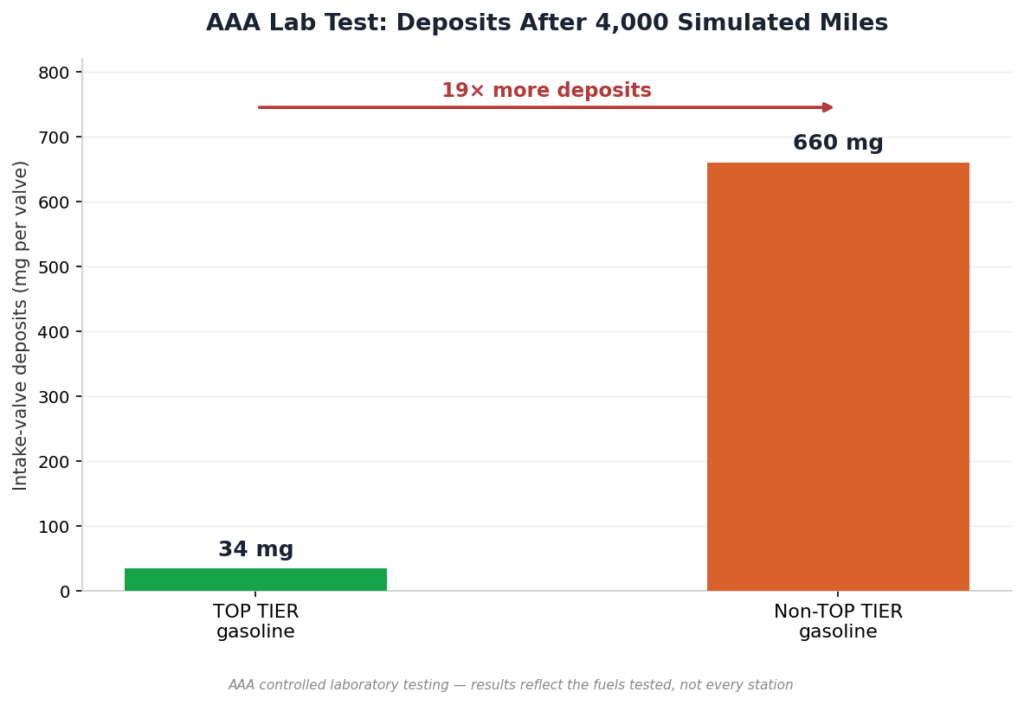
AAA’s laboratory testing found a substantial difference between tested TOP TIER and non-TOP TIER fuels. After a simulated 4,000 miles, non-TOP TIER gasoline produced 19 times more intake-valve deposits than TOP TIER gasoline in the tested conditions.
That is useful evidence, but it should not be stretched into a claim that every non-TOP TIER station produces harmful gasoline.
Fuel quality is more complicated than a simple brand-name ranking.
A station can have good fuel-handling practices without being TOP TIER, while a normally reputable brand can experience a localized storage or contamination problem.
The Most Important Red Flag Is Lack Of Enhanced Detergency
If the goal is long-term engine cleanliness, one of the clearest factors to check is whether the gasoline is certified under an enhanced detergent standard.
TOP TIER gasoline is required to meet a specific deposit-control performance standard. The program also uses station audits and fuel sampling to help verify compliance.
This makes certification more useful than simply judging a station by its logo, price, or appearance.
A consumer does not need to know the exact chemical formula inside the fuel.
Checking whether the station is currently listed as a TOP TIER gasoline retailer provides a much more practical screening method.
Cheap Gas Is Not Necessarily Poor Gas
Price alone is a weak indicator of gasoline quality.
An inexpensive station may have excellent fuel. A more expensive station may not necessarily have an enhanced detergent package.
AAA’s research found that the average price difference between TOP TIER and non-TOP TIER gasoline in its study was only about three cents per gallon.
That means choosing higher-quality gasoline does not necessarily require paying a large premium.
The bigger lesson is to avoid using fuel price as a substitute for researching fuel quality.
| Factor | What It Tells You |
| 87, 89, 91, 93 Octane | Knock Resistance |
| TOP TIER Certification | Enhanced Deposit-Control Standard |
| Low Pump Price | Price Only, Not Proof Of Poor Quality |
| Premium Grade | Higher Octane, Not Automatically Better Detergency |
| Station Cleanliness | May Indicate Maintenance, But Is Not Proof Of Fuel Quality |
| Fuel Turnover | Can Matter For Freshness |
| Tank Maintenance | Important For Contamination Control |
| Manufacturer Recommendation | Determines Appropriate Fuel Grade |
Gasoline Choices Worth Avoiding
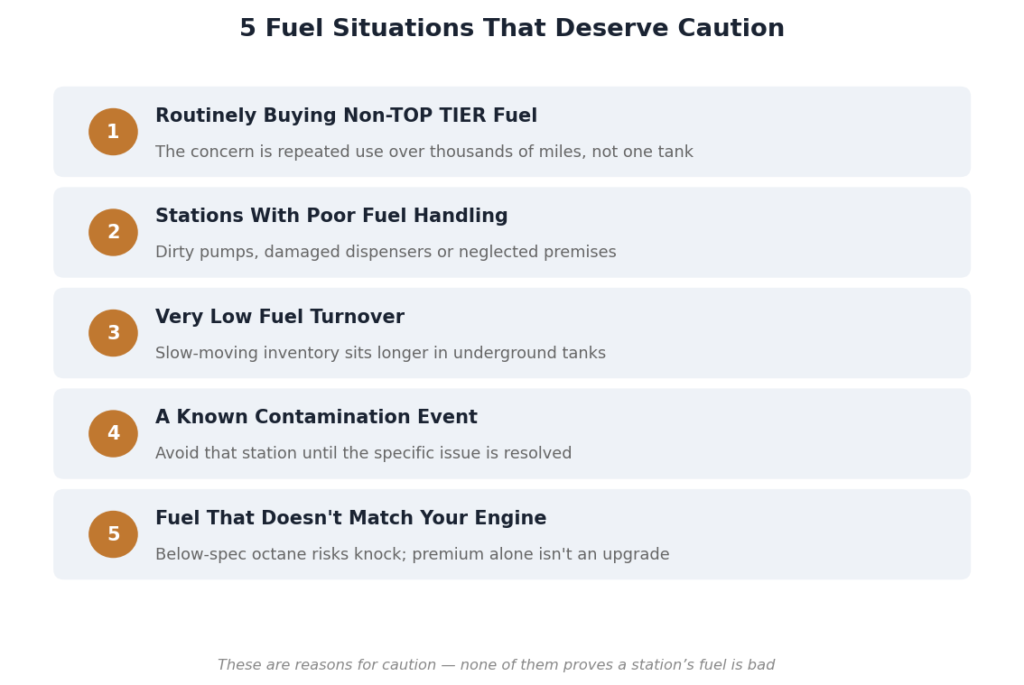
Rather than publishing an arbitrary list of companies as “the worst,” it is more accurate to identify fuel situations that deserve caution.
This approach also remains useful when fuel retailers change suppliers, add TOP TIER certification, reformulate products, or change their business arrangements.
1. Regularly Buying Non-TOP TIER Gasoline
For long-term engine cleanliness, consistently choosing gasoline that does not meet an enhanced detergent standard is one of the easiest habits to reconsider.
AAA’s testing is the strongest reason for this recommendation. Its laboratory comparison found significantly greater intake-valve deposits with tested non-TOP TIER fuel. The organization reported an average of 660 milligrams of deposits per intake valve with the non-TOP TIER fuels tested versus 34 milligrams with TOP TIER gasoline.
Modern engines can be particularly sensitive to deposits.
Gasoline direct-injection engines spray fuel directly into the combustion chamber rather than washing over the back of the intake valve. That changes the way deposits develop and makes deposit-control strategies increasingly important.
TOP TIER has also introduced a newer TOP TIER+ gasoline performance standard specifically addressing fuel-injector cleanliness for newer gasoline direct-injected engines.
This does not mean one tank of ordinary gasoline will damage your engine.
The concern is repeated use over a long period.
2. Unknown Independent Stations With Poor Fuel Handling
A small independent station should not automatically be considered a bad place to buy gasoline.
However, fuel handling matters.
Underground storage tanks collect water and sediment over time. Poor maintenance, damaged equipment, or improper tank management can potentially introduce contaminants into the fuel system.
The risk is more about the individual station’s maintenance than the name printed on the canopy.
Signs worth noticing include unusually dirty pump areas, damaged dispensers, leaking equipment, neglected premises, or a station that appears to have extremely low fuel turnover.
None of these proves that the gasoline is contaminated.
They are simply reasons to be more cautious.
3. Stations With Very Low Fuel Turnover
Gasoline does not become bad immediately because it sits in a tank.
However, fuel storage conditions still matter.
A busy station generally replaces its fuel inventory more frequently than a station with very little traffic. Higher turnover can reduce the amount of time fuel remains in underground storage.
This does not make a busy station automatically superior.
A well-maintained low-volume station can provide perfectly acceptable fuel, while a busy station can still experience contamination or equipment problems.
Fuel turnover should therefore be treated as one consideration rather than a quality ranking.
4. Fuel From A Station With A Known Contamination Event
This is different from simply using a non-TOP TIER brand.
If a station has an identified fuel contamination incident, such as water entering a storage tank or another confirmed fuel-quality problem, avoiding that station until the issue is resolved is sensible.
In these cases, the problem is not the brand’s overall reputation.
It is the condition of that particular station’s fuel supply.
Drivers should pay attention to local recalls, station notices, regulatory announcements, and documented fuel-quality incidents when available.
5. Fuel That Does Not Match Your Vehicle’s Requirements
A gasoline brand can be perfectly reputable and still be the wrong choice for a particular engine.
For example, some turbocharged and high-compression engines require or recommend premium gasoline.
Using a lower octane than specified can increase the risk of knock and may reduce performance.
The opposite mistake is also common.
Putting premium fuel into an engine designed for regular gasoline does not automatically make the fuel better for the engine. Premium refers primarily to octane, while detergent quality is a separate issue. AAA specifically notes that premium gasoline and TOP TIER certification are not the same thing.
The correct strategy is to use the octane recommended by the vehicle manufacturer and then choose a gasoline with strong detergent standards.
Why Detergent Additives Matter More Than Most Drivers Realize
Gasoline is not simply refined petroleum poured into a tank.
Commercial gasoline contains additive packages designed to influence properties such as deposit control, corrosion protection, fuel stability, and other aspects of fuel performance.
Detergents are particularly important because engines continuously expose fuel-system components to heat and combustion byproducts.
Deposits can form on fuel injectors, intake valves, pistons, and combustion-chamber surfaces.
Engine Deposits Can Change How A Vehicle Runs
Deposits do not always create an immediate failure.
The more common issue is gradual change.
An engine may develop rougher idle quality, hesitation, reduced efficiency, or altered combustion behavior as deposits accumulate.
AAA notes that deposits can contribute to reduced fuel economy, increased emissions, and performance problems. Its research also found that switching to TOP TIER fuel could help remove some deposits that had already formed in a high-mileage engine.
This is one reason fuel quality should be considered preventive maintenance.
The goal is not to wait for symptoms.
The goal is to reduce the conditions that contribute to them.
Direct Injection Makes Deposit Control More Interesting
Gasoline direct injection has changed modern engine design.
In a traditional port-injected engine, fuel is sprayed into the intake port before entering the combustion chamber. That means gasoline can contact the back side of the intake valve.
With direct injection, the injector sprays fuel directly into the cylinder.
As a result, fuel does not provide the same washing effect on the intake-valve surface.
This is one reason detergent technology has received more attention as engine designs have evolved.
TOP TIER’s newer gasoline performance standard includes a fuel-injector cleanliness test aimed specifically at newer GDI engines.
That does not mean every direct-injection engine will develop serious deposits.
It means fuel formulation and deposit control deserve greater attention than they once did.
Detergent Quality Is Different From Octane
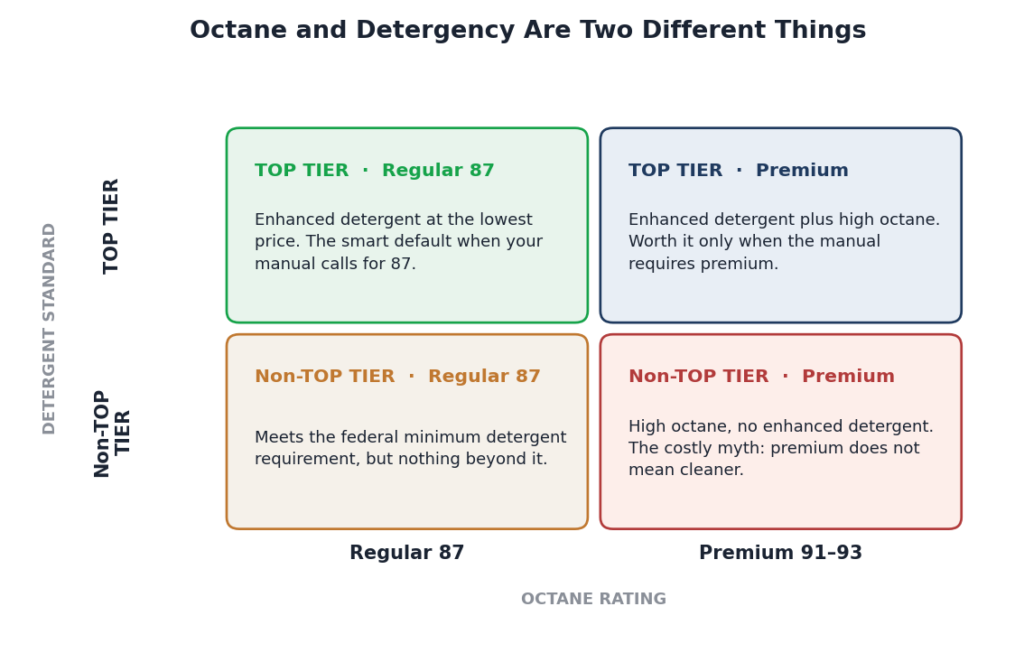
This distinction deserves repeating because it causes enormous confusion at fuel pumps.
Octane rating measures resistance to autoignition or engine knock.
Detergent additives are concerned with deposit control and cleanliness.
Therefore:
Premium does not automatically mean cleaner.
Regular does not automatically mean dirty.
TOP TIER regular gasoline can provide enhanced detergent performance.
Non-TOP TIER premium gasoline can have high octane without meeting the TOP TIER detergent standard.
A driver who needs 87 octane can therefore choose a TOP TIER 87-octane fuel without paying for unnecessary premium fuel.
That is often a more logical strategy than buying 93 octane simply because the driver assumes it is “better.”
How To Identify Better Gasoline At Any Station
Choosing gasoline does not have to become complicated.
A few simple checks can eliminate much of the guesswork.
Check The TOP TIER Station List
The TOP TIER organization maintains a list of licensed gasoline brands.
Its current gasoline-brand directory includes numerous retailers across the United States and other countries. The program states that the performance standard applies to all octane grades sold under a licensed retail brand.
That is useful because consumers do not have to compare chemical specifications at the pump.
They can simply check whether the retailer participates.
It is still sensible to verify the current status because certification lists can change.
Do Not Judge Fuel By The Pump Color
Pump colors are not a reliable universal indicator of fuel quality.
Different companies use different colors and branding.
One retailer may use a particular color for regular gasoline while another uses the same color for premium.
Always read the octane label and fuel grade.
Follow The Owner’s Manual
The owner’s manual is the most important source for octane requirements.
If the manufacturer says 87 octane is acceptable, there is usually no reason to automatically buy 91 or 93.
If premium is required, do not substitute regular simply because another station sells it more cheaply.
Fuel quality and octane are separate decisions.
Consider Fuel Turnover
A busy station can have a practical advantage because its tanks are replenished more frequently.
Look for stations that appear to have consistent customer traffic.
Again, this is not proof of fuel quality.
It is simply another reasonable factor when choosing between otherwise similar stations.
Pay Attention To Your Vehicle
Your vehicle can provide useful clues.
If the engine suddenly develops repeated hesitation, rough running, poor acceleration, hard starting, or an illuminated Check Engine Light after refueling, consider the fuel as one possible factor.
Do not automatically blame the gasoline.
Many mechanical and electrical faults create exactly the same symptoms.
A proper diagnosis is needed before concluding that fuel quality caused the problem.
What About Major Gasoline Brands?
Major brands often receive strong consumer recognition because of their advertising, station networks, rewards programs, and perceived consistency.
But brand reputation alone should not be used as a technical measurement of fuel quality.
The more useful question is whether the specific retailer is currently participating in an enhanced fuel-quality program.
The TOP TIER directory currently lists numerous major brands, including BP, Chevron, Citgo, Conoco, 76, ARCO, and others.
This demonstrates why blanket statements such as “Brand X has the worst gas” can be misleading.
A retailer may join a certification program, change suppliers, or alter its fuel strategy.
Likewise, an independent station can sell compliant gasoline without being part of TOP TIER.
Why Brand Rankings Are Difficult To Maintain
Gasoline is a commodity product with complex supply chains.
A branded station may not necessarily have gasoline refined exclusively by the company whose logo appears above the pump.
Different regions can have different fuel supply arrangements.
Seasonal gasoline requirements can also change formulations.
That makes internet lists claiming that one company universally has the “worst gasoline” unreliable unless they provide current, controlled laboratory evidence covering the specific products being compared.
A high-authority automotive guide should therefore avoid treating an old test or anecdotal complaint as a permanent ranking.
Gasoline Quality Can Vary By Location
Regional differences matter.
Fuel formulation can be affected by environmental regulations, seasonal requirements, refinery supply, transportation, and local fuel specifications.
The gasoline sold at two stations carrying the same brand name can therefore pass through different supply chains.
This is another reason a brand-only ranking is not a reliable method for judging fuel.
The individual station and its certification status can be more useful indicators.
What About Supermarket And Discount Gas Stations?
Discount fuel is not automatically inferior.
Some supermarket chains and discount retailers participate in enhanced gasoline programs.
The key question is not whether a station sells groceries, has a warehouse-club membership, or offers a lower price.
It is whether its gasoline meets the relevant quality requirements.
Costco, for example, is listed among the licensed TOP TIER gasoline retailers.
This is a useful reminder that price and fuel quality are not opposites.
A discount retailer can provide gasoline that meets a stringent detergent standard.
Why Some Cheap Gas Can Still Be A Smart Choice
A lower-priced station with strong detergent certification can be a sensible place to fuel.
The driver gets the benefit of a competitive price without necessarily giving up the enhanced deposit-control standard.
This is why checking certification is more useful than assuming expensive gasoline must be better.
Why Rewards Programs Should Not Be The Main Factor
Fuel rewards can save money, but they tell you little about gasoline chemistry.
AAA found that rewards programs were a significant factor in station choice, but fuel quality was much less frequently cited by consumers.
Rewards are useful when they reduce the cost of appropriate fuel.
They should not replace checking whether the station offers gasoline that meets the standards you want.
Signs That Your Car May Be Sensitive To Fuel Quality
Not every fuel-related symptom is caused by gasoline.
However, several symptoms can justify checking fuel quality as part of a broader diagnosis.
Rough Idle
A rough idle can have dozens of causes.
Dirty injectors, intake leaks, ignition faults, engine mounts, vacuum problems, incorrect air measurement, and deposits can all contribute.
If rough running began after repeated use of a lower-detergency fuel and improves after switching fuel sources, fuel quality may have contributed.
That does not prove causation.
Hesitation During Acceleration
A hesitation under acceleration can be related to fuel delivery.
Possible causes include clogged injectors, low fuel pressure, ignition problems, throttle issues, turbocharger problems, or incorrect sensor readings.
Fuel quality should be considered as one possibility rather than assumed to be the answer.
Reduced Fuel Economy
Fuel economy naturally changes with weather, traffic, tire pressure, driving style, vehicle load, fuel blend, and mechanical condition.
AAA’s research has associated non-TOP TIER gasoline with lower fuel economy in its testing and cited a 2% to 4% reduction in some secondary findings.
Real-world results will vary.
A small mileage change over one tank is not enough evidence to blame gasoline.
Look for a consistent pattern over several fill-ups.
Check Engine Light
A Check Engine Light should never automatically be blamed on gasoline.
Poor-quality or contaminated fuel can contribute to certain engine-control problems, but the same light can be triggered by oxygen sensors, ignition components, evaporative-emissions systems, catalytic converters, fuel-pressure issues, and many other faults.
The correct response is to retrieve diagnostic information and identify the actual cause.
What To Do If You Think You Got Bad Gas
The first step is to avoid panic.
A single questionable tank does not automatically mean an engine has been damaged.
Stop Driving If The Engine Is Running Extremely Poorly
If the engine starts misfiring badly, stalls repeatedly, loses significant power, or develops severe symptoms immediately after refueling, avoid continuing to drive unnecessarily.
Severe misfires can damage the catalytic converter.
The vehicle may need professional diagnosis.
Keep The Fuel Receipt
A fuel receipt can be valuable if there is a confirmed fuel-quality problem.
Keep the date, station location, pump number if available, and amount purchased.
If several customers report similar problems after fueling at the same station, the information can help establish a pattern.
Do Not Immediately Add Random Additives
Fuel-system cleaners are widely available, but adding several different products without diagnosing the problem can make troubleshooting more complicated.
Some additives are designed for specific applications.
Others may not be appropriate for every engine or fuel system.
Follow the vehicle manufacturer’s recommendations and the product’s instructions.
Have The Fuel System Tested When Appropriate
If contamination is suspected, a technician can inspect the fuel system and, where appropriate, obtain a fuel sample.
Water contamination, incorrect fuel, or significant particulate contamination requires a different response from ordinary deposit buildup.
Do not treat all fuel problems as detergent problems.
Best Strategy For Choosing Gasoline
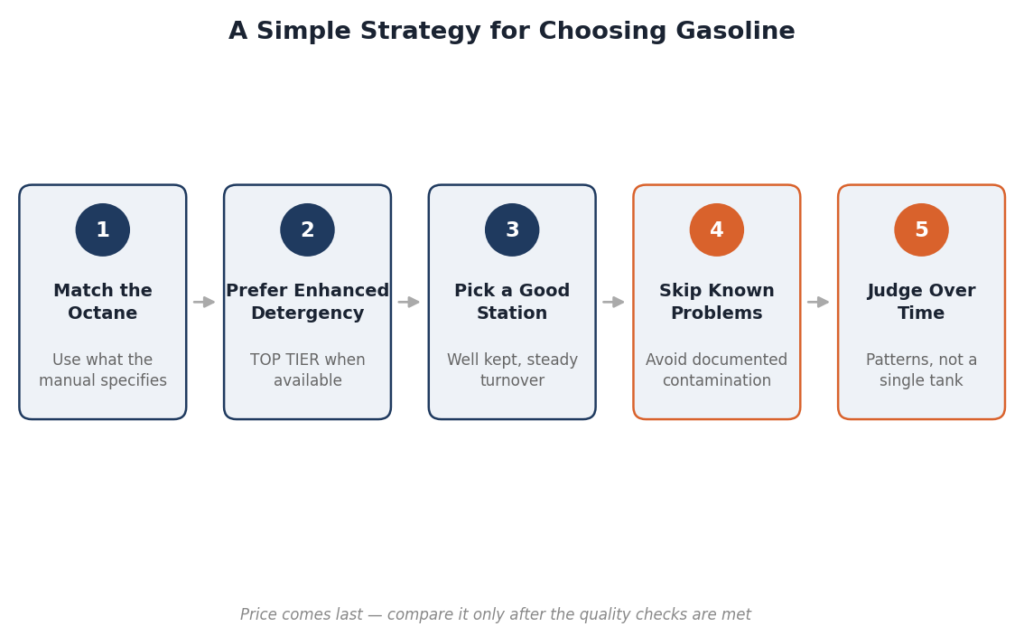
For most gasoline-powered vehicles in the United States, a simple strategy works well.
First, use the octane specified by the manufacturer.
Second, when practical, choose gasoline from a retailer that meets an enhanced detergent standard such as TOP TIER.
Third, favor stations that appear well maintained and have consistent fuel turnover.
Fourth, avoid stations with known contamination incidents.
Fifth, pay attention to how your vehicle behaves over time rather than judging gasoline based on one tank.
| What To Check | Recommended Approach |
| Octane | Follow Manufacturer Recommendation |
| Detergent Quality | Prefer TOP TIER When Available |
| Station Condition | Choose Well-Maintained Locations |
| Fuel Turnover | Prefer Regularly Used Stations When Practical |
| Price | Compare After Quality Requirements Are Met |
| Premium Fuel | Use When Required Or Recommended |
| Fuel Additives | Use Only When Appropriate |
| Symptoms After Refueling | Diagnose Before Blaming Fuel |
The Real Meaning Of “Worst Gasoline”
There is no responsible universal ranking of the worst gasoline brands.
The available evidence supports a more useful conclusion.
Gasoline that only meets minimum requirements may provide less deposit-control performance than gasoline meeting enhanced detergent standards. AAA’s controlled testing found dramatically greater deposits with tested non-TOP TIER fuel after simulated mileage.
That does not make every non-TOP TIER station a bad business.
It does not mean a tank of ordinary gasoline will destroy an engine.
And it certainly does not prove that one particular national brand is universally the worst.
The bigger issue is repeated fuel selection over thousands of miles.
Modern engines have tighter emissions requirements, advanced fuel injection, turbocharging, high compression ratios, and increasingly sophisticated engine-control systems.
Keeping the fuel system and combustion process clean therefore has practical value.
Frequently Asked Questions
What Are The Worst Gasoline Brands To Avoid?
There is no scientifically reliable permanent ranking of the “worst” gasoline brands. A better approach is to be cautious about gasoline that does not meet enhanced detergent standards, stations with documented contamination problems, and fuel that does not match your vehicle’s required octane. Brand status can also change over time.
Is Non-TOP TIER Gas Bad For Your Car?
Not necessarily. Non-TOP TIER gasoline still has to meet applicable federal requirements, including minimum detergent requirements. However, AAA testing found that tested non-TOP TIER gasoline produced substantially more deposits than tested TOP TIER gasoline after 4,000 miles of simulated driving.
Does Cheap Gas Damage Your Engine?
Cheap gasoline does not automatically damage an engine. Price is not a reliable measurement of fuel quality. Some low-cost retailers participate in enhanced fuel-quality programs, while some expensive gasoline may not. Check the station’s current certification and use the octane specified by your vehicle manufacturer.
Is Premium Gasoline Always Better?
No. Premium gasoline primarily refers to higher octane. It is not automatically cleaner or better for every engine. A regular-grade gasoline can meet TOP TIER detergent requirements, while premium gasoline can lack that certification. Use the octane recommended by the vehicle manufacturer and consider detergent quality separately.
Can Bad Gas Cause A Check Engine Light?
Contaminated or inappropriate fuel can contribute to engine problems and may trigger diagnostic faults, but a Check Engine Light has many possible causes. Ignition faults, oxygen sensors, fuel-pressure problems, emissions components, intake leaks, and other issues can produce similar symptoms. A diagnostic scan is the proper way to identify the cause.
What Is The Best Type Of Gasoline For Long-Term Engine Health?
Use the octane recommended by the vehicle manufacturer and, when available, choose gasoline that meets an enhanced detergent standard such as TOP TIER. Also use reputable, well-maintained stations and avoid known contamination incidents. Fuel quality is only one part of engine longevity; proper oil changes, air filtration, maintenance, and timely repairs remain important.
Final Thoughts
Choosing gasoline should not be reduced to a simple list of good and bad brands.
The more useful distinction is between minimum-compliance fuel and gasoline that meets stronger deposit-control standards.
Federal regulations provide a baseline, while programs such as TOP TIER establish additional requirements for detergent performance. AAA’s independent testing provides evidence that these enhanced detergent packages can make a substantial difference in engine deposits.
For everyday drivers, the practical formula is simple: use the correct octane, prefer enhanced-detergency gasoline when available, choose a well-maintained station, and avoid known fuel-contamination problems.
There is also no reason to assume that the cheapest pump is automatically the worst or that the most expensive pump is automatically the best.
A better decision comes from looking beyond the logo and price.
Check the fuel standard.
Check the octane requirement.
Consider the condition of the station.
And most importantly, judge gasoline quality using current, verifiable information rather than old internet rankings or isolated customer complaints.
That approach gives your engine a better chance of staying clean while avoiding unnecessary fuel expenses and unsupported claims about individual gasoline companies.