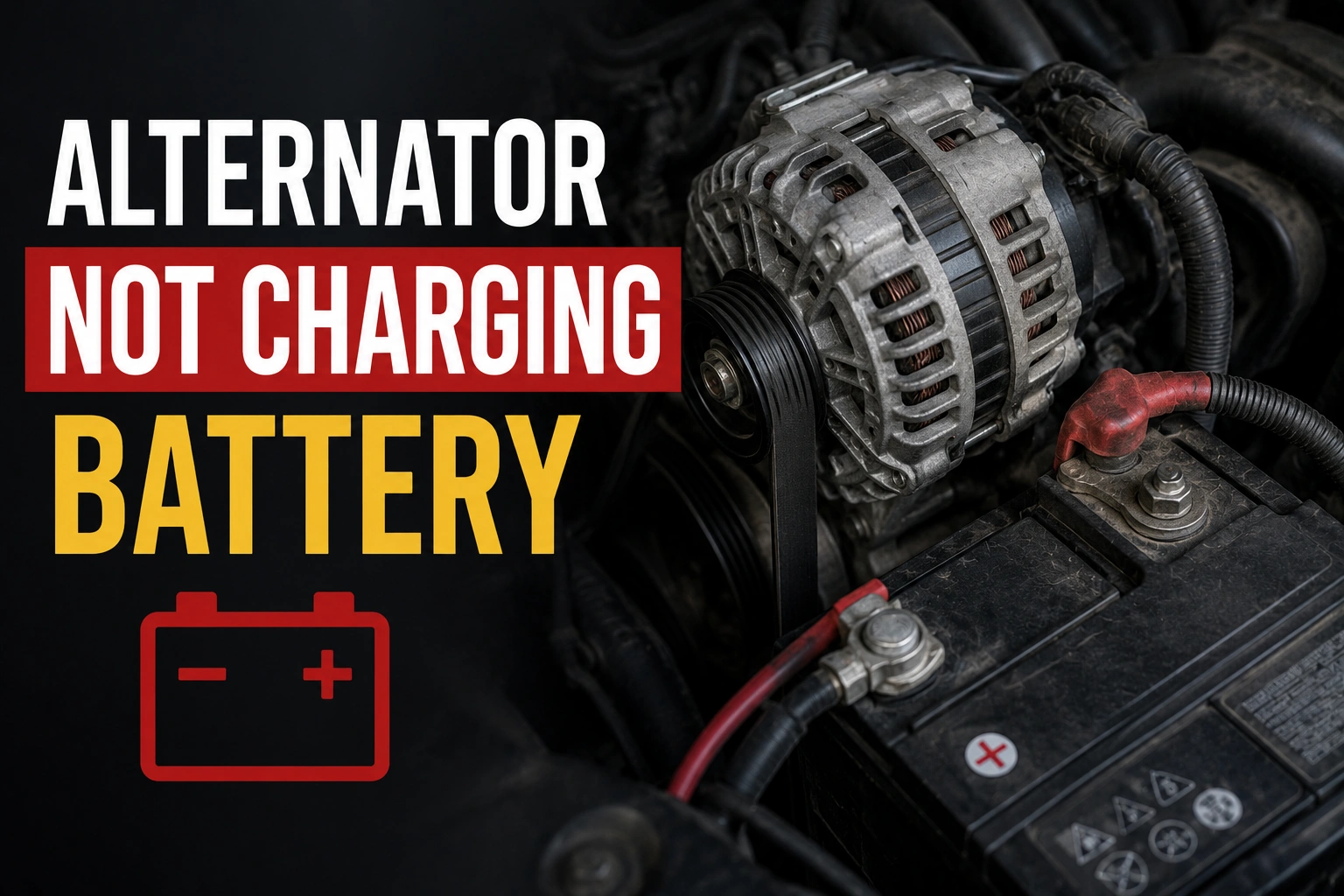
Every car battery has a silent partner working behind the scenes. That partner is the alternator, spinning quietly under the hood each time the engine runs.
Its job is simple on paper: convert mechanical motion into the electricity a vehicle depends on. In practice, dozens of small components have to work together for that job to succeed.
Most drivers never think about this part until the morning their car refuses to start. By then, the battery usually takes the blame, even though the real fault often sits one step upstream.
A charging system rarely fails with a loud bang. It creeps in through dim headlights, a flickering dashboard icon, or an engine that cranks a touch slower each day.
Below are the real causes behind a failing charging system, the early clues that give it away, and the fixes mechanics actually rely on instead of quick, temporary patches.
How The Alternator Keeps Your Battery Charged
A car battery alone cannot power a vehicle for long. It starts the engine, then hands the workload over to the alternator within seconds.
From that point on, the alternator runs the entire electrical system and tops up the battery at the same time.
The Charging Circuit In Simple Terms
An alternator is essentially a small generator bolted to the engine. A rubber serpentine belt spins its pulley every time the engine turns over.
Inside, a spinning rotor creates a rotating magnetic field. That field passes through copper windings called the stator, and this movement induces alternating current.
Since a car battery and most electronics run on direct current, the alternator cannot stop there. A set of diodes, arranged in what’s called a rectifier bridge, convert that alternating current into usable direct current.
The output then splits two ways. Part of it recharges the battery, replacing what the starter motor used moments earlier.
The rest powers everything running while the engine is on, from headlights to the infotainment screen. A healthy alternator typically pushes out between 13.5 and 14.5 volts.
Anything noticeably below that range, and the battery starts losing the tug of war against the vehicle’s electrical demand.
Role Of The Voltage Regulator And ECU
Raw alternator output alone would fry a car’s electronics without control. That job belongs to the voltage regulator, which limits output to a safe, steady range.
Older vehicles used a simple mechanical or electronic regulator bolted to or built into the alternator itself. It reacted only to voltage, nothing else.
Most vehicles built after the mid 2010s use what’s often called a smart charging system instead. Here, the engine computer decides how much voltage the alternator should produce at any given moment.
This decision depends on battery temperature, state of charge, and even fuel economy targets. A fully charged battery on a warm day might see the alternator ease off to around 13 volts, saving a small amount of fuel.
That single fact confuses plenty of home diagnostics. A voltage reading that looks low isn’t always a fault.
It could simply be the computer deliberately throttling output because the battery doesn’t need a full charge yet.
Warning Signs Of An Alternator Not Charging The Battery
A failing alternator rarely stays quiet for long. It leaves clues well before a car refuses to start completely.
Dashboard And Warning Light Clues
The battery shaped warning light is the most obvious clue, though its name confuses drivers every day. That icon actually reports on the entire charging system, not just the battery itself.
When it glows while the engine runs, the computer has detected voltage outside the normal charging range. It might flicker at first before staying on permanently.
Some vehicles pair this with a text alert like “Service Charging System” or “Check Alternator” on the driver display. Others simply dim the dashboard backlighting along with the icon.
Ignoring this light rarely ends well. Drivers who keep going often find themselves stranded within an hour or two, once the battery’s reserve runs out completely.
A quick glance at the dash each morning costs nothing and catches this problem early.
Electrical And Performance Clues
Headlights that dim at idle and brighten as engine speed rises point straight at the charging system. Idle speed generates the least alternator output, exposing weak charging fastest.
Power windows and seats may move slower than normal. Some drivers first notice their radio cutting out briefly or the clock resetting itself after every drive.
A whining or growling noise from the front of the engine often comes from failing alternator bearings or a slipping belt. That sound usually gets louder as more electrical accessories switch on.
The most telling clue is a car that starts fine in the morning but refuses to start again after running errands.
That pattern points at a battery that never actually recharged during the drive, not a battery that failed on its own.
Common Causes Behind Alternator Charging Failure
Not every charging problem starts inside the alternator itself. Several causes sit outside it entirely, and they’re often the cheapest to fix.
A slipping or snapped serpentine belt tops the list. Without steady rotation, the alternator can’t spin fast enough to generate a usable charge.
Corroded battery terminals come a close second. Even a thin layer of white or greenish buildup can choke the connection enough to block proper charging.
A worn voltage regulator, whether standalone or built into the alternator, throws voltage output outside its safe range. Some units overcharge, cooking the battery, while others undercharge and starve it slowly.
| Cause | What Happens | Typical Fix |
| Worn or slipping serpentine belt | Alternator spins too slowly or not at all | Replace belt, check tensioner |
| Corroded battery terminals | Resistance blocks current flow to the battery | Clean terminals, tighten clamps |
| Faulty voltage regulator | Output voltage drifts too high or too low | Replace regulator or alternator |
| Worn brushes or slip rings | Inconsistent or zero electrical contact inside the alternator | Replace brush set or alternator |
| Bad diode in the rectifier bridge | AC current leaks through, draining the battery overnight | Replace alternator or diode pack |
| Blown fuse or damaged wiring | Charging circuit breaks completely | Inspect fuses, repair wiring |
| Loose or cracked pulley | Belt slips under load, charging drops intermittently | Replace pulley, retension belt |
A battery that’s simply old often mimics a bad alternator perfectly. It accepts a surface charge, drives fine for a day or two, then dies again without warning.
The real test is measuring voltage while the engine runs, not just before starting it. A battery problem shows low voltage at rest that a running alternator instantly corrects.
A parasitic draw complicates this picture further. A dome light left ajar, a faulty relay, or an aftermarket stereo installed incorrectly can drain even a perfectly healthy battery overnight.
This mimics a charging fault closely, since the car dies at rest despite a fully functional alternator. A simple way to test connects a multimeter between the negative terminal and its cable, then pulls fuses one at a time until the draw disappears from the reading.
Alternator Fault Versus A Simply Weak Battery
Confusing these two problems wastes both time and money. Many drivers replace a battery twice before finally testing the alternator that caused the original failure.
A weak battery alone still lets the alternator push voltage up close to normal once the engine runs, even if it climbed slowly. A true alternator fault keeps that number flat no matter how long the engine runs.
Jump starting offers another clue. A car with only a bad battery starts instantly and keeps running fine afterward.
A car with a bad alternator restarts too, then stalls again within minutes once the jump pack’s boost fades.
Age matters as well. Most batteries last three to five years, while alternators often run seven to ten years before wearing out under normal conditions.
A five year old battery failing on schedule points to the battery first.
How To Test And Diagnose A Non-Charging Alternator
Confirming a charging problem takes minutes with the right approach. No special mechanic training is required for the first two tests.
Multimeter Voltage Test At Home
A basic digital multimeter, available cheaply from any hardware or auto parts store, handles this test easily. Set it to DC volts and touch the leads to the battery terminals.
With the engine off, a healthy battery reads between 12.4 and 12.7 volts. Anything below 12.2 volts suggests the battery itself needs charging or replacing before testing further.
Start the engine and take the reading again. A properly functioning alternator should push that number up to somewhere between 13.5 and 14.8 volts.
If the reading barely moves from the resting voltage, the alternator isn’t charging at all.
If it climbs past 15 volts, the regulator is likely overcharging, which damages the battery just as fast as no charge does.
Remember that surface charge can trick this test right after a drive. Turn on the headlights for two minutes first to bleed off that false reading before testing at rest.
| Test Condition | Normal Reading | What A Bad Reading Means |
| Engine off, resting | 12.4 to 12.7 volts | Below 12.2V means a weak or dying battery |
| Engine running, idle | 13.5 to 14.8 volts | No rise means the alternator isn’t charging |
| Engine running, AC and lights on | Stays above 13.2 volts | A drop here means weak alternator output under load |
| Engine running, above 15 volts | Not normal at any load | Regulator is overcharging and cooking the battery |
Professional Load Test And Diode Check
Home testing only goes so far. Auto parts stores and repair shops use a load tester that applies real electrical demand while measuring how the alternator responds.
This test reveals problems a simple voltage reading misses, especially an alternator that charges fine at idle but collapses the moment headlights, AC, and the radio all draw power together.
A diode ripple test catches a specific and sneaky fault: one bad diode inside the rectifier bridge. This lets a small amount of AC current leak into the DC circuit.
That leaked ripple shows up as a faint hum through the car stereo and slowly drains the battery even when the car sits parked overnight.
Most home multimeters can’t catch this the way a shop’s oscilloscope or specialized tester can.
Many auto parts chains run this full test free of charge, provided the battery and alternator can be brought to the counter or tested with the hood open.
Fixing The Problem And Preventing It Again
Not every charging fault means buying a new alternator. Some fixes cost less than a tank of fuel and take under an hour.
Deciding Between Repair And Replacement
A slipping belt, corroded terminal, or blown fuse costs very little to fix. Parts alone often run $15 to $40 for these smaller repairs.
A failing voltage regulator sold as a separate part is also a relatively affordable fix on many older vehicles. Replacing just that component can restore normal charging without touching the alternator body.
Once the fault moves inside the alternator itself, like worn brushes, a burnt stator, or a cracked diode, replacement usually makes more financial sense than a rebuild.
A remanufactured alternator typically runs $150 to $400 in parts, with labor adding another hour or two on most engines.
Some transverse mounted engines bury the alternator behind other components, pushing labor time and cost higher on those specific layouts.
Comparing that number against a brand new battery, which fails again quickly if the real fault sits at the alternator, makes the choice fairly clear for most owners.
Simple Habits That Protect Your Charging System
A charging system rarely fails without warning signs building for weeks beforehand. A few small habits catch trouble long before it strands anyone.
Popping the hood every few months to check belt tension and look for cracks takes less than a minute. A belt that flexes more than half an inch under thumb pressure needs attention soon.
Cleaning battery terminals with a wire brush and a baking soda solution prevents the corrosion that quietly kills charging efficiency. A thin coat of dielectric grease afterward keeps that buildup from returning.
Turning off headlights, interior lights, and accessories before shutting off the engine reduces strain on the alternator during startup.
Small reductions like this add years to both the alternator and the battery.
Getting the charging system tested during every oil change costs nothing at most shops and catches a weakening alternator long before it fails completely on the road.
A charging system rarely fails out of nowhere. Small clues build for days or weeks, waiting for a driver willing to notice them.
Catching a slipping belt or a corroded terminal early costs far less than a tow truck and a replacement alternator. The habits covered above take minutes and prevent most roadside failures entirely.
Keep a basic multimeter in the glovebox, glance at the dashboard each morning, and treat electrical dimming as a real clue rather than background noise. That small effort keeps the alternator and battery working reliably for years, not just months.
Frequently Asked Questions
Can a car run with a bad alternator?
A car can run for a short distance on battery power alone once the alternator stops charging. Most vehicles keep running anywhere from twenty minutes to a couple of hours, depending on how many electrical accessories stay switched on.
Headlights, air conditioning, and infotainment systems drain the battery faster and shorten that window considerably. Once the battery drops below the voltage the engine’s computer and fuel system need, the car stalls and won’t restart until it gets a fresh charge or a jump.
How long can you drive with a failing alternator?
Driving time depends heavily on the battery’s condition and what’s running electrically at the time. A newer battery paired with minimal electrical load might last close to an hour before the car stalls.
An older battery under heavy load, like night driving with headlights, wipers, and a phone charger all active, can drain in fifteen minutes or less. Pulling over safely beats pushing a failing charging system further, since a full stall in traffic creates real risk.
What is the difference between a dead battery and a bad alternator?
A dead battery struggles to start the car even on the very first attempt of the day, since it never held enough charge overnight. A bad alternator usually starts the car fine that first time, then fails to start again after a drive.
Testing voltage with the engine running settles the question quickly. A number that climbs to 13.5 volts or higher confirms the alternator works, pointing the fault back at the battery instead.
How much does replacing an alternator typically cost?
Parts alone for a remanufactured alternator usually fall between $150 and $400, depending on the vehicle’s make and model. Luxury or less common vehicles tend to sit at the higher end of that range.
Labor adds roughly one to two hours on most engines, though some layouts bury the alternator behind other components, pushing labor time and cost higher. A quote from a local shop gives the clearest picture for a specific vehicle.
Can a bad alternator damage a new battery?
Yes, and this happens more often than most drivers expect. An alternator stuck in overcharge mode pushes voltage well above the safe range, boiling the electrolyte inside the battery and warping its internal plates over time.
A brand new battery installed without first testing the alternator can fail within weeks under these conditions. Testing the charging system before replacing a battery saves both the cost and the frustration of a repeat failure.
Is it safe to jump start a car with a faulty alternator?
Jump starting remains safe even when the alternator has failed, since the process only relies on the donor battery or jump pack, not the charging system. The engine starts normally either way.
The catch is what happens next. Without a working alternator, the newly started engine draws power straight from the battery again, and the car stalls out once that charge runs down, often within the same short window as before.