The letter T has produced some of the most consequential names in automotive history — and a few that most people have never heard of, which turn out to be just as fascinating once you know their stories.
Toyota built itself into the largest car company on earth through decades of relentless quality improvement and a product range that practically covers every need imaginable. Tesla came along and forced every other manufacturer to rethink whether the internal combustion engine would still exist in twenty years. Tata Motors acquired two of Britain’s most iconic brands and turned a locomotive maker from Mumbai into a global automotive force.
Then there are the names like Tatra, Triumph, and TVR — smaller, stranger, and more intensely individual — that prove great automotive ideas do not require scale to leave a permanent mark. What follows covers all of them, in depth, along with the most significant car models whose names also begin with T.
All Car Brands That Start With T
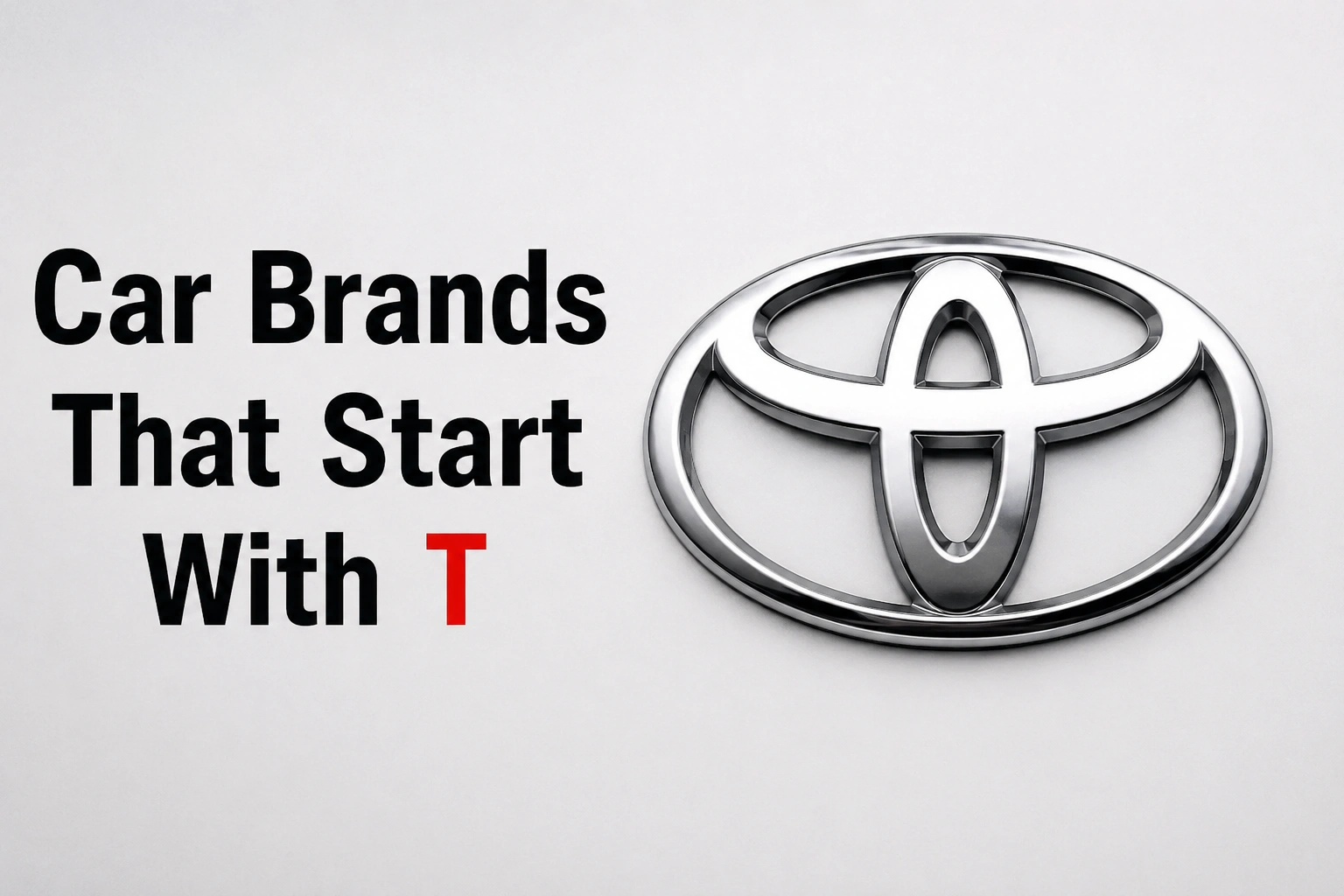
1. Toyota
- Country: Japan
- Founded: 1937
- Status: Active
- Headquarters: Toyota City, Aichi Prefecture, Japan
- Known For: Reliability, hybrid technology, the Prius, the Land Cruiser, global volume leadership
- Parent Group: Toyota Motor Corporation (also owns Lexus, Daihatsu, Hino)
Toyota is not just the world’s largest car manufacturer — it is the company that made reliability a measurable competitive advantage. Founded in 1937 by Kiichiro Toyoda as an offshoot of his father’s loom-making business, Toyota has grown from a regional Japanese automaker into a global institution that sells vehicles in more than 170 countries and routinely produces over ten million units per year.
The company’s Toyota Production System, developed in the postwar decades under the guidance of Taiichi Ohno, became the foundational model for lean manufacturing across every industry that makes physical products — not just cars. The idea of eliminating waste at every stage of production, keeping inventory minimal through just-in-time delivery, and building quality into the process rather than checking it at the end has been studied and adapted by manufacturers from electronics to aviation.
Toyota’s technical legacy is equally significant. The Prius, which launched in Japan in 1997 and globally in 2000, was the first mass-produced hybrid electric vehicle in history, introducing regenerative braking, a continuously variable transmission, and a parallel hybrid powertrain to mainstream buyers at a time when electric motors in passenger cars were still broadly seen as experimental.
That head start in electrified powertrain technology gave Toyota an enormous engineering advantage that persists today. The company is now pursuing solid-state battery development — technology that would fundamentally change the charge time, energy density, and safety profile of electric vehicles — with a commercialisation timeline that most analysts believe will arrive before any competitor.
2. Tesla
- Country: United States
- Founded: 2003
- Status: Active (NASDAQ: TSLA)
- Headquarters: Austin, Texas
- Known For: Battery electric vehicles, over-the-air software updates, autonomous driving development, Gigafactory manufacturing
- CEO: Elon Musk (from 2008)
Tesla did not invent the electric car, but it did something arguably more difficult: it made electric cars desirable. When Martin Eberhard and Marc Tarpenning founded Tesla Motors in 2003 — named after Nikola Tesla, the Serbian-American inventor who pioneered alternating current electrical systems — the company’s goal was not to produce a compromised commuter vehicle but to prove that a battery-powered car could outperform a combustion one and still be worth buying for reasons beyond environmental virtue.
The original Roadster, launched in 2008, delivered 0–60 mph in 3.7 seconds using a lithium-ion battery pack derived from laptop computer cells — a technological shortcut that was genuinely audacious for a startup with limited capital.
Elon Musk, who joined as CEO in 2008, pushed the company toward a mass-market trajectory with the Model S in 2012, the Model 3 in 2017, and the Model Y in 2020. The Model Y became the best-selling car in the entire world in 2023 — not just the best-selling EV, but the best-selling vehicle of any type, across any powertrain — a commercial outcome that would have seemed entirely implausible when the company was burning through cash to survive its early years.
Tesla’s Gigafactories in Nevada, Shanghai, Berlin, and Texas represent one of the most ambitious manufacturing scale-up operations in industrial history. The company’s over-the-air software update system, which allows vehicles to gain new features and improved performance remotely without a dealer visit, fundamentally changed customer expectations of what car ownership looks like after purchase.
3. Tata Motors
- Country: India
- Founded: 1945
- Status: Active (part of Tata Group conglomerate)
- Headquarters: Mumbai, Maharashtra, India
- Known For: Commercial vehicles, Indian passenger cars, acquiring Jaguar Land Rover, the Nano — formerly the world’s most affordable production car
- Subsidiaries: Jaguar Land Rover (acquired from Ford in 2008)
Tata Motors began life not as a car company but as a locomotive manufacturer. Founded in 1945 as TELCO (Tata Engineering and Locomotive Company) in Jamshedpur, it entered commercial vehicle production through a joint venture with Daimler-Benz in 1954, and moved into passenger cars only in 1991 when the Tata Sierra — an SUV-like multi-utility vehicle — became the first passenger car with a truly indigenous design to come from Indian industry.
What followed was a sequence of strategic moves that transformed Tata Motors from a domestic commercial vehicle producer into one of the most interesting automotive groups in the world.
The Tata Nano, launched in 2008, was one of the most ambitious social engineering projects in automotive history — a genuine attempt to produce a four-wheeled car accessible to Indian families who could otherwise only afford motorcycles, priced at one lakh rupees at launch.
The Nano’s engineering was extraordinary in its frugality: a two-cylinder 624cc rear-mounted engine, tubeless tyres, a single windshield wiper, and a body held together with adhesive rather than conventional welding in some areas, all adding up to a vehicle that cost roughly $2,000 USD at launch.
But the Nano’s acquisition of Jaguar Land Rover from Ford in 2008 for $2.3 billion was an equally audacious move that ultimately proved far more consequential. JLR has since become the principal driver of Tata Motors’ revenue and profitability, with the Range Rover and Defender generating margins that the core Indian business has never approached.
4. Tatra
- Country: Czech Republic (formerly Czechoslovakia / Austro-Hungarian Empire)
- Founded: 1850 (as Schustala & Company; cars from 1897)
- Status: Active (trucks only; passenger car production ceased 1999)
- Known For: Air-cooled rear-engined luxury cars, the world’s first aerodynamic production car (Tatra 77), backbone tube chassis design
- Historic Fact: Tatra is considered the third oldest automobile manufacturer in the world, after Peugeot and Daimler
Tatra is one of the most intellectually significant car manufacturers that most people outside Central Europe have never heard of. Founded in 1850 in what is now Kopřivnice, Czech Republic, the company began with horse-drawn carriages before producing its first automobile in 1897 — a vehicle called the Präsident, which places Tatra among the earliest car manufacturers anywhere in the world.
The company’s engineering identity was defined largely by Hans Ledwinka, the Austrian engineer who developed Tatra’s backbone tube chassis system in the early 1920s: a central tubular spine running the length of the car, with the engine, transmission, and suspension all attached to it rather than to a conventional ladder frame.
This architecture was so structurally efficient and so forward-thinking that Ferdinand Porsche acknowledged studying it when developing the Volkswagen Beetle. Tatra sued VW for patent infringement, and in 1965 Volkswagen paid one million Deutschmarks in an out-of-court settlement.
The Tatra 77, launched in 1934, was the world’s first production aerodynamic car. Its drag coefficient of 0.2455 — measured on a 1:5 scale model — was lower than many modern vehicles achieve with contemporary computational fluid dynamics tools.
The car used a rear-mounted air-cooled V8 engine, a layout that Tatra continued using through the T87 and the legendary T603 luxury saloon, which was the preferred transport of Communist-era Czechoslovak government officials.
Tatra’s ability to combine genuine aerodynamic sophistication with rear-engine packaging and independent suspension across all four corners in the 1930s puts the company in a very small group of manufacturers that were decades ahead of the industry’s mainstream direction.
5. Triumph
- Country: United Kingdom
- Founded: 1885 (bicycles); cars from 1923
- Status: Discontinued 1984 (cars); motorcycles continue under separate ownership
- Last Parent: British Leyland
- Known For: British sports cars, the TR series, Spitfire, Stag, Herald, Dolomite Sprint
Triumph’s car division occupies one of the most celebrated chapters in British sports car history, and its closure in 1984 remains one of the more mourned discontinuations in the industry. The brand started as a bicycle manufacturer in Coventry in 1885, moved into motorcycles, and entered car production in 1923.
The TR (Triumph Roadster) sports car series that began in 1952 defined the brand’s postwar character: lightweight, open-top, moderately powered, and styled with a freshness that attracted buyers who wanted something more individual than the mainstream saloons that dominated European roads.
The TR2, TR3, TR4, TR6, and TR7 each built on the last, with the TR6 of 1969–1976 — powered by a 2.5-litre straight-six producing 150 hp — widely considered the finest car the TR series ever produced.
The Dolomite Sprint of 1973 deserves particular mention because its 16-valve cylinder head was the first in any European production car — a significant engineering achievement that predated the multi-valve revolution that swept the industry in the 1980s.
The Triumph Stag, though beset by the reliability issues that plagued much of British Leyland’s output in the 1970s, remains visually one of the most beautiful cars ever to come from a British manufacturer, with a T-bar roll-over hoop integrated into its styling rather than bolted on as an afterthought. These cars continue to command strong prices and passionate ownership communities.
6. TVR
- Country: United Kingdom
- Founded: 1947
- Status: Active (limited production resumed; Griffith expected)
- Headquarters: Whitby, North Yorkshire (new ownership from 2013)
- Known For: Lightweight, high-powered, handbuilt British sports cars; Sagaris, Tuscan, Griffith (new)
TVR occupies a position in British automotive culture that is entirely its own. Founded in Blackpool in 1947 by Trevor Wilkinson — the name TVR comes from the letters in TreVoR — the company has spent its entire history building sports cars that prioritise power-to-weight ratio, tactile mechanical feedback, and individual character over the kind of refinement and reliability that mainstream manufacturers treat as minimum requirements.
TVR’s output during its peak years in the 1990s and 2000s — the Chimaera, the Cerbera, the Tuscan, and the extraordinary Sagaris — offered performance that embarrassed cars costing twice the price, packaged in bodywork that looked unlike anything else on the road.
The company was acquired in 2013 by a new ownership group led by Les Edgar, who has since worked to re-establish production in the UK. The new TVR Griffith — a front-engined, rear-wheel-drive sports car using a 5.0-litre Ford Coyote V8 engine and a carbon fibre body — has been announced with performance figures that suggest 0–60 in under four seconds from a car weighing around 1,200 kg.
Development has been slower than initially planned, but production is expected to begin at a new facility in Wales. The brand’s identity — raw, British, intensely driver-focused — has remained unchanged through every ownership transition and remains as distinctive as it was when Trevor Wilkinson first started building specials from a garage in Blackpool.
7. Talbot
- Country: France / United Kingdom
- Founded: 1903 (original); 1978 (as Chrysler Europe brand revival)
- Status: Discontinued 1994
- Parent Company: PSA Peugeot Citroën (final owner)
- Known For: European family cars under Chrysler/PSA, Talbot-Lago racing heritage, Sunbeam-Talbot models
Talbot is a name that means very different things depending on your generation and nationality. For pre-war enthusiasts, Talbot-Lago represents one of the great French luxury and racing marques — handbuilt grand tourers and Le Mans competitors of extraordinary quality.
For European buyers in the late 1970s and 1980s, Talbot was the name PSA applied to the former Chrysler Europe models — the Horizon, the Samba, and the Tagora — after acquiring Chrysler’s European operations in 1978. The revival of the Talbot name on what were essentially rebadged Chrysler products was a strategic oddity:
PSA was paying to use a name that carried significant prestige associations in racing and luxury circles on products that were, at best, competent family cars with no particular connection to that heritage. The brand was discontinued in 1994, and its passenger car legacy survived through the Peugeot products that ultimately replaced the overlapping lineup.
8. Tucker Corporation
- Country: United States
- Founded: 1946
- Status: Discontinued 1951
- Founded By: Preston Tucker
- Known For: The Tucker 48 “Torpedo” — one of the most technologically advanced American cars of its era; subject of the 1988 film Tucker: The Man and His Dream
Tucker Corporation may be the most famous one-model car company in history. Founded in Chicago in 1946 by entrepreneur Preston Tucker, the company produced exactly 51 units of the Tucker 48 before the company collapsed in 1951 amid federal fraud charges that many automotive historians have since characterised as a coordinated effort by established Detroit manufacturers and Washington interests to eliminate a disruptive new competitor.
The Tucker 48 was extraordinary by the standards of its time: a centre-mounted headlight that turned with the steering wheel, a padded dashboard and windscreen designed to absorb impact in a crash (a concept the industry would not standardise for another twenty years), a rear-mounted flat-six engine, a sealed safety compartment for the passenger, and a top speed of around 120 mph from an engine producing 166 hp.
Of the 51 cars built, 47 are believed to survive today, making them among the rarest and most historically significant American automobiles in existence.
9. Thai Rung
- Country: Thailand
- Founded: 1967
- Status: Active
- Known For: Thailand’s longest-established domestic automaker, producing bespoke utility and pick-up vehicles
- Notable Product: TRX series utility vehicles; conversions and special-purpose builds on Toyota and Isuzu platforms
Thai Rung is Southeast Asia’s best-kept automotive secret. Founded in Bangkok in 1967, it holds the distinction of being Thailand’s oldest and most established domestic car manufacturer — a title that often surprises people given how thoroughly the Thai market has been dominated by Japanese brands for most of the last half-century.
Thai Rung does not attempt to compete in the conventional passenger car segment; instead, it builds bespoke utility vehicles, special-purpose conversions, and customised pick-up derivatives on proven platforms sourced from Toyota and Isuzu. The TRX pickup, designed and built entirely in Thailand, has been exported to markets in the Middle East, Africa, and neighbouring Southeast Asian countries.
The company also produced the TRX as a pickup-based SUV conversion that predates the commercial popularity of that body style in the region. Thai Rung represents something valuable — proof that a small domestic manufacturer in a developing market can build a sustainable, export-capable business by focusing on genuine utility rather than attempting to replicate mainstream passenger car products.
All T-Brand Quick Reference
| Brand | Country | Founded | Status | Known For |
| Toyota | Japan | 1937 | Active | Global volume, hybrid tech, reliability |
| Tesla | USA | 2003 | Active | Battery EVs, software-defined cars |
| Tata Motors | India | 1945 | Active | Indian passenger cars, owns JLR |
| Tatra | Czech Republic | 1850 | Active (trucks) | Backbone chassis, air-cooled rear engines |
| Triumph | UK | 1923 (cars) | Discontinued 1984 | British TR sports cars, Dolomite Sprint |
| TVR | UK | 1947 | Limited active | Raw, lightweight British sports cars |
| Talbot | France/UK | 1903 | Discontinued 1994 | Chrysler Europe successor, Talbot-Lago racing |
| Tucker | USA | 1946 | Discontinued 1951 | Tucker 48; 51 cars; safety pioneer |
| Thai Rung | Thailand | 1967 | Active | Thailand’s oldest domestic automaker |
Car Models That Start With T (Across All Manufacturers)
1. Taycan — Porsche
- Produced By: Porsche AG (Volkswagen Group)
- Type: All-electric sports saloon, available as sedan, Sport Turismo (estate), and Cross Turismo (crossover)
- In Production: 2019–present (major update for 2024)
- Key Fact: The first series-production car to use an 800-volt electrical architecture, which enables 320 kW DC fast charging and a 10–80% charge in under 18 minutes
The Porsche Taycan is the most important electric vehicle that is not made by Tesla, and its significance to the industry extends far beyond its own sales figures. When it arrived in 2019, the Taycan proved something that had not yet been convincingly demonstrated: that a legacy performance manufacturer could build an electric car that preserved the emotional character its combustion predecessors had established over decades.
The 800-volt electrical system — borrowed from Porsche’s motorsport programme and implemented in a production car for the first time — is not just a specification point but a genuine engineering leap. Conventional EV architectures operate at 400 volts, which limits the speed at which power can be delivered to or from the battery. By doubling the voltage, Porsche halved the current required for the same power output, which means less heat generation, smaller cables, faster charging, and better sustained performance under repeated hard acceleration.
The 2024 facelift updated every dimension of the Taycan substantially. Power outputs across the range increased, with the Turbo S sedan now producing 952 PS with launch control engaged — enough to reach 100 km/h in 2.4 seconds from a car with four seats and genuine luggage capacity. Range improved by up to 35% across the lineup, with the top WLTP figure reaching 678 km for the most efficient variant.
The Sport Turismo body, which adds estate-car practicality without visually softening the car’s proportions, and the Cross Turismo, which adds raised suspension and a roof rail system for genuine multi-surface capability, have broadened the Taycan’s appeal significantly.
Porsche produced nearly 150,000 Taycans through its first five years, making it the marque’s second-best-selling nameplate after the Cayenne — another indication that the performance EV market is far larger than sceptics initially predicted.
2. Tacoma — Toyota
- Produced By: Toyota Motor Company
- Type: Mid-size pickup truck (compact in first generation)
- In Production: 1995–present (fourth generation from 2024)
- Key Fact: The best-selling mid-size pickup truck in the United States every year since 2005; manufactured exclusively in San Antonio, Texas since 2010
The Toyota Tacoma is one of the most commercially consistent vehicles in modern automotive history. Launched in 1995 as the successor to Toyota’s various compact truck models — themselves descendants of the Hilux that had been sold in North America since the 1960s — the Tacoma has held its position as the top-selling mid-size pickup truck in the United States every year since 2005, a twenty-year streak that speaks to how thoroughly it has embedded itself in a specific type of American ownership culture.
The Tacoma buyer tends to care deeply about off-road capability, long-term durability, resale value, and the kind of utilitarian practicality that does not require periodic reinvention to stay relevant. Toyota has understood this and generally evolved the Tacoma conservatively — adding technology and refining comfort without fundamentally changing what the truck is.
The fourth generation, arriving for 2024, brought the most significant changes in the model’s history. It moved to Toyota’s TNGA-F platform, shared with the Tundra, Sequoia, and Land Cruiser — a substantial upgrade in structural rigidity and refinement.
The old naturally aspirated 3.5-litre V6 was replaced by a 2.4-litre turbocharged four-cylinder producing 228 hp in standard form and 326 hp in the i-Force Max hybrid configuration. The multi-link rear suspension replaced the previous generation’s leaf springs, improving both ride quality and off-road wheel articulation.
The Trailhunter trim — an overlanding-focused variant with factory-fitted Old Man Emu suspension, ARB bumpers, and a rooftop tent mounting system — signals Toyota’s awareness that the traditional truck buyer has increasingly merged with the overlanding community.
3. Tundra — Toyota
- Produced By: Toyota Motor Company
- Type: Full-size pickup truck
- In Production: 1999–present (third generation from 2022)
- Key Fact: In 2016, a Tundra with 1,000,000 miles on its original engine was documented — the truck had never had a major engine rebuild
The Toyota Tundra has always been the outsider in the American full-size truck segment, competing against the entrenched dominance of the Ford F-Series and Chevrolet Silverado in a market where brand loyalty runs deeper than perhaps any other in the world. Its strategy has not been to outsell these competitors but to offer a compelling alternative for buyers who prioritise mechanical durability above all else — and that approach has worked well enough to sustain consistent sales.
The first generation, introduced in 1999 as the T150 before Ford’s legal challenge forced the name change to Tundra, was the first V8-equipped Toyota pickup to reach American consumers and the first full-size pickup from any manufacturer to earn a “Good” rating from the Insurance Institute for Highway Safety’s frontal offset crash test at launch, while both its Ford and GM competitors received “Poor” and “Marginal” ratings respectively.
The third-generation Tundra, arriving for 2022, finally gave the model the comprehensive overhaul that enthusiasts had been requesting for years. It replaced the long-running 5.7-litre V8 with a twin-turbocharged 3.5-litre V6 producing 389 hp — more than the old V8 — paired with a ten-speed automatic transmission.
The i-Force Max hybrid variant adds an electric motor between the engine and transmission for a combined 437 hp and 583 lb-ft of torque, with significantly improved fuel economy over any previous Tundra configuration.
The new platform also brought a more sophisticated multi-link rear suspension and a substantially more premium interior, addressing two areas where the second-generation truck had trailed its American rivals for years.
4. Tayga — Marussia / Karlmann King (Various)
Note: Several niche manufacturers have used the Tayga/Taiga name for extreme off-road vehicles; the most significant is the Taiga Orca — Canada’s first performance electric watercraft, though this falls outside automotive scope. In the broader T-model context, the term is used across several Russian and Eastern European off-road vehicles.
5. Tucson — Hyundai
- Produced By: Hyundai Motor Company
- Type: Compact crossover SUV
- In Production: 2004–present (fourth generation from 2021)
- Key Fact: Named after Tucson, Arizona — the hometown of two Hyundai design engineers who proposed the name during a naming brainstorm
The Hyundai Tucson is one of the compact crossover SUV segment’s genuine success stories — a vehicle that started as a reasonably competent but unremarkable entry in a crowded market and evolved, generation by generation, into one of the most visually distinctive and technically interesting products in its class.
The nameplate launched in 2004, replacing the Santa Fe in the smaller crossover slot, and its early generations were commercially solid without being class leaders in any specific attribute.
The transformation began with the third generation and accelerated decisively with the fourth, launched in 2021 under Hyundai’s Sensuous Sportiness design language, which produced one of the most polarising but unmistakable front-end treatments in the segment.
The parametric jewel hidden lights — daytime running lamps that blend invisibly into the body panel until switched on — and the cascading grille design gave the fourth-generation Tucson a face that either delighted or confounded observers, but nobody mistook it for anything else.
Mechanically, the fourth generation arrived with a full suite of powertrain options: a 2.5-litre naturally aspirated petrol unit, a 1.6-litre turbocharged petrol, a diesel in European markets, a conventional petrol hybrid, and a plug-in hybrid delivering up to 62 km of electric-only range. The PHEV’s all-wheel drive system uses a rear electric motor rather than a conventional rear drive shaft, giving it full electric AWD capability independently of the combustion engine.
6. Tiguan — Volkswagen
- Produced By: Volkswagen AG
- Type: Compact crossover SUV
- In Production: 2007–present (third generation from 2024)
- Key Fact: The Tiguan is Volkswagen’s best-selling model globally, outselling the Golf in most recent years — a commercial shift that reflects the broader industry-wide move away from traditional hatchbacks
When the Volkswagen Tiguan launched in 2007, it arrived as a relatively straightforward SUV built on the Golf’s platform — sensible, well-engineered, typically Volkswagen in its combination of quality and restraint.
What happened next surprised even VW: the Tiguan became the company’s most important single product, eventually outselling the Golf that had defined the brand for four decades.
This reflected a broader shift in European and global buying patterns rather than anything the Tiguan did particularly dramatically — buyers migrated from conventional hatchbacks to crossovers so thoroughly and so quickly that even the Golf, with its enormous installed base of loyal buyers, could not hold the volume it had once commanded.
The third-generation Tiguan, launched in 2024, brings the most comprehensive update in the nameplate’s history. It uses Volkswagen’s MQB Evo platform with wheelbase dimensions that provide noticeably more rear cabin space than the second generation.
The powertrain range includes a 1.5-litre eTSI mild hybrid, a 2.0-litre TDI diesel, and a 1.5-litre TSI eHybrid plug-in with a claimed 100+ km of electric range from a substantially larger battery than the previous PHEV generation.
The interior adopts VW’s latest interface philosophy with a larger curved display unit and revised touch-sensitive controls, though the brand has been attentive to criticism of the previous generation’s reliance on capacitive controls and has retained some physical switches. The Tiguan’s commercial success has been so complete that it now anchors VW’s global financial performance in a way the Golf once did.
7. Taurus — Ford
- Produced By: Ford Motor Company
- Type: Full-size front-wheel-drive family sedan
- Produced: 1985–2019 (with a gap between 2006 and 2010)
- Key Fact: The Ford Taurus was the best-selling car in the United States every year from 1992 to 1995, briefly dethroning the Honda Accord and Chevrolet Cavalier at the peak of its popularity
The Ford Taurus is one of the most important cars in American automotive history — a model that rescued Ford from a period of commercial vulnerability in the mid-1980s and then demonstrated, through its own subsequent decline, how quickly a dominant product can lose relevance when a manufacturer takes success for granted.
The original 1986 Taurus arrived as a genuinely revolutionary product for the American market: aerodynamic styling that looked nothing like the boxy sedans that had dominated the segment, front-wheel drive instead of the traditional rear-wheel layout, a thoroughly modern interior, and engineering that felt genuinely contemporary rather than derivative. It sold 263,000 units in its first year and became the best-selling car in America by the early 1990s.
The problems came with complacency. Ford updated the Taurus less frequently and less thoroughly than the market required, and by the late 1990s it was losing ground to the Toyota Camry and Honda Accord — both better-resourced updates — at a rate that Ford’s management initially underestimated.
The sixth-generation Taurus returned in 2010 as a genuinely impressive large sedan powered by a 3.5-litre twin-turbocharged EcoBoost V6 producing 365 hp in the SHO (Super High Output) variant — a genuinely fast car that received strong reviews but insufficient sales volume.
Ford discontinued the Taurus in 2019 as part of its strategic withdrawal from passenger car production in North America, ending a nameplate that had shaped American family motoring for more than three decades.
8. Touareg — Volkswagen
- Produced By: Volkswagen AG
- Type: Full-size luxury crossover SUV
- In Production: 2002–present (third generation from 2018)
- Key Fact: The first Touareg, co-developed with Porsche for the Cayenne, used the same basic platform and once held a towing record — it pulled a 285-tonne Boeing 747-400 aircraft in 2006
The Volkswagen Touareg is a more interesting vehicle than its understated market position might suggest. It was co-developed with Porsche in the early 2000s, sharing its platform with the Cayenne, and the off-road capability of that original car went far beyond what most buyers ever explored: air suspension with significant height adjustment, low-range gearing, and locking differentials as standard in higher configurations.
The Touareg’s party trick, pulling a Boeing 747-400 aircraft at London Heathrow in 2006 to set a Guinness record, was a legitimate demonstration of the towing capacity the car’s hardware could deliver rather than a marketing stunt built around artificial conditions.
The third generation, launched in 2018, moved the Touareg substantially upmarket — occupying a position in VW’s range that now competes comfortably with premium-brand SUVs from Audi, BMW, and Mercedes-Benz.
The Innovision Cockpit, featuring a 15-inch infotainment touchscreen paired with a 12-inch digital instrument display, appeared first in the Touareg before filtering to smaller models.
A plug-in hybrid variant, the Touareg R, uses a 3.0-litre V6 petrol engine combined with an electric motor for 462 hp total output, and with a 17.9 kWh battery, offers up to 48 km of electric-only range. The Touareg’s position as a flagship VW product — positioned above the Tiguan and Tiguan Allspace — makes it the brand’s halo SUV, even if it rarely commands the public profile of more aggressively marketed rivals.
9. Transit — Ford
- Produced By: Ford Motor Company (globally); Ford Otosan (Turkey, for European market)
- Type: Full-size van (light commercial)
- In Production: 1965–present (multiple global generations)
- Key Fact: The Ford Transit is the best-selling commercial van in the world by cumulative production volume, with over eight million built across all generations and markets
The Ford Transit deserves a place in any comprehensive automotive overview because its impact on commerce, industry, and everyday logistics is genuinely immense. First launched in 1965 in Europe, the Transit became the defining benchmark for the light commercial van segment — the vehicle against which every competitor was measured and the one most commonly driven by the tradespeople, courier services, and small businesses that form the backbone of developed economies.
The phrase “Transit van” entered the English language as a generic term for any large cargo van, much as “Hoover” became synonymous with vacuum cleaners, which is one of the most reliable indicators of a product’s true market dominance.
The current generation, sold globally under slightly different specifications for different markets, offers a remarkable range of body configurations: panel van, minibus, crew van, chassis cab, and platform-body versions across multiple roof heights and wheelbase lengths.
The E-Transit, introduced in 2022, brought a fully electric version with a 68 kWh usable battery delivering up to 317 km of range and a payload capacity of up to 1,758 kg. For businesses operating in urban areas with zero-emission zones, the E-Transit offers a practical transition without compromising the cargo capacity and configuration flexibility that Transit operators have relied on for decades. The fact that Ford chose the Transit as its first vehicle to electrify for the commercial sector — ahead of the F-150 Lightning in the commercial fleet context — reflects how central the van is to the company’s fleet sales strategy.
T Models At A Glance
| Model | Brand | Type | Years | Key Spec / Fact |
| Taycan | Porsche | Electric sports saloon/estate | 2019–present | 800V architecture; Turbo S 0–100 in 2.4 sec |
| Tacoma | Toyota | Mid-size pickup | 1995–present | US mid-size bestseller every year since 2005 |
| Tundra | Toyota | Full-size pickup | 1999–present | Documented 1,000,000-mile engine with no rebuild |
| Tucson | Hyundai | Compact crossover SUV | 2004–present | Parametric hidden lights; PHEV with 62km EV range |
| Tiguan | Volkswagen | Compact crossover SUV | 2007–present | VW’s global best-seller; outsells the Golf |
| Taurus | Ford | Full-size family sedan | 1985–2019 | US best-seller 1992–1995; EcoBoost SHO: 365 hp |
| Touareg | Volkswagen | Full-size luxury SUV | 2002–present | Pulled a 285-tonne Boeing 747; Touareg R: 462 hp |
| Transit | Ford | Full-size commercial van | 1965–present | World’s best-selling van; E-Transit since 2022 |
FAQs
What car brands start with the letter T?
The main car brands beginning with T are Toyota (Japan), Tesla (USA), Tata Motors (India), Tatra (Czech Republic), Triumph (UK, cars discontinued 1984), TVR (UK), Talbot (France/UK, discontinued 1994), Tucker Corporation (USA, discontinued 1951), and Thai Rung (Thailand). There are also numerous smaller and historical brands including Tramontana (Spain), Toroidion (Finland), and Turcat-Méry (France, founded 1899).
What car models start with the letter T?
Prominent car models beginning with T include the Porsche Taycan, Toyota Tacoma, Toyota Tundra, Hyundai Tucson, Volkswagen Tiguan, Ford Taurus, Volkswagen Touareg, Ford Transit, Toyota Tarago (Previa), Audi TT, Honda Talon, and the Toyota Tazz (sold in South Africa). The list across all manufacturers is extensive, spanning every segment from city cars to full-size trucks.
Is Toyota the world’s largest car manufacturer?
Yes, Toyota has consistently ranked as the world’s largest automobile manufacturer by production volume since the early 2010s. The company produces over ten million vehicles per year across its Toyota, Lexus, Daihatsu, and Hino brands and sells in more than 170 countries. It held the world sales leadership title in 2021, 2022, and 2023.
What was the Tata Nano and why did it fail?
The Tata Nano was launched in 2008 as the world’s most affordable production car, priced at approximately 100,000 Indian rupees at launch. It was designed to bring four-wheel transportation to Indian families who could only afford motorcycles. Commercial reception was significantly below projections because aspirational Indian buyers did not want to be associated with the world’s cheapest car — the “poor man’s car” label worked against it in a market where vehicle purchases carry significant social meaning. Production ended in 2018.
What is the Porsche Taycan’s 800-volt advantage?
The Taycan uses an 800-volt electrical architecture instead of the 400-volt systems found in most other EVs. This higher voltage allows the same power to be delivered at half the current, which significantly reduces heat generation in the cables and battery, enables a peak DC fast-charging rate of 320 kW, and allows the 10–80% charge to be completed in approximately 18 minutes. It also enables better sustained performance because the motors maintain output more consistently under repeated hard use.
Why did Tatra sue Volkswagen?
Tatra’s engineer Hans Ledwinka developed the backbone tube chassis and rear-mounted air-cooled engine layout in the 1920s and 1930s. When Ferdinand Porsche developed the Volkswagen Beetle, which used a similar rear-engine, air-cooled, backbone-chassis configuration, Tatra filed a patent infringement lawsuit. The German invasion of Czechoslovakia in 1939 ended the legal proceedings at the time, but the case was reopened after World War II, and in 1965 Volkswagen paid Tatra one million Deutschmarks in an out-of-court settlement.
Is TVR still making cars?
TVR was acquired by new ownership in 2013 after the previous company ceased operations around 2006. The new TVR has announced the Griffith sports car — a front-engined, rear-wheel-drive car using a Ford Coyote 5.0-litre V8 — and has been in a prolonged development and production preparation phase. Limited production is expected, though the timeline has extended beyond original projections. The brand remains legally and commercially active under Les Edgar’s ownership.
How many Tucker 48 cars survive today?
Of the 51 Tucker 48 automobiles produced before the company collapsed in 1951, approximately 47 are believed to survive, making it one of the highest survival rates of any discontinued American production vehicle. Their rarity, historical significance, and the dramatic story of Preston Tucker’s legal battles have made them among the most valuable American collector cars, with well-preserved examples selling for several million dollars at major auctions.
When did the Toyota Tacoma launch and how many generations has it had?
The Toyota Tacoma launched in 1995 as the replacement for Toyota’s compact truck lineup in North America. It has gone through four generations: the first from 1995 to 2004, the second from 2005 to 2015, the third from 2016 to 2023, and the fourth beginning in 2024. The fourth generation introduced Toyota’s TNGA-F platform and a new turbocharged 2.4-litre engine with an available i-Force Max hybrid system producing 326 hp.
What is the best-selling van in the world?
The Ford Transit is the best-selling commercial van in the world by cumulative production volume, with over eight million units built across all generations since its 1965 launch. The name has become so synonymous with the large van category in British English that “Transit” is commonly used as a generic term for any similar vehicle regardless of manufacturer.