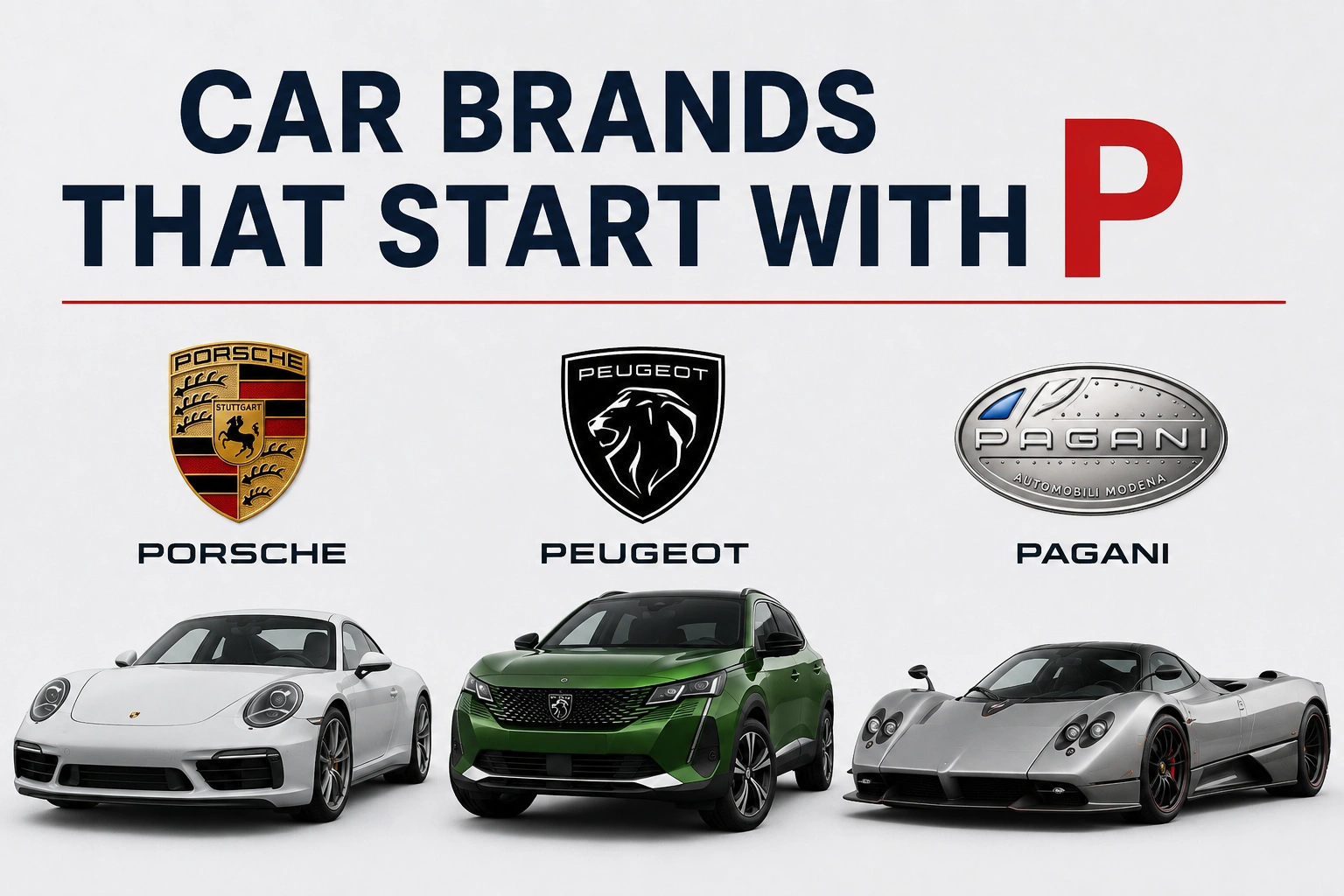
The letter P quietly holds one of the most diverse collections of automobile names in history. You have Porsche — an engineering institution built on six decades of motorsport obsession. You have Packard — once the pinnacle of American luxury, now a ghost.
You have Plymouth building winged NASCAR homologation cars in 1970, and Pagani hand-stitching leather in a Modena atelier today. Spread across this single letter are budget sedans from Malaysia, three-row SUVs from South Korea, French family crossovers, Czech track weapons, and Italian hypercars that cost more than apartment buildings.
Here we document every significant car brand and car model that begins with the letter P — not just the famous ones, but the overlooked, the discontinued, and the genuinely surprising ones too.
Car Brands That Start With P
The range of manufacturers under this letter is wider than most people realize. Some spent over a century defining what luxury or performance meant. Others built a single decade of extraordinary cars before disappearing. A few are still producing vehicles today, quietly serving markets that most automotive journalists never cover. What follows is a thorough account of every meaningful brand, presented in enough depth to actually tell you something.
1. Packard
Packard was founded in 1899 in Warren, Ohio, by brothers James and William Packard after James reportedly told a Winton car salesman he could build a better automobile — and then did exactly that.
Within two decades, Packard had become the definitive American luxury automobile, the car of choice for American presidents, royalty visiting the United States, and industrialists who wanted the best money could buy.
The 1934 Packard Twelve was powered by a 7.8-liter V12 engine producing 160 horsepower, which in the context of the era made it faster than almost anything else on public roads.
Packard’s engineering was genuinely ahead of its time — the brand introduced the first production air conditioning system in 1940, a technology that wouldn’t become mainstream for decades. The collapse came in stages. Packard merged with the ailing Studebaker Corporation in 1954, and the 1957 “Packardbaker” — essentially a rebadged Studebaker — was so far removed from the original vision that loyal customers walked away. The last true Packard was produced in 1956.
Today, pristine pre-war Packards sell for six figures at Barrett-Jackson and RM Sotheby’s, and the brand’s styling legacy still influences coachbuilders who work in the classic idiom.
2. Plymouth
Plymouth arrived in 1928 as Chrysler’s weapon in the affordable car market, designed specifically to take market share from Ford Model A and Chevrolet buyers. It worked — Plymouth became the third bestselling brand in America by 1931, just three years after launch.
The brand’s entire early identity was built on value: more car for less money, reliable transportation for working families during the Depression. Then something remarkable happened in the 1960s.
Chrysler’s engineers and marketing people, watching Ford and GM grab headlines with performance cars, decided Plymouth would become a muscle car brand. The Road Runner, Barracuda, GTX, and Superbird that followed weren’t just fast cars — they were cultural events.
The 426 cubic inch Hemi V8 that powered the best of them is still considered one of the most brutally effective production engines ever built. Plymouth was eventually discontinued in 2001, a victim of product line overlap with Dodge more than any failure of the brand itself.
3. Pontiac
Pontiac began as a companion brand to General Motors’ Oakland division in 1926, then absorbed Oakland entirely by 1932. For the first few decades it was exactly what GM wanted — a slightly more affordable alternative to Oldsmobile, sensible and profitable.
That changed in 1964 when engineer John DeLorean pushed through the GTO, a project GM management had tried to block. DeLorean’s team quietly installed a 389 cubic inch V8 into the mid-size Tempest body as an option package, knowing corporate rules prohibited putting large engines in smaller cars.
The GTO sold 32,450 units in its first year, far exceeding every projection, and effectively established the American muscle car formula that every competitor would spend the next decade trying to copy.
The Firebird, Grand Prix, and Trans Am that followed kept Pontiac’s performance reputation alive through the 1970s before badge engineering gradually hollowed out the brand through the 1980s and 1990s. GM discontinued Pontiac in 2010 during bankruptcy restructuring.
4. Porsche
Porsche was founded in Stuttgart, Germany in 1931 by Ferdinand Porsche, who had already designed the original Volkswagen Beetle and worked on Auto Union Grand Prix racers before creating his own company.
The first car bearing the Porsche name, the 356, appeared in 1948 and was essentially assembled from Volkswagen components in a sawmill in Gmünd, Austria. The 911 replaced it in 1963 and has remained in continuous production ever since — the most remarkable product longevity story in the entire automotive industry.
What makes Porsche genuinely different from other premium brands is the depth of its motorsport involvement. The company has won Le Mans outright 19 times, more than any other manufacturer.
That track experience feeds directly into road cars. The 911 GT3’s naturally aspirated flat-six engine, the carbon ceramic brakes, the active rear steering on the Turbo S — none of it is marketing.
It is engineering tested at Daytona, Le Mans, and the Nürburgring before it reaches the customer. Porsche went public in a landmark 2022 IPO that valued the company at over 70 billion euros, making it one of the most valuable automotive companies in the world.
5. Pagani
Pagani occupies a category that barely existed before Horacio Pagani created it. Horacio grew up in Argentina, moved to Italy at 26 with a letter of introduction to Lamborghini’s founder, and spent years at Lamborghini mastering carbon fiber construction before founding his own company in 1992.
The Zonda, revealed at Geneva in 1999, shocked the automotive world not because of its performance numbers but because of its aesthetic obsession. Aluminum machined components that most manufacturers would hide were displayed like jewelry.
The carbon weave patterns were specified with the same care a jeweler gives to a watch dial. The Huayra, which arrived in 2011 using an AMG-built 6.0-liter twin-turbocharged V12, pushed even further.
Pagani builds perhaps 40 to 50 cars per year across all variants. The Utopia, introduced in 2021, offered a manual gearbox option — in a car producing 864 horsepower, which is either insane or wonderful depending on your perspective.
6. Peugeot
Peugeot is one of the oldest manufacturing companies on earth. The Peugeot family was making steel tools and springs as far back as 1810, moved into bicycles in the 1880s, and produced its first automobile in 1889.
The automotive company we know today has been through wars, economic collapses, nationalization, and multiple ownership structures, and it has come out the other side as a genuine high-volume manufacturer with a distinct design voice.
The current i-Cockpit interior philosophy — a tiny steering wheel positioned below a high-mounted instrument cluster — is genuinely polarizing, but it is a real point of view rather than a committee compromise.
Peugeot has significant motorsport heritage including Dakar Rally dominance in the late 1980s and early 1990s, and the brand is now investing heavily in electrification as part of the Stellantis group. The e-208 and e-2008 are among the more complete electric small cars available in Europe today.
7. Panhard
Panhard holds an extraordinary historical claim: it is among the oldest automotive companies in the world, founded in 1887. The early Panhard et Levassor cars essentially defined what a car should look like — engine in front, transmission in the middle, drive to the rear wheels — a layout so logical it became universal.
By the 1950s Panhard had become known for something entirely different: featherlight economy cars like the Dyna, which used aluminum body panels and achieved fuel economy figures that would be respectable in a modern hybrid.
Citroën acquired Panhard in 1965, civilian car production stopped, and the company transitioned entirely to military vehicles — armored personnel carriers and light tactical vehicles that are still built and sold to armed forces around the world today.
8. Piaggio
Piaggio is primarily a motorcycle and scooter company, home of the Vespa, but earns its place here through the Ape — a three-wheeled light commercial vehicle that has been produced since 1948 and remains in continuous production.
The Ape Calessino variant, a tiny three-wheeled open taxi, is a functional vehicle across tourist destinations in Italy and throughout South and Southeast Asia.
Piaggio’s automotive footprint is genuinely small, but the Ape’s cultural and commercial impact across developing markets over seven decades is significant enough to warrant inclusion in any serious survey of P-branded vehicles.
9. Panoz
Panoz was founded in Braselton, Georgia in 1989 by Don Panoz, a pharmaceutical entrepreneur who wanted to build American sports cars the old-fashioned way. Panoz vehicles use aluminum-intensive construction to reduce weight, and they are powered by American V8 engines.
The brand competes seriously at Le Mans and Daytona, which is remarkable for a company building fewer than 50 cars per year. The GTR-1 raced at Le Mans in 1997 and 1998, running a Ford GT40 V8 mounted in front of the driver in a configuration that was genuinely unlike anything else in sports car racing at the time.
The road cars — the Esperante GT and the more recent Abruzzi — are genuinely handbuilt in small numbers and have a following among collectors who want American performance with European sports car sensibility.
10. Perodua
Perodua (Perusahaan Otomobil Kedua) is Malaysia’s second national carmaker, established in 1992 with technical assistance from Daihatsu. Unlike Proton, which has chased the mid-market and premium segments, Perodua has focused almost entirely on small, affordable, practical cars for the Malaysian domestic market and neighboring ASEAN countries.
That focus has paid off — Perodua consistently outsells Proton in Malaysia, and the Myvi has been the single bestselling car in the country for years at a time. The current lineup includes the Axia city car, Bezza compact sedan, Myvi hatchback, Ativa compact SUV, and the Alza MPV, all positioned at accessible price points with strong reliability records.
11. Proton
Proton was established in 1983 as Malaysia’s first national car project, with initial technical assistance from Mitsubishi. The Saga, launched in 1985, was a point of genuine national pride — Malaysia’s first own automobile, proof that a developing economy could build cars. International ambitions led to exports to the UK and other markets in the late 1980s, with mixed results — the early cars had quality issues that damaged the brand’s reputation abroad.
In 2017, Chinese automaker Geely acquired a 49.9% stake in Proton, bringing new platforms, technology, and investment. The current lineup — X50, X70, S70 — uses Geely-derived architectures and has received significantly better reviews than anything Proton produced independently.
12. Premier
Premier was one of India’s earliest automobile manufacturers, producing Fiat-licensed vehicles from 1947 through the 1990s. The Premier Padmini, a version of the Fiat 1100, became the standard yellow taxicab of Mumbai and is one of the most recognizable cars in Indian automotive history.
The Padmini remained in production until 1997, by which point it was entirely obsolete by international standards but still met the needs of the Mumbai taxi trade. After market liberalization opened India to international competition, Premier attempted a revival with compact SUVs but never regained relevance.
13. Pierce-Arrow
Pierce-Arrow operated from 1901 to 1938 as one of America’s most exclusive and innovative luxury carmakers, competing directly with Packard at the very top of the market.
The brand pioneered fender-mounted headlights — integrated into the bodywork rather than bolted on as a separate component — which was a genuinely radical aesthetic and engineering innovation for its time. Pierce-Arrow cars were also among the first to offer hydraulic brakes, power-assisted steering concepts, and V12 engines.
The Great Depression destroyed demand for ultra-luxury vehicles, and despite a brief partnership with Studebaker, Pierce-Arrow closed in 1938. Fewer than 2,000 Pierce-Arrow vehicles survive today, making them extremely rare museum and auction pieces.
14. Praga
Praga is a Czech manufacturer that dates to 1907 and spent most of its history building trucks, military vehicles, and commercial equipment before pivoting to high-performance track cars in the modern era.
The Praga R1 is a carbon fiber, mid-engine, turbocharged track machine that has competed and won in international endurance racing including the Britcar championship. The R1R and R1 Turbo variants produce around 380 horsepower from a 2.0-liter turbocharged four-cylinder, in a car weighing around 580 kilograms — which gives it a power-to-weight ratio that embarrasses most road cars in any price range.
Praga is an excellent example of a small European manufacturer that found a viable niche by building uncompromised track tools for wealthy enthusiasts who want to race seriously.
15. Prince Motor Company
Prince Motor Company was a Japanese manufacturer that operated from 1952 to 1966, when it was absorbed by Nissan. Prince’s engineering legacy is more significant than the brand’s short independent life suggests — the Skyline nameplate originated with Prince, and the Prince R380 racing car was genuinely competitive against Ferrari and Porsche in Japanese domestic racing in the mid-1960s.
After the Nissan merger, the Skyline continued as a Nissan product and eventually evolved into the GT-R, which means every GT-R enthusiast alive today owes something to Prince’s engineers.
| Brand | Country | Founded | Active Status | Core Identity |
| Porsche | Germany | 1931 | Active | Sports cars, SUVs, EVs — performance engineering |
| Peugeot | France | 1889 | Active (Stellantis) | Mass-market European — superminis to executives |
| Pagani | Italy | 1992 | Active | Handbuilt hypercars — carbon fiber and V12 artistry |
| Panoz | USA | 1989 | Active (low volume) | Aluminum sports cars, Le Mans competitor |
| Proton | Malaysia | 1983 | Active (Geely-backed) | Malaysian national brand — budget to mid-market |
| Perodua | Malaysia | 1992 | Active | Affordable ASEAN city and compact cars |
| Packard | USA | 1899 | Defunct 1956 | Pre-war American ultra-luxury |
| Plymouth | USA | 1928 | Defunct 2001 | Affordable to muscle car legend |
| Pontiac | USA | 1926 | Defunct 2010 | Performance identity — GTO to Firebird |
| Panhard | France | 1887 | Military vehicles only | Pioneer carmaker, now defense contractor |
| Pierce-Arrow | USA | 1901 | Defunct 1938 | Pre-war American ultra-luxury rival to Packard |
| Premier | India | 1944 | Defunct (effectively) | Fiat-licensed cars, Mumbai taxi era |
| Prince | Japan | 1952 | Absorbed by Nissan 1966 | Origin of the Skyline nameplate |
| Praga | Czech Republic | 1907 | Active (track cars) | Carbon fiber track weapons |
| Piaggio | Italy | 1884 | Active (micromobility) | Vespa, Ape three-wheelers |
Car Models That Start With P — Every Brand Covered
This section covers car models starting with P from across the entire automotive world — not just the famous ones from famous brands. The goal here is to be genuinely comprehensive. Models are grouped thematically to make the content more useful, and each receives the depth it deserves rather than a one-line dismissal.
1. Porsche Panamera
The Panamera is Porsche’s answer to a question nobody asked in 2009: can you make a proper four-door executive sedan that drives like a sports car? The answer turned out to be yes, though the first generation’s sloping roofline and awkward rear haunches took some getting used to.
The second generation, launched in 2016, solved the aesthetic problems while sharpening the dynamic character, and the Panamera has since become a legitimate rival to the Mercedes-AMG GT 4-Door and BMW M5 rather than an expensive compromise.
The current Panamera range covers a wide spectrum. The base Panamera uses a 2.9-liter twin-turbocharged V6, while the Panamera Turbo S uses a 4.0-liter twin-turbocharged V8 producing 630 horsepower.
The Panamera Turbo S E-Hybrid adds an electric motor to the V8, pushing combined output to 700 horsepower and enabling a claimed 0–100 km/h time of 3.2 seconds. The Sport Turismo wagon body variant is the most practically gifted, adding a longer roofline and proper boot space without meaningfully compromising the car’s fundamental character.
Key specifications (Panamera Turbo S E-Hybrid):
- Engine: 4.0-liter twin-turbo V8 + electric motor
- Combined output: 700 hp / 870 Nm
- 0–100 km/h: 3.2 seconds
- Top speed: 315 km/h
- Electric range: approx. 50 km (WLTP)
- Wheelbase: 2,950 mm
2. Pajero (Mitsubishi)
The Mitsubishi Pajero — sold as the Montero in North America, Shogun in the United Kingdom, and Challenger in some Southeast Asian markets — is one of the most decorated off-road vehicles in motorsport history.
It won the Dakar Rally 12 times between 1985 and 2007, a record that no other vehicle type has matched. That competition pedigree was not marketing decoration — the road-going Pajero was genuinely engineered to traverse desert, mountain, and jungle terrain that would destroy less capable vehicles.
The Pajero’s development began as a concept shown at the 1973 Tokyo Motor Show. Full production launched in 1982 with a body-on-frame construction, solid rear axle, and a suite of four-wheel drive options including a Super Select 4WD system that allowed the driver to shift between two-wheel drive, part-time four-wheel drive, and full-time four-wheel drive on the move.
Three subsequent generations refined the formula without abandoning it. The third and fourth generation models offered both short-wheelbase three-door and long-wheelbase five-door configurations, and the interior quality improved substantially in the final generation to compete with more road-focused rivals.
Mitsubishi quietly ended Pajero production in Japan in 2019, a market decision driven by the global shift toward car-derived crossovers. However, the Pajero continued in certain export markets, and its legacy lives on in the Pajero Sport — a body-on-frame mid-size SUV that carries the nameplate forward with a more contemporary character.
Key specifications (Pajero 3.8 V6 final generation):
- Engine: 3.8-liter MIVEC V6 petrol
- Power: 250 hp
- Transmission: 5-speed automatic
- 4WD system: Super Select 4WD II
- Ground clearance: 235 mm
- Approach angle: 37 degrees
- Departure angle: 30 degrees
3. Patrol (Nissan)
The Nissan Patrol is a vehicle that earns its reputation in the places where reputation is hardest to earn — the Empty Quarter of Saudi Arabia, the Outback of Australia, the track networks of sub-Saharan Africa. First produced in 1951 as a utilitarian four-wheel drive for military and government use, the Patrol has evolved through six generations into one of the most respected body-on-frame SUVs still available to civilian buyers.
The current Y62 generation, which launched in 2010 and has been continuously updated since, uses a 5.6-liter naturally-aspirated V8 petrol engine producing 405 horsepower.
That engine choice is telling — in an era when most manufacturers have turbocharged smaller engines in the name of efficiency, Nissan kept the large-displacement V8 because Patrol owners in the Middle East, Australia, and Africa value mechanical simplicity and proven durability over fuel economy figures.
The result is a truck that is genuinely overbuilt for most of what the average buyer will ever demand from it, and that overbuilt quality is precisely why Patrol owners are among the most loyal in the automotive world.
In Australia particularly, the aftermarket ecosystem around the GU and Y62 Patrol is enormous — lift kits, long-range fuel tanks, and recovery equipment designed specifically for this vehicle are sold by dozens of specialist companies.
Key specifications (Nissan Patrol Y62 V8):
- Engine: 5.6-liter VK56VD V8
- Power: 405 hp / 560 Nm
- Transmission: 7-speed automatic
- 4WD: Part-time with two-speed transfer case
- Ground clearance: 240 mm
- Towing capacity: 3,500 kg
- Fuel tank: 140 liters
4. Prado (Toyota Land Cruiser Prado)
The Toyota Land Cruiser Prado occupies a careful position in Toyota’s SUV hierarchy — more accessible and car-friendly than the full-size Land Cruiser, but built on a proper ladder-frame chassis rather than the monocoque construction used by most crossovers.
That architectural choice means the Prado gives up nothing to its larger sibling in terms of fundamental off-road engineering while being more manageable in urban environments.
The 150 Series Prado, which ran from 2009 to 2024, became the definitive version for most markets. It was available with petrol and diesel four-cylinder and six-cylinder engines, a sophisticated Kinetic Dynamic Suspension System (KDSS) that improved both on and off-road handling, and a well-appointed interior that genuinely competed with European premium SUVs on comfort and technology.
Strong resale values became one of the Prado’s defining characteristics — in markets like Australia, the Middle East, and Japan, used Prados often sell for close to their new price years after purchase, reflecting genuine confidence in the vehicle’s longevity.
The 250 Series Prado arrived in 2024 with significant changes including a 2.8-liter turbo diesel hybrid powertrain option, a completely redesigned interior with modern infotainment, and updated safety technology — while retaining the ladder-frame chassis and multi-terrain capability that the nameplate is built on.
Key specifications (250 Series Prado 2.8 Turbo Diesel Hybrid):
- Engine: 2.8-liter inline-4 turbo diesel + electric motor
- Combined output: 243 hp
- Torque: 700 Nm
- Transmission: 8-speed automatic
- 4WD: Part-time with crawl control
- Ground clearance: 215 mm
- Wading depth: 700 mm
5. Passat (Volkswagen)
The Volkswagen Passat has been a fixture of European family motoring since 1973, making it one of the longest-running automotive nameplates still in active production. Nine generations and over 30 million units sold across more than 150 countries represent a scale of commercial success that tends to get overlooked precisely because the Passat does its job without demanding attention.
It is the quintessential sensible choice — and in the D-segment family car market, sensible choices are what move volume.
The eighth and ninth generation Passats are particularly relevant. The eighth generation introduced Volkswagen’s MQB platform architecture, which underpins an enormous range of cars across the VW Group from the Golf to the Audi A3.
The ninth generation, sold in Europe exclusively as a wagon (the sedan was discontinued there), represents a sharp upgrade in both interior quality and powertrain technology. Standard equipment on European models now includes advanced driver assistance systems, digital cockpit displays, and plug-in hybrid powertrains producing around 272 horsepower in GTE specification.
In China, the Passat is a different vehicle entirely — a larger, more formal sedan tailored for a market that values rear-seat space and a more imposing presence. The Chinese Passat regularly outsells the European version by significant margins, and it uses different platforms and powertrains to match local preferences.
Key specifications (Passat Estate 2.0 TDI 4Motion):
- Engine: 2.0-liter turbocharged diesel
- Power: 200 hp / 400 Nm
- Transmission: 7-speed DSG
- Drive: 4Motion all-wheel drive
- Boot space: 650 liters (1,780 liters seats down)
- Fuel consumption: approx. 5.2 l/100km
6. Polo (Volkswagen)
The Volkswagen Polo is something of an underappreciated engineering achievement. Over six generations since 1975, it has moved from a basic economy car to a genuinely refined small car that offers a quality of build and refinement that competitors in the supermini segment still struggle to match. It sits below the Golf in VW’s lineup but shares enough DNA — particularly in the MQB A0 platform underpinning the sixth generation — that the step down from Golf to Polo is much smaller than the price gap might suggest.
The Polo GTI deserves specific attention. With 207 horsepower from a 2.0-liter turbocharged four-cylinder, it occupies the compact hot hatch segment where it competes with the Ford Fiesta ST and the SEAT Ibiza FR.
The GTI version uses a seven-speed DSG dual-clutch gearbox and offers a driving character that is genuinely engaging for a car of its size and price. The standard Polo lineup covers a wide range of specifications from the entry-level to the R-Line exterior package, with petrol and mild-hybrid powertrains available depending on market.
7. Pathfinder (Nissan)
The Nissan Pathfinder’s history is a study in transformation — and the transformation has been deeply controversial among the people who loved the original. When the WD21 Pathfinder launched in 1986, it was a compact body-on-frame SUV built on the same underpinnings as the Nissan Hardbody pickup truck.
It had solid axles, real ground clearance, and the kind of mechanical straightforwardness that made it genuinely capable off-road. The second and third generations maintained some of that identity.
The fourth generation (2012 onwards) moved to a unibody crossover platform, seating seven adults in reasonable comfort and adding fuel-efficient CVT automatic transmissions. The transformation was commercially logical — the market for three-row family SUVs was growing, and the market for body-on-frame compact off-roaders was shrinking.
But it displaced a generation of Pathfinder owners who had specifically chosen the vehicle for its capability. The current fifth generation (2022 onwards) refines the family-hauler formula with a nine-speed automatic, standard eight-seating capacity, and a Rock Creek appearance package for buyers who want to look adventurous.
Key specifications (Pathfinder Platinum AWD):
- Engine: 3.5-liter V6
- Power: 284 hp / 353 Nm
- Transmission: 9-speed automatic
- Drive: Intelligent AWD
- Seating: 8 passengers
- Towing capacity: 2,722 kg
8. Pilot (Honda)
Honda’s three-row SUV, the Pilot, launched in 2002 and has consistently represented the brand’s approach to family transportation: prioritize function, build it to last, avoid unnecessary drama. That approach has built a loyal following among families who need genuine third-row seating without the operational complexity or fuel costs of a truck-based SUV.
The fourth generation Pilot (2022 onwards) brought the most substantial changes in the model’s history. The platform was updated, the interior quality moved significantly upward, and a TrailSport variant was added — featuring all-terrain tyres, an i-VTM4 torque-vectoring AWD system, and skid plates for buyers who want occasional off-road ability.
The top-specification Elite trim offers features previously reserved for premium brands, including a panoramic sunroof, heated and ventilated second-row captain’s chairs, and a 10.2-inch digital display.
Key specifications (Pilot TrailSport AWD):
- Engine: 3.5-liter i-VTEC V6
- Power: 285 hp / 362 Nm
- Transmission: 10-speed automatic
- Drive: i-VTM4 AWD with torque vectoring
- Ground clearance: 207 mm
- Seating: 8 passengers (7 with second-row captains)
9. Palisade (Hyundai)
When Hyundai revealed the Palisade in 2019, the automotive press treated it as a surprise. Here was a three-row SUV from a brand better known for affordable reliable transportation, priced and equipped to compete directly with the Toyota Highlander, Ford Explorer, and Kia Telluride — a vehicle that won comparison tests against all of them within months of launch. The Palisade’s success represented a maturation of Hyundai’s ambition: the brand was no longer competing on price alone.
The Palisade is built on Hyundai’s third-generation platform, shared with the Kia Telluride but with substantially different tuning. The exterior design is deliberately imposing — a wide grille, squared-off proportions, and large dimensions that communicate SUV seriousness.
The interior executes premium details at a price point where competitors typically cut corners: real stitching on the dashboard, ventilated second-row captain’s chairs in higher trims, and a standard 12.3-inch navigation display. The Calligraphy trim level adds genuine premium touches including nappa leather, a head-up display, and a Lexicon premium audio system.
Key specifications (Palisade Calligraphy AWD):
- Engine: 3.8-liter Lambda II V6
- Power: 291 hp / 355 Nm
- Transmission: 8-speed automatic
- Drive: HTRAC AWD with traction mode selector
- Seating: 8 (or 7 with second-row captains)
- Cargo volume: 2,779 liters (all seats folded)
10. Passport (Honda)
The Honda Passport is a two-row SUV that sits between the CR-V and Pilot in Honda’s North American lineup. Revived in 2019 after a gap since 2002, the current Passport uses the same platform as the Pilot but with a shorter wheelbase and only five-seat capacity — a configuration that gives it a more carlike character and better cargo access from the rear.
The Passport TrailSport, added for 2022, brought serious all-terrain tires, a raised suspension, underbody protection, and Honda’s torque-vectoring AWD system. In the growing segment of two-row SUVs aimed at buyers who want capability without the length of a full-size, the Passport occupies a genuine niche rather than a compromise position.
Frequently Asked Questions
What car brands currently start with P?
Active car brands starting with P include Porsche, Peugeot, Proton, Perodua, Pagani, Panoz, and Praga. Piaggio also qualifies in the light vehicle space through its Ape three-wheeler range. Most of the other historic P brands — Packard, Plymouth, Pontiac, Pierce-Arrow — are no longer in production.
Which P-named car is considered the most important historically?
The 1964 Pontiac GTO is arguably the most important single model, because it created an entirely new vehicle category — the American muscle car — that defined an entire era of automotive culture and influenced what manufacturers built and what buyers demanded for the next two decades. The Porsche 911 is equally significant from an engineering and longevity standpoint.
What is the most expensive car that starts with P?
The Pagani Utopia is currently the most expensive P-named car in production, with each of the 99 units priced at approximately 2.64 million euros before taxes. Special edition Pagani Zonda commissions from the 2010s have sold for over 15 million euros on the secondary market, making them among the most expensive cars ever sold regardless of starting letter.
Are there any reliable off-road vehicles starting with P?
Yes — the Nissan Patrol, Toyota Land Cruiser Prado, and Mitsubishi Pajero are three of the most proven off-road vehicles ever built. The Patrol in particular has an almost fanatical following in the Middle East and Australia specifically because of its durability in extreme conditions.
Which P-named car has the longest production run?
The Nissan Patrol has been in continuous production since 1951, making it one of the longest-running nameplates in automotive history at over 70 years. The Volkswagen Polo (1975–present) and Porsche 911 (1963–present) are also among the longest-lived.
What Plymouth models are most valuable today?
The 1970 Plymouth Hemi ‘Cuda convertible is the most valuable Plymouth, with documented examples selling for over $3.5 million at auction. The 1970 Plymouth Superbird with a Hemi engine, the 1969 Road Runner 440+6, and the AAR ‘Cuda (All American Racers) are among the other most sought-after models.
How many Pagani cars are built each year?
Pagani produces approximately 40 to 50 cars per year across all models and variants. Some special edition variants — like the Zonda Cinque, the Huayra Codalunga, and the various one-off commissions — are produced in single-digit quantities. The Utopia is limited to 99 examples total.
What happened to Plymouth and Pontiac?
Plymouth was discontinued in 2001 when Chrysler determined that the brand duplicated the Dodge lineup without adding meaningful differentiation. Pontiac was discontinued in 2010 when General Motors went through bankruptcy restructuring and eliminated brands considered nonessential. Both had strayed significantly from their most successful periods — Plymouth’s muscle car era and Pontiac’s performance identity of the 1960s and 1970s.
Is the Porsche Panamera a practical daily car?
Yes — the Panamera Sport Turismo variant in particular is an extremely capable daily car. It offers 520 liters of boot space in standard configuration, comfortable seating for four adults, a sophisticated adaptive air suspension that handles urban road imperfections well, and advanced driver assistance systems. The plug-in hybrid variants also offer useful electric-only range for shorter commutes.
What is the Perodua Myvi’s significance in Malaysia?
The Myvi is Malaysia’s bestselling car and has been for many consecutive years. It holds a cultural place in the Malaysian automotive landscape similar to what the Golf holds in Germany or the Corolla holds in Japan — a default choice that represents a trusted benchmark rather than a compromise. The third generation Myvi (2017–present) brought significant quality improvements that moved it beyond pure budget territory into genuinely good small car territory by any regional standard.