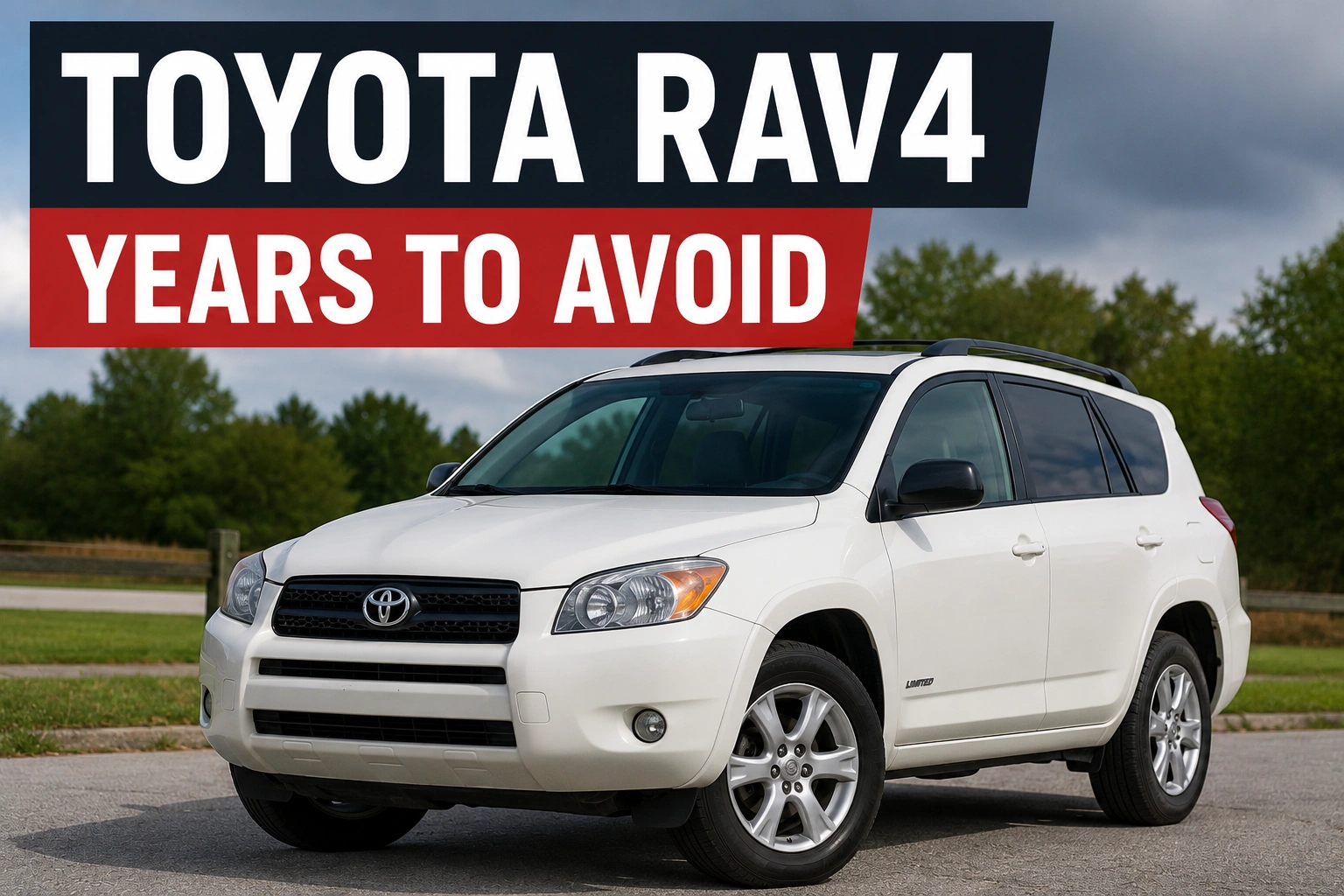
The Toyota RAV4 practically invented the compact crossover category. Since its North American debut in 1996, it has grown from a quirky, two-door adventure wagon into the best-selling SUV in the United States — and in some years, the best-selling vehicle of any kind. More than 868,000 RAV4s were sold globally in 2022 alone. That level of popularity earns it a level of trust that very few automotive nameplates have ever matched.
But trust should always be earned by the specific vehicle you’re about to buy, not the brand name on the badge. Across thirty years of production and six distinct generations, the RAV4 has had some genuinely troubled model years — ones where documented transmission failures, defective piston rings, torque converter problems, and coolant system failures have cost owners thousands of dollars in unexpected repairs.
These problems are not rumors or isolated incidents. They are backed by thousands of NHTSA complaints, class action lawsuits, Consumer Reports data, and Toyota’s own extended warranty programs that were issued in direct response to widespread owner grievances.
Knowing which years to avoid, exactly what went wrong, and why it happened protects you when shopping the used market. It also tells you something important about the years that are genuinely worth buying — the ones that came through the data clean.
Note
Data in this guide is verified from NHTSA complaint databases, Toyota Technical Service Bulletins (including T-SB-0023-15, T-SB-0030-15), CarComplaints.com analysis, Consumer Reports subscriber surveys, RepairPal maintenance cost data, J.D. Power Quality and Reliability studies, CarGurus market pricing, and class action lawsuit filings from California federal court (Barrientos v. Toyota, 2024).
How The RAV4 Has Evolved Across Six Generations
Before going generation by generation through the problem years, it helps to understand the full lifecycle of the RAV4. Each generation brought meaningful changes to the platform, powertrain, and technology, and many of the documented problems are specific to particular engines or transmissions introduced in a given era. Knowing where a model year sits in its generation cycle also tells you something about its reliability risk — first-year launches of new generations carry more probability of early production issues than cars in their third or fourth model year.
The Six RAV4 Generations At A Glance
| Generation | Years | Body Style | Key Engine | Notes |
| 1st Gen | 1996–2000 | 2-door and 4-door | 2.0L inline-4 | Original RAV4, basic and durable |
| 2nd Gen | 2001–2005 | 4-door only | 2.0L / 2.4L inline-4 | Full redesign; ECM/transmission problems begin |
| 3rd Gen | 2006–2012 | 4-door | 2.4L / 2.5L inline-4 + V6 option | Oil consumption problems; V6 added in 2006 |
| 4th Gen | 2013–2018 | 4-door | 2.5L inline-4 | Torque converter shudder; last V6 dropped |
| 5th Gen | 2019–2024 | 4-door | 2.5L inline-4 / hybrid | Coolant bypass valve issues; strong overall |
| 6th Gen | 2025–present | 4-door | Hybrid-only | All-hybrid; early production data still emerging |
The first generation (1996–2000) is largely a non-issue for modern used car shoppers because these vehicles are now 25–30 years old and the value proposition for buying one has passed. The relevant concern starts in the second generation and runs through specific pockets of the fifth.
One pattern worth noting: the first model year of any new RAV4 generation tends to carry elevated risk. The 2001, 2006, 2013, and 2019 model years — all launch years for their respective generations — appear consistently on every reliable list of problem RAV4s. That’s not a coincidence. New platforms, new engines, and new transmission systems introduce variables that only become fully apparent after thousands of real-world owners put miles on them. Toyota is better at managing first-year launches than many competitors, but it is not immune to the pattern.
The 2001–2003 RAV4: A Transmission Disaster That Toyota Had To Acknowledge
The second-generation RAV4 arrived in 2001 as a complete redesign, and early reception was largely positive. The new body was larger, the interior more refined, and the powertrain updates gave it more competitive performance. What nobody saw coming at the time — but became devastatingly apparent over the following years — was that this generation carried one of the most widely documented transmission failures in Toyota’s history.
The problem was rooted in a defective Electronic Control Module, universally referred to by owners and mechanics as the ECM. This small computer module governs automatic transmission shift commands, telling the gearbox when to shift up or down and how aggressively to engage gear changes.
In the 2001–2003 RAV4, the ECM was prone to malfunction in ways that directly damaged the automatic transmission over time. The ECM would send incorrect signals to the gearbox, causing abnormal clutch engagement and premature wear on internal transmission components.
The symptoms were hard to ignore: harsh gear changes, a sudden violent downshift to first gear while traveling at highway speed, lurching forward from stops, hesitation of one to two seconds before the vehicle would move after engaging drive, and eventually — in the most severe cases — complete transmission failure.
The repair scenario that played out for thousands of owners was particularly costly because replacing only the transmission without addressing the defective ECM meant the same problem would return.
Mechanics who replaced the gearbox but left the original ECM in place watched their customers come back with identical symptoms months later. The correct fix required both a replacement or remanufactured ECM and a rebuilt or replacement transmission — a combined repair bill that regularly exceeded $3,000 to $4,600 at independent shops and considerably more at Toyota dealerships.
What Toyota Did — And When They Did It
Consumer outrage coupled with pressure from different agencies led Toyota to extend the warranty nationwide back in 2010. The previous powertrain warranty only covered 5 years/60,000 miles, while the extended warranty now covers the transmission and ECM for 10 years/150,000 miles. Toyota also pledged to reimburse any owners who had previously paid for repairs, if they had proper proof.
The timeline of that response is important to understand. The ECM problem was generating NHTSA complaints and forum discussions as early as 2003 and 2004. Toyota issued a Technical Service Bulletin in 2006, acknowledging the high failure rate.
Despite this, no recall was issued. The company extended the warranty only in 2010 — nine years after the 2001 model went on sale — and only after sustained public pressure, BBB complaints, and legal action from owners who had already paid out of pocket.
By 2010, the extended warranty covering 10 years/150,000 miles had already expired for most 2001 models. For 2001 RAV4 owners with vehicles beyond that mileage, the warranty extension arrived too late to help. Many of those owners were left absorbing repair costs that, by their accounts in NHTSA complaint databases, ranged from $1,490 to $4,600 depending on what exactly needed to be replaced.
2001–2003 RAV4 Problem Summary
- Root cause: Defective Electronic Control Module (ECM)
- Effect on transmission: Abnormal shift commands causing clutch wear, harsh shifting, gear-jumping, and eventual failure
- Typical repair cost: $1,490–$4,600 (ECM + transmission rebuild combined)
- Toyota response: Technical Service Bulletin in 2006; warranty extended in 2010 to 10 years/150,000 miles
- Complaint volume: Among the highest of any RAV4 generation on CarComplaints.com
- Verdict: Avoid all three years unless an independent mechanic has confirmed the ECM was replaced with an updated unit and transmission documented as rebuilt or replaced
The 2001 model year is the worst of the three, carrying the highest complaint volume per vehicle sold. The 2002 and 2003 models improved slightly — production adjustments were made mid-cycle — but the fundamental ECM design flaw remained present through the entire second generation up to 2003. Any used RAV4 from these years should be approached only with a confirmed ECM replacement history and a full transmission service record in hand.
One angle that is rarely discussed: some owners discovered the ECM could be repaired by specialist electronics companies for roughly $100–$275, rather than replaced entirely at Toyota’s quoted cost of over $1,000.
That knowledge did not reach most owners in time, and Toyota never publicized it. The disparity between what Toyota charged for a new ECM and what a competent electronics rebuilder could do for a fraction of that cost speaks to a broader transparency failure during this period.
The 2006–2008 RAV4: When A Design Flaw Destroyed Engines
The third-generation RAV4 launched for 2006 with a genuinely significant upgrade. The new body was larger, more modern in appearance, and for the first time, Toyota offered a V6 engine option alongside the standard four-cylinder. The V6-equipped RAV4 was praised by automotive journalists for its accessible power delivery. The standard four-cylinder, however, carried a design problem that would become one of the most widely discussed reliability failures in Toyota’s compact SUV history.
The 2.4-liter 2AZ-FE engine fitted to the 2006, 2007, and 2008 RAV4 models consumed oil at rates that went far beyond normal. Owners reported adding between one and four quarts of oil every 600 to 3,000 miles — not due to an external leak, not due to maintenance neglect, but because the engine was burning oil internally at a rate that Toyota’s own engineering team eventually had to acknowledge as a design defect.
The problem has been found to be a design issue where piston rings are too loose in their clearance and some PCV crankcase ventilation problems. In many countries Toyota has given extra warranties, but only after class action lawsuits, both of which they don’t publicize.
The piston rings in the 2AZ-FE engine were engineered with tolerances that allowed oil to pass the rings and enter the combustion chamber, where it burned alongside fuel. The PCV (Positive Crankcase Ventilation) system, which recirculates combustion gases, also contributed to accelerated oil consumption when it became clogged or functioned below specification.
What made the situation particularly dangerous was how it played out in real-world ownership. An owner who checked their oil at every 3,000-mile oil change might find the level critically low or completely empty before the next service interval. In the worst documented cases, owners running highway speeds suddenly lost engine power as the engine ran dry — the oil light had either illuminated too late or not at all before catastrophic internal damage occurred.
Toyota’s Technical Service Bulletins And What They Admitted
Toyota issued multiple Technical Service Bulletins related to this problem. The most significant was T-SB-0030-15, revised May 26, 2015, which explicitly identified the 2006, 2007, and 2008 RAV4 as affected and provided a repair procedure involving replacement of pistons and rings.
The bulletin established an allowable consumption rate threshold — if a vehicle consumed more than one quart per 1,200 miles during a consumption test, Toyota would authorize the piston and ring replacement procedure under warranty enhancement programs.
Some drivers add multiple quarts between oil changes, and in severe cases, engines fail catastrophically. Toyota released technical bulletins about this problem and offered warranty extensions, but many owners were left to deal with the issue on their own after the deadlines passed.
The catch with the warranty enhancement program was the consumption test itself. Toyota required owners to bring the vehicle in, have the oil filled to a precise level, drive exactly 1,200 miles without adding oil, then return for a measurement.
Owners who added oil during that interval — which many did to protect the engine — were told consumption was within normal limits because the oil level hadn’t dropped far enough over the full interval. That requirement put owners in the position of either risking engine damage to qualify for the repair program or losing eligibility by protecting the engine they were paying to maintain.
2006–2008 RAV4 Problem Summary
- Affected engine: 2.4-liter 2AZ-FE inline-4
- Root cause: Piston ring clearance too loose; PCV valve issues contributing
- Symptoms: Engine burning 1–4 quarts of oil every 600–3,000 miles with no external leaks
- Additional risks: Flickering dashboard lights; power steering failure from ECU malfunctions; power window switch fire risk
- Repair under TSB: Piston and ring replacement (labor-intensive; typically $1,500–$3,000 at independent shops)
- Toyota response: TSB issued in 2011, updated 2015; warranty enhancement program offered with strict consumption test requirement
- Important note: The 2009 RAV4 switched to a new 2.5-liter 2AR-FE engine, completely redesigned with VVT-i on both intake and exhaust. The oil consumption problem does not carry over to 2009 and later models
Oil Consumption By Year — Third Generation
| Model Year | Engine | Oil Consumption Problem | Severity |
| 2006 RAV4 | 2.4L 2AZ-FE | Yes — severe | High |
| 2007 RAV4 | 2.4L 2AZ-FE | Yes — severe | High |
| 2008 RAV4 | 2.4L 2AZ-FE | Yes — present | High |
| 2009 RAV4 | 2.5L 2AR-FE | No — new engine design | Low |
| 2010 RAV4 | 2.5L 2AR-FE | No | Very Low |
The 2006 model year also picked up a separate, unrelated problem: the airbag non-deployment issue. NHTSA complaints from 2006 RAV4 owners documented cases where airbags failed to deploy in crashes where deployment was expected.
Consumer Reports assigned a severity rating of 10.0 to this issue — the maximum on their scale — reinforcing the recommendation to avoid this particular year entirely regardless of engine condition.
The V6-powered 2006–2008 RAV4 is not affected by the oil consumption problem, since the piston ring defect was specific to the 2AZ-FE four-cylinder unit. However, the V6 models carry their own long-term maintenance considerations, and finding a V6 RAV4 in clean mechanical condition at this age requires careful inspection.
The 2013–2015 RAV4: Torque Converter Shudder And What It Does To A Transmission
The fourth generation RAV4, launched for 2013, was a significant step forward in design and refinement. Toyota dropped the aging V6 option, standardized a 2.5-liter four-cylinder across the lineup, and gave the SUV a more contemporary appearance. Sales were strong immediately, and the 2013 RAV4 quickly became the best-selling SUV in the US. That commercial success, however, masked a mechanical problem that was already developing in the earliest examples.
The torque converter in the 2013–2015 RAV4 was prone to a condition called flex lock-up shudder. The torque converter is a fluid coupling device that connects the engine to the automatic transmission; at highway cruising speeds, it locks up mechanically to improve efficiency.
In the affected RAV4s, this lock-up process produced an intermittent shuddering or vibration — described by owners as feeling like driving over a rumble strip — occurring most commonly between 25 and 50 mph under light throttle.
What started as an annoying vibration could escalate significantly. The vehicle shudders significantly when accelerating or cruising between 35–45 mph. The shudder started slight and did not pose an issue for a while, but now it’s significant enough that it causes erratic steering. The vehicle waved back and forth from the vibration yesterday and went across the median line into oncoming traffic.
That NHTSA complaint — where a shuddering 2013 RAV4 crossed a median line into oncoming traffic — represents the severe end of what could happen when the torque converter condition was left unaddressed. Toyota issued a Technical Service Bulletin (T-SB-0023-15) specifically for the 2013–2015 RAV4, prescribing a torque converter replacement and ECM software reprogramming. Toyota also issued a warranty enhancement covering these repairs for 8 years or 150,000 miles from the original sale date.
The Warranty Extension That Many Owners Missed
The challenge with the torque converter warranty enhancement was awareness. Unlike a formal recall — which requires direct notification to every registered owner — a warranty enhancement is a dealer-level program that owners must proactively request.
Many 2013–2015 RAV4 owners had their torque converters fail without ever knowing Toyota had acknowledged the problem and would have covered the repair at no cost. By the time the failure became undeniable, some owners found the 8-year warranty enhancement window had closed.
Toyota has received reports of customer concerns in which their RAV4 exhibits a brief intermittent shudder during torque converter flex lock-up and that this happens under light throttle conditions between 25–50 MPH. The torque converter and Engine Control Module/ECM logic have been modified to reduce the possibility of this condition from occurring.
The repair procedure involves physically removing and replacing the torque converter — a labor-intensive job that required draining the transmission, disconnecting drivetrain components, and reinstalling everything to specification.
At independent shops, the parts and labor for this repair run $2,500 to $5,000. Under the warranty enhancement, it was covered fully. For owners who paid out of pocket because they were unaware of the enhancement, there was no straightforward path to reimbursement.
2013–2015 RAV4 Problem Summary
- Affected component: Torque converter (automatic transmission)
- Symptoms: Shudder or vibration between 25–50 mph under light throttle; can cause erratic vehicle behavior
- ECO mode connection: Running the RAV4 in ECO mode consistently accelerated torque converter wear by forcing earlier upshifts and more frequent converter lockup cycling
- Toyota’s official fix: Torque converter replacement + ECM software update (per TSB T-SB-0023-15)
- Warranty enhancement: 8 years / 150,000 miles from original sale date
- Out-of-pocket repair cost: $2,500–$5,000
- Additional 2013 issue: 247 complaints and 2 recalls on NHTSA’s 2025 database; unintended acceleration reports; class action involving unresolved issues
- Verdict: If buying any 2013–2015 RAV4, confirm whether the torque converter warranty enhancement repair was completed. Request documentation at the dealer level through a VIN search before purchasing
One underreported detail: ECO mode’s role in accelerating the problem. Several owners and mechanics determined that running the 2013–2015 RAV4 consistently in ECO mode forced the transmission into higher gears at lower speeds, cycling the torque converter lock-up mechanism more frequently than it was designed to handle.
The fix was to simply not use ECO mode — but most owners never connected their driving mode selection to the mechanical failure developing underneath them.
The 2019–2021 RAV4: A Strong Platform With Documented Early Problems
The fifth generation RAV4, arriving for 2019, represented Toyota’s most significant RAV4 redesign in years. Built on Toyota’s New Global Architecture (TNGA) platform, it brought a completely new structure, dramatically updated styling, meaningfully improved technology, and the introduction of the wildly popular RAV4 Hybrid and RAV4 Prime variants. Sales climbed sharply.
For a brand-new generation launched with significant platform changes, it also launched with the kind of early-production issues that tend to follow major redesigns — and some of them were serious enough to generate hundreds of NHTSA complaints and, eventually, a class action lawsuit.
The 2019 RAV4 carries the worst reliability score among fifth-generation models according to Consumer Reports and RepairPal, with BumperScan noting its complaint rate runs 2.9 times the class average for small SUVs. Seven NHTSA recalls were filed against the 2019 RAV4. The problems broke into several distinct categories.
Fuel System Problems — The Most Complained Issue Of The 2019 RAV4
The most commonly reported issue with the 2019 Toyota RAV4 is related to the fuel system, with 263 complaints filed with NHTSA. Fuel System complaints account for 26% of all reports filed for the 2019 Toyota RAV4, with the median mileage at time of complaint being approximately 3,000 miles, suggesting issues tend to surface around the 3K-mile mark.
The fuel system problems manifested in two distinct ways. The first was the overfill issue: many owners reported the fuel pump clicked off early during fill-ups, preventing the tank from accepting more than 8–10 gallons despite the tank’s stated 14.5-gallon capacity. The gauge would then show less than full despite just fueling, creating range calculation problems and persistent low-fuel-level anxiety on long trips.
The second, more serious fuel system problem involved the EVAP (Evaporative Emission Control) system. The vapor canister in the fuel system failed repeatedly, triggering a check engine light and disabling the AWD system — since the AWD warning was triggered through the same ECU that flagged the EVAP fault. Several owners had the charcoal canister replaced under warranty two and three times without resolution, because the root cause was a design issue with the tank itself rather than the canister component.
2019 RAV4 Complaint Distribution By System
| Problem Category | NHTSA Complaints | % of Total Complaints | Severity |
| Fuel system | 263 | 26% | High |
| Engine | 162 | 16% | High |
| Electrical | 81 | 8% | Medium |
| Drivetrain | 68 | 7% | Medium |
| Transmission | Multiple | Significant | High |
| Brakes | Documented | Present | Medium |
The Coolant Bypass Valve — A Problem That Spread To 2020 And 2021
The coolant bypass valve defect affected 2019–2023 RAV4 models, but the 2019 and 2020 model years saw the highest concentration of failures. The coolant bypass valve is a small electronic component that directs coolant flow through the engine’s warm-up cycle. When it fails, owners receive an “Engine Maintenance Required” warning on the instrument cluster — a message that looks alarming but initially has no immediate driveability impact.
A Toyota class action lawsuit alleges that the coolant bypass valves crack and prematurely fail. According to the Toyota class action lawsuit, coolant will leak and the engine will overheat, stall and fail. Once coolant corrodes the coolant bypass valve sensor, the valve will allegedly get stuck in the open or closed position and not properly direct coolant through the engine.
The repair cost for a coolant bypass valve replacement ranged from $800 to $1,200 at Toyota dealerships. Many owners had the part replaced once, received the same “Engine Maintenance Required” warning months later, and were told the same part had failed again. Because the updated replacement part shared the original design flaw, the fix was only temporary for a significant number of owners.
Toyota has introduced a Customer Support Program (CSP 24TE04) that acts similarly for certain models. This program addresses a defect affecting 2019 to 2023 Toyota RAV4 and Corolla vehicles, where the coolant bypass valve may fail prematurely. Under CSP 24TE04, Toyota offers free replacement of the coolant bypass valve for 5th-generation RAV4s built before February 2021, covering both gasoline and hybrid models with an updated valve featuring a new part number.
If you own or are considering a 2019 or 2020 RAV4 built before February 2021, the first practical step is to check VIN eligibility for Customer Support Program CSP 24TE04 directly through a Toyota dealer or at NHTSA.gov.
If the repair was already completed under CSP 24TE04 with the updated part number, the risk of recurrence is meaningfully reduced. If the vehicle shows an open campaign or has had multiple valve replacements with the original part, that’s important information to factor into the purchase decision.
2019–2021 RAV4 Problem Summary
- Fuel system: EVAP vapor canister failures; tank underfill issue; 263 NHTSA complaints on 2019 alone
- Coolant bypass valve: Affects 2019–2023; class action filed 2024; Toyota Customer Support Program CSP 24TE04 offers free fix for pre-February 2021 builds
- Transmission: Rough shifting, hesitation, and lurching at low speeds — consistent pattern in 2019 owner reports
- Electrical: AWD system disabled via EVAP/ECU fault link; flickering dash warnings
- Brakes (2019 hybrid): NHTSA recall for brake-booster pump non-compliance on select RAV4 Hybrid units
- Recalls on 2019 RAV4: 7 total
- 2020 improvement: Measurably fewer complaints than 2019; many early-production issues addressed in production changes
- 2021 model: Generally improved; coolant bypass valve still present but higher percentage of clean units post-February 2021 build date
The 2019 RAV4 is not an automatic write-off, but it requires more due diligence than almost any other fifth-generation model. A 2019 with documented coolant bypass valve replacement under CSP 24TE04, confirmed EVAP repair, and smooth transmission behavior on a thorough test drive can be a reasonable purchase at the right price. A 2019 with open recalls, an undocumented service history, or transmission symptoms is a risk that the used price rarely compensates for adequately.
The Best RAV4 Years To Buy — What The Data Actually Recommends
After the problem years, the picture of where to spend money becomes clearer. The Toyota RAV4 has more good years than bad ones. The years where documented problems are absent or minimal are not just acceptable alternatives — several are genuinely excellent compact SUVs at competitive used prices.
Fourth Generation: 2016, 2017, And 2018
The 2016 mid-cycle refresh represented a turning point for the fourth generation. Toyota upgraded the exterior styling with LED lighting, added more interior sound insulation, improved infotainment options, and introduced the RAV4 Hybrid to the US market for the first time.
Crucially, by 2016, the torque converter shudder problem that plagued the 2013–2015 models had been addressed through both the warranty enhancement program and production changes.
The 2017 RAV4 added Toyota Safety Sense P (TSS-P) as standard equipment across the entire lineup — adaptive cruise control, pre-collision warning with emergency braking, lane departure alert, and automatic high beams. Consumer Reports gave it a perfect 5/5 reliability score for 2017. J.D. Power scored it 87/100. These are not marketing figures — they reflect real owner survey data from thousands of RAV4 owners reporting on their actual ownership experiences.
The 2018 model is what we consider the best year for the Toyota RAV4 if reliability is the key consideration. The 2018 RAV4 has just 33 issues logged on Car Complaints, lower than all other fourth-gen RAV4s. On the NHTSA, it has three recalls, but two are for incorrect load-carrying labels, which have nothing to do with reliability.
The 2018 RAV4 is the last model year before the fifth-generation redesign, and like many final-year variants of a long-running generation, it has the most thoroughly sorted hardware and software. The powertrain has had five years of production refinement. The dealer network and independent mechanics know the car inside and out. Common issues are well-documented and have known fixes. Parts are widely available. The used market for 2018 RAV4s is well-supplied, and pricing reflects a reasonable depreciation curve from their original sale values.
Fifth Generation: 2022 And 2023
The most reliable Toyota RAV4 years are 2016, 2017, 2020, 2021, 2022, and 2023. These model years sit outside the documented problem ranges for transmission failure, oil consumption, and roof leaks.
The 2022 and 2023 RAV4 represent the best of the fifth generation. By 2022, the early-production issues of 2019 had been resolved through production changes, software updates, and the post-February 2021 revised coolant bypass valve. The 2022 model also brought meaningful powertrain improvements to the RAV4 Hybrid, increasing combined output and improving efficiency. The RAV4 Prime plug-in hybrid, available from 2021, became one of the fastest-selling vehicles in Toyota’s entire lineup, with 42 miles of EV range making it one of the most practical PHEVs available.
Consumer Reports data on 2022 and 2023 RAV4 models shows above-average reliability ratings, with the hybrid variants earning particularly strong marks. Annual maintenance costs run approximately $429 according to RepairPal — well below the average for compact SUVs as a class — reflecting the basic mechanical simplicity of a well-sorted platform.
Best RAV4 Years — Quick Reference
| Model Year | Generation | Reliability Rating | Why It’s Recommended |
| 2010 RAV4 | 3rd Gen | JD Power 88/100 | New 2.5L engine, no oil consumption issue, solid long-term record |
| 2016 RAV4 | 4th Gen | CR 4/5 | Post-torque converter fix, new hybrid available, BSM added |
| 2017 RAV4 | 4th Gen | CR 5/5; JD Power 87/100 | TSS-P standard, best fourth-gen safety spec |
| 2018 RAV4 | 4th Gen | Fewest complaints of 4th gen | Last and most refined 4th-gen model |
| 2022 RAV4 | 5th Gen | Above average | Post early-production fixes, strong hybrid |
| 2023 RAV4 | 5th Gen | Above average | Refined infotainment, full TSS standard |
What To Check Before Buying Any Used RAV4
Knowing the problem years is only half the preparation needed before a used RAV4 purchase. Even within safe model years, individual vehicle history, maintenance records, and physical condition determine whether a specific car is a sound investment. The following checks are relevant for every used RAV4 regardless of model year.
Pre-Purchase Inspection Checklist
Documents and History:
- Pull a full vehicle history report (CARFAX or AutoCheck) — check for accident damage, number of owners, title status, and odometer consistency
- Request the complete service history from the seller; look for oil change intervals, transmission fluid changes, and any TSB or recall repairs
- Run the VIN through NHTSA.gov to identify open recalls and confirm which have been addressed
For 2001–2003 Models Specifically:
- Ask directly whether the ECM was ever replaced with an updated unit
- Request transmission service documentation — a 2001–2003 RAV4 with no transmission history is a significant gamble
- Have an independent mechanic test-drive the vehicle and specifically evaluate shift quality from cold start
For 2006–2008 Models Specifically:
- Check for oil consumption: ask the seller to confirm mileage since last oil change, then check the dipstick yourself. A reading below the “add” mark with fewer than 3,000 miles since the last change is a warning
- Look for signs of oil burning: blue-tinted exhaust on startup or at operating temperature, faint burning smell from the engine bay
- Confirm whether the piston and ring replacement procedure under Toyota’s TSB was ever performed (documented in service records)
For 2013–2015 Models Specifically:
- Test-drive at 30–45 mph under light throttle on a flat road and listen for any shudder or vibration
- Ask the dealer or previous owner to search for warranty enhancement completion on the torque converter under ZE5 program
- Avoid consistent ECO mode use if you do purchase one of these years
For 2019–2021 Models Specifically:
- Check for the “Engine Maintenance Required” warning by test-driving with sufficient warm-up time
- Ask specifically about coolant bypass valve history and whether CSP 24TE04 was completed
- Verify EVAP recall status and fuel system campaign completion
- Test AWD engagement if applicable (a failed EVAP can disable AWD without obvious symptoms)
Universal Checks For All RAV4s:
- Check roof seals and headliner at front corners — roof leaks appeared across multiple generations and are common at higher mileage
- Inspect under the hood for any coolant residue on hoses, the firewall, or around the coolant overflow reservoir
- Test the power tailgate if equipped — failure is common on older fifth-generation models and replacement is expensive
- Confirm tire wear is even front to back; uneven wear can indicate alignment issues, suspension wear, or AWD system irregularities that haven’t yet triggered a warning light
Full Model Year Reference Guide
| Model Year | Generation | Avoid? | Primary Concern | Safety |
| 1996–2000 | 1st | No (too old) | Age-related wear | No modern ADAS |
| 2001 | 2nd | Yes | ECM / transmission failure | No ESC |
| 2002 | 2nd | Yes | ECM / transmission failure | No ESC |
| 2003 | 2nd | Yes | ECM / transmission failure | No ESC |
| 2004–2005 | 2nd | Proceed with caution | Minor transmission concerns | No ESC |
| 2006 | 3rd | Yes | Oil consumption + airbag non-deployment | ESC available |
| 2007 | 3rd | Yes | Oil consumption (worst year) | ESC available |
| 2008 | 3rd | Yes | Oil consumption continues | ESC available |
| 2009 | 3rd | Generally OK | New engine, unintended acceleration TSB | ESC standard |
| 2010 | 3rd | Recommended | Strong reliability record | ESC standard |
| 2011 | 3rd | Generally OK | 9 recalls (check status) | ESC standard |
| 2012 | 3rd | Generally OK | Minor complaints | ESC standard |
| 2013 | 4th | Avoid | Torque converter + unintended acceleration | TSS not yet available |
| 2014 | 4th | Avoid | Torque converter shudder | TSS not yet available |
| 2015 | 4th | Avoid | Torque converter shudder | TSS not yet available |
| 2016 | 4th | Recommended | Post-fix; hybrid arrives | TSS optional |
| 2017 | 4th | Highly Recommended | Best 4th-gen safety + reliability | TSS-P standard |
| 2018 | 4th | Highly Recommended | Fewest complaints of 4th gen | TSS-P standard |
| 2019 | 5th | Proceed with caution | Fuel system, coolant valve, 7 recalls | TSS 2.0 standard |
| 2020 | 5th | Generally OK | Coolant valve (check CSP) | TSS 2.0 standard |
| 2021 | 5th | Generally OK | Minor coolant valve risk post-Feb build | TSS 2.0 standard |
| 2022 | 5th | Recommended | Strong reliability, improved hybrid | TSS 2.0 standard |
| 2023 | 5th | Recommended | Refined platform, strong data | TSS 2.0 standard |
| 2024 | 5th | Generally OK | Early data, limited used supply | TSS 2.0 standard |
| 2025–2026 | 6th | Too new | All-hybrid; early production data emerging | TSS 4.0 standard |
Frequently Asked Questions
What are the Toyota RAV4 years to absolutely avoid?
Based on NHTSA complaint data, Consumer Reports ratings, and documented repair patterns, the years with the strongest case for avoidance are 2001, 2002, and 2003 (ECM-driven transmission failures), 2006, 2007, and 2008 (oil consumption from defective piston rings in the 2AZ-FE engine), 2013, 2014, and 2015 (torque converter shudder), and the 2019 model year specifically (fuel system issues, coolant bypass valve, and seven NHTSA recalls). These years carry documented mechanical problems that Toyota acknowledged through warranty extensions and technical service bulletins but did not address through formal recalls in most cases.
Is a 2019 RAV4 worth buying used in 2026?
With significant caution — yes, it can be worth considering, but only with thorough due diligence. The 2019 RAV4 runs on Toyota’s strong TNGA platform and delivers good fuel economy and a well-equipped interior. The risks — primarily the fuel system, coolant bypass valve, and transmission roughness — are manageable if you can confirm the Customer Support Program CSP 24TE04 was completed on the coolant valve, all seven recalls show as resolved at NHTSA.gov, and the transmission shifts smoothly on an extended test drive. A discounted price to reflect the documented issues is reasonable to negotiate. Paying full market value for a 2019 RAV4 without confirmed repairs carries more risk than the price differential typically justifies.
Which RAV4 generation has the best overall reliability?
The fourth generation’s 2016–2018 models and the fifth generation’s 2022–2023 models represent the strongest reliability points across the RAV4’s history. The 2017 RAV4 earned a perfect 5/5 reliability score from Consumer Reports, while the 2018 carries the fewest documented complaints of any fourth-generation model. For the fifth generation, the 2022 and 2023 models have moved far enough past the early-production issues of 2019 to show consistently strong owner satisfaction data.
How long do Toyota RAV4s typically last?
A well-maintained RAV4 from a reliable model year is generally capable of reaching 200,000–300,000 miles with regular maintenance. The 2010 Toyota RAV4 specifically has earned a 9.3/10 reliability rating in data showing strong performance past 200,000 miles. The key variables are oil change intervals, transmission fluid maintenance, cooling system health, and avoiding the known problem years where the underlying issues can cause premature failure regardless of maintenance quality.
Did Toyota recall the 2006–2008 RAV4 for oil consumption?
No official recall was ever issued. Toyota’s response came through a series of Technical Service Bulletins and a Warranty Enhancement Program that offered piston and ring replacement for vehicles failing a consumption test threshold. The most comprehensive TSB (T-SB-0030-15, revised May 2015) provided a formal repair procedure, but owners had to proactively seek out the repair and meet the consumption test criteria. Many owners missed the warranty enhancement window or failed to qualify due to the test’s strict methodology. For current used buyers, the best protection is requesting documentation that the piston and ring repair was completed under Toyota’s enhancement program.
What is Toyota Customer Support Program CSP 24TE04?
CSP 24TE04 is Toyota’s Customer Support Program that provides free replacement of the coolant bypass valve on 2019–2021 RAV4 and Corolla vehicles built before February 2021. It was established in response to widespread owner complaints and the class action lawsuit filed in 2024 alleging Toyota concealed the defect. The program replaces the defective valve with an updated design carrying a new part number. To check eligibility, provide your VIN to a Toyota dealer or check NHTSA’s recall database. Owners who paid out of pocket for the valve replacement before the CSP was issued may be eligible for reimbursement in some cases — the March 2026 update to one owner’s complaint noted that their dealership was able to receive a payout after the recall was issued.
Is the RAV4 Hybrid more reliable than the standard RAV4?
Generally, yes — particularly for the 2022–2024 model years. The RAV4 Hybrid uses Toyota’s well-proven 5th-generation hybrid system, which has an established reliability track record across Prius, Camry, and Highlander applications. The hybrid powertrain’s regenerative braking reduces brake wear, and the electric motor assists the engine in high-load situations, reducing thermal stress. RepairPal data shows the RAV4 Hybrid with an above-average reliability rating and annual maintenance costs comparable to the conventional model. One nuance: the RAV4 Hybrid was not available until the 2016 model year, and early 2019 hybrid models shared some of the same first-year production issues as the gas version before production matured.
What should I budget for a used RAV4 from the best model years?
Based on market data as of 2026, a 2016–2017 gas-powered RAV4 in good condition with under 100,000 miles typically sells for $14,000 to $20,000. Fourth-generation RAV4 Hybrids (2016–2018) with reasonable mileage sell for $22,000 to $28,000 due to high demand. The 2018 RAV4 in good condition commands $18,000 to $24,000 for gas models. Fifth-generation gas RAV4s from 2022–2023 with moderate mileage typically range from $25,000 to $32,000. RAV4 Hybrid 2022–2023 examples rarely fall below $28,000, with well-specified units reaching $36,000 depending on trim and mileage. These are used market ranges — final prices vary significantly by region, mileage, trim level, and condition.