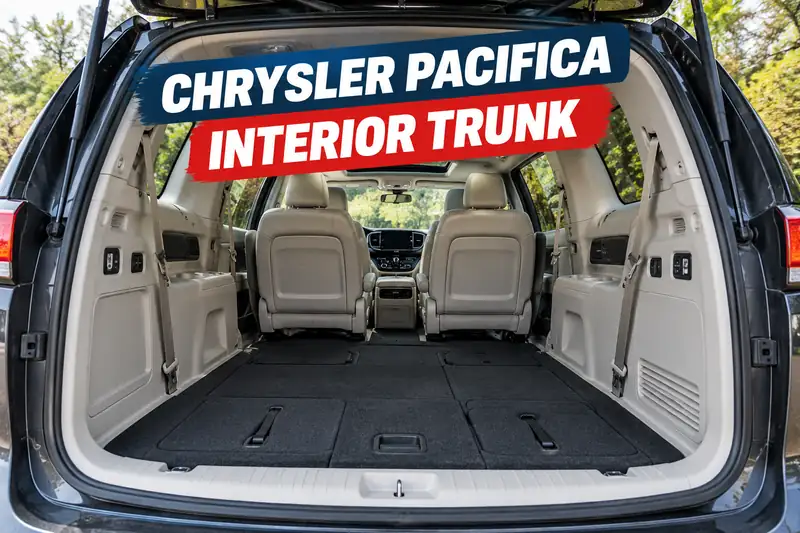
The Chrysler Pacifica interior and trunk are designed around a simple idea: a family vehicle should be able to change its layout as quickly as the needs of the people inside it change. A normal cargo area is useful, but a minivan has another advantage because the passenger compartment itself can become part of the storage space.
That flexibility is one of the main reasons the Pacifica has remained distinctive among minivans. Depending on configuration and model year, the cabin can carry passengers in three rows, provide storage beneath the second-row area, or create a large flat load floor when the seats are stowed.
Chrysler’s current Pacifica information lists up to 243 seating configurations, with seating for seven standard on most 2026 models and eight-passenger seating available on select versions.
The rear cargo area is useful even with all three rows occupied, while folding or stowing the rear seats dramatically changes the amount of usable space. For 2026, Chrysler lists 32.3 cubic feet behind the third row and up to 140.5 cubic feet behind the first row with the second- and third-row seating stowed or removed.
Chrysler Pacifica Interior Layout And Passenger Space
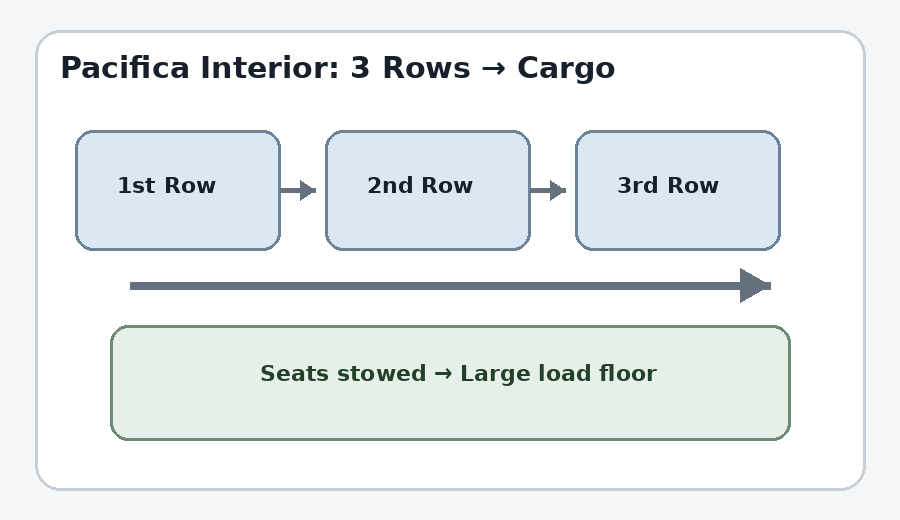
The Pacifica’s interior is more than three rows of seats surrounded by a large cabin. Its main advantage is the way passenger space, storage compartments, floor bins, and cargo volume interact with one another.
A family may need all three rows during the week and then need a large load floor for luggage, home-improvement supplies, sports equipment, camping gear, or furniture on the weekend. The Pacifica is designed to accommodate those changes without requiring the owner to treat the vehicle like a traditional SUV with a permanently fixed cargo area.
First-Row Interior And Front Cabin
The front portion of the Pacifica has the controls and storage areas expected in a modern minivan, but its larger significance is how the first row becomes the fixed boundary of the maximum cargo area.
When the second- and third-row seats are stowed or removed, Chrysler lists the maximum cargo volume at 140.5 cubic feet in the current Pacifica. The manufacturer also lists cargo length of up to 99.5 inches from behind the first row to the rear of the cargo area, depending on configuration.
That measurement gives a better sense of the vehicle’s practical capacity than cubic feet alone. Cargo volume tells you how much space exists overall, while cargo length helps determine whether a particular long object can physically fit.
The front seats remain in their normal positions while the rear section is transformed into a large load area. This is one reason the Pacifica can function as both a passenger vehicle and a serious hauling vehicle without needing a separate commercial-style interior.
Second-Row Seating And Floor Storage
The second row is where Pacifica configurations can differ significantly.
Chrysler’s current lineup uses Stow ‘n Go seating in certain trims, while the availability of second-row Stow ‘n Go varies by model and trim. Chrysler states that second-row Stow ‘n Go is standard on Pacifica Select and Limited trims for the current gasoline models, while Pinnacle models have different second-row seating arrangements.
This distinction is important when shopping for a used Pacifica.
Two Pacificas that look very similar from the outside may have noticeably different interior flexibility. A buyer who wants maximum floor-level storage should check the exact seating configuration instead of assuming that every Pacifica has identical second-row equipment.
When equipped with Stow ‘n Go, the second-row seating system creates under-floor storage areas. Chrysler describes these built-in floor bins as useful for keeping equipment organized, and its accessory information also shows storage totes and cargo organizers designed around the system.
These bins are particularly useful for smaller objects that would otherwise move around the cabin. Grocery bags, children’s equipment, emergency supplies, cleaning products, blankets, and road-trip accessories can be separated from the main cargo area.
Third-Row Seating
The third row is one of the Pacifica’s most important parts because it allows the vehicle to carry passengers while still retaining a useful amount of cargo space.
For 2026, Chrysler lists 32.3 cubic feet of cargo volume behind the third row. That means the vehicle does not become completely unusable for luggage simply because all three seating rows are occupied.
The third-row seats are also designed to fold into the floor. Chrysler states that third-row Stow ‘n Go seating is standard across the Pacifica lineup, although second-row configurations can differ.
That creates an important practical advantage: the third row can disappear without needing to be physically carried out of the vehicle and stored somewhere else.
For families, this matters more than the headline cargo figure. A removable seat may create a large opening, but it also becomes a heavy object that needs somewhere to go. An integrated folding system eliminates that separate storage problem.
Interior Storage Beyond The Main Cargo Area
The Pacifica’s storage capacity is not limited to the rear trunk.
Door pockets, console areas, floor bins, cupholders, seatback storage, and under-floor compartments can all contribute to everyday organization.
This matters because large cargo volume does not automatically mean good organization. A vehicle can have enormous maximum capacity but still become difficult to use if small items have nowhere to go.
The Pacifica’s floor-storage concept addresses part of that problem by giving passengers dedicated areas for smaller objects.
There is also a practical distinction between storage space and cargo space.
Storage space is useful for objects that need to remain separated and accessible. Cargo space is better for large luggage, boxes, strollers, sports equipment, and other bulky items.
A well-designed minivan needs both.
Chrysler Pacifica Trunk And Cargo Space
Although many owners casually call the rear area a trunk, the Pacifica technically has a large rear cargo area accessed through its liftgate. It behaves more like an SUV-style cargo compartment than a traditional sedan trunk.
The biggest advantage is the opening itself.
A liftgate provides a tall rear opening, allowing larger objects to be loaded from behind instead of being forced through a relatively narrow trunk opening. This can make a noticeable difference when loading strollers, large luggage, coolers, boxes, bicycles, or household equipment.
Cargo Space Behind The Third Row
The Pacifica’s 32.3-cubic-foot cargo area behind the third row is one of the most useful figures for families because it represents the space available while retaining all three rows of seating. Chrysler publishes this figure for the current 2026 Pacifica.
This is the configuration most relevant to everyday family use.
A seven-passenger vehicle that still has meaningful rear cargo room is more practical than one where the third-row seat consumes nearly all available space.
The exact shape of the cargo area matters too. Cubic-foot measurements are calculated volumes and do not necessarily tell you how easily a particular object will fit.
A tall object may require more vertical clearance. A long box may require greater floor length. A wide item may be limited by the wheel wells or side trim.
For that reason, anyone planning to transport a particular object should measure the object and compare those dimensions with the vehicle rather than relying solely on the published cargo-volume number.
Cargo Space With The Third Row Folded
Folding the third row changes the rear portion of the vehicle substantially.
Instead of reserving floor space for passengers, the rear section becomes available for luggage and other equipment.
This is useful for trips where only two rows are required. Families can leave the second row available for passengers while using the rear floor for bags, groceries, sports equipment, and other gear.
The ability to switch between passenger and cargo configurations is one of the Pacifica’s defining characteristics.
It also makes the vehicle useful for different types of owners. A family might use all three rows on one day, fold the third row for a hardware-store trip the next day, and create a much larger load floor for moving equipment on the weekend.
Maximum Cargo Capacity
With the rear seating appropriately stowed or removed, Chrysler lists maximum interior cargo volume of 140.5 cubic feet for the 2026 Pacifica.
The manufacturer also lists cargo length of up to 99.5 inches in the maximum configuration.
Those numbers illustrate why the Pacifica can handle jobs that would normally require a much larger vehicle.
The flat-floor concept is particularly useful because a large amount of volume is not enough if the floor contains large steps, exposed seat mounts, or other obstacles.
The Stow ‘n Go concept is designed specifically to turn the passenger compartment into a usable cargo floor.
Chrysler has highlighted the system’s ability to create a flat load area, including the ability to accommodate large sheet material when the seats are stowed in applicable configurations.
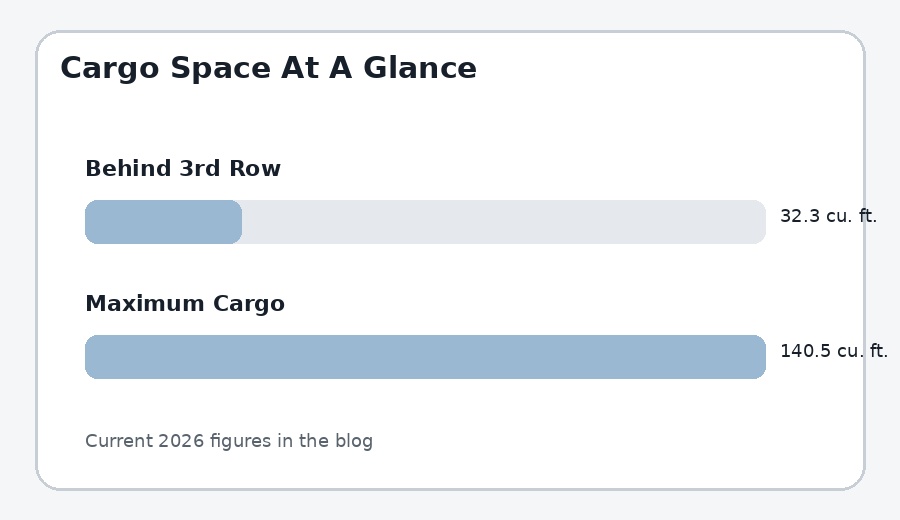
Cargo Capacity At A Glance
| Pacifica Configuration | Approximate Cargo Volume |
|---|---|
| Behind Third Row | 32.3 cu. ft. |
| Maximum Behind First Row | 140.5 cu. ft. |
| Maximum Cargo Length | Up To 99.5 Inches |
| Seating | Up To 7 Standard / 8 Available On Select Configurations |
| Third Row | Stow ‘n Go |
| Second Row | Configuration Varies By Trim |
The figures above are based on Chrysler’s current 2026 specifications and should not automatically be applied to every earlier Pacifica model year or every trim.
What Fits In The Pacifica Trunk?
The Pacifica’s rear cargo space is suitable for many everyday items, but the exact fit depends on how many seats are being used.
With all three rows occupied, the rear area can accommodate normal family luggage and shopping. Soft-sided bags make particularly efficient use of irregular spaces because they can conform to the available shape.
With the third row folded, larger items become easier to carry.
With both rear seating areas stowed where the configuration permits, the Pacifica becomes substantially more flexible. Large boxes, camping equipment, bicycles with appropriate preparation, home-improvement materials, and other bulky items can become much easier to transport.
For long objects, the maximum published cargo length is especially relevant. Chrysler lists up to 99.5 inches for the current configuration, although some model-year or trim differences can apply.
Stow ‘n Go Seating And Practical Cargo Flexibility
Stow ‘n Go is the feature that gives the Pacifica interior its distinctive character.
Instead of requiring the owner to remove second- and third-row seats and store them elsewhere, compatible seats can be folded into dedicated floor compartments. This creates a major difference between the Pacifica and a traditional three-row SUV.
How The Stow ‘n Go Concept Works
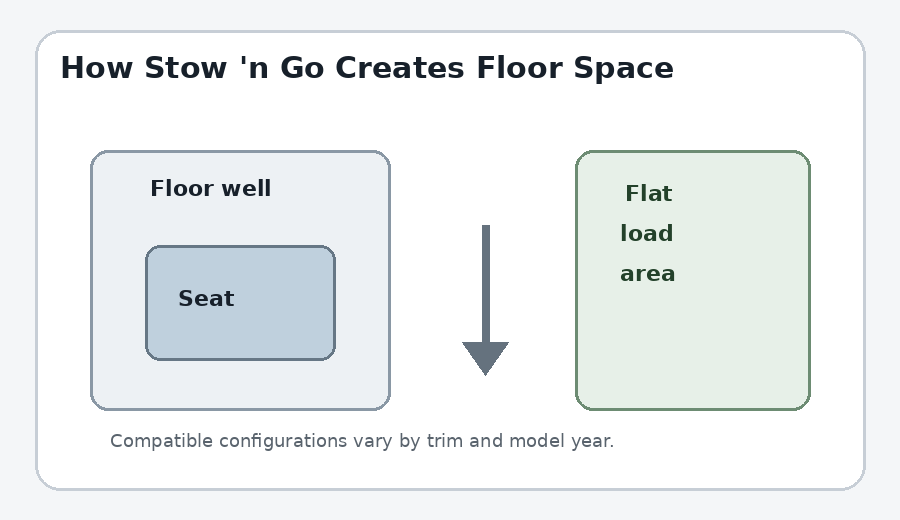
The basic idea is straightforward.
The floor contains dedicated storage wells for the seats. When the seats are folded and placed into those compartments, the previously occupied passenger area becomes available as cargo space.
When the seats are needed again, they can be returned to their seating positions.
The system is especially convenient for owners who regularly switch between passenger and cargo duties.
Chrysler says the current Pacifica can offer up to 243 seating configurations, illustrating how many combinations are possible when the cabin’s seats and storage areas are used in different ways.
The exact configuration count should not be interpreted as 243 completely different interior designs that every owner will use. It represents the various possible seating and storage arrangements supported by the vehicle.
Under-Floor Storage Is A Hidden Advantage
The floor bins are easy to overlook when discussing cargo volume, but they can be one of the most useful features for daily ownership.
Large cargo areas are excellent for large objects, but loose small items can quickly become difficult to organize.
Under-floor bins provide another layer of storage.
For example, an owner can keep emergency supplies, vehicle accessories, sports equipment, cleaning items, or children’s gear separated from groceries and luggage.
Chrysler also offers accessories designed around its storage system, including hard floor cargo bins and totes.
This makes the Pacifica’s interior more than a large empty box. It provides multiple levels of organization.
Stow ‘n Go Versus Removable Second-Row Seats
Not every Pacifica has identical second-row seating.
Some configurations prioritize the Stow ‘n Go system, while others use second-row seating that can be removed or otherwise repositioned. Chrysler specifically notes that certain Pacifica models without second-row Stow ‘n Go have second-row seats that can be removed or tumbled forward.
This distinction matters for used-car buyers.
A removable captain’s-chair configuration can provide a different passenger comfort and cargo strategy from a floor-stowing second row.
Someone who frequently carries seven passengers may value the seating arrangement more highly, while someone who regularly hauls bulky equipment may place greater importance on maximum flat-floor flexibility.
There is no universal “best” configuration because the useful layout depends on how the vehicle will actually be used.
Important Difference Between Gas And Hybrid Models
Model-year and powertrain differences deserve attention when researching Pacifica cargo space.
Older Pacifica Hybrid versions, for example, have had different seating and storage arrangements. Chrysler documentation for the Pacifica Hybrid describes seating for seven, removable second-row captain’s chairs, and third-row Stow ‘n Go seating.
That means shoppers should not assume that a gasoline Pacifica’s interior layout applies identically to a hybrid model.
The same caution applies to used Pacificas from different model years.
When buying a used vehicle, check the VIN, trim, model year, and original equipment rather than relying on a generic Pacifica specification.
Living With The Pacifica Interior: Family Use, Cargo And Organization
The real value of a minivan interior is not measured only by maximum cubic feet.
A vehicle can have a large cargo number but still be inconvenient to load, difficult to clean, or awkward to organize.
The Pacifica’s design has several features that address those everyday issues.
Loading Groceries And Everyday Shopping
For normal grocery trips, the rear cargo area provides an open loading zone with a low enough floor arrangement to make lifting bags easier than loading many tall SUVs.
The available floor storage can also prevent smaller items from becoming mixed together with larger cargo.
A practical strategy is to use the under-floor areas for items that should remain in the vehicle while keeping the primary cargo area available for groceries and temporary loads.
This reduces the need to empty the entire vehicle every time you need to transport something large.
Road Trips And Family Luggage
A family road trip presents a different storage challenge because the vehicle may need to carry both passengers and luggage simultaneously.
With all three rows occupied, the 32.3-cubic-foot rear cargo figure gives the Pacifica useful luggage capacity without sacrificing the third row.
Soft luggage can help maximize the available shape.
Heavy objects should be positioned low and secured so they cannot move forward during hard braking.
This is particularly important in a large open interior because a loose object can become a projectile in a collision.
Chrysler’s own material emphasizes that cargo should be properly secured.
Strollers, Sports Equipment And Bulky Family Gear
The Pacifica is particularly suited to objects that are awkward rather than extremely heavy.
Strollers, sports bags, folding chairs, coolers, camping equipment, and similar items can take up substantial volume in a conventional trunk.
The Pacifica’s tall rear opening and flexible seating make it easier to change the shape of the available cargo area.
A stroller, for example, may fit behind the third row when folded, but families with larger equipment may prefer to fold the third row and place the stroller farther forward.
The advantage is not simply having more space. It is being able to change where the space exists.
Cleaning The Interior
A family minivan can accumulate dirt quickly.
Food crumbs, pet hair, mud, spilled drinks, sand, and dust tend to find their way into floor seams and seat tracks.
The Pacifica has also offered available Stow ‘n Vac technology in certain configurations. Chrysler describes the system as an integrated vacuum designed to help clean the cabin and cargo area.
Whether a particular used Pacifica has that feature depends on model year and equipment.
When inspecting a used Pacifica, check the floor bins, seat mechanisms, carpet, door tracks, cargo trim, and under-seat areas rather than looking only at the visible upholstery.
A clean-looking cabin can still hide years of accumulated debris inside storage compartments.
Liftgate And Cargo Access
The rear liftgate is another important part of the cargo experience.
The ability to open the entire rear section provides a much larger access point than a conventional sedan trunk.
Current Pacifica models also offer power-liftgate equipment depending on trim, and the 2027 model introduces an adjustable-height power liftgate as standard across the lineup, according to Chrysler.
The adjustable-height feature is particularly useful in garages or parking structures where overhead clearance can be limited.
When evaluating a used vehicle, power-liftgate operation should be tested several times. Listen for unusual noises and check whether the liftgate opens, closes, and latches smoothly.
Chrysler Pacifica Interior: What Buyers Should Check
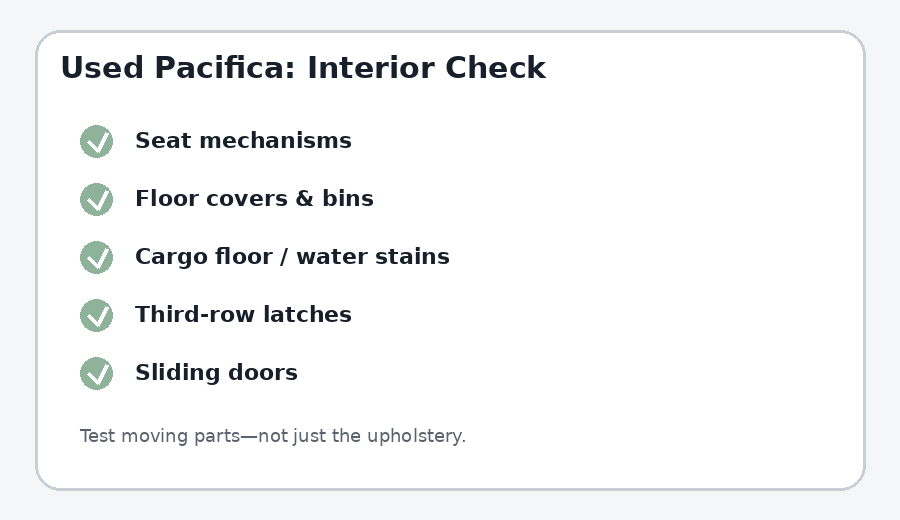
The Pacifica’s flexible interior is a major part of its appeal, but more moving parts mean more components to inspect when purchasing a used vehicle.
Inspect Every Seat Mechanism
If a Pacifica has Stow ‘n Go seating, operate the seats and storage covers.
Check whether the seats fold smoothly and whether the floor compartments open and close properly.
Do not assume that a seller’s statement that “everything works” means every seat mechanism has actually been tested.
A seat that has been left in one position for years may have a problem that does not become obvious until someone attempts to stow it.
Also inspect the hinges, latches, release handles, carpeting, and plastic trim around the storage wells.
Check The Cargo Floor For Damage
A minivan cargo floor can experience heavy use.
Look for:
- Deep scratches
- Broken plastic trim
- Damaged floor covers
- Water stains
- Torn carpet
- Missing storage covers
- Signs of overloaded cargo
- Improper aftermarket modifications
Water intrusion deserves special attention.
A damp cargo area can produce odors, corrosion, mold, or electrical problems if moisture reaches wiring and electronic components.
If the vehicle smells strongly of moisture, inspect beneath removable floor coverings and storage areas.
Inspect The Third Row
Fold the third-row seats and return them to their upright position.
The operation should be straightforward and should not require excessive force.
Check the seat belts, head restraints, latches, and floor mechanisms.
A third-row seat that does not lock securely into its intended position should not be ignored because seating components are safety equipment.
Test The Sliding Doors
Although the doors are not technically part of the trunk, they are central to the Pacifica’s interior usability.
Power sliding doors should open and close smoothly.
Check operation from the interior controls, exterior handles, and remote functions when equipped.
Listen for grinding, repeated motor operation, or unusual pauses.
A minivan with a malfunctioning sliding door can quickly become frustrating because the feature is used frequently when loading children and passengers.
Check The Rear Climate And Entertainment Equipment
Depending on trim and model year, the Pacifica can have rear-seat climate controls, entertainment screens, USB connections, power outlets, and other passenger-focused equipment.
Test these features individually when inspecting a used vehicle.
Electronics that appear attractive in a specification sheet have less value if the actual components do not function.
Check USB ports with a compatible device, test the rear controls, inspect display screens for damage, and verify that power outlets work.
The exact equipment varies substantially by trim and model year.
Frequently Asked Questions
How Much Cargo Space Does The Chrysler Pacifica Have?
The current 2026 Chrysler Pacifica has an estimated 32.3 cubic feet of cargo volume behind the third row and up to 140.5 cubic feet behind the first row when the second- and third-row seating is appropriately stowed or removed. Chrysler also lists cargo length of up to 99.5 inches in the maximum configuration.
Does The Chrysler Pacifica Have A Trunk?
The Pacifica does not have a traditional sedan-style trunk. It has a large rear cargo area accessed through a liftgate. The tall opening and flexible seating allow the rear section to function as a large cargo compartment, while the second- and third-row seating can be configured to create substantially more usable floor space.
Can The Chrysler Pacifica Seats Fold Into The Floor?
Yes, the Pacifica is known for its Stow ‘n Go seating system. Third-row Stow ‘n Go seating is standard across the current Pacifica lineup, while second-row Stow ‘n Go availability depends on the trim and configuration. Chrysler states that current models can provide up to 243 seating configurations.
How Much Can Fit Behind The Third Row Of A Chrysler Pacifica?
The current Pacifica provides approximately 32.3 cubic feet of cargo volume behind the third row. That space is suitable for luggage, groceries, sports bags, and other everyday cargo while all three seating rows remain available. Actual usable capacity depends on the shape and dimensions of the objects being loaded.
Can You Sleep Inside A Chrysler Pacifica?
The Pacifica’s flexible seating and large interior can make it suitable for certain camping or overnight setups, particularly when the rear seating is stowed. However, the available floor length and configuration depend on the specific model and seating arrangement. Any sleeping setup should leave adequate ventilation and should never interfere with safe vehicle operation or obstruct required emergency exits.
Does Every Chrysler Pacifica Have The Same Interior?
No. Interior layouts vary by model year, trim, powertrain, and seating configuration. For example, second-row Stow ‘n Go availability differs between current trims, and some Pacifica Hybrid configurations have had different seating arrangements. Used-vehicle buyers should verify the exact equipment on the specific vehicle rather than relying on a generic Pacifica specification.