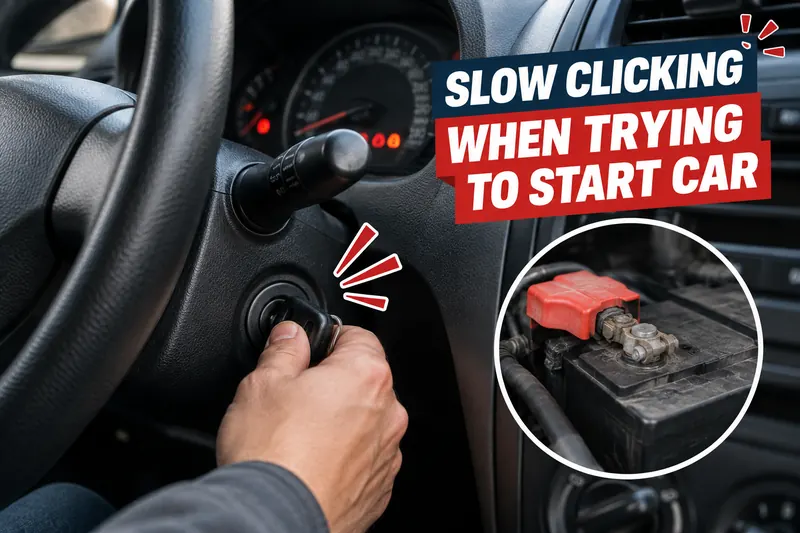
A slow clicking sound when trying to start a car is one of those noises that can seem minor at first but often points toward a problem in the starting or electrical system. A healthy starting system normally produces a quick, solid engagement from the starter motor, followed by the engine turning over at a steady speed.
When the sound becomes slow, weak, or unusually drawn out, the battery, battery connections, starter circuit, or starter motor deserves attention.
The important part is not to focus only on the clicking noise itself. The sound is a clue, and the behavior of the headlights, dashboard lights, engine cranking speed, and electrical accessories can provide much more information.
A weak battery can create symptoms that look similar to a failing starter, while a poor ground connection can make a perfectly good starter behave as if it is defective.
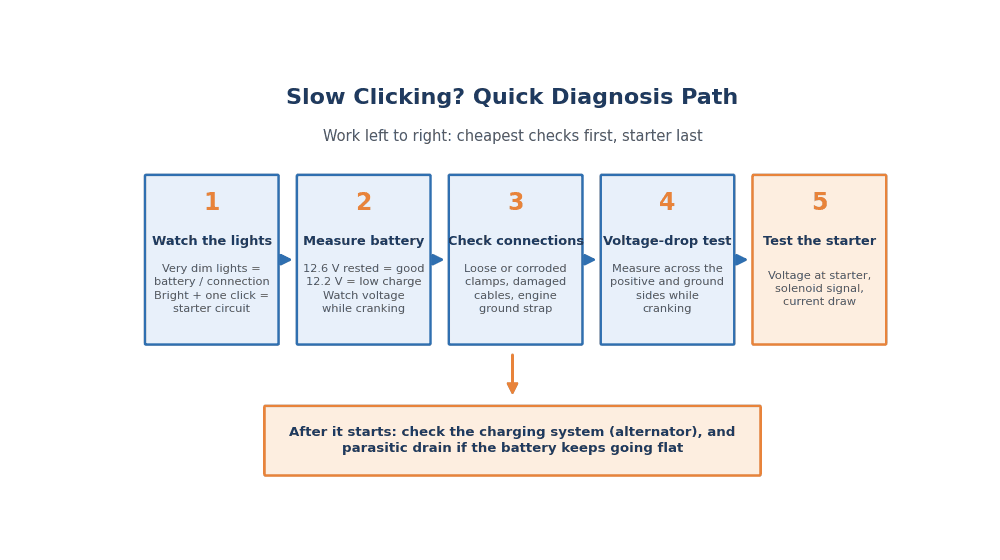
Finding the actual cause before replacing parts can save considerable money. The checks below move from simple electrical inspections toward more involved starter-system diagnosis, making it easier to identify what is actually happening.
What Slow Clicking Means When Starting A Car
A starter system needs a large amount of electrical current for a very short period. When the ignition key is turned or the start button is pressed, the vehicle’s control system allows the starter circuit to operate.
The starter solenoid then helps connect battery power to the starter motor, and the motor turns the engine through the starter gear and flywheel or flexplate.
A clicking sound usually means that part of this sequence is occurring, but the starter motor is not receiving or using power normally. In some cases, the solenoid engages and disengages repeatedly because the battery voltage falls sharply when the starter attempts to draw current.
That distinction is useful because slow clicking when trying to start car does not automatically mean the starter itself is bad.
Slow Clicking Versus Rapid Clicking
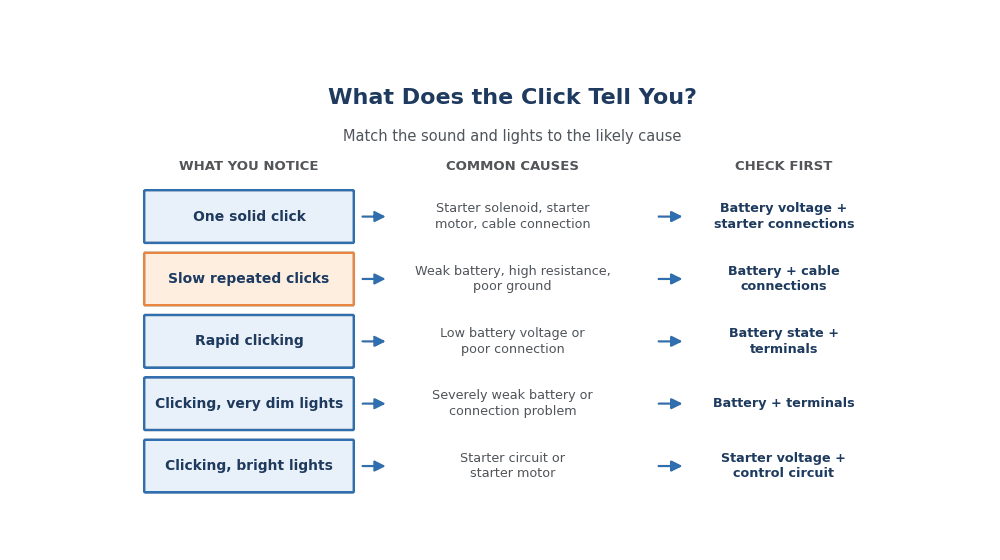
The rhythm of the sound can provide an important diagnostic clue.
| Clicking Pattern | Common Possibilities | What To Check First |
|---|---|---|
| One solid click | Starter solenoid, starter motor, cable connection | Battery voltage and starter connections |
| Slow repeated clicks | Weak battery, high resistance, poor ground | Battery and cable connections |
| Rapid clicking | Low battery voltage or poor connection | Battery state and terminals |
| Click followed by no crank | Starter motor, solenoid, cable, battery | Voltage and starter circuit |
| Clicking with very dim lights | Severely weak battery or connection problem | Battery and terminals |
| Clicking but normal bright lights | Starter circuit or starter motor | Starter voltage and control circuit |
A slow clicking sound can occur because the solenoid receives enough power to engage initially, but the voltage drops as the starter attempts to operate. Once voltage falls, the solenoid releases. Voltage then rises again, allowing it to engage once more.
That creates a repeating cycle.
This is why listening carefully can be more useful than simply deciding that “the starter is clicking.” The frequency, strength, and relationship between the click and the dashboard lights can narrow down the possibilities.
Why Battery Voltage Can Fall During Starting
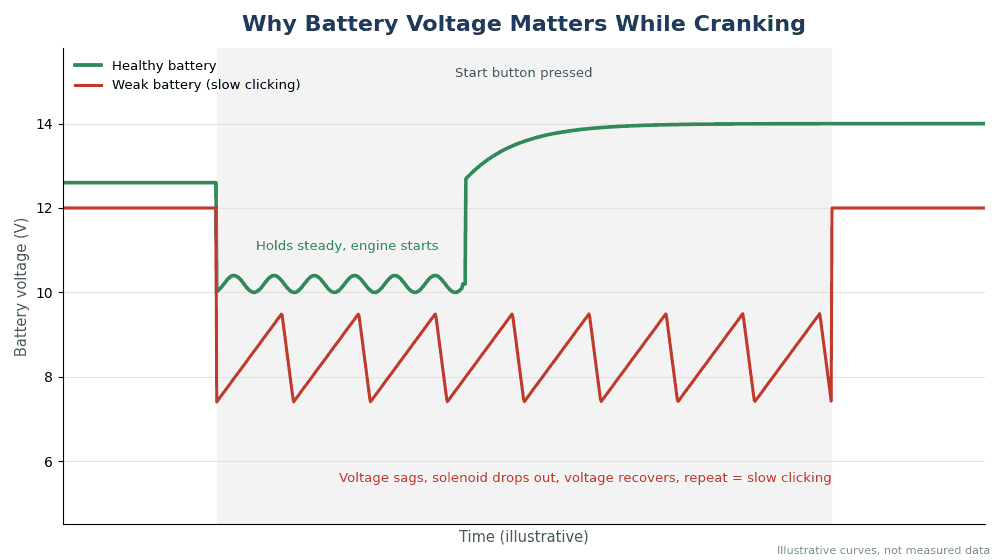
A car battery can show a reasonable voltage when the vehicle is sitting still and still fail when a starting load is applied. This happens because starting requires much more current than accessories such as interior lights or a radio.
A fully charged conventional 12-volt automotive battery commonly measures around 12.6 volts at rest, although temperature, battery design, state of charge, and measurement conditions affect the reading. A significantly lower resting voltage suggests that the battery is discharged or has another problem.
More importantly, the battery must maintain sufficient voltage while the starter is operating. If voltage collapses under load, the starter may not have enough electrical power to turn the engine.
This is one reason a voltage measurement taken only before starting does not provide the complete picture.
The Role Of Battery Terminals And Ground Connections
Electrical resistance is another major factor. The starter may require hundreds of amps during cranking, depending on the engine and conditions. Even a relatively small amount of resistance at a battery terminal or ground connection can cause a substantial voltage drop under that load.
Corrosion around the battery posts, loose terminal clamps, damaged cables, or a poor engine ground can therefore produce symptoms that resemble a dead battery.
A useful diagnostic principle is simple:
The more current a circuit carries, the more important the quality of every connection becomes.
A connection that works perfectly for a small electrical accessory may fail badly when the starter demands high current.
Most Common Causes Of Slow Clicking During Starting
There are several possible reasons for slow clicking when trying to start car, but they are not equally common. Starting with the electrical supply is usually sensible because the battery and connections are relatively easy to inspect and are responsible for many no-crank complaints.
Weak Or Discharged Battery
A weak battery is one of the first things to investigate. Leaving lights on, extended vehicle storage, repeated short trips, extreme temperatures, or an aging battery can reduce available starting power.
A battery can also become internally damaged. For example, a failing cell may prevent the battery from maintaining adequate voltage under load even after charging.
If the battery is weak, the starter solenoid may click but the starter motor may not receive enough usable power to crank the engine.
Before replacing the battery, consider how old it is and whether the vehicle has recently needed jump-starts. Repeatedly needing external assistance is more meaningful than a single incident after the lights were accidentally left on.
Corroded Or Loose Battery Terminals
Battery terminals should be clean and mechanically secure. White, blue, green, or powdery deposits around the connections can indicate corrosion, although corrosion is not always visible from the outside.
A loose terminal can be particularly confusing because the vehicle’s electronics may still function. The headlights may turn on, the radio may work, and the dashboard may illuminate, yet the starter may fail when a much larger current is demanded.
Turn off the vehicle and inspect both battery connections carefully. The clamps should not rotate easily by hand. If corrosion is present, clean the terminals using appropriate battery-terminal cleaning equipment and follow safe handling procedures.
Do not assume that a visually clean connection is electrically perfect. Voltage-drop testing is more reliable when a connection problem remains uncertain.
Damaged Battery Cables
The cable itself can fail even when the terminal ends appear normal. Internal corrosion can develop beneath insulation, especially in areas exposed to moisture or road contamination.
A cable with excessive resistance may allow enough electricity through for normal accessories but restrict current when the starter is engaged.
Pay particular attention to the positive cable running toward the starter and the negative cable or ground strap connecting the battery to the engine and chassis.
A damaged engine ground strap is especially important because the starter’s current needs a complete electrical path back to the battery.
Faulty Engine Ground
A poor engine ground can produce some unusual symptoms. The battery may be healthy, but the starter cannot complete its high-current circuit efficiently.
Ground straps can become corroded, loose, frayed, or damaged. In older vehicles, the problem may not be obvious without inspecting the connection points.
One useful test for suspected ground resistance is a voltage-drop test while attempting to crank the engine. Excessive voltage on the ground side indicates resistance somewhere between the starter housing and battery negative terminal.
This is more informative than simply measuring resistance with the vehicle switched off because high-current problems often become visible only under load.
Failing Starter Solenoid
The starter solenoid controls the high-current connection between the battery and starter motor. Depending on vehicle design, it may be mounted directly on the starter or integrated into the starter assembly.
When the solenoid receives the correct control signal, it engages the starter mechanism and connects high-current battery power to the motor.
A worn solenoid can click but fail to provide reliable current to the starter. Internal contacts may become burned or damaged after years of repeated high-current operation.
One click followed by silence is often more suggestive of a starter or solenoid problem than continuous rapid clicking, but symptoms can overlap. Proper electrical testing is needed before condemning the starter.
Worn Starter Motor
Starter motors eventually wear out. Internal brushes, bearings, windings, commutators, and other components can deteriorate.
A worn starter may draw excessive current while producing insufficient torque. Alternatively, it may work intermittently depending on the position of its internal components.
A common mistake is replacing the battery because the vehicle starts after a jump, even though the real problem may involve a starter that is drawing abnormal current. A jump-start can sometimes provide enough additional voltage and current to make a marginal starter operate temporarily.
If a fully charged battery and healthy cables are confirmed, starter testing becomes much more important.
Cold Weather And Thick Engine Oil
Temperature can influence starting performance significantly. Cold batteries generally deliver less starting power, while engine oil becomes thicker at lower temperatures.
That means the starter has to work harder while the battery may be capable of delivering less current.
A battery that starts the vehicle easily in warm weather can struggle during a cold morning if its reserve capacity is already reduced.
Cold-weather starting problems should therefore be evaluated differently from a recurring no-start problem that occurs in normal temperatures.
Engine Mechanical Resistance
Although less common, an engine that is mechanically difficult or unable to rotate can create starter symptoms.
A seized engine, internal mechanical failure, accessory failure, or another condition that prevents normal crankshaft rotation can make the starter draw extremely high current or fail to turn the engine.
This possibility becomes more important when battery voltage and starter-circuit testing appear normal but the engine will not rotate.
A professional technician can determine whether the engine rotates normally using appropriate mechanical testing procedures.
How To Diagnose Slow Clicking Step By Step
Good diagnosis is about eliminating possibilities rather than replacing parts based on a single symptom. Start with the easiest checks and progress toward measurements that require more equipment.
Check The Dashboard And Headlights
Before touching the starter, observe what happens when the ignition is switched on and when you attempt to crank the engine.
Do the headlights remain bright? Do they become dramatically dim? Does the dashboard reset? Does the clock disappear? Does the vehicle’s interior lighting become noticeably weaker?
These observations are not definitive, but they provide useful clues.
If the lights become extremely dim while the starter clicks, the battery or high-current connection deserves close attention. If the lights remain relatively bright while you hear one strong click and the engine does not crank, the starter circuit becomes more suspicious.
Modern vehicles may behave differently because electronic control modules can react to low voltage in various ways. Therefore, visual symptoms should support electrical measurements rather than replace them.
Measure Battery Voltage
A digital multimeter can provide a useful first measurement.
With the engine off and the vehicle allowed to sit for a while, place the meter across the battery terminals. A healthy, fully charged conventional battery will often be around 12.6 volts at room temperature, while readings around 12.2 volts indicate a substantially lower state of charge.
These numbers are guidelines rather than absolute pass/fail limits.
Next, observe the voltage while attempting to start the engine. A significant voltage drop indicates that the battery is under substantial load. The exact acceptable minimum varies with the vehicle, temperature, battery type, and test method, so manufacturer specifications should be used where available.
A proper battery load test or electronic conductance test can provide additional information when the result is uncertain.
Inspect The Battery Connections
Turn the vehicle off before inspecting the terminals.
Look for:
- Loose terminal clamps
- Corrosion
- Damaged cable ends
- Cracked battery cases
- Swollen battery housing
- Frayed ground straps
- Signs of overheating around terminals
- Damaged insulation
Do not ignore the negative side. Many people inspect the positive terminal and overlook the engine ground connection.
If the battery has a removable vented design, do not casually open or handle it without following the manufacturer’s safety instructions. Modern batteries may be maintenance-free, AGM, EFB, or another design with different service requirements.
Perform A Voltage-Drop Test
Voltage-drop testing is one of the most useful ways to find high resistance in a starter circuit.
For the positive side, a technician can measure between the battery positive terminal and the starter’s positive terminal while the engine is being cranked. For the ground side, the measurement can be taken between the starter housing or appropriate engine ground point and the battery negative terminal.
If the voltage drop is excessive, the problem may be a cable, terminal, connection, or ground path rather than the starter itself.
This test has an important advantage: it tests the circuit under the same high-current condition that causes the problem.
Test The Starter
If the battery and cables pass inspection, the starter should be evaluated.
Starter testing may involve checking voltage at the starter terminal during a start attempt, confirming that the solenoid receives the correct control signal, and measuring starter current draw with appropriate equipment.
An unusually high current draw can indicate an internally failing starter or excessive mechanical resistance. Very low current draw can indicate an open circuit, poor connection, solenoid issue, or another electrical problem.
The results need to be interpreted together rather than viewed in isolation.
Check The Charging System After Starting
If the vehicle eventually starts with a jump or charger, do not immediately assume the battery is the only issue.
The alternator is responsible for maintaining the battery’s charge while the engine runs. A charging-system problem can leave the battery repeatedly undercharged.
Check charging voltage according to the vehicle manufacturer’s specifications. Modern vehicles with smart charging systems may intentionally vary alternator output, so a simple assumption that every vehicle should show one fixed voltage can lead to an incorrect diagnosis.
If the battery repeatedly goes flat, investigate both the battery and the charging system.
Practical Fixes And When Professional Diagnosis Is Needed
Once the likely cause has been identified, the repair should target that specific problem rather than the symptom.
Recharge Or Replace The Battery
If testing shows that the battery is discharged but still healthy, recharging it with an appropriate battery charger may solve the immediate problem.
However, charging a failing battery does not restore lost capacity. If the battery repeatedly loses charge, fails a load test, or has an internal fault, replacement may be necessary.
Choose a replacement battery that matches the vehicle’s required group size, cold-cranking rating, terminal arrangement, and battery technology. Some vehicles require battery registration or adaptation after replacement, particularly when battery monitoring systems are installed.
Clean And Tighten Electrical Connections
If corrosion or looseness is responsible, correcting the connection can restore proper starter performance.
Clean battery terminals using suitable tools, ensure the mating surfaces are clean, and tighten the connections according to the vehicle or battery manufacturer’s requirements.
Avoid overtightening because battery terminals and clamps can be damaged.
Ground connections should receive the same attention. A clean battery terminal does not help if the engine ground strap is severely corroded.
Replace Damaged Cables Or Ground Straps
A cable with internal corrosion or excessive voltage drop should be replaced rather than temporarily patched.
Use a properly sized replacement cable with suitable terminals and routing. The cable must be able to handle the starter’s current demand and should be secured away from excessive heat, moving components, and sharp edges.
Poorly routed replacement cables can create additional problems later.
Replace A Defective Starter Or Solenoid
When testing confirms that the starter or solenoid is faulty, replacement is generally the appropriate repair.
Before installation, compare the replacement component carefully with the original. Check mounting points, electrical connections, gear configuration, and compatibility with the vehicle.
It is also worth inspecting the starter mounting area and engine ground connections while the starter is accessible.
Replacing a starter without addressing a poor ground or damaged cable can result in the new unit appearing faulty even though the original circuit problem remains.
Consider Parasitic Drain If The Battery Keeps Going Flat
A battery that repeatedly becomes weak may not have a starting-system fault at all.
A parasitic electrical drain occurs when a vehicle continues consuming excessive current after it has been shut down and allowed to enter its normal sleep state.
Possible sources include aftermarket alarms, dash cameras, remote starters, infotainment equipment, lighting faults, modules that fail to enter sleep mode, and accessories connected incorrectly.
If the battery is repeatedly discharged overnight or after sitting for several days, parasitic-draw testing may be necessary.
Know When Not To Keep Trying
Repeatedly attempting to start a vehicle with a weak battery can produce additional complications.
Low system voltage can cause electronic modules to behave unpredictably, and excessive repeated cranking can place additional stress on the starter and battery.
If the starter only clicks and the engine does not crank, it is usually better to diagnose the problem rather than repeatedly holding the key or start button.
If you smell burning insulation, see smoke, notice a battery that is swollen or leaking, or observe cables becoming unusually hot, stop attempting to start the vehicle and seek professional assistance.
Common Mistakes That Make Diagnosis More Difficult
Several habits can make a simple starting problem harder to diagnose.
The first is assuming that dashboard lights prove the battery is healthy. They do not. A starter can demand vastly more current than the vehicle’s smaller electrical accessories.
Another mistake is replacing the starter immediately after hearing a click. The click may actually be caused by insufficient battery voltage or resistance in the battery cables.
Jump-starting can also hide the original problem. If the vehicle starts with another battery connected, that tells you the additional power helped, but it does not necessarily prove that the original battery is defective.
Finally, replacing a battery without investigating why it became discharged can lead to another no-start condition. If an alternator, parasitic drain, or poor connection remains, the replacement battery may eventually suffer the same fate.
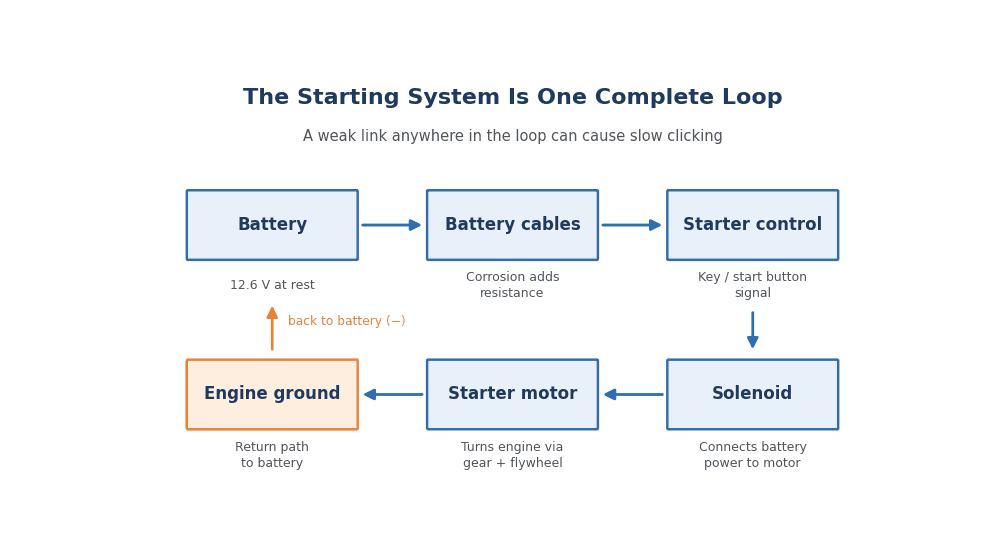
A better approach is to treat the starting system as a complete circuit: battery → cables → starter control → solenoid → starter motor → engine ground → battery.
When each part is tested systematically, the clicking noise becomes a useful diagnostic clue rather than a vague symptom.
Frequently Asked Questions
Why does my car make a slow clicking noise but not start?
Slow clicking usually means the starter circuit is attempting to operate but the starter motor is not receiving or using enough electrical power to crank the engine. A weak battery, poor battery connection, damaged cable, weak ground, starter solenoid problem, or failing starter can produce similar symptoms. Battery voltage and voltage-drop testing are useful for separating these possibilities.
Can a bad battery cause slow clicking when starting?
Yes. A weak or discharged battery may have enough energy to operate the dashboard and lights but not enough current to operate the starter properly. When the starter attempts to draw a heavy current load, battery voltage can fall sharply, causing the solenoid to engage and disengage and producing repeated clicking.
Will a jump-start fix slow clicking?
A jump-start may allow the vehicle to start if the original battery is discharged or weak. However, it does not prove that the battery is the only problem. A poor cable connection, failing starter, charging-system problem, or excessive electrical drain can still exist. If the problem returns, the complete starting and charging systems should be tested.
Why does my car click slowly after replacing the battery?
If a new battery does not solve the problem, inspect the battery terminals, positive cable, engine ground strap, starter solenoid, and starter motor. A new battery cannot compensate for excessive resistance in a cable or ground connection. On some vehicles, battery replacement may also require battery monitoring-system registration or adaptation.
Can a bad alternator cause clicking when starting?
An alternator normally does not directly make the starter click. However, a failing alternator can leave the battery chronically undercharged, eventually causing a weak-battery starting symptom. If the battery repeatedly becomes discharged after the vehicle has been driven, charging-system testing is important.
How do I know whether the starter or battery is bad?
Testing is more reliable than sound alone. A battery that shows low voltage or fails a proper load test points toward the battery. If the battery passes testing but voltage at the starter is inadequate, investigate the cables and connections. If the starter receives the correct voltage but fails to crank the engine properly, the starter assembly becomes a stronger suspect.