
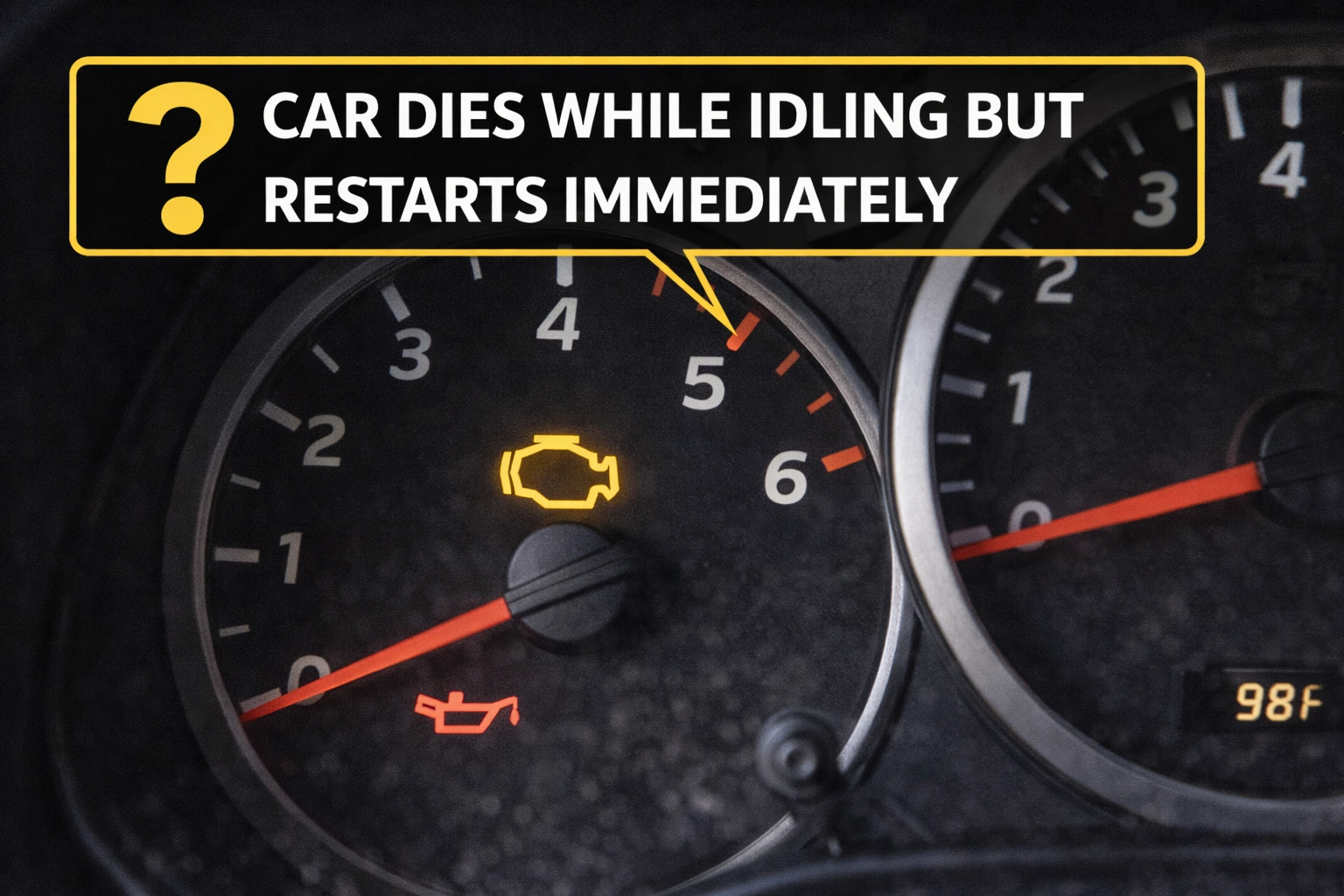
Few car problems are as unsettling as an engine that suddenly stalls while idling, only to restart without hesitation seconds later. It often happens at traffic lights, in parking lots, or while warming up—never at a convenient time.
Because the car restarts immediately, many drivers assume it’s a fluke and keep driving. That’s understandable, but it’s not always wise.
This article is written for everyday drivers, DIY-minded owners, and anyone trying to decide whether a stalling issue is minor, manageable, or a sign of something more serious.
We’ll break down why a car can die at idle but restart right away, what systems are most commonly involved, and how to approach diagnosis without guessing or overspending.
You’ll also learn when not to keep driving, which fixes are inexpensive, and which symptoms deserve immediate attention. The goal isn’t just to explain the problem—but to help you make a confident, informed decision about what to do next.
Research Note
This article is based on established engine diagnostic principles and real-world failure patterns documented in OEM service manuals, manufacturer technical service bulletins (TSBs), and professional automotive repair databases such as ALLDATA, Mitchell 1, and Identifix.
Additional reference was made to Bosch and Denso engine management documentation, ASE (Automotive Service Excellence) training materials, and emissions-system diagnostic guides commonly used in professional workshops.
What “dies at idle but restarts” actually tells you
When a car stalls at idle but restarts immediately, it usually means three important things:
- The engine is mechanically capable of running
- Fuel and spark are present at least intermittently
- The problem is often related to airflow, sensors, or idle control—not catastrophic failure
At idle, engines operate with very tight margins. Airflow is minimal, fuel delivery is precise, and the engine relies heavily on sensors and control systems to maintain around 600–800 RPM (most modern vehicles).
A small disruption—too little air, incorrect sensor data, or unstable fuel pressure—can cause the engine to stall even though it runs fine at higher speeds.
The Most Common Causes (from most to least likely)
1. Dirty or failing idle air control (IAC) system
The idle air control system regulates how much air bypasses the throttle plate when your foot is off the accelerator. If it sticks or responds slowly, the engine may not get enough air to stay running.
Typical symptoms:
- Stalls only at idle
- Restarts immediately
- Rough or fluctuating idle RPM
- More noticeable when engine is warm
In many vehicles, idle airflow is controlled electronically through the throttle body rather than a standalone IAC valve. Carbon buildup can reduce airflow by 20–30%, which is enough to stall an engine at idle.
Fix:
Throttle body and IAC cleaning ($20–$40 DIY, $100–$200 shop)
Not recommended:
Replacing parts before cleaning. Cleaning fixes this issue far more often than replacement.
2. Vacuum leaks (especially small or intermittent ones)
At idle, engines rely on precise air-fuel ratios. A small vacuum leak introduces unmetered air, leaning out the mixture enough to stall the engine.
Common leak points:
- Cracked vacuum hoses
- PCV valve hoses
- Intake manifold gaskets
- Brake booster lines
Typical symptoms:
- Idle stalling, especially when warm
- Hissing sound
- Higher idle RPM at times
- Check engine light may or may not appear
Data point:
Even a vacuum leak equivalent to a 2–3 mm hose crack can destabilize idle while remaining unnoticed at higher RPM.
Fix:
Hose replacement ($10–$50) or gasket repair ($200–$600 depending on engine)
3. Faulty mass airflow (MAF) sensor
The MAF sensor measures incoming air so the ECU can calculate fuel delivery. If it under-reports airflow at idle, the engine may stall even though it runs fine when accelerating.
Typical symptoms:
- Stalls at idle but restarts easily
- Hesitation when stopping
- Worse with A/C on
- Sometimes no check engine light
Practical insight:
A MAF sensor that’s only 10–15% out of range can cause idle stalling without affecting highway driving.
Fix:
MAF sensor cleaning ($10 cleaner) or replacement ($150–$400)
Not recommended:
Using brake cleaner or carb cleaner on a MAF—this often ruins it.
4. Throttle body carbon buildup
Modern engines use electronic throttle control. Carbon buildup around the throttle plate reduces airflow at idle, especially when the plate is nearly closed.
Typical symptoms:
- Stalls when coming to a stop
- Rough idle after restart
- Happens more often after long drives
Vehicles driven mostly in city traffic often accumulate throttle deposits faster than highway-driven cars.
Fix:
Throttle body cleaning ($50–$150)
5. Failing crankshaft or camshaft position sensor (early stages)
These sensors tell the ECU where the engine is in its rotation. If signal drops briefly at idle, the engine can stall but restart once the signal returns.
Typical symptoms:
- Sudden stall with immediate restart
- No warning lights initially
- Problem worsens over time
Data point:
Many sensors fail intermittently before complete failure—sometimes for weeks or months.
Fix:
Sensor replacement ($150–$350)
Not recommended:
Ignoring it. When it fails completely, the car may not restart at all.
6. Fuel delivery issues (pressure drops at idle)
At idle, fuel pressure must remain stable. Weak fuel pumps or failing pressure regulators may drop pressure just enough to stall the engine.
Typical symptoms:
- Stalls at idle, especially hot
- Longer cranking over time
- Worse with low fuel level
Numbers that matter:
Most engines require 40–60 psi of fuel pressure. Drops below that at idle can cause stalling.
Fix:
Fuel pressure testing ($100 diagnostic), pump replacement ($400–$1,000)
7. EGR valve stuck open
The EGR valve should close at idle. If it stays open, exhaust gases dilute the air-fuel mixture, causing stalling.
Typical symptoms:
- Rough idle
- Stalling at stops
- Often triggers a check engine light
Fix:
EGR cleaning or replacement ($150–$500)
When it’s Usually Safe to Keep Driving—and When it’s Not
Usually safe (short term):
- Stalls only occasionally
- Restarts immediately
- No warning lights
- No loss of power while driving
Not recommended to keep driving if:
- Stalling becomes more frequent
- Engine dies while slowing down
- Check engine light flashes
- Car stalls and does not restart immediately
Repeated stalling can strain starters, batteries, and catalytic converters over time.
Pros and Cons of Addressing the Issue Early
Pros
- Prevents sudden no-start situations
- Avoids secondary damage
- Often cheaper to fix early
- Improves fuel economy and idle quality
Cons
- Diagnostic costs if symptoms are intermittent
- Some trial-and-error if no codes are present
Practical Examples
- City commuter: Carbon buildup + IAC issue causes stalling at red lights
- High-mileage car: Weak crank sensor drops signal at idle
- Older vehicle: Vacuum hose crack worsens when engine warms
- Hot climate driving: Heat-soaked fuel pump loses pressure at idle
Common Mistakes Drivers Make
- Replacing parts without cleaning first
- Ignoring early symptoms because the car restarts
- Clearing codes without reading them
- Assuming stalling equals major engine failure
Frequently asked questions
Why does my car stall only when idling with the A/C on?
A/C adds load. Weak idle control systems can’t compensate.
Can bad gas cause this?
Rarely, unless contaminated with water.
Will a tune-up fix it?
Sometimes, but idle stalling is often sensor or airflow related.
Is this dangerous?
It can be if the car stalls in traffic or while turning.
Conclusion
When a car dies while idling but restarts immediately, it’s rarely random—and it’s rarely catastrophic. Most of the time, the engine is signaling that idle control or airflow precision is compromised.
The good news is that many fixes are affordable and straightforward when addressed early. The bad news is that ignoring the problem often leads to bigger failures later.
If your car is stalling at idle, treat it as a message—not an emergency, but not something to dismiss. A methodical approach will save money, reduce frustration, and keep your car reliable where it matters most: in everyday driving.
