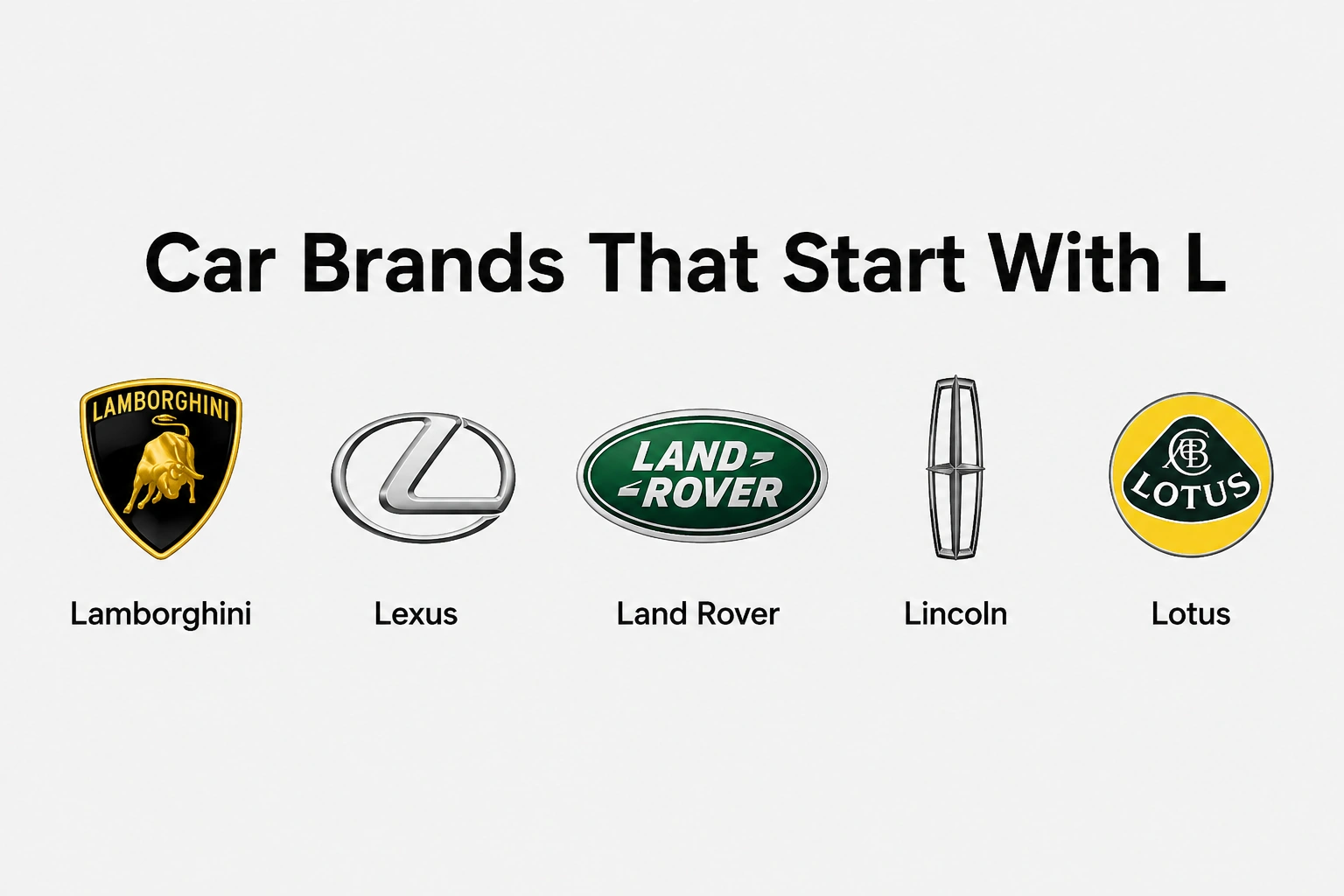
Few letters in the automotive alphabet carry as much weight as L. This single letter opens the door to the world’s most recognizable supercar maker, the brand that redefined what a Japanese luxury car could be, the off-road name that British royalty has trusted for generations, and the electric vehicle startup that built one of the most technically advanced cars in America almost from nothing. Lamborghini, Lexus, Land Rover, Lincoln, Lotus, Lucid — these six names alone span continents, eras, and price points from six figures to entry-level luxury, and that is before even touching the dozens of smaller, historic, and emerging manufacturers that also call the letter L home.
What makes the L category genuinely fascinating is its range. On one end sits Lamborghini, producing vehicles that cost more than most houses. On the other end sits Lada, the Russian manufacturer that has spent six decades building some of the most basic, durable, and widely produced cars in Eastern Europe. In between are luxury icons, rally legends, Chinese EV disruptors, and a long list of historic names that shaped automotive engineering long before most current manufacturers existed.
This guide covers every significant car brand starting with L globally, followed by a complete look at car models — across any brand — whose own names begin with L.
All Car Brands That Start With L — The Complete Global List
1. Lamborghini
Automobili Lamborghini is, by most measures, the most famous car brand beginning with L anywhere in the world. Founded by Ferruccio Lamborghini, an Italian industrialist who had already built a successful tractor manufacturing business, the company’s origin story is famously rooted in a personal dispute. Ferruccio reportedly complained to Enzo Ferrari about the clutch in his Ferrari, and Ferrari dismissively suggested Lamborghini stick to making tractors. Lamborghini’s response was to found a rival supercar company.
- Founded: 1963 in Sant’Agata Bolognese, Italy
- Current Owner: Volkswagen Group (via Audi)
- Status: Active — among the most profitable brands in the VW Group portfolio
- Known For: Mid-engine supercars, V10 and V12 engines, fighting-bull naming tradition
- Notable Fact: Every Lamborghini model since the Miura has been named after a famous Spanish fighting bull or related bullfighting term — the Aventador, Huracán, Urus, and Revuelto all continue this tradition
- Flagship Model: Revuelto — Lamborghini’s first V12 hybrid supercar, priced above $600,000
- Logo: A golden raging bull on a black shield-shaped badge
2. Lexus
Lexus represents one of the most successful brand-launch strategies in automotive history. Toyota created Lexus from scratch in 1989 specifically to compete with established European luxury marques in the American market — and within a decade, Lexus was outselling BMW and Mercedes-Benz in the United States, a feat that seemed almost impossible for a brand with no prior history.
- Founded: 1989 in Nagoya, Japan
- Parent Company: Toyota Motor Corporation
- Status: Active — sold in over 70 countries
- Known For: Reliability, refinement, hybrid luxury vehicles
- Notable Fact: The Lexus LS400, the brand’s launch model, was developed with a then-unprecedented engineering budget and was specifically benchmarked against the Mercedes-Benz S-Class for noise, vibration, and harshness levels
- Logo: A stylized “L” inside an oval — one of the simplest luxury brand logos in the industry
- Current Lineup Highlights: LX, GX, RX, NX, ES, LS, LC, IS, RZ (electric)
3. Land Rover — United Kingdom
Land Rover is the off-road specialist within Jaguar Land Rover, and its history is intertwined with British colonial-era agriculture and military use. The original Land Rover — now known as the Series I — was developed by Rover Company in the years immediately following World War II, inspired partly by the American Willys Jeep that British officers had encountered during the war.
- Founded: 1948 in Solihull, England
- Current Owner: Tata Motors (Jaguar Land Rover)
- Status: Active — among the most profitable luxury SUV brands globally
- Known For: Luxury off-road SUVs, Range Rover sub-brand, Defender
- Notable Fact: The original Land Rover prototype used a centrally mounted steering wheel — a configuration borrowed from agricultural tractors — before production versions moved the wheel to either side for road use
- Sub-brands: Range Rover, Defender, Discovery — each now effectively operates as its own model family with distinct identities
- Royal Connection: Land Rover vehicles have been used by the British Royal Family for ceremonial and practical purposes for over seven decades
4. Lincoln — United States
Lincoln is Ford Motor Company’s luxury division and one of the oldest American luxury brands still in production. Named after Abraham Lincoln, the brand was founded by Henry Leland — the same engineer who founded Cadillac — after he left General Motors. Ford acquired Lincoln in 1922, just a few years after its founding.
- Founded: 1917 in Detroit, Michigan
- Parent Company: Ford Motor Company
- Status: Active — repositioned in recent years toward SUVs
- Known For: Luxury sedans historically; now primarily luxury SUVs
- Notable Fact: The Lincoln Continental, particularly the 1961-1969 generation, is considered one of the most influential American automotive designs of the twentieth century and was the official state car for several US presidents
- Current Lineup: Navigator, Aviator, Nautilus, Corsair — Lincoln no longer produces a traditional sedan as of recent model years
- Presidential History: Lincoln Continentals and Lincoln limousines have served as official presidential transport for decades, including the vehicle involved in the 1963 Kennedy assassination
5. Lotus
Lotus occupies a unique position in British automotive history — a company built on the engineering philosophy of its founder, Colin Chapman, whose famous principle was “simplify, then add lightness.” That philosophy produced some of the most influential racing and sports cars of the twentieth century, and Lotus’s Formula One team won multiple World Championships during the brand’s golden era.
- Founded: 1952 by Colin Chapman in England
- Current Owner: Geely (Chinese automotive group)
- Status: Active — transitioning toward electric performance vehicles
- Known For: Lightweight sports cars, Formula One heritage, the Lotus Elise and Exige
- Notable Fact: Lotus pioneered the use of the monocoque chassis in Formula One with the Lotus 25 in 1962 — a design revolution that every subsequent F1 car has followed
- Current Direction: Under Geely ownership, Lotus has pivoted toward producing electric hypercars (Evija) and electric SUVs (Eletre) alongside its traditional lightweight sports car lineup
- James Bond Connection: The Lotus Esprit submarine car from “The Spy Who Loved Me” remains one of the most famous movie cars ever created
6. Lada
Lada is the most significant Russian automotive brand and one of the highest-volume car manufacturers in Eastern European history. Originally established under the Soviet state automotive enterprise AvtoVAZ with substantial technical assistance from Fiat, Lada became the default car for Soviet and post-Soviet citizens for decades, producing vehicles renowned for mechanical simplicity and durability in harsh conditions rather than refinement.
- Founded: 1966 (AvtoVAZ established with Fiat technical assistance)
- Country: Russia
- Status: Active — primarily serving Russian and CIS markets
- Known For: Simple, durable, affordable vehicles; the Lada Niva off-roader
- Notable Fact: The Lada Niva, introduced in 1977, was one of the first mass-produced car-based 4x4s in the world, predating many Western compact SUVs by over a decade
- Current Status: Following Western sanctions and the departure of international automakers from Russia, Lada has become an even more dominant force in the domestic Russian market
- Models Include: Lada Granta, Lada Vesta, Lada Niva, Lada Largus
7. Lancia
Lancia is one of Italy’s oldest and most technically influential automotive brands, with a history of engineering firsts that rivals any manufacturer in the world. Founded by Vincenzo Lancia, a former racing driver for Fiat, the company introduced the first production unibody car (the Lambda in 1922) and the first production V6 engine in a mainstream vehicle.
- Founded: 1906 in Turin, Italy
- Current Owner: Stellantis
- Status: Active but dramatically reduced — historically near-discontinuation, now being revived
- Known For: Rally heritage (Lancia Delta Integrale), engineering innovation, the Lancia Stratos
- Notable Fact: The Lancia Delta Integrale won the World Rally Championship manufacturer’s title for six consecutive years from 1987 to 1992 — a record that remains unmatched
- Current Revival: Stellantis has committed to reviving Lancia with new electric models, including a new Ypsilon, as part of a broader strategy to restore the brand’s relevance in European markets
8. Lagonda
Lagonda is one of the oldest British luxury car names, with a history dating back to before World War I. Founded by an American expatriate, Wilbur Gunn, in Staines, England, Lagonda built ultra-luxury vehicles throughout the early-to-mid twentieth century before merging into Aston Martin’s history.
- Founded: 1906 in Staines, England
- Current Owner: Aston Martin (Lagonda operates as Aston Martin’s ultra-luxury sub-brand)
- Status: Active in name, primarily as a future EV sub-brand under Aston Martin
- Known For: Pre-war luxury touring cars, the Lagonda V12 of the 1930s
- Notable Fact: Lagonda’s M45 won the 1935 Le Mans 24 Hours outright — a significant achievement for a primarily road-car-focused luxury manufacturer
- Future Direction: Aston Martin has repeatedly announced plans to relaunch Lagonda as an all-electric ultra-luxury brand, though timelines have shifted multiple times
9. Lordstown Motors
Lordstown Motors was an American electric vehicle startup focused specifically on electric pickup trucks for commercial fleet customers, named after the Lordstown, Ohio factory it acquired from General Motors. The company’s story is a cautionary tale of the broader EV startup boom of the early 2020s.
- Founded: 2018
- Country: United States (Lordstown, Ohio)
- Status: Filed for bankruptcy in 2023 following significant financial and production difficulties
- Known For: Endurance electric pickup truck aimed at fleet buyers
- Notable Fact: Lordstown’s factory was the same plant where GM had produced the Chevrolet Cruze — its acquisition by Lordstown was seen as symbolically significant for American EV manufacturing ambitions
- Legacy: Despite its collapse, Lordstown’s story is frequently cited in discussions of the challenges facing EV startups attempting to scale production without established automotive manufacturing experience
10. Laraki
Laraki is one of the few automotive brands originating from North Africa, founded by Moroccan businessman Abdesslam Laraki to produce ultra-exclusive, hand-built luxury sports cars. The brand has never operated at significant volume, instead positioning itself as a boutique manufacturer for collectors seeking genuinely rare vehicles.
- Founded: 1999
- Country: Morocco
- Status: Active but extremely low volume
- Known For: Hand-built luxury sports cars and grand tourers
- Notable Models: Laraki Fulgura, Laraki Borac
- Notable Fact: Laraki vehicles have been displayed at major European motor shows including Geneva, representing one of the only African nations with a presence in that arena
11. LEVC — London Electric Vehicle Company
LEVC is the modern successor to the historic London taxi manufacturer, producing the iconic black cab in electrified form. Now owned by Geely, LEVC represents one of the more successful transitions of a heritage transportation brand into the electric era.
- Founded: 2013 (as the rebranded successor to the London Taxi Company)
- Current Owner: Geely
- Status: Active
- Known For: The LEVC TX electric London taxi
- Notable Fact: The LEVC TX is a range-extended electric vehicle — it uses a small petrol engine purely to generate electricity for the battery, never directly powering the wheels, a configuration shared with some early Chevrolet Volt designs
12. Lynk & Co
Lynk & Co is one of the more interesting recent entrants in the global automotive landscape — a brand created by Geely specifically with international expansion in mind from its inception, using a subscription-based ownership model that was unusual when the brand launched.
- Founded: 2016
- Country: China
- Parent Company: Geely (sister brand to Volvo)
- Status: Active — expanding into European markets
- Known For: Subscription-based car ownership models, shared platform technology with Volvo
- Notable Fact: Lynk & Co vehicles share underlying platform architecture with Volvo models due to common Geely ownership, giving the brand access to safety engineering typically associated with much more expensive vehicles
- Models Include: Lynk & Co 01, 02, 03, 05, 09
13. Li Auto
Li Auto is one of China’s most significant electric and plug-in hybrid vehicle manufacturers, founded by entrepreneur Li Xiang and known for its extended-range electric vehicle (EREV) technology, which addresses range anxiety concerns through a combination of battery power and a small onboard generator.
- Founded: 2015
- Country: China
- Status: Active — among China’s most successful EV startups by sales volume
- Known For: Extended-range electric vehicles (EREVs), large family SUVs
- Notable Fact: Li Auto’s EREV approach — using a small gasoline engine purely as a generator rather than for direct propulsion — has proven particularly successful in the Chinese market, where charging infrastructure varies significantly by region
- Models Include: Li Auto L9, L8, L7, Mega (MPV)
14. Leapmotor
Leapmotor is a Chinese electric vehicle manufacturer that has gained significant international attention through its partnership with Stellantis, which acquired a substantial stake and established a joint venture for international distribution.
- Founded: 2015
- Country: China
- Status: Active — expanding into Europe via Stellantis partnership
- Known For: Affordable electric vehicles, in-house battery and software development
- Notable Fact: The Stellantis-Leapmotor joint venture, established in 2023, gives Leapmotor access to Stellantis’s European dealer network — one of the most significant Chinese-European automotive partnerships of the decade
- Models Include: Leapmotor T03, C10, C11, B10
15. Lucid Motors
Lucid Motors is the American electric vehicle manufacturer most directly positioned as a Tesla competitor in the ultra-premium segment, founded by former Tesla and Apple engineers and backed substantially by Saudi Arabia’s Public Investment Fund.
- Founded: 2007 (as Atieva); renamed Lucid Motors in 2016
- Country: United States (headquartered in Newark, California)
- Major Investor: Saudi Arabia’s Public Investment Fund
- Status: Active — production challenges balanced against industry-leading engineering credentials
- Known For: The Lucid Air sedan — exceptional range and efficiency figures
- Notable Fact: The Lucid Air Sapphire produces over 1,200 horsepower and held the production EV range record at over 500 miles on a single charge with the Air Grand Touring variant
- Current Lineup: Lucid Air (sedan), Lucid Gravity (SUV)
16. Luxgen
Luxgen is Taiwan’s primary domestically-developed automotive brand, established as a subsidiary of Yulon Motor with origins in producing licensed Nissan and Mitsubishi vehicles for the Taiwanese market before developing its own model lineup.
- Founded: 2009 (some sources note 2008 origins)
- Country: Taiwan
- Parent Company: Yulon Motor
- Status: Active — primarily serving Asian markets
- Known For: Connected car technology, SUVs and crossovers
- Notable Fact: The Luxgen 7 won significant Taiwanese automotive awards upon its 2011 launch, representing a milestone for Taiwan’s domestic automotive engineering capability
- Models Include: Luxgen U6, U7, S3, M7
17. Lister
Lister is a historic British sports car and racing manufacturer with a name closely associated with one of the most famous “special” racing cars of the 1950s — the Lister-Jaguar, which combined Lister’s chassis engineering with Jaguar’s powerful engines to dominate British sports car racing.
- Founded: 1954 in Cambridge, England
- Status: Active in modern form, producing high-performance variants of Jaguar models
- Known For: Lister-Jaguar racing cars of the 1950s; modern Lister Storm and tuned Jaguar variants
- Notable Fact: The original Lister-Jaguar “Knobbly” of 1958, driven by Stirling Moss and other top drivers of the era, was one of the most feared sports racing cars of its time
18. Lifan
Lifan was a significant Chinese automotive manufacturer known for affordable vehicles, though the company’s automotive operations ceased independent existence following financial restructuring.
- Founded: 1992
- Country: China
- Status: Defunct as an independent automaker (2020) — assets restructured under Geely-affiliated entities
- Known For: Budget-oriented passenger vehicles for Chinese domestic and export markets
- Notable Fact: Lifan was historically one of the larger Chinese automakers exporting to markets including Russia, the Middle East, and parts of Africa before its financial difficulties
19. Ligier
Ligier is a French manufacturer with a dual identity — historically known for Formula One participation under founder Guy Ligier, and currently known for producing small, license-free “voiturette” vehicles that can be driven without a full driving license in several European countries.
- Founded: 1968 in France
- Status: Active — focused on microcars and voiturettes
- Known For: License-free small vehicles, historic Formula One team (1976-1996)
- Notable Fact: Ligier’s Formula One team won multiple Grand Prix races during the 1970s and 1980s, while the road car division has shifted entirely toward the European microcar segment that does not require a standard driving license
What Makes L Brands Popular
Looking across the complete list of car brands beginning with L, a pattern emerges that is genuinely different from most other letters in the automotive alphabet: extreme polarity. The L category contains more brands sitting at the absolute top of the price and prestige spectrum — Lamborghini, Lexus, Lagonda, Lucid — than almost any other letter, while simultaneously containing brands defined entirely by affordability and mechanical simplicity, particularly Lada and the historic Lifan.
This polarity is not accidental. Several of the luxury L brands were deliberately created to occupy a specific positioning gap. Lexus was engineered from a blank sheet specifically to challenge European luxury incumbents. Lucid was founded specifically to challenge Tesla at the very top of the EV market with superior range and efficiency engineering. Lagonda has been repeatedly positioned as an ultra-luxury electric sub-brand precisely because Aston Martin needed a name with sufficient historical prestige to support pricing above its own core lineup. The letter L, for whatever reason, has repeatedly been chosen by manufacturers launching genuinely ambitious premium projects.
At the other end, Lada’s six-decade dominance of the Russian market and Lifan’s historic role in Chinese exports both represent a different kind of automotive significance — not technological leadership, but the kind of mass-market presence that defines how millions of ordinary people actually experience car ownership. The L category, more than most letters, illustrates the full breadth of what “automotive brand” can mean: from a $600,000 V12 hybrid hypercar to a $10,000 Lada Granta serving as someone’s only vehicle in rural Russia.
The Chinese EV wave is also disproportionately represented in the L category. Li Auto, Leapmotor, and Lynk & Co are all significant, well-funded, technologically serious Chinese EV manufacturers — and all three have already established meaningful international distribution partnerships or export strategies. Combined with Lucid’s position as America’s most credible Tesla alternative and Lotus’s pivot toward electric performance vehicles under Geely, the L category arguably represents the electric vehicle transition more comprehensively than any other letter of the alphabet.
Car Models That Start With L — Across Every Brand
This section covers vehicles whose model names — not brand names — begin with the letter L, spanning manufacturers from Toyota to Ferrari to Buick.
1. Toyota Land Cruiser
The Toyota Land Cruiser is one of the most enduring and globally significant SUV nameplates ever produced, with a continuous production history dating back to 1951 and a reputation for durability that has made it the vehicle of choice for United Nations missions, humanitarian organizations, and military forces across multiple continents.
- Starting Price (2026, US market): Approximately $58,000 MSRP
- Engine: 2.4-liter turbocharged hybrid four-cylinder, approximately 326 hp combined
- Drivetrain: Full-time 4WD with locking differentials
- Key Features:
- Multi-Terrain Select and Crawl Control off-road systems
- Returned to the US market after a hiatus, positioned below the Lexus GX
- Toyota Safety Sense standard
- Available 12.3-inch touchscreen with wireless Apple CarPlay and Android Auto
- Renowned global reputation for reliability across decades of continuous production
2. Nissan Leaf
The Nissan Leaf holds the historic distinction of being the first mass-produced, affordable electric vehicle from a major global automaker, launched in 2010 — well before Tesla achieved mainstream production volume.
- Starting Price (2026): Approximately $29,000 MSRP (estimated for redesigned generation)
- Battery/Range: Newer generation targets significantly improved range over the original Leaf’s approximately 150-mile figures
- Key Features:
- First mainstream affordable EV from a major manufacturer (2010 launch)
- Redesigned generation moves to a crossover-style body
- CHAdeMO charging historically used; newer generations expected to adopt more widely supported standards
- ProPilot Assist driver assistance available
3. Mitsubishi Lancer (Historic, 1973–2017)
The Mitsubishi Lancer is one of the most significant compact car nameplates in rally history, with the Lancer Evolution variant becoming a legendary performance icon that defined an entire generation of Japanese performance car enthusiasts.
- Production Years: 1973–2017 (Lancer Evolution ended 2016)
- Most Notable Variant: Lancer Evolution — turbocharged, all-wheel-drive performance sedan
- Lancer Evolution Final Edition (2015): 2.0-liter turbocharged four-cylinder, 303 hp
- Key Heritage:
- World Rally Championship success across multiple generations
- Direct rival to the Subaru Impreza WRX STI
- Cult enthusiast following persists years after discontinuation
- All-wheel-drive system technology influenced later Mitsubishi and Mitsubishi-derived platforms
4. Subaru Legacy
The Subaru Legacy is the brand’s longest-running mainstream sedan nameplate, representing Subaru’s core philosophy of standard all-wheel drive applied to a mid-size family sedan format.
- Starting Price (2026): Approximately $26,000 MSRP
- Engine: 2.5-liter naturally aspirated four-cylinder, 182 hp; turbocharged XT variant available on certain trims
- Drivetrain: Symmetrical All-Wheel Drive — standard across the entire lineup
- Key Features:
- Only mainstream mid-size sedan with standard AWD across all trims
- Subaru EyeSight driver assistance suite standard
- Available 11.6-inch vertical touchscreen on upper trims
- Strong reliability reputation reflected in resale values
5. Maserati Levante
The Maserati Levante represents the Italian luxury brand’s entry into the SUV segment — a category Maserati had avoided for decades before market pressure made an SUV essential for the brand’s survival.
- Starting Price (Recent Production): Approximately $90,000+ MSRP
- Engine Options: Twin-turbocharged V6 (350-424 hp depending on trim); Trofeo variant with Ferrari-built V8
- Levante Trofeo: 3.8-liter twin-turbo V8 (Ferrari-built), 580 hp, 0-60 mph in approximately 3.7 seconds
- Key Features:
- Air suspension with adjustable ride height
- Italian interior craftsmanship with extensive leather options
- Q4 intelligent all-wheel-drive system
- Maserati’s first SUV — named after a Mediterranean wind, continuing the brand’s wind-naming tradition
6. Ferrari LaFerrari
The Ferrari LaFerrari represents the pinnacle of Ferrari’s hybrid hypercar engineering at the time of its production — one of the “Holy Trinity” hypercars alongside the McLaren P1 and Porsche 918 Spyder that defined the hybrid hypercar era of the early 2010s.
- Production Years: 2013–2018 (including Aperta convertible variant)
- Engine: 6.3-liter naturally aspirated V12 plus electric motor (HY-KERS system)
- Combined Power: 950 hp
- 0-60 mph: Under 3 seconds
- Key Features:
- Limited production — 499 coupes plus 209 Aperta convertibles
- Carbon fiber monocoque chassis derived directly from Formula One technology
- Active aerodynamics with multiple movable elements
- Among the most valuable modern Ferraris on the collector market, with values significantly above original sale prices
7. Buick LaCrosse
The Buick LaCrosse was the brand’s flagship sedan for over a decade, representing General Motors’ attempt to position Buick as a near-luxury alternative with genuinely competitive styling and technology against Japanese and European mid-size luxury sedans.
- Production Years: 2005–2019 (across two generations)
- Final Generation Engine Options: 2.5-liter four-cylinder; 3.6-liter V6; eAssist mild-hybrid variant available
- Key Features:
- Significant design overhaul for the second generation (2010) earned widespread praise for interior quality
- eAssist hybrid system improved fuel economy without a full hybrid powertrain
- Discontinued as part of GM’s broader move away from traditional sedans toward SUVs and crossovers
8. Mitsubishi L200 / Triton
The Mitsubishi L200 — sold as the Triton in several markets — is one of the most globally significant mid-size pickup trucks, with a multi-decade production history and particular dominance in markets across Asia, Africa, Latin America, and Australia where Ford and Toyota mid-size pickups also compete intensely.
- Current Generation: Significantly redesigned with bold new exterior styling
- Engine Options: 2.4-liter turbodiesel four-cylinder, approximately 200+ hp on top trims
- Key Features:
- Super Select 4WD-II system with multiple drive modes
- Strong payload and towing capacity competitive with segment leaders
- Sold under different names (L200, Triton, Strada) depending on regional market
- Long-standing reputation for durability in commercial and agricultural use
9. Subaru Levorg
The Subaru Levorg is a sporty wagon variant primarily sold in markets outside North America, combining Subaru’s turbocharged performance characteristics with practical wagon utility — a body style that has become increasingly rare globally as SUVs have displaced traditional wagons.
- Markets: Primarily Japan, Europe, Australia — not sold in North America
- Engine: Turbocharged 1.6-liter or 2.4-liter four-cylinder depending on market and generation
- Key Features:
- Symmetrical All-Wheel Drive standard
- EyeSight driver assistance technology
- Positioned as a performance-oriented wagon alternative to crossover SUVs
- Popular in markets where wagon body styles retain stronger consumer demand than in North America
Quick Reference Table — L Brands At A Glance
| Brand | Country | Founded | Status | Best Known For |
| Lamborghini | Italy | 1963 | Active (VW Group) | Supercars, bull naming |
| Lexus | Japan | 1989 | Active (Toyota) | Luxury reliability |
| Land Rover | UK | 1948 | Active (Tata) | Luxury off-roaders |
| Lincoln | USA | 1917 | Active (Ford) | American luxury SUVs |
| Lotus | UK | 1952 | Active (Geely) | Lightweight sports cars |
| Lada | Russia | 1966 | Active | Affordable durability |
| Lancia | Italy | 1906 | Active (limited) | Rally heritage |
| Lagonda | UK | 1906 | Active (Aston Martin) | Ultra-luxury EV future |
| Lordstown | USA | 2018 | Defunct (2023) | EV pickup attempt |
| Laraki | Morocco | 1999 | Active (low volume) | Hand-built supercars |
| LEVC | UK | 2013 | Active (Geely) | Electric London taxi |
| Lynk & Co | China | 2016 | Active | Subscription ownership |
| Li Auto | China | 2015 | Active | EREV family SUVs |
| Leapmotor | China | 2015 | Active (Stellantis JV) | Affordable EVs |
| Lucid | USA | 2007 | Active | Premium EV efficiency |
| Luxgen | Taiwan | 2009 | Active | Connected vehicles |
| Lister | UK | 1954 | Active | Tuned Jaguar variants |
| Lifan | China | 1992 | Defunct (2020) | Budget exports |
| Ligier | France | 1968 | Active | Microcars/voiturettes |
Frequently Asked Questions
What is the most famous car brand starting with L?
Lamborghini is widely regarded as the most famous car brand starting with L, recognized globally for its mid-engine supercars, distinctive angular styling, and the tradition of naming models after Spanish fighting bulls. Lexus is also extremely well-known, particularly in North America, where it has been one of the best-selling luxury brands for decades. Land Rover and Lincoln are also globally recognized names within their respective luxury SUV and American luxury segments.
Is Lexus owned by Toyota?
Yes. Lexus was created by Toyota Motor Corporation in 1989 specifically as a luxury division to compete with established European luxury brands in markets like the United States. Lexus operates with its own dealership network, design language, and model lineup, but shares platform engineering, manufacturing quality standards, and powertrain technology with Toyota. The relationship has been central to Lexus’s reputation for reliability, since it inherits Toyota’s manufacturing quality processes.
What car brands starting with L are electric vehicle manufacturers?
Several significant EV manufacturers begin with L. Lucid Motors, based in the United States, produces the Lucid Air and Lucid Gravity, positioned as premium alternatives to Tesla. Li Auto and Leapmotor are major Chinese EV manufacturers, with Li Auto known for extended-range electric vehicles and Leapmotor expanding into Europe through a Stellantis partnership. Lynk & Co, also Chinese, uses a subscription ownership model and shares platform technology with Volvo. LEVC produces the electric London taxi. Lordstown Motors was an American EV pickup truck startup that filed for bankruptcy in 2023.
What happened to Lordstown Motors?
Lordstown Motors was an American electric vehicle startup founded in 2018 that aimed to produce the Endurance electric pickup truck for commercial fleet customers, operating out of a former General Motors factory in Lordstown, Ohio. The company faced significant production, quality, and financial challenges and filed for bankruptcy in 2023. Its story has become a frequently cited example of the difficulties faced by EV startups attempting to scale manufacturing without the resources and experience of established automakers.
What car models start with the letter L?
Many notable car models across different brands start with L. These include the Toyota Land Cruiser, one of the most durable and globally significant SUVs ever produced; the Nissan Leaf, the first mass-produced affordable electric vehicle from a major automaker; the Mitsubishi Lancer, particularly its Evolution variant which became a rally and enthusiast icon; the Subaru Legacy, the brand’s standard-AWD mid-size sedan; the Maserati Levante, the Italian brand’s first SUV; and the Ferrari LaFerrari, one of the defining hybrid hypercars of the 2010s.
Is Lancia still making cars in 2026?
Lancia’s production has been dramatically reduced compared to its historic output, with the brand having come close to discontinuation in recent years. However, Stellantis — Lancia’s parent company — has committed to reviving the brand with new electric vehicles, including a new generation of the Ypsilon, as part of a broader European brand strategy. Lancia’s revival is positioned around restoring relevance primarily in European markets where the brand retains historical recognition from its rally heritage and earlier model lineups.
What is the difference between Land Rover and Range Rover?
Land Rover is the overall brand name and parent marque, while Range Rover, Defender, and Discovery operate as sub-brands or model families under that parent. In recent years, Jaguar Land Rover has increasingly marketed Range Rover, Defender, and Discovery as standalone identities with their own distinct design languages and positioning, even though all of them are produced and sold under the broader Land Rover corporate umbrella. Range Rover specifically represents the luxury end of the lineup, while Defender emphasizes rugged off-road capability with a more utilitarian design heritage.