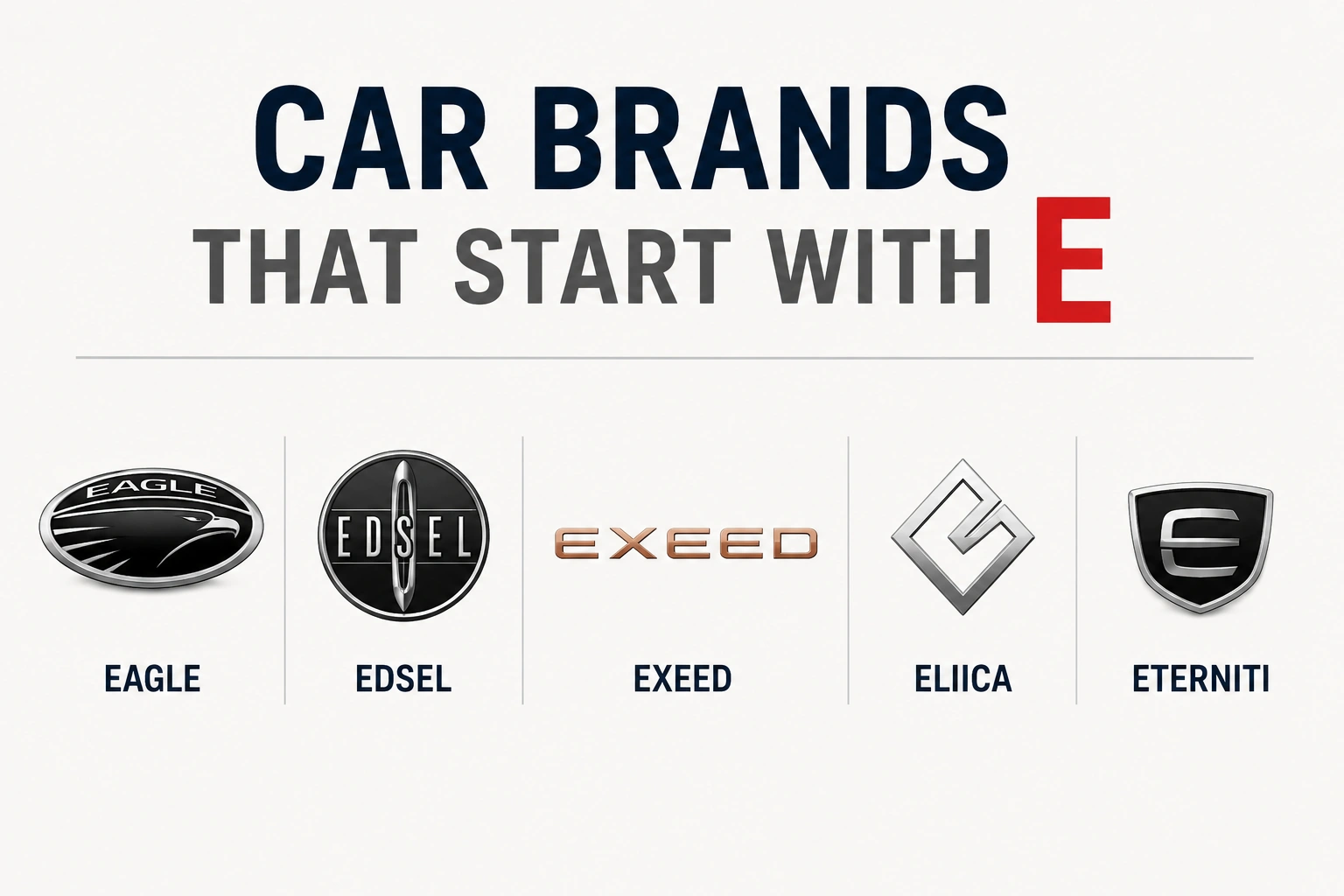
The letter E has never been the loudest in the automotive alphabet. There is no E equivalent of Ford, Ferrari, or General Motors dominating global sales charts.
And yet, look closer and the E-brands carry some of the most compelling stories the industry has produced — a $250 million failure that became the dictionary definition of a corporate blunder, a Chinese premium brand with Le Mans ambitions, a British lightweight track-car company that holds lap records across Europe, and an American brand that gave us one of the great muscle car names before quietly disappearing.
The car models are even richer: the E-Class defined what a German executive saloon should be for forty years; the Elantra N is the compact performance benchmark nobody expected from Hyundai; and the Escalade IQ is Cadillac’s electric vision of what a flagship should look like in 2026.
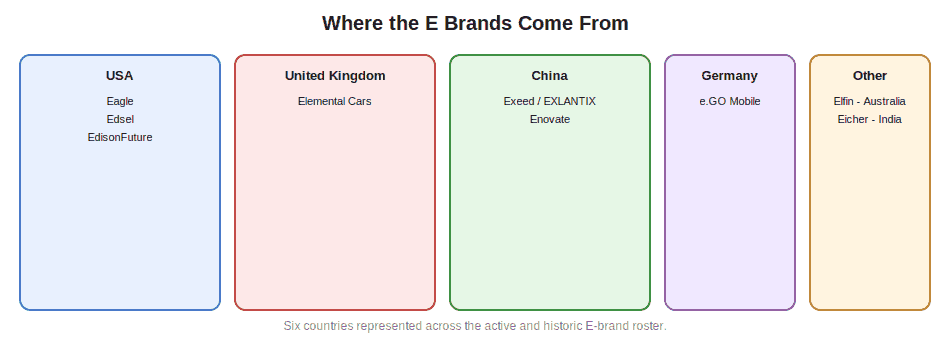
Car Brands That Start With E
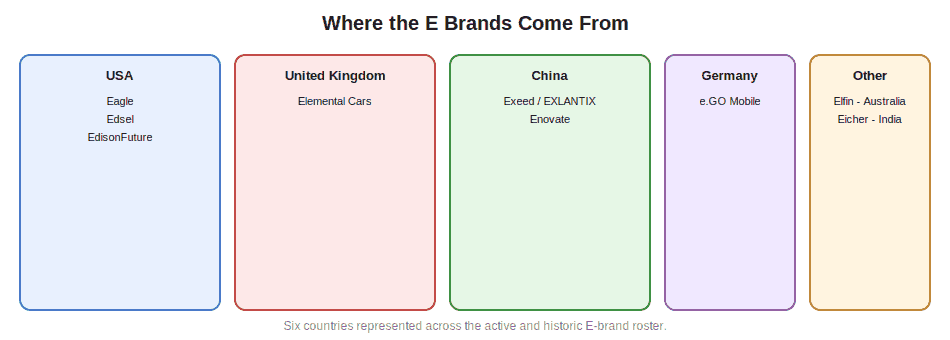
1. Eagle
Eagle was an American automobile brand that existed between 1988 and 1999 under Chrysler ownership. It was created from the remnants of AMC (American Motors Corporation) after Chrysler acquired AMC in 1987, and initially served as a platform for rebadged AMC, Renault, and Mitsubishi vehicles sold through former AMC dealers who needed the product to survive.
Despite producing some genuinely interesting vehicles, Eagle never achieved brand clarity or consumer recognition and was discontinued in 1999. Its most notable contribution to automotive history was not any single model but the platform that would later become the Jeep Cherokee — arguably one of the most influential vehicles of the 1990s.
Key Models:
- Eagle Premier (1988–1992) — Executive sedan; shared platform with Renault 25; front-wheel drive in an era when that was still unusual for larger American cars
- Eagle Vision (1993–1997) — LH-platform large sedan; shared underpinnings with Dodge Intrepid and Chrysler LHS; 3.5L V6; reasonably well-received but the brand lacked identity
- Eagle Talon (1990–1998) — AWD turbocharged sports coupe; shared platform with Mitsubishi Eclipse; cult following among enthusiasts still active today; available with 195 hp AWD turbo
Brand facts:
- Founded: 1988 (from AMC remnants)
- Defunct: 1999
- Owner (while active): Chrysler Corporation
- Legacy: Eagle Talon remains collectible; Jeep lineage traces through AMC acquisition
2. Edsel
Edsel was a Ford Motor Company brand that existed for exactly 26 months — from September 1957 to November 1959 — and cost Ford approximately $350 million (equivalent to roughly $3.6 billion in today’s money). It has since become the textbook case study for how not to launch a new automotive brand, taught in business schools around the world as a lesson in marketing failure.
The backstory is important: in the early 1950s, the US car market was booming and consumers were moving upmarket into mid-price vehicles. Ford had only Mercury competing in that segment against GM’s Buick, Oldsmobile, and Pontiac. In 1955, Ford’s board approved an ambitious plan to create an entirely new brand. By the time the Edsel launched in 1957, the economy had turned, a recession had begun, and consumer tastes had shifted toward smaller, more economical cars. The Edsel arrived as exactly the opposite — large, flashy, and expensive.
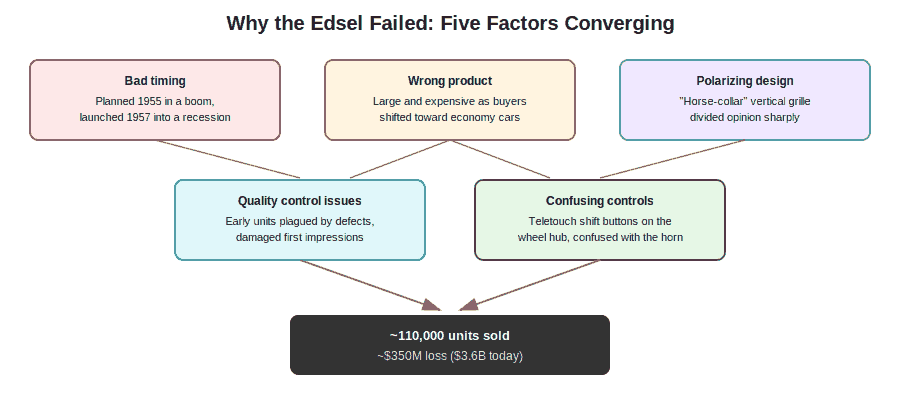
Its distinctive “horse-collar” vertical oval grille polarised opinion immediately. Quality control problems plagued early models. The Teletouch transmission system placed shift buttons on the steering wheel hub, which many drivers confused with the horn. Despite 18 model variants and $50 million in advertising, Ford sold only 109,466 Edsels across its entire run. The brand was discontinued in November 1959.
Key Models:
- Edsel Corsair (1958) — Entry model; V8 engine; most recognisable of the range
- Edsel Ranger (1959) — Streamlined final year model with less pronounced grille
- Edsel Citation — Top trim for 1958; convertible available
Brand facts:
- Founded: September 1957
- Defunct: November 1959
- Owner: Ford Motor Company
- Total production: ~110,000 units
- Cost to Ford: ~$350 million ($3.6B in 2023 money)
- Named after: Edsel Bryant Ford, son of Henry Ford
3.Elemental
Elemental Cars is a British manufacturer founded in 2014, based in Chichester, West Sussex, and focused entirely on building ultra-lightweight, high-performance track and road cars. It produces the RP1 — a carbon fibre sports car weighing just 550 kg with a turbocharged engine producing 300 hp, giving a power-to-weight ratio competitive with Lamborghini and Ferrari at a fraction of the purchase price.
The company is small by any standard — production is genuinely handbuilt and limited — but it represents the continued tradition of British lightweight sports car manufacturers that includes Caterham, Ariel, and BAC. Its vehicles have competed in the Britcar Endurance Championship and are capable of road legal use in the UK.
Key Models:
- RP1 — Carbon fibre monocoque; 550 kg; 300 hp turbocharged 4-cylinder; 0–60 mph in approximately 2.7 seconds; starts at approximately £100,000
Brand facts:
- Founded: 2014, Chichester, UK
- Status: Active, ultra-low volume
- Market: Primarily UK and European road and track use
4. Exeed (EXLANTIX)
Exeed is the premium automotive brand of Chinese manufacturer Chery — one of China’s largest and most export-focused carmakers. Founded in 2017 and targeting premium buyers in China, Eastern Europe, the Middle East, and increasingly Western Europe, Exeed (also marketed as EXLANTIX in international markets) produces a range of SUVs and crossovers positioned above mainstream Chinese brands and competing with entry-level luxury vehicles from European manufacturers.
The brand has expanded aggressively through 2025 and 2026, unveiling multiple new models including shooting-brake-style vehicles, extended-range electric SUVs, and plug-in hybrids. Exeed is also partnering with Le Mans — becoming the first Chinese brand to sign with ACO for motorsport development — which gives it credibility in performance engineering that most Chinese brands lack.
Key Models (2025/2026):
- Exeed VX — Mid-large flagship SUV; from ~$26,600 USD (China); PHEV version: 1.5T + dual electric motors, 456 hp, 143 km pure electric range, 1,300 km total range
- Exeed Exlantix MX (ET5) — Mid-size extended-range SUV; 1.5T generator + 195 kW rear motor; 32.66 kWh LFP battery; 210 km electric range; 1,310 km combined; from ~$19,070 USD
- Exeed ES8 / ES7 GT — Shooting brake-style coupe models; unveiled December 2025
- Exeed ET8 / ET9 — Flagship SUVs; unveiled December 2025; solid-state battery testing planned for 2026
- EX8 — Redesigned flagship SUV; revealed at Auto China 2026 (April)
- EX6 — Compact SUV; redesigned for 2026
Brand facts:
- Founded: 2017
- Owner: Chery Automobile Co., Ltd.
- Headquarters: Wuhu, Anhui, China
- Cumulative sales (Jan–Nov 2025): 109,466 units
- International presence: 20+ countries; EU entry underway via EXLANTIX branding
5.e.GO Mobile
e.GO Mobile is a German electric vehicle startup founded in 2015 by Professor Günther Schuh of RWTH Aachen University. It produces the e.GO Life — a compact, affordable urban electric city car designed specifically for short-range commuting in European cities. The company went through insolvency proceedings in 2020, was restructured, and continues operating in a rebuilt form through a joint venture with Chinese backing.
The e.GO Life targets the same affordable urban EV niche as the Dacia Spring but with a distinctly German design philosophy and a focus on recyclable materials and modular construction. Production volumes remain limited but the brand remains active in the European small EV segment.
Key Model:
- e.GO Life — Urban EV; approximately 60–80 hp; 100–140 km real-world range; target price around €15,000–€17,000 in the European market; 4-seat city car
Brand facts:
- Founded: 2015, Aachen, Germany
- Status: Active (post-restructuring 2021–2022)
- Market: European urban EV segment
- US availability: No
6. Elfin Sports Cars
Elfin Sports Cars is an Australian manufacturer founded in 1957 by Garrie Cooper in Adelaide. It produces small, lightweight sports and racing cars primarily for Australian customers and motorsport participants. The company is one of the longest-surviving independent sports car manufacturers in the world, having operated continuously for over six decades.
Elfin’s vehicles are hand-built in very limited numbers and designed for track use and occasional road registration. The MS8 Streamliner was one of the most recent production models, featuring a Chevrolet LS V8 and a carbon fibre body.
Brand facts:
- Founded: 1957, Adelaide, Australia
- Status: Active, ultra-low volume
- Market: Australian and select international motorsport customers
7. Eicher Motors
Eicher Motors is an Indian company primarily known for Royal Enfield motorcycles but also produces commercial trucks and buses through its VECV (VE Commercial Vehicles) joint venture with Volvo. While not a passenger car manufacturer in the traditional sense, Eicher is included here as a motorised vehicle manufacturer beginning with E with significant global commercial vehicle operations.
Brand facts:
- Founded: 1948, India
- Status: Active
- Primary product: Commercial vehicles and Royal Enfield motorcycles
- Passenger cars: No
8. EdisonFuture
EdisonFuture is an American electric truck and van startup announced in 2021. It has shown concepts for an electric pickup truck (EF1-T) and electric van (EF1-V), targeting the commercial fleet and consumer truck markets. As of 2026, no production vehicles have been delivered and the company has not confirmed a firm launch date, placing it firmly in the concept/pre-production category.
Brand facts:
- Founded: 2021, USA
- Status: Pre-production; no confirmed delivery date as of 2026
- Planned products: Electric pickup truck and cargo van
9. Enovate
Enovate is a Chinese electric vehicle brand founded in 2017 and owned by Sokon Industry Group. It produces premium electric SUVs for the Chinese domestic market, with the ME7 being its flagship model. The brand has limited international presence and is primarily known in China’s domestic EV market.
Key Model:
- Enovate ME7 — Large electric SUV; up to 700 km claimed range; targeted at premium Chinese EV buyers
Brand facts:
- Founded: 2017, China
- Owner: Sokon Industry Group
- Status: Active in China; very limited international sales
Car Models That Start With E
1. Hyundai Elantra
The Hyundai Elantra has been quietly evolving into one of the best-value compact sedans on sale, and the 2026 model year delivers a comprehensive and well-rounded package that earns its IIHS Top Safety Pick+ rating without needing a premium badge to justify the price. It sits alongside the Honda Civic and Toyota Corolla in the segment but has arguably surpassed both on standard feature content per dollar.
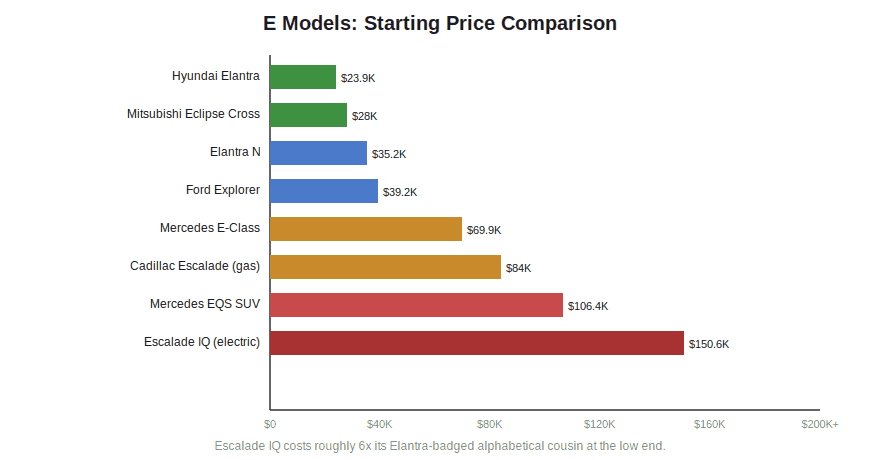
- Starting MSRP: $23,870 (SE, including destination)
- Engine options: 2.0L four-cylinder (147 hp); 1.6L turbo N Line (201 hp); 2.0L turbo N (276 hp); 1.6L hybrid (139 hp combined)
- Transmission: CVT (standard); 7-speed DCT (N Line); 6-speed manual or 8-speed DCT (N)
- Fuel economy: 31/40 mpg (SE gas); 50+ mpg city (Hybrid Blue)
- Cargo: 14.2 cubic feet (sedan only; GT hatchback discontinued)
- Safety: IIHS Top Safety Pick+ (2026); Hyundai SmartSense standard across all trims
- Top trim (N): $36,345 including destination; 276 hp; Brembo brakes; electronic LSD; track-tuned suspension
- Reliability: 4.5/5.0 RepairPal; ranked 8th of 36 compact cars
2. Hyundai Elantra N
The Elantra N deserves its own entry because it occupies a genuinely rare space in the compact car market — a purpose-built performance version of a family sedan, tuned by Hyundai’s N division (which also developed the Hyundai i30 N and Veloster N), with Brembo front brakes, an electronically controlled limited-slip differential, and launch control available for under $37,000. It is one of the most discussed performance bargains in any class.
- Engine: 2.0L turbocharged inline-4; 276 hp / 289 lb-ft torque
- Transmission: 6-speed manual (standard) or 8-speed wet dual-clutch (DCT); both with launch control
- Drivetrain: Front-wheel drive with electronic LSD
- 0–60 mph: Approximately 5.3 seconds (manual); 5.0 seconds (DCT)
- Brakes: Brembo 4-piston front calipers
- Suspension: N-tuned with 3-way electronic damper control (NGS)
- Starting MSRP: From $35,245 (manual) / $36,745 (DCT)
- N e-Shift: On DCT models — simulates manual rev-matching even in automatic mode
- Rivals: Volkswagen Golf GTI, Honda Civic Type R (more expensive), Toyota GR Corolla
3. Mercedes-Benz E-Class
The Mercedes-Benz E-Class is one of the longest-running and most commercially successful nameplate families in automotive history, having defined the executive saloon segment across multiple generations since the name was formalised in 1993 (though its lineage goes back to the W114 of 1967). The 2024/2025 generation W214 is the most technologically advanced E-Class ever built.
- Starting MSRP (2025 E 350): ~$69,900
- Engine options: E 350: 2.0L turbocharged inline-4 mild hybrid (255 hp); E 450: 3.0L inline-6 mild hybrid (375 hp); AMG E 53: 3.0L inline-6 hybrid (603 hp)
- Transmission: 9-speed automatic (9G-TRONIC)
- Drivetrain: RWD standard; 4MATIC AWD optional
- Fuel economy (E 350): 25 city / 34 highway mpg
- Interior: 14.4-inch central touchscreen; 12.3-inch digital instrument cluster; optional rear 11.6-inch entertainment screen
- MBUX system: Latest generation with ChatGPT integration for natural language queries
- Active safety: PRE-SAFE; Attention Assist; Active Brake Assist; optional automated driving Level 2+
4. Mercedes-Benz EQS SUV
The Mercedes-Benz EQS SUV is the German brand’s flagship electric SUV — a three-row, seven-seat luxury vehicle that sits above the EQE SUV in the model hierarchy and competes directly with the Cadillac Escalade IQ, BMW iX, and Audi Q8 e-tron at the top of the premium electric segment.
- Starting MSRP (2025): $106,400
- Power (450 4MATIC AWD): 536 hp combined
- Range: Up to 323 miles EPA estimated
- Battery: 122 kWh
- Charging: 200 kW DC fast charging
- Interior: Standard 56-inch Hyperscreen (spanning the full dashboard width) with three separate displays
- Seating: 7 passengers (optional third row)
- Suspension: Active air suspension standard
- Safety: Level 2+ driver assistance; DRIVE PILOT available in select states (Level 3 conditional automation)
5. Cadillac Escalade (and Escalade IQ)
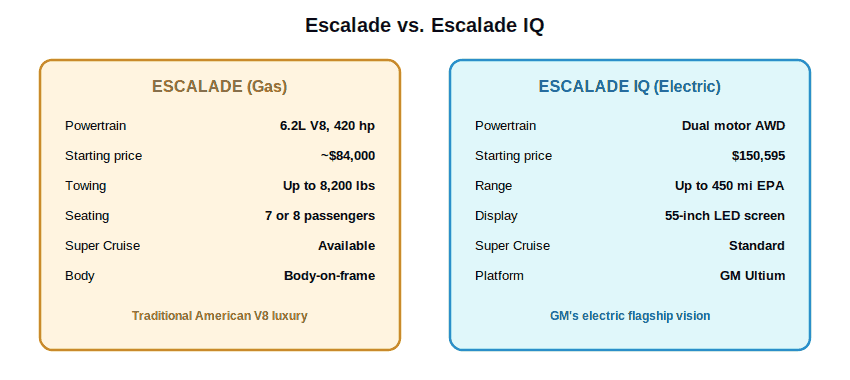
The Escalade has been the most recognisable symbol of American luxury SUV culture since its debut in 1999. The 2025/2026 fifth-generation model continues with both a gasoline powertrain and the new Escalade IQ electric variant, which started production in 2024.
Escalade (Gas, 2026):
- Engine: 6.2L V8; 420 hp / 460 lb-ft torque
- Transmission: 10-speed automatic
- Starting MSRP: ~$84,000
- Towing: Up to 8,200 lbs
- Seating: 7 or 8 passengers
- Super Cruise: Available (hands-free highway driving)
Escalade IQ (Electric, 2025/2026):
- Starting MSRP: $150,595
- Battery: Large-format Ultium pack
- Range: Up to 450 miles EPA estimated
- Power: Dual motor AWD
- Super Cruise: Standard
- Air Ride Adaptive Suspension: Standard
- Key interior features: Executive rear seating, 55-inch diagonal LED screen, privacy partition option
6. Explorer (EV and Gas)
The Ford Explorer is one of the most important SUV nameplates in American automotive history — it practically created the mainstream SUV market in 1991 and has remained a top-seller ever since. The 2025/2026 Explorer continues in its sixth-generation form for the US market (gas), while the Explorer EV entered the European market in 2024/2025 as a separate model on Volkswagen’s MEB platform.
Explorer (Gas, US 2026):
- Starting MSRP: ~$39,200 (Base)
- Engine: 2.3L EcoBoost turbocharged inline-4 (300 hp) standard; 3.0L twin-turbo V6 (400 hp) in ST
- Drivetrain: RWD standard; 4WD optional
- Seating: 7 passengers
- Towing: Up to 5,600 lbs
Explorer EV (European market, 2024/2025):
- Platform: Volkswagen MEB
- Battery: 77 kWh (Standard) / 82 kWh (Extended)
- Range: Up to 374 miles WLTP (Extended Range RWD)
- Power: 170–286 hp
- Starting price: ~£42,000 UK
7. Mitsubishi Eclipse Cross
The Eclipse Cross is Mitsubishi’s compact crossover SUV and one of the brand’s most globally distributed models. It carries the Eclipse name — previously attached to a well-regarded sports coupe produced from 1989 to 2011 — though the two vehicles share nothing mechanically.
- Starting MSRP (2026): ~$27,995
- Engine: 1.5L turbocharged inline-4; 152 hp
- Transmission: CVT
- Drivetrain: FWD standard; S-AWC all-wheel control optional
- Fuel economy: 26 city / 29 highway (FWD)
- PHEV variant: 2.4L PHEV system; 74 MPGe; 23 miles electric-only range; from ~$36,995
- Cargo: 57.6 cubic feet (seats folded)
- Infotainment: 9-inch touchscreen with Apple CarPlay and Android Auto
8. Toyota Echo
The Toyota Echo (sold as the Yaris in most markets) was a subcompact car produced from 1999 to 2005 for the US market. Lightweight, fuel-efficient, and genuinely reliable, the Echo reached over 40 mpg highway at a time when hybrid technology was still expensive and rare. It developed a quiet cult following among economy-minded drivers and remains in active use in many parts of the world under the Yaris name.
- Years: 1999–2005 (US market as Echo)
- Engine: 1.5L DOHC inline-4; 108 hp
- Fuel economy: Up to 43 mpg highway (EPA)
- Weight: ~2,035 lbs — extremely light
- Legacy: Rebranded as Yaris in 2006 for US market; Echo name still used in some international markets
9. Lotus Elan
The Lotus Elan was one of the defining sports cars of the 1960s — a lightweight, front-engine, rear-wheel-drive roadster that handled with a precision and balance that influenced almost every sports car designer who followed. Built from 1962 to 1975, it weighed just 1,500 lbs and used Lotus’s proprietary fibreglass body bonded to a steel backbone chassis — a construction method Chapman borrowed and refined for multiple subsequent models.
A front-wheel-drive version was briefly revived in 1989–1995, less well-received, and the Elan nameplate has not been used since. An electric Lotus Eletre bears some spiritual kinship but is a very different machine.
- Original production: 1962–1975
- Engine: 1.6L Ford-based twin-cam; approximately 105–126 hp depending on tune
- Weight: ~1,500 lbs
- Layout: Front-engine, RWD
- Legacy: Inspired the Mazda MX-5 Miata designer Shunji Tanaka, who has cited the Elan as a primary reference
10. Lotus Elise
The Lotus Elise is one of the most celebrated sports cars of the modern era — a two-seat roadster produced from 1996 to 2021, using an extruded and bonded aluminium chassis that weighed just 690 lbs on its own. With a total car weight of approximately 1,550 lbs and engines ranging from 120 to 220 hp depending on variant, the Elise delivered driving sensations unavailable at any price point in a conventional vehicle.
Production ended in 2021 as Lotus transitioned to its new Hethel-manufactured EV lineup. No direct replacement has been confirmed as of 2026.
- Production: 1996–2021
- Weight: ~1,550–1,700 lbs depending on variant
- Engines: 1.6L (134 hp) through supercharged 1.8L (220 hp)
- 0–60 mph: 4.0–5.5 seconds depending on variant
- Top speed: 127–150 mph
- Total production: Approximately 35,000 units over 25 years
- Price at end of production: From approximately $55,000 USD
Complete Reference Table
| Brand / Model | Type | Country | Status | Price (approx.) | Notable Feature |
| Eagle | American brand | USA | Defunct (1999) | — | AMC successor; Talon AWD coupe |
| Edsel | American brand | USA | Defunct (1959) | — | Ford’s $350M failure |
| Elemental | British track car | UK | Active (limited) | ~£100,000 | 550 kg; 300 hp RP1 |
| Exeed / EXLANTIX | Chinese premium | China | Active + EU entry | From ~$19,070 | Le Mans partner; 1,310 km EREV |
| e.GO Mobile | German EV startup | Germany | Active (restructured) | ~€15,000–17,000 | Affordable urban EV |
| Elfin | Australian sports car | Australia | Active (limited) | Varies | 65+ year heritage |
| Eicher Motors | Indian commercial | India | Active | Varies | Commercial vehicles; Royal Enfield |
| EdisonFuture | US EV startup | USA | Pre-production | TBA | Electric truck / van concept |
| Enovate | Chinese EV | China | Active (China only) | Varies | 700 km claimed range ME7 |
| Hyundai Elantra | Compact sedan | South Korea | Active | From $23,870 | IIHS Top Safety Pick+; 50 mpg hybrid |
| Hyundai Elantra N | Performance compact | South Korea | Active | From $35,245 | 276 hp; Brembo; sub-$37K |
| Mercedes-Benz E-Class | Executive sedan | Germany | Active | From ~$69,900 | ChatGPT MBUX; Level 3 capable |
| Mercedes-Benz EQS SUV | Luxury EV SUV | Germany | Active | From $106,400 | 56-inch Hyperscreen; 323 mi range |
| Cadillac Escalade | Full-size luxury SUV | USA | Active | From ~$84,000 | American luxury icon |
| Cadillac Escalade IQ | Electric SUV | USA | Active | From $150,595 | 450 mi range; 55-inch screen |
| Ford Explorer (gas) | 3-row SUV | USA | Active | From ~$39,200 | Created mainstream SUV market 1991 |
| Ford Explorer EV | Electric SUV (EU) | USA/Germany | Active (EU) | From ~£42,000 | MEB platform; 374 mi WLTP |
| Mitsubishi Eclipse Cross | Compact SUV | Japan | Active | From ~$27,995 | PHEV 74 MPGe available |
| Toyota Echo | Subcompact (historic) | Japan | Defunct (US 2005) | — | 43 mpg; Yaris successor |
| Lotus Elan | Sports car (historic) | UK | Defunct (1975/1995) | — | Inspired Mazda MX-5 design |
| Lotus Elise | Sports car | UK | Ended production 2021 | ~$55,000 (final) | 1,550 lbs; 25-year production run |
Frequently Asked Questions
What car brands start with the letter E?
Active brands starting with E include Exeed / EXLANTIX (China), e.GO Mobile (Germany), Elemental (UK), Elfin Sports Cars (Australia), Enovate (China), and Eicher Motors (India). Notable defunct brands include Eagle (USA, 1988–1999), Edsel (USA, 1957–1959), and Excalibur (USA, 1964–1997). EdisonFuture is a US-based EV startup that has shown concepts but has not confirmed a production launch date as of 2026.
Why did the Edsel fail so spectacularly?
Several factors combined. The car’s development began in 1954 when the US economy was strong and medium-priced cars were selling well. By its September 1957 launch, a recession had begun, consumer tastes had shifted toward economy cars, and the Edsel’s large, expensive styling was exactly wrong for the moment. Quality control problems on early production units damaged first-impression credibility during a critical launch window. The distinctive vertical-oval grille divided opinion sharply. Ford had over-hyped the car with a teaser campaign that created expectations the product could not meet. Total losses exceeded $350 million — approximately $3.6 billion in modern terms. The Edsel’s production facilities were later repurposed for the Ford Falcon, which succeeded where the Edsel had failed.
What happened to the Eagle brand?
Eagle was created in 1988 when Chrysler acquired American Motors Corporation (AMC) and needed to keep the former AMC dealer network supplied with product. The brand initially sold rebadged AMC, Renault, and Mitsubishi vehicles. Despite producing some genuinely capable cars — particularly the Eagle Talon AWD turbo coupe — the brand never established a clear identity with consumers. Chrysler discontinued Eagle in 1999 after years of declining sales. The AMC acquisition’s lasting value was in the Jeep brand, which Chrysler retained and grew into one of its most valuable assets.
Is the Hyundai Elantra N worth buying over a Golf GTI?
For buyers prioritising value and absolute performance, the Elantra N makes a compelling argument. At roughly $35,000–$37,000, it produces 276 hp with Brembo front brakes, an electronically controlled limited-slip differential, and launch control — all standard. The Golf GTI produces 241 hp and starts at a higher price for comparable specification. The GTI has a more refined overall package and better long-term reliability data. The Elantra N rewards drivers who want to explore its limits and accept a slightly less polished everyday experience in return for more performance capability per dollar.
What is the most expensive car model starting with E?
The Cadillac Escalade IQ starts at $150,595, making it the most expensive mainstream production vehicle starting with E. The Mercedes-Benz EQS SUV starts at $106,400. For ultra-exclusive vehicles, the Elemental RP1 carries a starting price of around £100,000 in the UK. Custom-specification Escalade IQ models with full Executive Package content can exceed $175,000.
Are Exeed cars available in Europe?
Yes, EXLANTIX — Exeed’s international branding — officially entered the European Union market in 2026. The brand has established dealer networks in Eastern Europe and is expanding into Western European markets. The EU entry was announced at Auto China 2026 in April, where EXEED also previewed four new models. UK and mainland European pricing had not been officially published as of June 2026, but Chinese domestic pricing suggests competitive positioning against entry-level luxury brands from Audi and BMW.
What is the difference between the Escalade and the Escalade IQ?
The standard Escalade is a gasoline-powered, third-generation body-on-frame SUV powered by a 6.2L V8 producing 420 hp, starting at approximately $84,000. The Escalade IQ is an entirely separate vehicle built on General Motors’ Ultium electric platform, sharing only the Escalade name and overall proportions. It starts at $150,595, offers up to 450 miles of electric range, features a 55-inch diagonal LED display as standard, and includes Super Cruise hands-free highway driving as standard equipment. The two models are sold alongside each other in 2026, targeting different buyers rather than the IQ replacing the gasoline version.