
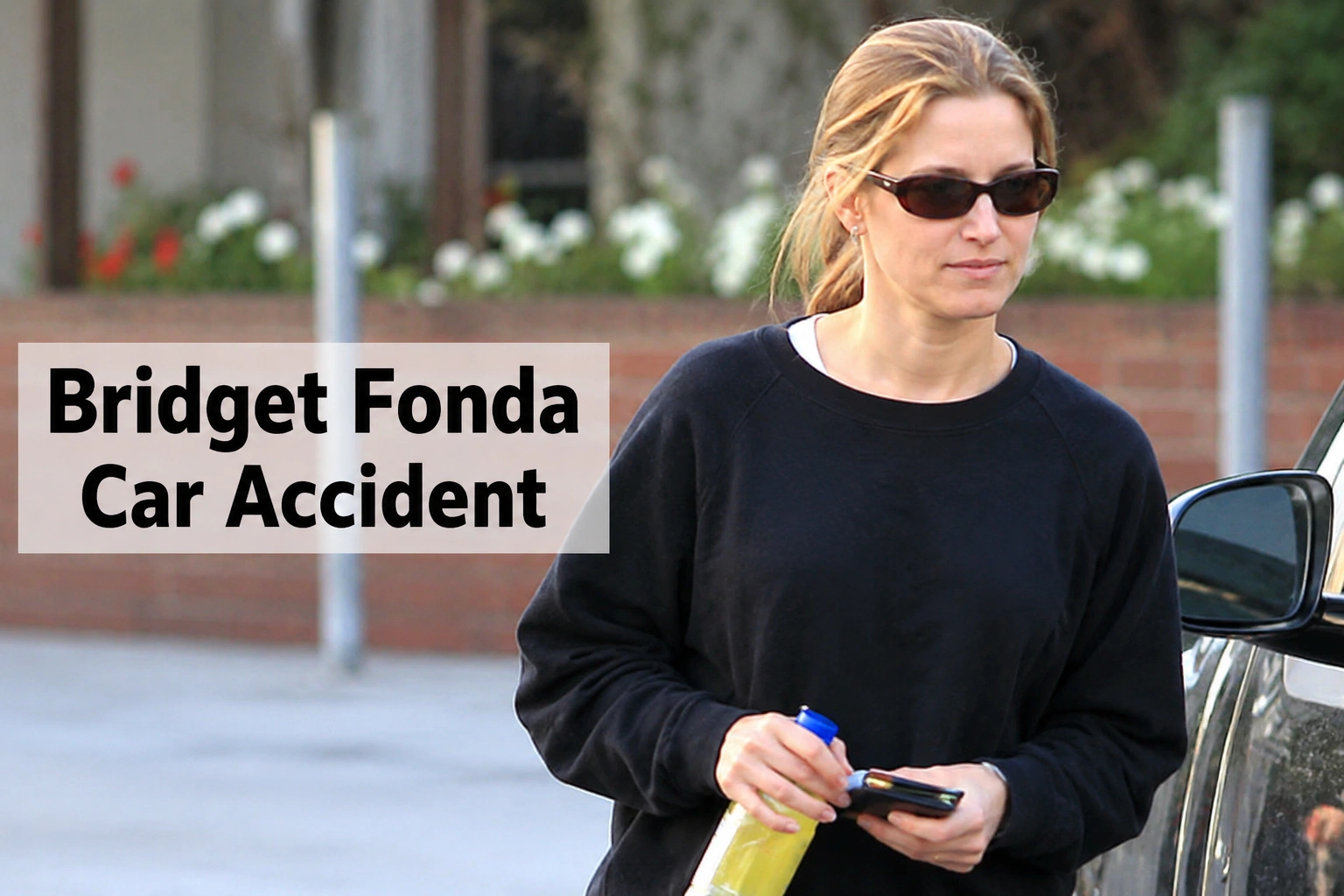
Bridget Fonda was one of the most quietly compelling actresses of the 1990s — not the loudest name in the room, not the most tabloid-front-page celebrity, but consistently working at a high level across a remarkable range of genres. Single White Female, Point of No Return, Jackie Brown, A Simple Plan — these were not small projects, and her work in them was not small work. She had what serious film critics recognized as genuine depth: the ability to carry a role without overwhelming it, to share a scene with Samuel L. Jackson or Kiefer Sutherland and hold her own without trying too hard.
Then, on a rainy morning in February 2003, her Jaguar slid off the Pacific Coast Highway in Malibu and went down an embankment. The car was completely destroyed. Bridget survived with injuries that were serious but not life-ending. She went to the hospital, recovered at home, married composer Danny Elfman later that year, and then — almost completely — disappeared from Hollywood. No farewell film. No retirement announcement. No explanation offered to the public. Just a gradual, deliberate retreat from a career that many people expected to continue for decades more.
The accident and the retirement that followed have been connected in countless articles and discussions, but the relationship between the two is more nuanced and more interesting than a simple cause-and-effect story allows.
The Accident — What Actually Happened On February 28, 2003
The facts of the Bridget Fonda car accident are well-documented because they were reported at the time by credible outlets including CNN, the BBC, People magazine, the Tampa Bay Times, and the New York Post. This is not a rumor, a speculation, or a social media-generated narrative — it is a real event with a real paper trail, covered by mainstream news organizations on the day it happened and in the days that followed.
On the morning of February 28, 2003, Bridget Fonda was driving her Jaguar in the Malibu area when she lost control of the vehicle on the Pacific Coast Highway. The PCH — as it is universally known to anyone who has spent time in Los Angeles — runs along the coastline through Malibu, connecting the city to the Santa Monica Mountains and the communities beyond them. It is a beautiful road and, in wet weather, a genuinely dangerous one. The road narrows in sections, runs close to steep drops, and becomes slippery with remarkable speed when rain falls on pavement that has accumulated oil and residue during dry periods.
That morning was rainy. The roads were wet. Her Jaguar lost traction, slid, went over the side of an embankment, and rolled. The car was completely totaled by the time it stopped.
Bridget Fonda was wearing her seatbelt. That detail — confirmed by her publicist Nancy Seltzer at the time and widely reported — is the most important single fact in the accident story. The seatbelt, in the most literal sense, saved her life. Her car was destroyed and unrecoverable. She walked away with injuries.
The Injuries — What The Medical Record Shows
The injuries Bridget Fonda sustained in the accident have been described with some variation across different reports, but the consistent core is clear. The New York Post reported at the time that she had minor cuts and bruises. The BBC’s contemporaneous reporting noted a slight fracture of two thoracic vertebrae, with an expectation of full recovery. Later, more detailed accounts confirmed that her injuries included head and neck injuries and a fractured vertebra — serious enough to require hospitalization and a period of home recovery, but not catastrophic in the sense of permanent disability.
Her publicist Nancy Seltzer confirmed to CNN that Fonda had been taken to hospital due to back injuries sustained when her Jaguar went over the side of a Pacific Coast Highway embankment. The hospital stay was described as not long, and her recovery was primarily managed at home in the weeks that followed.
The thoracic vertebrae — the section of the spine that runs through the chest region — are the bones most commonly fractured in vehicle rollovers, because the compressive and flexion forces generated when a vehicle rolls put intense stress on that section of the spine. A slight fracture of thoracic vertebrae is a painful, recovery-requiring injury that restricts movement and requires careful management, but it is categorically different from the kind of spinal cord injury that causes paralysis or permanent neurological damage. The BBC’s characterization — slight fractures, expected full recovery — was medically accurate and ultimately correct. Fonda did recover.
What she did not do was return to her career. That distinction between physical recovery and professional return is at the center of the most interesting question surrounding this story.
The Pacific Coast Highway Context — Why The Road Matters
The Pacific Coast Highway has a specific significance in the Bridget Fonda accident story that goes beyond geography. The PCH is one of the most iconic roads in American culture — it appears in films, in music, in the broader imagination of California as a place of freedom, beauty, and possibility. It is also a road with a documented history of serious accidents, particularly in wet weather, where its narrow lanes, sharp curves, and proximity to steep drops create conditions that demand full attention and appropriate speed.
Her Jaguar was a vehicle well-suited to dry coastal roads but, like all performance-oriented cars, particularly sensitive to traction loss on wet surfaces. Some reports at the time noted that authorities considered the possibility of speeding as a contributing factor to the loss of control, though no formal finding on that question was publicly confirmed. The combination of a wet road, a performance vehicle, and the inherent geometry of the PCH created the conditions for the accident. Nothing about what happened that morning was unusual in the mechanical sense — it was a type of accident that happens on that stretch of road with some regularity. What made it significant was who was involved.
Bridget Fonda’s Career Before The Accident — What Was At Stake
To properly understand the weight of what the accident interrupted, it is worth spending time on the career that existed before February 2003. Bridget Fonda’s professional story is one of building a reputation through consistent work over more than a decade — never quite reaching the top tier of 1990s stardom that contemporaries like Julia Roberts or Sandra Bullock occupied, but establishing a body of work that film critics and serious film audiences consistently respected.
Her first screen credit came in Easy Rider in 1969 — she was five years old and appeared as part of her family’s connection to the film. Her father Peter Fonda produced and starred in it, so her early film connection was literal and familial. She did not seriously pursue acting until her late teens and early twenties, graduating from New York University’s Tisch School of the Arts and beginning her professional career in the mid-1980s.
The Films That Defined Her Career
A Simple Plan from 1998 remains her most critically acclaimed film, certified fresh at 90% on Rotten Tomatoes according to Looper’s retrospective. Directed by Sam Raimi, the film is a cold, tense crime drama set in rural Minnesota in which Fonda plays a pivotal supporting role that requires significant emotional range. The film earned Bill Paxton a SAG Award nomination and was considered one of the best American films of that year. Fonda’s performance was a major part of why the film worked.
Single White Female from 1992 showed she could carry a psychological thriller with a co-lead of equal stature, sharing the screen with Jennifer Jason Leigh in a film that required both actresses to push the psychological intensity of their characters to extreme places. Point of No Return from 1993 was an American remake of the French film La Femme Nikita, and Fonda held the lead role — demanding both physical preparation for action sequences and the kind of emotional subtlety that the original French performance had established as the standard.
Jackie Brown in 1997, directed by Quentin Tarantino, gave her a genuinely challenging supporting role alongside Samuel L. Jackson, Robert De Niro, and Michael Keaton. Tarantino films are ensemble pieces by design, and being cast in one was a significant professional credential. Her role as Melanie — the vapid, passive-aggressive girlfriend of Jackson’s arms dealer — was smaller in screen time than some of her other work but was considered a precise and effective character performance.
Lake Placid from 1999 and Kiss of the Dragon from 2001 showed a willingness to work in genre films without the prestige credentials of Tarantino or Raimi, which was a practical career choice in an era when actresses with her profile were expected to maintain continuous visibility. Her final screen appearance before the retirement that followed the accident was in Snow Queen in 2002 — a television film that, in retrospect, marked the quiet end of an active career without either of them knowing it at the time.
The Career She Almost Had: The Practice And Its Aftermath
One of the most poignant details in the Bridget Fonda accident story is the role she was about to take when the crash happened. She had been cast in a recurring role on The Practice — the ABC legal drama that had been running since 1997 and had won a string of awards including the Emmy for Outstanding Drama Series. The role had appealed to her partly because The Practice was a David E. Kelley production, and Fonda had years earlier turned down a role in Kelley’s Ally McBeal — a decision she reportedly had mixed feelings about.
The accident ended that opportunity. She joined the long list of actors who have been replaced in roles as a result of injury during production planning or early filming. The Practice continued without her, and the career momentum that the recurring television role might have generated simply never materialized. In retrospect, the accident arrived at a moment when Fonda’s career was pivoting toward a new format — and the pivot was never completed.
The Retirement — What Actually Caused It
The relationship between the 2003 car accident and Bridget Fonda’s permanent retirement from acting is one of the most frequently misunderstood aspects of her story, and getting it right requires acknowledging a timing coincidence that looks like causation but is more complicated.
Fonda had already decided to step back from Hollywood before the accident happened. Her last film role was in Snow Queen in 2002 — a full year before the PCH crash. She had already communicated, in various ways, that she was transitioning away from the intense demands of an active acting career toward a more private life. The accident, as AOL’s retrospective confirmed, was not the primary reason for her retirement but rather a painful experience that coincided with her already-planned life changes.
In November 2003 — approximately nine months after the accident — she married Danny Elfman, the composer known for his work as the frontman of Oingo Boingo and his extensive film score career including Tim Burton’s Batman, Edward Scissorhands, and The Nightmare Before Christmas. Peter Fonda walked her down the aisle to the sounds of a 20-person choir, as People reported at the time. They had met during the production of A Simple Plan in 1998, when Elfman was composing the score.
The marriage marked a clear and deliberate transition. She became a stepmother to Elfman’s two daughters from a previous marriage and, in 2005, welcomed their son Oliver. She chose, as she has described it herself in the few public statements she has made since, to be a civilian. The word is revealing — it suggests someone who has left a demanding professional theater and returned to a world where the rules are different and the demands are more manageable.
Was The Accident A Contributing Factor?
Honest analysis requires acknowledging that the accident almost certainly contributed to the speed and finality of the retirement decision, even if it was not the primary cause. A serious car accident — one that totaled the vehicle, fractured vertebrae, and required hospitalization and home recovery — is the kind of physical and psychological shock that changes a person’s relationship to their priorities. The experience of physical vulnerability, of a moment when life could have ended, commonly accelerates decisions that were already forming.
Fonda had been moving toward retirement before February 2003. The accident in February and the marriage in November of the same year combined to crystallize that movement into a definitive step that she has shown no inclination to reverse in the two decades since. The physical recovery from fractured vertebrae takes weeks to months. The psychological recalibration that follows a near-death experience takes longer and is less predictable. Both likely contributed to a retirement that the public experienced as sudden but that Fonda herself had been preparing for gradually.
Life After Hollywood — Where Bridget Fonda Is In 2026
The story of what happened after the accident is, in several ways, more interesting than the accident itself — because it involves a person making a deliberate and sustained choice to leave extraordinary professional success behind in favor of a private life, and then actually doing it rather than periodically returning to the spotlight.
The most remarkable fact about Bridget Fonda’s post-Hollywood life is how genuinely private it has remained. Most public figures who announce retirements from entertainment return within a few years, drawn back by boredom, financial incentive, a compelling project, or the simple difficulty of giving up the identity that fame provides. Fonda has not done this. For a period of approximately twelve years following the accident and marriage, she was essentially unseen in public. That level of sustained privacy is genuinely unusual for someone with her career profile.
In April 2023, she was spotted at LAX airport — a rare sighting that generated significant media attention simply because she had been absent so long. Paparazzi who spotted her asked whether she would consider returning to Hollywood. She responded simply: no. When pressed, she said she doesn’t think she would make a movie because it’s too nice being a civilian.
That phrase — too nice being a civilian — is the most revealing public statement she has made about her life since the accident. It does not suggest regret about her career, nor does it express bitterness toward an industry that she left. It suggests someone who made a choice, found the alternative genuinely satisfying, and has no particular motivation to change course.
She and Danny Elfman have remained married for over twenty years as of 2023. Their son Oliver was born in 2005 and is now a young adult. Elfman’s own career has continued at a high level — he has remained one of Hollywood’s most sought-after composers throughout this period. The couple lives quietly, largely outside the tabloid coverage that surrounds most entertainment figures.
The Question Of Legacy And What Might Have Been
The question that film enthusiasts most frequently raise about Bridget Fonda is what her career might have looked like had she continued past 2002 and 2003. She was 39 years old when the accident happened — not past the point where significant work was possible, but approaching the period where actresses in Hollywood have historically faced the most significant systemic barriers to leading roles in major productions. The industry’s treatment of women over 40 during the early-to-mid 2000s was considerably less equitable than it has become, and several of her contemporaries who continued working found the quality and quantity of available roles changing in ways that were not always satisfying.
It is genuinely impossible to know whether Fonda would have sustained the level of work she produced in the 1990s, found a productive transition into character roles or television, or encountered the frustrations that led several of her contemporaries to reduce their own output. What is clear is that the career she had — before retirement, before the accident — was substantial and genuinely well-regarded. A Simple Plan alone, at 90% on Rotten Tomatoes with the kind of critical reception it received, stands as evidence of what she was capable of at her best.
Key Facts Timeline — Bridget Fonda’s Story At A Glance
| Year | Event | Significance |
| 1964 | Born in Los Angeles, California | Daughter of Peter Fonda; granddaughter of Henry Fonda |
| 1969 | First screen appearance in Easy Rider | Aged five; cameo in father’s landmark film |
| 1988 | Professional acting career begins | Early roles in You Can’t Hurry Love and Scandal |
| 1990 | Role in The Godfather Part III | Major mainstream exposure; career breakthrough |
| 1992 | Single White Female | Critical success; psychological thriller lead role |
| 1993 | Point of No Return | Lead role in American remake of La Femme Nikita |
| 1997 | Jackie Brown (Tarantino) | Supporting role; significant critical credential |
| 1998 | A Simple Plan | Most critically acclaimed film — 90% RT score |
| 2002 | Snow Queen — final acting role | Last screen appearance before retirement |
| February 28, 2003 | Car accident on Pacific Coast Highway, Malibu | Jaguar goes over PCH embankment; fractured vertebrae; car totaled |
| November 2003 | Marries Danny Elfman | Nine months after accident; life transition confirmed |
| 2005 | Son Oliver born | First biological child with Elfman |
| 2003–2015 | Approximately 12 years from public view | Extended private life; no professional appearances |
| April 2023 | Spotted at LAX airport | Rare public sighting; confirms contentment with civilian life |
| 2026 | Living privately with family in Los Angeles | No plans to return to acting; confirmed in 2023 |
Frequently Asked Questions
What happened in the Bridget Fonda car accident?
On February 28, 2003, Bridget Fonda lost control of her Jaguar while driving on the Pacific Coast Highway in Malibu during rainy weather. The car slid off the road and went over an embankment, rolling and becoming completely totaled. She was wearing her seatbelt, which her publicist confirmed saved her life. She sustained minor cuts and bruises along with a slight fracture of two thoracic vertebrae, as reported by the BBC at the time. She was hospitalized briefly and recovered at home over the following weeks.
Did the car accident cause Bridget Fonda to retire from acting?
The accident coincided with her retirement but was not its primary cause. Fonda had already made her last film appearance in Snow Queen in 2002 — a full year before the accident occurred. She had already been transitioning away from her acting career toward a private family life before the PCH crash. The accident, her engagement, and her marriage to Danny Elfman in November 2003 all occurred within the same year, creating a concentration of life events that confirmed and accelerated the retirement direction she had already chosen.
Was Bridget Fonda speeding when the accident happened?
Some reports at the time noted that investigating officers considered speed as a possible contributing factor to the loss of traction, given the wet road conditions. However, no formal finding on that question was publicly confirmed, and her publicist and multiple reports emphasized that the primary cause was the wet and rainy road conditions. She was not reported to have been under the influence of any substance. The PCH has a history of accidents in wet weather due to its narrow lanes and steep roadside drops.
Where is Bridget Fonda now in 2026?
Bridget Fonda lives privately in Los Angeles with her husband Danny Elfman and their son Oliver, who was born in 2005. She has been married to Elfman since November 2003. She is not professionally active in the entertainment industry and has no publicly announced plans to return to acting. In a 2023 public sighting at LAX, she described herself as a civilian and said it was too nice being one to consider returning to film work. She was 60 years old as of 2024.
How serious were Bridget Fonda’s injuries from the accident?
Her injuries were described by the BBC as a slight fracture of two thoracic vertebrae, with an expected full recovery. Multiple sources confirmed minor cuts and bruises in addition to the vertebral fractures. The injuries were serious enough to require hospitalization and home recovery, and they cost her a planned recurring role on the television series The Practice. However, they were not classified as life-threatening after the immediate accident, and her recovery proceeded as expected without long-term permanent physical impairment being reported.
What car was Bridget Fonda driving during the accident?
Bridget Fonda was driving a Jaguar when the accident occurred on February 28, 2003. The car went over the embankment on the Pacific Coast Highway and was completely totaled — described across multiple contemporaneous reports as fully destroyed and unrecoverable. The vehicle’s condition contrasted with Fonda’s own survival, which multiple sources attributed directly to her seatbelt use at the time of the crash.
Why did Bridget Fonda leave Hollywood?
Fonda’s departure from Hollywood reflects a deliberate personal choice to prioritize family life over professional career rather than a forced exit caused by the accident or any industry rejection. She had been moving toward retirement before the 2003 accident, made her last film appearance in 2002, and married Danny Elfman in November 2003. She has described her current life as that of a civilian — a word that suggests someone who left a demanding professional world voluntarily and found the alternative genuinely satisfying. Her twelve-year period without any public sightings between the mid-2000s and the mid-2010s reflects a commitment to private life that goes well beyond typical industry sabbaticals.