Some tragedies fade quickly from public memory. Others plant themselves there permanently — not because they involve famous people or dramatic twists, but because they reflect something painfully familiar about how easily ordinary lives get destroyed on roads we drive every single day. The Brittany Johns car accident on Interstate 55 in Arkansas is one of those cases.
Brittany was not a public figure. She had no celebrity status, no political connections, and no reason to end up in national news.
Yet her death — sudden, violent, entirely preventable — sparked genuine community grief, a wave of legal action, and a pointed conversation about high-speed police pursuits that the state of Arkansas could not ignore.
Years after the crash, people still search for answers about what happened that night, why it happened, and whether any of it could have been stopped. Those are the right questions. This piece attempts to answer all of them honestly.
The Night Interstate 55 Became A Crime Scene
Interstate 55 near West Memphis, Arkansas is not a glamorous stretch of highway. It’s a working road — heavy with truck traffic, bordered by flat Delta landscape, and often exposed to the kind of weather that rolls in fast and leaves little warning. On the evening of September 7, 2022, conditions were already hostile.
Rain had been falling for hours. The road surface was wet, drainage along key sections of I-55 had known maintenance issues that state authorities had not yet addressed, and visibility was poor as night approached.
Brittany Johns was traveling that evening as a passenger. According to available accounts, she was in a vehicle caught in the wrong place at the wrong time — a detail that makes her death especially difficult to process, because she wasn’t driving recklessly, wasn’t fleeing anything, and made no decisions that night that should have cost her life.
The sequence of events began when Arkansas State Police officers spotted a red Pontiac Grand Prix moving erratically and at extreme speed — reportedly traveling more than 120 mph, roughly 50 mph over the posted limit.
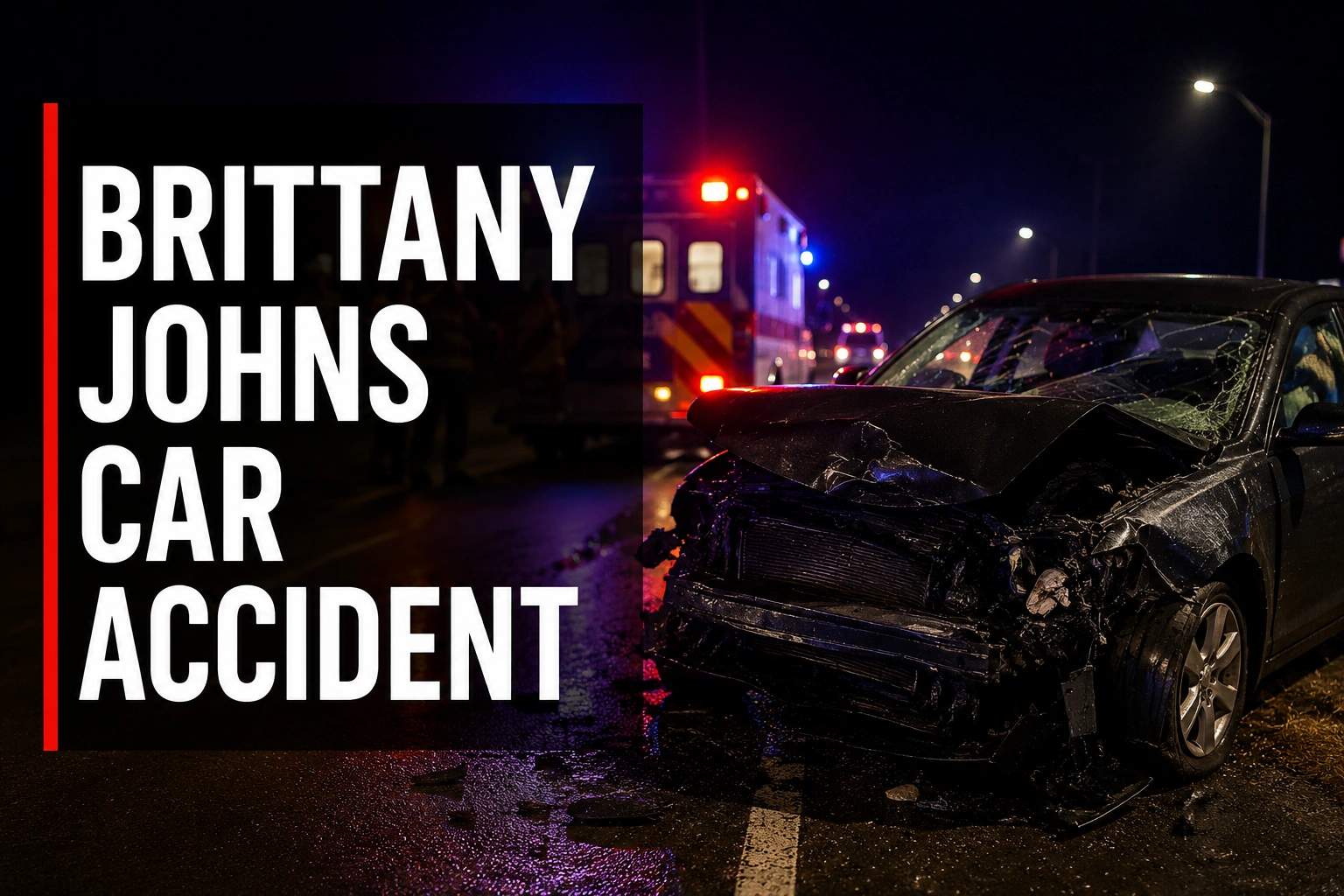
Standard protocol called for pursuit. Officers initiated a chase. What followed was a high-speed sequence of events on a rain-soaked highway that ended in a fatal multi-vehicle collision. The Pontiac struck another vehicle. The impact was catastrophic.
Three people lost their lives: Brittany Johns, Erik Winfert, and James Smith. Emergency crews arriving at the scene encountered twisted wreckage spread across multiple lanes, and there was nothing medically that could be done for the three victims.
The Factors That Turned A Police Stop Into A Fatal Crash
Understanding how this crash happened requires looking at several contributing elements at once, because no single cause tells the complete story. The driver involved, Kenneth Williams, was reportedly using his mobile phone during the pursuit — witnesses described him posting on social media even as police sirens followed him down the interstate.
That detail is not just shocking — it represents a complete disconnection from the reality of what high-speed driving on a wet road demands. At 120 mph in dry conditions, a driver has almost no margin for error. In rain, on a road with documented drainage problems, that margin disappears entirely.
The wet pavement factor deserves specific attention. Wet road surfaces reduce tire traction by approximately 30% compared to dry asphalt — a figure cited consistently across road safety research. At extreme speeds, that reduction doesn’t just affect stopping distance; it affects a vehicle’s ability to maintain directional control at all.
Any sudden input — a steering correction, a braking attempt, a shift in the road surface — can trigger a loss of control that the driver has no mechanical ability to recover from. The Pontiac was already at that threshold before the final collision occurred.
The road conditions on the I-55 stretch where the crash took place were not incidental. Civil lawsuits filed after the accident specifically cited drainage deficiencies along that section of Interstate 55 — documented infrastructure failures that contributed to water pooling on the road surface.
Personal injury law in Arkansas permits negligence claims against government entities when known infrastructure deficiencies contribute to fatal accidents and the responsible authority failed to address them within a reasonable time frame. That legal principle became central to the wrongful death claims that followed.
Police pursuit protocol is the third pillar of this analysis. When officers initiated the chase, they were following standard procedure.
However, multiple lawsuits and community advocates argued that the decision to maintain a high-speed pursuit on a populated highway during active rain — when conditions made any crash far more likely to be fatal — reflected a policy failure rather than sound judgment.
The argument is not that officers acted illegally, but that the policy governing when pursuits should be terminated lacked the situational specificity needed to prevent exactly this kind of outcome.
| Factor | Detail | Impact |
| Vehicle speed | Approx. 120+ mph | 50+ mph over posted limit |
| Road surface | Wet from sustained rain | ~30% reduction in traction |
| Drainage condition | Documented maintenance failures | Water pooling on road |
| Driver behavior | Phone use during pursuit | Zero situational awareness |
| Police protocol | Pursuit maintained in adverse weather | Policy under post-crash review |
| Vehicle safety | Older model, no ADAS features | No emergency braking capability |
Legal Consequences And What The Courts Revealed
The legal aftermath of the Brittany Johns crash stretched across multiple fronts and became more significant than many comparable accidents because it directly influenced Arkansas State Police policy. That rarely happens, and it’s worth understanding why this case had that effect.
Kenneth Williams, identified as the driver of the Pontiac Grand Prix, faced serious criminal charges including causing death by vehicle.
Investigators collected physical evidence from the scene — skid marks, wreckage distribution, vehicle data — and recovered phone records that corroborated witness testimony about Williams’ phone use during the pursuit. The combination of distracted driving and reckless speeding gave prosecutors a strong factual foundation for the case against him.
The Wrongful Death Lawsuits And Their Broader Impact
The civil litigation that emerged from this crash reached further than criminal proceedings typically do. The families of Erik Winfert and James Smith filed wrongful death lawsuits against the Arkansas State Police Department, specifically targeting pursuit protocols as the mechanism of harm.
Their argument was straightforward: officers should have terminated the chase given the documented weather conditions and the populated nature of the highway. By maintaining pursuit at extreme speeds in those circumstances, the department contributed to the conditions that produced three fatalities.
The Arkansas State Police adjusted its policy on ramming vehicles to end pursuits as a result of a settlement, with state police clarifying its use-of-force policy as part of the agreement, going “above and beyond to be perfectly clear” in training and policies that troopers must use an objective standard to determine if it is appropriate to use a precision immobilization technique (PIT) maneuver.
That outcome — a concrete policy adjustment tied directly to litigation from a specific crash — is rarer than it should be in road safety law. It represents a tangible consequence that the legal system produced, even while criminal proceedings against Williams moved separately through the courts.
Brittany’s family also pursued a wrongful death claim tied to road maintenance failures. The state’s documented failure to address the I-55 drainage deficiencies provided a basis for arguing that inadequate infrastructure contributed to the severity of the crash.
These types of infrastructure negligence claims are difficult to litigate because they require demonstrating that the responsible agency was aware of the problem and had a reasonable opportunity to address it. In this case, the documented maintenance record supported that argument.
The insurance dimension of the case was also unusually complex. Because the accident involved both alleged criminal behavior and infrastructure failures, insurance claims adjusters faced challenges in assigning responsibility percentages to different parties, highlighting how multi-layered accountability can be in complex traffic collisions.
Multiple parties carried potential liability — the driver, the state police, and the road maintenance authority — which made settlement negotiation a lengthy and technically demanding process.
The Statistics Behind The Story: Why This Happens More Than People Know
The Brittany Johns accident is not an isolated event. It is a specific, named instance of a pattern that plays out hundreds of times every year across the United States, and the data behind that pattern is deeply troubling.
Reports show that on average, more than 320 people are killed each year in high-speed police pursuits, and 27 percent of those killed are innocent bystanders. Since 1979, more than 5,000 bystanders have been killed during police pursuits in the US.
That statistic — 27% of fatalities being innocent bystanders — is the number that should stop people cold. In any given year, nearly one in three people killed in police pursuit crashes had nothing to do with the original situation. They were in other cars, or walking near the road, or simply traveling in the same direction as a chase they had no knowledge of. Brittany Johns was one of those people.
In 2021 alone, police pursuits caused 412 fatalities in the US, injured 7,892 civilians, and involved 5,238 crashes nationwide, with the average pursuit speed recorded at 78 mph.
The speed figure is significant. An average pursuit speed of 78 mph means that half of all pursuits are moving faster than that. On a wet interstate, at night, with normal traffic present, 78 mph in a pursuit situation is already an extreme risk to everyone on the road. At 120 mph — as the Pontiac was traveling — the physics become almost incompatible with any safe outcome once control is lost.
New data from NHTSA from 2022, the latest year for which data is available, showed deaths from police pursuits were up more than 8% over the prior year, with nearly half of those killed being innocent bystanders — drivers and passengers in cars not involved in the chase, or people not even in a vehicle.
The year 2022 — the same year as the Brittany Johns crash — saw a documented spike in pursuit-related deaths nationally. That context matters because it frames the Arkansas case not as a freak occurrence but as part of a broader, worsening trend that law enforcement agencies and lawmakers were simultaneously grappling with across multiple states.
What The Data Says About Pursuit Policy Reform
The case for reform in pursuit policies is grounded in genuine tension. Law enforcement has a legitimate interest in apprehending people who flee, particularly when the underlying crime is serious. But the data shows that a significant percentage of fatal pursuits begin over traffic infractions or non-violent offenses — situations where the calculus of chasing at 100+ mph through civilian areas does not hold up under scrutiny.
A San Francisco Chronicle investigation found that officers routinely start deadly chases that begin with a low-level crime — or no crime at all, with more than 1,550 of the 1,900 people studied dying in pursuits that began over traffic infractions, nonviolent crimes, or no crime at all.
That investigative finding reframes the entire debate. If the majority of fatal pursuit crashes originate from non-violent situations, then the question is not whether police should ever pursue suspects — it’s whether the risk calculation for low-level offense chases makes any rational sense given the documented harm to uninvolved people.
Arkansas was not the only state asking that question in 2022, but the Brittany Johns case gave it a specific, human face.
Community Response, Safety Advocacy, And What Changed After
The community response to Brittany’s death was both personal and organized. Friends described her as warm, caring, and full of energy — someone who had an impact on the people around her in the way that makes a loss feel genuinely irreplaceable rather than abstractly tragic. Memorials were held at local schools and community spaces. A fundraiser organized in her memory reached $50,000, directed toward her family and toward road safety awareness work. The hashtag #BrittanyJohns circulated widely on social media, bringing the story to audiences well beyond Arkansas.
The Brittany’s Angels foundation formed in the wake of the crash, specifically focused on advocating for stronger distracted driving legislation in Arkansas and pushing for updated pursuit guidelines at the state police level. That advocacy was directly connected to the legal action taken by families — the community organizing and the courtroom proceedings reinforced each other, creating more sustained pressure than either would have alone.
Arkansas made tangible infrastructure changes on the I-55 stretch affected by the crash. Drainage improvements were implemented, guardrail upgrades were completed, and road surface conditions in the area received maintenance attention that had been deferred. Whether those changes came quickly enough is debatable — the drainage failures were documented before the September 2022 crash — but the improvements represent acknowledgment that infrastructure negligence contributed to the outcome.
The pursuit policy reform that came through the Arkansas State Police settlement was the most legally significant outcome. The clarification of PIT maneuver standards and the emphasis on objective situational assessment before initiating or continuing a chase established a higher bar for pursuit decisions in adverse conditions. Police departments in other states watched the Arkansas settlement closely, and several revised their own pursuit policies in the period following, citing the case as a reference point.
The Distracted Driving Dimension That Gets Lost In The Pursuit Debate
One aspect of the Brittany Johns case that tends to get overshadowed by the pursuit policy conversation is the distracted driving element. Kenneth Williams was reportedly using his phone to post on social media during an active police chase at 120 mph on a rain-soaked highway. That is not a momentary distraction — that is a complete abdication of any awareness of the situation. It represents the extreme end of a behavior pattern that causes tens of thousands of crashes every year under far less extreme circumstances.
According to the NHTSA, distracted driving claimed 3,308 lives in the US in 2022 — the same year as the Brittany Johns crash. Phone use while driving remains one of the most underenforced traffic laws despite being one of the most consistently lethal behaviors behind the wheel. The Brittany Johns case doesn’t add new statistical weight to that problem, but it gives it a specific, documented story that advocates and legislators can reference when arguing for stricter enforcement and heavier penalties.
Key Facts At A Glance
| Detail | Information |
| Date | September 7, 2022 |
| Location | Interstate 55, near West Memphis, Arkansas |
| Vehicles Involved | Red Pontiac Grand Prix, Toyota Camry (and others) |
| Fatalities | Brittany Johns, Erik Winfert, James Smith |
| Driver Identified | Kenneth Williams (Pontiac) |
| Speed at Impact | Approximately 120+ mph |
| Weather Conditions | Active rain, wet road surface, documented drainage failures |
| Legal Outcomes | Criminal charges (Williams), wrongful death suits, ASP policy reform |
| Infrastructure Changes | I-55 drainage and guardrail upgrades completed post-crash |
| Community Response | Brittany’s Angels foundation, $50K fundraiser, legislative advocacy |
Frequently Asked Questions
What exactly happened in the Brittany Johns car accident?
On September 7, 2022, a fatal multi-vehicle crash occurred on Interstate 55 near West Memphis, Arkansas. A red Pontiac Grand Prix, driven by Kenneth Williams, was being pursued by Arkansas State Police after officers spotted it traveling more than 120 mph in wet conditions. The vehicle collided with other cars during the chase. Brittany Johns, a passenger in one of the affected vehicles, along with Erik Winfert and James Smith, died from injuries sustained in the crash. The combination of extreme speed, wet roads, documented drainage failures on I-55, and distracted driving during the pursuit contributed to the fatal outcome.
Who was at fault in the Brittany Johns crash?
Legal proceedings identified multiple points of responsibility. Kenneth Williams was criminally charged for causing deaths through reckless driving while using his phone. Civil lawsuits targeted the Arkansas State Police for maintaining a high-speed pursuit in dangerous weather conditions, and the state government for documented road maintenance failures on the I-55 stretch where the crash occurred. Courts and insurers worked through a multi-layered liability process because the accident involved criminal behavior, infrastructure negligence, and pursuit policy failures simultaneously.
Did the Brittany Johns accident lead to any law changes in Arkansas?
Yes, in a concrete way. The wrongful death lawsuits filed by families of victims resulted in a settlement with the Arkansas State Police that included a formal clarification and strengthening of the department’s pursuit policy — specifically around the use of PIT maneuvers and the criteria for continuing a chase in adverse weather conditions. Arkansas also made drainage and guardrail upgrades on the affected section of Interstate 55. Community advocacy through the Brittany’s Angels foundation pushed for stronger distracted driving legislation at the state level.
Why was the police pursuit continued in such dangerous conditions?
At the time of the incident, Arkansas State Police pursuit protocol required officers to pursue vehicles for certain violations. Critics of the policy argued — and the subsequent lawsuits formalized this argument — that the protocol lacked sufficient guidance for situations involving active rain, wet roads, and high-traffic highways. The settlement that followed required the department to go “above and beyond” in training officers to apply an objective standard when deciding whether conditions justify initiating or continuing a chase.
How common are fatal crashes from police pursuits?
More common than most people realize. NHTSA data shows that police pursuits cause approximately 412 deaths per year in the US, with roughly 27–30% of those fatalities involving innocent bystanders who were not part of the original chase. In 2022, the year of the Brittany Johns crash, pursuit-related deaths increased more than 8% over the prior year. These crashes are more likely to occur at night, on urban roadways, and at high speeds — conditions that match the I-55 incident closely.
Was the distracted driving aspect of the crash prosecuted separately?
Yes. Phone records and witness testimony corroborating Williams’ phone use during the pursuit were part of the criminal case against him. Using a mobile device while driving is a traffic violation in Arkansas, and in the context of a vehicle causing three deaths at extreme speed, it became part of the broader criminal charging framework. The case became a reference point for Arkansas advocates pushing for stricter enforcement of distracted driving laws and harsher penalties for phone-related violations that result in fatalities.
Where can families find help after a crash involving a police pursuit?
Families dealing with injuries or deaths from police pursuit crashes have several legal pathways available. Civil wrongful death claims can be filed against the driver, and in some circumstances against the law enforcement agency or government entity responsible for road maintenance. Legal specialists in vehicular negligence and government liability are the appropriate first contact. Organizations like Pursuit for Change, which tracks and advocates around pursuit-related fatalities, can also provide resources and connect families with legal and emotional support.