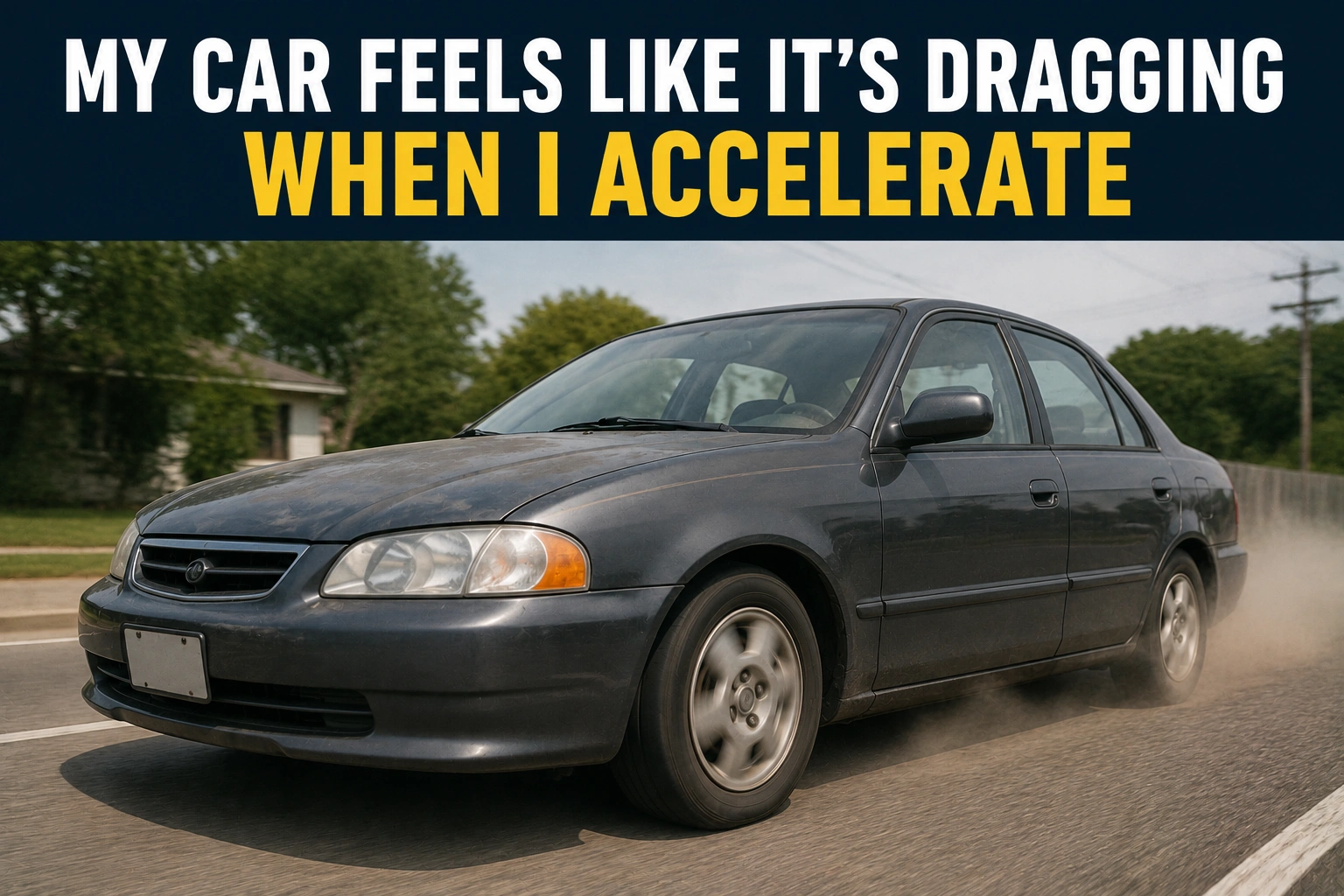
There is a specific kind of unease that comes with pressing the accelerator and feeling the car respond as though something invisible is holding it back.
Not a full stall, not a complete power loss — just a heavy, reluctant resistance that was not there last week. The car moves, the engine runs, but something feels fundamentally wrong with how effortlessly it used to gather speed compared to how labored it feels right now.
That sensation has a name in the diagnostic world: acceleration drag. And after reviewing dozens of owner accounts, mechanic forums, and real-world diagnosis threads from communities ranging from general repair forums to model-specific enthusiast boards, one pattern emerges consistently.
Most people describe the same initial confusion — the car is technically functional, so they keep driving. And the more they delay, the more expensive the underlying problem becomes. What might have been a $40 fix at the first sign of drag quietly turns into a $400 problem six weeks later.
The causes are more varied than most people realize, and some of them have nothing to do with the engine at all.
Brakes, wheel bearings, transmission components, tires, and sensors are all capable of creating this same heavy, dragging sensation — each through a completely different mechanism. Knowing which system is responsible is the fastest path to the right repair.
What The Dragging Sensation Is Actually Telling You
The human instinct when a car feels sluggish is to assume the engine is losing power. That assumption is correct in some cases but wrong in many others. The dragging sensation during acceleration has two fundamentally different origins, and distinguishing between them shapes every diagnostic step that follows.
The first category is resistance drag — something is physically opposing the car’s motion. A brake caliper that is not fully releasing keeps the pad pressed against the rotor even when the pedal is not depressed, creating constant friction at one or more wheels.
A seized parking brake cable does the same thing. A failing wheel bearing increases rolling resistance. In these cases, the engine may be producing normal power, but the car is fighting friction it should not have to overcome. The result feels like driving with a weight attached — heavy, resistant, and accompanied by heat buildup at the affected wheel.
The second category is power deficit drag — the engine is not generating the power the driver expects. A clogged air filter, worn spark plugs, failing fuel injectors, a blocked catalytic converter, or malfunctioning sensors all reduce the combustion efficiency that generates engine output.
The car does not feel like it is fighting resistance in these cases — it feels like it is simply underpowered, like the engine is working at 70 percent capacity instead of 100.
The distinction matters enormously for diagnosis: resistance drag creates heat, often produces smells, and is usually wheel-specific. Power deficit drag shows up across all driving conditions and typically comes with reduced fuel economy and sometimes a check engine light.
The Most Common Causes
Stuck Brake Caliper Or Dragging Brakes
A stuck brake caliper is consistently the most common cause of a car that feels like it is dragging during acceleration — and consistently one of the most misdiagnosed, because the symptom feels like a power problem rather than a brake problem.
When a caliper seizes in the applied position, the brake pad maintains constant contact with the rotor. The engine works to accelerate, the caliper works to resist, and the result is a car that requires noticeably more throttle input to maintain speed than it should.
After reviewing diagnostic threads across multiple automotive forums, including a particularly instructive account from a 2003 Nissan Altima owner whose description — the car goes into gear but when pressing the gas it feels like something has it caught up, almost like the brake is on — matches hundreds of similar complaints verbatim, a stuck caliper tends to exhibit a specific pattern of accompanying symptoms.
The wheel with the seized caliper runs noticeably hotter than the others after driving. In more advanced cases, there is a burning smell after highway driving, similar to hot metal or scorched rubber. If the car is allowed to sit after a drive and one wheel is noticeably hotter to the hand than the others — specifically, too hot to touch comfortably — that is a strong indicator of a dragging brake at that corner.
The inspection for this is straightforward. With the car safely on jack stands and the wheel removed, a seized caliper shows clear visual evidence: glazed or deeply scored rotor surfaces, brake pad material worn significantly more on one side than the other, and sometimes discoloration on the rotor from sustained heat.
The repair involves either rebuilding the caliper with new seals and a piston rebuild kit — a job within reach of a confident home mechanic — or replacing the caliper assembly entirely, which typically costs between $80 and $200 per corner for a standard passenger vehicle. The mistake to avoid is only replacing the brake pads when a caliper is the actual cause. New pads installed into a seized caliper will show the same one-sided wear pattern within a few thousand miles.
Catalytic Converter Restriction — The Slow Strangler
Among all the power-robbing causes of acceleration drag, a failing catalytic converter deserves more attention than it typically receives in basic troubleshooting guides.
The catalytic converter sits in the exhaust stream and uses a honeycomb-like internal structure coated with platinum, palladium, and rhodium to convert exhaust gases into less harmful compounds before they exit the vehicle.
When that internal substrate breaks down — from excessive heat, age, contamination from oil or coolant burning, or physical damage from road debris — the fragments can partially block the exhaust flow.
What a partially blocked catalytic converter feels like from the driver’s seat is very similar to what an engine with reduced intake feels like: low-end torque is noticeably diminished, the car accelerates through the lower part of the rev range with less urgency than expected, and at higher engine loads — merging onto a highway, climbing a hill, carrying a full load of passengers — the resistance becomes more pronounced.
Some owners describe it as a ceiling on the car’s ability to build speed, as though there is a soft limit beyond which the engine cannot push further regardless of how far the pedal travels.
The accompanying signs are specific. A sulfur or rotten egg smell from the exhaust is one of the clearest indicators, caused by unprocessed sulfur compounds that a healthy converter would neutralize. Fuel economy drops noticeably.
In some cases the exhaust pipe has less flow volume than normal — a rough check involves holding a hand near the exhaust outlet at idle and at higher revs, comparing the volume and force of the exhaust flow to what would be expected from a healthy system.
A professional backpressure test, where a mechanic measures the pressure upstream of the converter, confirms the restriction quantitatively. Replacement converters for standard passenger vehicles range from $150 to $600 for aftermarket units, with OEM replacements costing more.
This is not a repair to delay — a severely restricted converter can cause the engine to run rich, fouling spark plugs and potentially causing additional damage.
Transmission Slipping Or Fluid Degradation — When The Power Disappears Mid-Gear
The transmission’s job is to take power produced by the engine and transfer it efficiently to the wheels. When it fails at that job, the result is a specific and recognizable form of acceleration drag where the engine revs freely — the RPM needle climbs normally — but the car’s actual speed does not keep pace.
The engine is producing power. The transmission is failing to transfer it. That gap between engine effort and vehicle response is what drivers experience as the heavy, reluctant feeling of a car that should be accelerating more decisively.
In an automatic transmission, the most common cause of this sensation is hydraulic slippage — the clutch packs or bands inside the transmission are not engaging firmly enough to lock up the gear solidly.
Low transmission fluid is one cause, as the fluid provides the hydraulic pressure that applies those clutch packs. Degraded fluid — dark, burnt-smelling fluid that has lost its viscosity and friction-modifying additives — is equally problematic because even correct fluid volume cannot compensate for compromised fluid chemistry.
A torque converter that is failing to lock up properly at highway speeds creates a shudder or slip specifically during cruising, which some drivers describe as the car momentarily losing drive and then re-engaging.
The transmission fluid check is the first and easiest diagnostic step. Most automatic transmissions have a dipstick accessible from the engine bay — the fluid should be checked at operating temperature, with the engine running and the transmission in Park.
The correct fluid level sits between the MIN and MAX markers on the dipstick. Healthy automatic transmission fluid is typically a clear, slightly reddish color and has a faintly sweet smell.
Fluid that is dark brown or black and smells burnt indicates a transmission that has been running degraded fluid, and a fluid change along with a fresh filter is the appropriate immediate response. This does not guarantee the transmission’s internal components are undamaged — a fluid change on a severely neglected transmission can sometimes reveal existing wear — but it is the correct first step.
For manual transmissions, a slipping clutch produces the same RPM-versus-speed disconnect but is most noticeable in higher gears and at higher loads.
The clutch pedal engagement point migrates noticeably toward the top of its travel as the clutch wears, and in severe cases, the smell of burnt friction material appears after demanding driving. Clutch replacement is a moderately complex job and typically runs $400 to $900 in labor plus parts on most vehicles.
Wheel Bearing Failure
Wheel bearings are among the most underestimated causes of acceleration drag in used vehicle discussions, partly because they fail gradually rather than suddenly and partly because the dragging sensation they create is more subtle than a seized brake caliper.
A wheel bearing’s job is to allow the wheel to rotate freely with minimal friction while carrying the vehicle’s weight. When the bearing’s internal races and rolling elements wear — from age, contamination, or damage — the friction within the bearing increases and the wheel that should rotate freely now creates measurable resistance.
At low speeds, this might feel like nothing more than a slight heaviness in how the car moves away from a stop.
At higher speeds, the most common accompanying symptom is a drone or hum that changes in character when the car is cornered gently — the sound typically diminishes when weight is transferred onto the bad bearing and increases when weight transfers away from it.
In advanced failure, the bearing generates enough friction to create heat at the affected wheel and enough noise that it is audible inside the cabin without any special effort.
The test for a suspect wheel bearing is a simple jacking exercise. With the wheel safely off the ground, grasping the tire at the 12 o’clock and 6 o’clock positions and rocking it in and out checks for vertical play.
Then grasping at the 9 o’clock and 3 o’clock positions and rocking side to side checks for horizontal play. Any detectable play in a wheel bearing indicates the bearing is worn past its service limit. Spinning the wheel by hand with the vehicle on jack stands and feeling or listening for roughness or grinding is another useful check.
Wheel bearing replacement typically runs $150 to $350 per corner including labor at an independent shop, and the job should always be done in axle pairs — if one bearing on an axle has failed, the opposite side has experienced the same mileage and loading conditions and is a reasonable preventative investment to replace simultaneously.
Engine Performance Issues
Engine-related causes of acceleration drag are the category most people jump to first, and while they are genuinely common, they tend to be oversimplified in basic troubleshooting into a single suggestion to check spark plugs. The actual engine-side causes are more varied, each with its own specific symptom pattern.
Worn or fouled spark plugs reduce combustion efficiency by producing a weaker, less consistent spark. The result is particularly noticeable during hard acceleration when all cylinders are firing at maximum frequency and any weak link in that chain shows up as hesitation or power loss.
A clogged air filter restricts the air supply that combustion requires, effectively starving the engine of what it needs to generate full power — some owners describe this as feeling like the engine hits a wall partway through acceleration, as though it cannot breathe deeply enough to go harder.
A failing mass airflow sensor sends incorrect air quantity data to the engine control unit, which responds by miscalculating the fuel delivery, resulting in a mixture that is either too lean or too rich for efficient combustion.
The oxygen sensor is a specific cause worth highlighting because of how frequently it produces the dragging sensation without triggering an obvious check engine light in early failure stages.
The O2 sensor monitors unburned oxygen in the exhaust and sends that data to the ECU, which uses it to continuously refine the fuel delivery. A slow or contaminated O2 sensor delivers delayed or inaccurate readings, causing the engine to run slightly off-mixture at various load points. The result is subtle but persistent: the car never feels quite as responsive as it should, particularly during the transition from light throttle to moderate acceleration.
Quick Diagnostic Reference Table
| Symptom Pattern | Most Likely Cause | Key Confirming Sign | Approx. Repair Range |
| Hot wheel after short drive, burning smell | Stuck brake caliper | One wheel significantly hotter than others | $80–$200 per caliper |
| RPM climbs but speed lags behind | Transmission slipping | Dark or burnt transmission fluid | $150–$900 depending on severity |
| Power cuts off at higher loads, rotten egg exhaust smell | Catalytic converter restriction | Backpressure test above spec | $150–$600 aftermarket |
| Humming drone that shifts with cornering | Wheel bearing failure | Play detected on jack stands | $150–$350 per corner |
| Hesitation during hard acceleration, poor fuel economy | Worn spark plugs or dirty air filter | Visual inspection of plug condition | $30–$150 for plugs and filter |
| Sluggish throughout all throttle positions | O2 or MAF sensor fault | Stored fault codes via OBD-II scan | $50–$250 sensor replacement |
| Car pulls to one side when accelerating | Uneven tire pressure or rear brake drag | Pressure check, wheel spin test on lift | $0–$150 |
| Engagement delay from stop, clunking into gear | Torque converter or low fluid | Transmission fluid check | $150–$400+ |
The Home Diagnostic Sequence — Where To Start Before Calling A Shop
After analyzing the most productive diagnostic approaches from both professional mechanics and experienced forum contributors, a clear sequence emerges for efficiently identifying the cause of acceleration drag at home before spending money on professional diagnosis.
Start with the zero-cost checks. Check all four tire pressures against the specification on the door jamb sticker. Low or uneven tire pressure increases rolling resistance meaningfully and is one of the fastest fixes available.
Check whether the parking brake is fully released — a cable that does not fully disengage leaves partial brake engagement at the rear wheels. Check the transmission fluid level and condition. None of these require tools beyond a tire gauge and a clean rag.
If the zero-cost checks reveal nothing, the next step is an OBD-II scan. Any vehicle made after 1996 has an OBD-II port, typically located beneath the driver’s side dashboard. A basic scan tool costs $25 to $60 and reads any stored diagnostic trouble codes.
Codes in the P0100 to P0199 range relate to airflow and intake sensors. P0300 series codes indicate misfires. P0420 is the most common catalytic converter code. Transmission-related codes appear in the P0700 series.
These codes do not diagnose the problem definitively, but they narrow the search from a dozen possible causes to two or three.
The wheel spin test comes next. With the vehicle safely on jack stands — never under a vehicle supported only by a floor jack — spin each wheel by hand and feel for roughness, grinding, or resistance that differs between wheels.
A wheel that resists spinning more than the others, or produces noise or vibration when spun, points toward a brake or bearing issue at that corner. A wheel that spins freely but is noticeably hotter than the others after the car has been driven points toward a caliper issue specifically.
When To Stop Diagnosing And Drive Directly To A Shop
Some symptom combinations indicate conditions where continued driving carries genuine risk and professional diagnosis should not wait for a convenient appointment.
A flashing check engine light — as opposed to a steady one — indicates active misfiring that is damaging the catalytic converter with every combustion cycle.
Continued driving with a flashing check engine light turns what might be a $150 catalytic converter repair into a $600 to $1,200 replacement. Stop driving and have the vehicle inspected the same day.
If the car pulls noticeably to one side during acceleration, particularly toward a wheel that is warm or hot after driving, a brake system fault is likely. A vehicle that pulls unpredictably under braking or acceleration is a safety concern that belongs in a shop before the next long drive.
A grinding or growling sound that deepens and increases in pitch with vehicle speed — particularly one that changes when the steering wheel is turned gently — is a wheel bearing in advanced failure.
Bearings do not improve; they deteriorate progressively, and a complete bearing failure at highway speed can cause the wheel to lose its controlled motion. This is a repair that should not be deferred once the bearing noise reaches the point of being audible inside the cabin.
Frequently Asked Questions
Can low tire pressure actually make a car feel like it is dragging when accelerating?
Yes, and more significantly than most drivers expect. Underinflated tires have a larger, deformed contact patch with the road surface, which increases rolling resistance meaningfully across all four wheels. The effect is most noticeable at the transition from rest to motion and during initial acceleration, where the increased resistance requires more engine effort to achieve the same result as properly inflated tires. The effect compounds on fuel economy — underinflated tires consistently reduce fuel efficiency by one to three percent per PSI below specification across the tire set. Checking and correcting tire pressure to the specification on the driver’s door jamb is the right first diagnostic step precisely because it is free, takes two minutes, and occasionally turns out to be the entire cause.
How does a stuck brake caliper feel different from an engine power problem?
The distinction is important because the repairs are completely different. A stuck caliper creates a dragging sensation that is localized — the resistance comes from one corner of the vehicle rather than from the powertrain itself. The car may feel like it is fighting an invisible force rather than simply being underpowered. The definitive test is wheel temperature after a short drive: touch each wheel carefully near the center of the wheel (not the brake rotor, which is always hot) and compare. The stuck caliper wheel will be significantly warmer — sometimes too hot to touch — compared to the others. An engine power deficit produces uniform sluggishness at all wheels without any localized heat signature.
What does transmission slipping feel like compared to normal acceleration drag?
Transmission slippage has a distinctive feel that separates it from most other causes: the engine RPM climbs freely and the tachometer needle rises normally, but the vehicle’s actual speed does not increase proportionally. There is a disconnect between how hard the engine appears to be working and how quickly the car is actually moving. This is different from an engine power problem, where both RPM and vehicle speed are sluggish together, and different from a brake drag issue, where the engine feels like it is fighting physical resistance. If the RPM climbs past 3,000 or 4,000 on acceleration without the vehicle gaining speed proportionally, the transmission — not the engine — is the first system to investigate.
Is it safe to keep driving a car that feels like it is dragging?
It depends entirely on which system is causing the sensation. A slightly clogged air filter or marginally worn spark plugs create drag that is a performance concern rather than an immediate safety issue, and driving while scheduling a repair is reasonable. A stuck brake caliper or a failing wheel bearing are different — they worsen progressively and create genuine safety risk. A stuck caliper generates heat that can lead to brake fluid boiling, fade, and in severe cases, rotor or brake line damage. A wheel bearing in advanced failure can cause loss of wheel control. If the dragging sensation is accompanied by heat at a specific wheel, pulling to one side, or grinding sounds that increase with speed, professional inspection should happen before the next significant drive.
Can a bad oxygen sensor cause a car to feel like it is dragging without turning on the check engine light?
Yes, particularly in the early stages of sensor degradation. The check engine light for an oxygen sensor typically illuminates when the sensor’s output falls outside the ECU’s expected parameters by a defined threshold. A sensor that is slow to respond — contaminated but not completely failed — may still produce readings within the acceptable range while delivering delayed or imprecise data. The engine responds to this imprecise data by running slightly off-mixture at various load points, which shows up as subtle hesitation or sluggishness during the transition from light to moderate throttle. The condition often presents without any warning lights, which is why an OBD-II scan that checks both stored codes and live sensor data values provides more diagnostic information than simply checking for warning lights on the dashboard.