
A vehicle’s engine depends on several systems working together at the same time. Fuel must reach the engine, ignition must create a strong spark, sensors must provide accurate information, and the electrical system must maintain stable voltage. When one of these systems suddenly fails, the result can be an unsettling problem: the car cuts off while driving.
An engine that shuts down on the road should never be dismissed as a minor inconvenience. The vehicle may lose power steering assistance, brake assist, acceleration, and other functions that depend on the running engine. In some cases, the engine restarts immediately. In others, it may crank without starting or remain completely unresponsive.
The cause can range from a weak fuel pump or failing crankshaft position sensor to an alternator problem, electrical connection, ignition fault, or engine-management issue. Finding the pattern of the shutdown is often the biggest clue.
Why A Car Can Cut Off While Driving
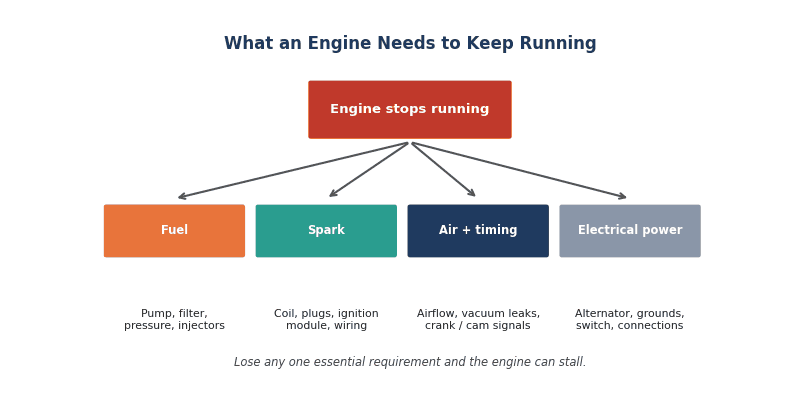
An engine does not continue running simply because the vehicle is moving. Combustion must continue every second, and the engine computer must constantly coordinate fuel injection, ignition timing, air intake, and crankshaft position.
If one essential requirement disappears, the engine can stop.
A useful way to approach an unexpected shutdown is to think about the three basic ingredients an internal-combustion engine needs: fuel, spark, and correctly timed air/compression. Modern vehicles add another major requirement: stable electrical power and accurate electronic signals.
A problem in any one of these areas can cause an engine to stall.
The exact symptoms before and after the shutdown can narrow the possibilities considerably.
Fuel Delivery Problems
Fuel starvation is one of the most common reasons an engine can suddenly stop running.
The fuel pump moves gasoline from the tank toward the engine, while the fuel filter, fuel lines, pressure regulator, injectors, and electrical controls all contribute to delivering the correct amount of fuel.
A weak fuel pump may work normally when the vehicle is cold but lose pressure as it heats up. The engine may hesitate, lose power, or stall after driving for a while. After sitting for several minutes, the pump may cool and work again, allowing the vehicle to restart.
A clogged fuel filter can create a similar pattern. The engine may receive enough fuel during light operation but struggle when demand increases.
If the engine cranks normally after stalling but refuses to start, fuel pressure testing can be particularly useful. A mechanic can compare actual fuel pressure with the specification for that vehicle.
Simply replacing the fuel pump without testing is not always the best approach because wiring, relays, fuel pressure regulation, or another component can create similar symptoms.
Crankshaft And Camshaft Position Sensors
Position sensors are essential because the engine computer needs to know exactly where the crankshaft and camshafts are located.
The crankshaft position sensor is especially important. It provides information used to determine engine speed and crankshaft position, allowing the computer to control fuel injection and ignition timing.
When the signal disappears, the engine computer may stop controlling spark or fuel correctly. The result can be an immediate stall.
A failing crankshaft sensor can create an intermittent problem that is difficult to diagnose. The vehicle may run perfectly for several miles and then shut off without warning. After cooling down, it may start again.
A camshaft position sensor can also cause starting and running problems, although the exact symptoms vary by vehicle.
Diagnostic trouble codes can provide clues, but a failed sensor does not always guarantee that a specific sensor code will be stored.
Alternator And Charging System Failure
The engine needs electricity to keep the ignition and electronic control systems operating.
The alternator normally replenishes the battery while the engine is running. If the alternator stops producing sufficient voltage, the vehicle can continue operating temporarily from battery power.
Eventually, however, the battery voltage can fall too low for essential systems to function correctly.
Depending on the vehicle, warning lights may appear before the engine stops. The battery warning indicator is especially important because it can indicate a charging-system problem rather than a bad battery itself.
Other symptoms can include dimming lights, electrical accessories behaving strangely, slow windshield wipers, or difficulty restarting.
A failed alternator can therefore create a situation where the vehicle starts normally, drives for some time, and then stalls as electrical voltage falls.
Ignition System Faults
Gasoline engines require a reliable ignition system to ignite the air-fuel mixture.
Depending on the vehicle, this system may include ignition coils, spark plugs, wiring, control modules, and other components.
A failing ignition coil can produce misfires, hesitation, reduced power, and eventually stalling. In some cases, the engine may restart after the component cools.
Older vehicles with conventional ignition systems can develop problems involving distributors, ignition modules, or related wiring.
The important clue is whether the engine loses spark when the problem occurs. A technician can test for ignition output rather than replacing components based only on symptoms.
Electrical Power Or Ground Problems
Not every stall is caused by a traditional engine component.
A loose battery terminal, damaged ground cable, corroded connector, failing ignition switch, or intermittent wiring fault can interrupt electrical power.
These problems can be especially difficult because the vehicle may behave as though several unrelated systems have failed at once.
For example, if the dashboard suddenly goes completely dark at the same time the engine stops, an electrical supply problem becomes more likely than a simple fuel-delivery issue.
Battery terminals should be clean and tight. Ground connections between the battery, engine, chassis, and body should also be inspected.
A vehicle can have a relatively new battery and still suffer from poor electrical connections.
What The Car Does Before And After It Stalls Matters
The moment the engine stops is only part of the diagnostic story.
Pay attention to what happened immediately beforehand and what happens when you attempt to restart it. These details can separate a fuel problem from an electrical failure, sensor issue, transmission problem, or mechanical fault.
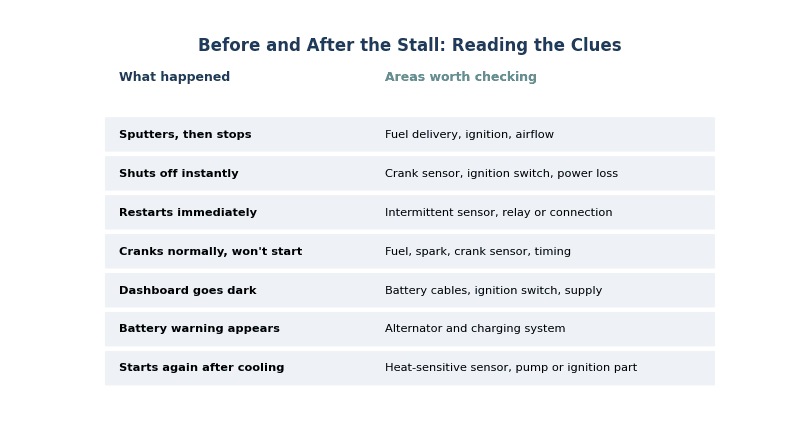
For example, an engine that sputters and gradually loses power points toward a different set of possibilities than an engine that shuts off instantly as though someone turned off an electrical switch.
The restart behavior is equally valuable.
If The Engine Sputters Before Shutting Off
Sputtering, hesitation, surging, or loss of power before the shutdown often suggests that the engine was struggling to maintain combustion.
Possible causes include:
- Low fuel pressure
- Weak fuel pump
- Restricted fuel filter
- Failing ignition components
- Airflow problems
- Sensor failures
- Severe vacuum leaks
- Certain exhaust restrictions
A fuel-delivery problem often becomes more obvious during acceleration because the engine requires more fuel under load.
A weak pump may maintain enough pressure during idle but fail to keep up when demand rises.
Misfires can also create a similar sensation. If several cylinders stop producing power, the engine may shake heavily before eventually stalling.
If The Engine Shuts Off Instantly
An immediate shutdown without hesitation often points toward an interruption in ignition, engine-position information, electrical power, or another critical control signal.
A crankshaft position sensor is one possibility.
An ignition switch or power relay is another.
A loose electrical connection can also interrupt power suddenly.
If the dashboard remains powered normally after the stall, the problem may be localized to engine operation rather than the vehicle’s main electrical supply.
If the dashboard and accessories also lose power, investigate the battery connections, grounds, ignition switch, charging system, and related electrical circuits.
If It Restarts Immediately
An immediate restart is an important clue.
If the vehicle stalls and then starts normally within seconds, the failure may be intermittent.
Possible causes include a sensor with an intermittent signal, a relay that occasionally loses contact, an electrical connection with poor continuity, or a fuel system component that briefly fails.
The fact that the vehicle restarted does not mean the problem has disappeared.
Intermittent faults can become more frequent and eventually cause a complete no-start condition.
If the problem has already happened more than once, recording the circumstances can help. Note engine temperature, outside temperature, speed, fuel level, electrical loads, and whether the vehicle was accelerating or cruising.
If It Cranks But Does Not Start
A cranking engine tells you that the starter is turning the engine, but it does not prove that the engine has fuel, spark, or correct sensor information.
This distinction is important.
A technician should determine whether the engine has adequate fuel pressure, ignition spark, and the required sensor signals.
The following simplified pattern can be useful:
| Symptom After Stall | Areas Worth Checking |
|---|---|
| Cranks normally, no start | Fuel, spark, crank sensor, timing |
| No crank | Battery, starter, connections, transmission interlock |
| Starts after cooling | Heat-sensitive sensor, fuel pump, ignition component |
| Dashboard goes dark | Main electrical supply, battery cables, ignition switch |
| Battery warning appears | Alternator and charging system |
| Sputters first | Fuel delivery, ignition, airflow |
| Restarts immediately | Intermittent electrical or sensor issue |
This table is not a substitute for diagnosis, but it shows why the symptoms surrounding the stall matter so much.
Common Mechanical And Electronic Causes
Modern vehicles are complicated systems, but most unexpected engine shutdowns still fall into a manageable group of categories.
The key is to test rather than guess.
Replacing several expensive components simply because they can cause stalling is an inefficient approach. A structured diagnosis usually costs less and provides a more reliable answer.
Fuel Pump Failure
The fuel pump is located inside or near the fuel tank on many vehicles.
Its job is to maintain adequate fuel flow and pressure. A worn pump may become noisy, weak, or intermittent.
One clue is a vehicle that stalls after prolonged driving but restarts after sitting for a short period.
Another clue can be a change in pump noise. A pump that suddenly becomes unusually loud may be struggling.
Fuel pressure should be measured according to the manufacturer’s testing procedure. Some vehicles require a mechanical gauge, while others use electronic pressure monitoring.
Fuel-pump diagnosis should also include the pump’s electrical supply. A good pump cannot operate properly if it is not receiving sufficient voltage.
Clogged Fuel Filter Or Restricted Fuel Supply
A restricted fuel filter can limit flow to the engine.
The effect depends on the vehicle and filter design. Some modern vehicles integrate the filter with the fuel-pump module and do not use a conventional externally replaceable filter.
When applicable, filter replacement should follow the manufacturer’s service recommendations.
A restricted fuel system may cause hesitation under heavy acceleration before producing a stall.
If fuel pressure drops when the engine is under load, the technician can investigate the pump, filter, regulator, fuel lines, and electrical supply.
Failing Alternator
The alternator is another major suspect when an engine shuts down after several electrical symptoms appear.
The battery provides energy for starting, but once the engine is running, the alternator normally supplies electrical power and recharges the battery.
A charging-system fault can therefore produce a gradual decline rather than an immediate engine failure.
A technician should test charging voltage under appropriate operating conditions and inspect the belt, wiring, terminals, and ground connections.
Modern vehicles may have sophisticated charging systems, so the correct testing procedure varies by model.
Faulty Crankshaft Position Sensor
The crankshaft sensor deserves particular attention when a vehicle shuts down abruptly and then restarts after cooling.
Heat can affect an aging sensor or its internal electronics.
When the sensor stops sending a valid signal, the engine control module may no longer know engine speed or position accurately.
The sensor itself may be defective, but wiring and connector problems can create the same symptoms.
A scan tool capable of viewing live data can sometimes show whether the engine computer is receiving an RPM signal while cranking.
Bad Ignition Switch Or Relay
A worn ignition switch can interrupt power to engine-control circuits.
Depending on the design, the switch may supply multiple circuits. Internal wear can cause intermittent contact.
Relays can also develop electrical or mechanical faults. Heat and vibration may make an intermittent relay problem more noticeable.
These faults can be difficult to reproduce in a workshop because the vehicle may operate normally when inspected.
This is why documenting exactly when the failure occurs can be valuable.
Vacuum Leaks And Airflow Problems
An engine needs the correct relationship between air and fuel.
A significant vacuum leak can upset that balance, particularly at idle or low engine speeds. Depending on the size and location of the leak, the engine may run poorly or stall.
A dirty throttle body can also contribute to unstable idle and stalling on certain vehicles.
Modern electronic throttle systems require careful diagnosis because the throttle body, accelerator-pedal position sensors, engine computer, and related wiring all interact.
Cleaning a throttle body can sometimes help when deposits are genuinely causing a problem, but it should not be treated as a universal fix for every stall.
A Practical Diagnostic Process
When a vehicle cuts off while driving, diagnosis should proceed from basic observations toward more specific testing.
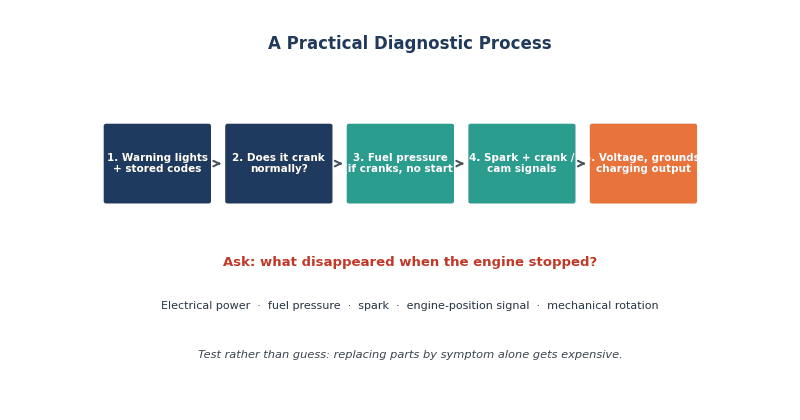
The goal is to identify what disappears when the engine stops.
Does the vehicle lose electrical power?
Does it lose fuel pressure?
Does it lose spark?
Does the engine computer lose its crankshaft signal?
Does the engine mechanically turn normally?
Answering these questions can reduce a long list of possibilities to a small number.
Step One: Check For Warning Lights And Stored Codes
After safely stopping, observe the dashboard.
Look for the check-engine light, battery warning light, oil-pressure warning, temperature warning, or other indicators.
A scan tool can retrieve stored diagnostic trouble codes.
However, the absence of a code does not prove that the vehicle has no electronic problem. Intermittent failures may not always trigger a code, and some mechanical or electrical problems may occur without generating a useful diagnostic code.
Codes should be treated as clues rather than automatic instructions to replace a component.
Step Two: Determine Whether The Engine Cranks
When attempting to restart, listen carefully.
If the starter turns the engine at normal speed, the problem is likely different from a situation where the starter does nothing.
A normal crank with no start leads the diagnosis toward fuel, ignition, timing, sensor, or engine-management problems.
A no-crank condition shifts attention toward the battery, starter circuit, electrical connections, transmission range switch, immobilizer system, or related components.
Step Three: Check Fuel Pressure
If the engine cranks but does not start, fuel pressure testing can be valuable.
The required pressure varies considerably between vehicles, so use the manufacturer’s specification.
If pressure is too low, investigate the pump, filter, regulator, fuel lines, wiring, and control circuit.
If pressure is correct, move to other parts of the diagnosis rather than automatically replacing the pump.
Step Four: Verify Spark And Engine Position Signals
Spark testing can determine whether the ignition system is functioning.
If there is no spark, inspect the ignition system and determine whether the engine computer is receiving the required crankshaft and camshaft signals.
A scan tool can sometimes display engine RPM during cranking. If RPM remains at zero despite the starter turning the engine, a crankshaft position signal problem becomes a strong possibility, although the exact diagnostic process depends on the vehicle.
Step Five: Check Electrical Voltage And Grounds
Measure battery voltage and charging-system output using the appropriate procedure.
Inspect battery terminals, ground straps, engine grounds, fuses, relays, and major electrical connectors.
A voltage-drop test can be especially useful for finding resistance in a connection that appears visually normal.
A cable can look clean from the outside while having corrosion inside the terminal or at a connection point.
When A Car Stalls While Driving, Safety Comes First
An engine shutdown on the road creates a safety issue because vehicle systems can behave differently once the engine stops.
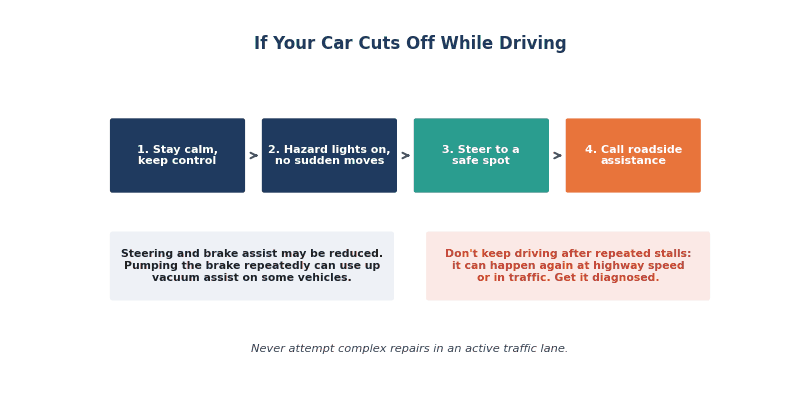
Modern vehicles generally retain some braking and steering assistance, but the available assistance may decrease after the engine shuts down. Repeatedly pumping the brake pedal can also reduce available vacuum assist on vehicles that use vacuum-assisted brakes.
The safest response is to remain calm, maintain control, and move toward a safe location when possible.
Turn on the hazard lights and avoid making sudden movements.
If the vehicle cannot be moved safely, remain aware of surrounding traffic and seek roadside assistance or emergency help when appropriate.
Do not attempt complex repairs in an active traffic lane.
Why The Engine May Feel Different After It Stops
Power steering assistance may become reduced or disappear depending on the vehicle’s design.
Electric power steering systems behave differently from hydraulic systems, while some hydraulic systems depend directly on the engine running.
Brake assist may also be affected.
The brakes do not necessarily stop functioning when the engine stalls, but the pedal can become harder after the available assist is depleted.
This is why a sudden stall should be treated seriously even if the vehicle appears mechanically intact.
Do Not Keep Driving After Repeated Stalls
A vehicle that has stalled once may stall again.
If the cause has not been identified, continuing to drive can put the driver and others at risk.
A problem that initially occurs once every few days may become more frequent without warning.
This is particularly concerning if the stall occurs at highway speed, during turns, in heavy traffic, or at intersections.
Professional diagnosis is the safer choice when the cause is uncertain.
How To Prevent A Car From Cutting Off While Driving
Not every stall can be prevented, especially when a component fails unexpectedly. However, good maintenance can reduce the likelihood of many common causes.
Regular oil changes, proper cooling-system maintenance, battery inspections, charging-system checks, and scheduled replacement of service items help keep the engine operating reliably.
Pay attention to early symptoms.
A fuel pump that becomes unusually loud, an engine that occasionally hesitates, a battery warning light that flickers, or a vehicle that takes longer to start may be giving you information before a major failure occurs.
Keep The Fuel System In Good Condition
Use fuel appropriate for the vehicle and follow the manufacturer’s recommendations.
If the vehicle has a replaceable fuel filter, replace it according to the prescribed maintenance schedule.
Avoid repeatedly driving with an extremely low fuel level. Although modern fuel pumps are designed to operate in fuel, the gasoline in the tank also helps manage pump temperature on many designs.
Repeated low-fuel operation can place additional stress on the fuel system.
This does not mean a single low-fuel trip will destroy a pump. The broader point is that good operating habits can help reduce unnecessary stress on aging components.
Maintain The Charging System
Inspect the battery, terminals, belts, and charging system during routine service.
A battery that repeatedly goes flat should not simply be replaced without finding out why.
The cause may be an alternator problem, parasitic electrical drain, poor connection, or charging-control issue.
The charging system should be evaluated as a complete system.
Pay Attention To Engine Temperature
Overheating can create serious engine problems and may eventually result in shutdown.
If the temperature gauge moves beyond its normal range or a temperature warning appears, stop safely as soon as possible.
Do not continue driving simply because the engine is still running.
Coolant leaks, thermostat problems, radiator restrictions, cooling-fan faults, water-pump failures, and other issues can cause overheating.
Continuing to operate an overheating engine can turn a repairable cooling-system problem into severe engine damage.
When Professional Diagnosis Is Necessary
Some vehicle problems can be handled by an experienced owner, but intermittent engine shutdowns often require diagnostic equipment and systematic testing.
A technician may need a scan tool, fuel-pressure gauge, multimeter, oscilloscope, test light, smoke machine, or other specialized equipment depending on the symptoms.
A professional diagnosis becomes particularly important when the vehicle stalls repeatedly, stalls at highway speed, loses electrical power, overheats, produces an oil-pressure warning, or refuses to restart.
The cost of diagnosis is generally preferable to replacing several unrelated components based on guesses.
Information To Give The Mechanic
Before taking the vehicle in, write down as much information as possible.
Include:
| Information | Why It Helps |
|---|---|
| Engine temperature | Identifies heat-related patterns |
| Vehicle speed | Separates operating conditions |
| Fuel level | Helps evaluate fuel-related issues |
| Warning lights | Provides diagnostic clues |
| Weather | May reveal temperature sensitivity |
| Restart behavior | Narrows possible causes |
| Time before restart | Useful for intermittent faults |
| Recent repairs | Identifies possible connections |
| Electrical symptoms | Points toward charging or power issues |
A detailed description can save diagnostic time.
“Car stalled” is useful, but “engine stopped after 30 minutes of highway driving, dashboard stayed on, it cranked normally but would not restart for 15 minutes, then started normally” provides considerably more information.
Final Thoughts
When a car cuts off while driving, the cause can range from a relatively straightforward fuel or electrical problem to a more complicated sensor, ignition, or engine-management fault. The most useful clue is often not the stall itself but what happened immediately before and after it.
A vehicle that sputters before shutting down suggests a different direction than one that turns off instantly. A battery warning light points toward the charging system, while a normal crank with no start raises questions about fuel, spark, timing, and sensor signals.
The safest approach is to avoid guessing and focus on evidence. Check warning lights, note the restart behavior, inspect basic electrical connections, and use appropriate diagnostic tests to determine whether fuel pressure, ignition, engine-position signals, and charging voltage are present.
Regular maintenance can reduce the chances of some failures, but no vehicle is immune to component failure. If the engine repeatedly shuts down, treat the issue as a safety concern rather than continuing to drive and hoping it does not happen again.
Why Does My Car Cut Off While Driving But Start Again?
An intermittent fault can allow the engine to restart after the vehicle sits for a few minutes. Common possibilities include a failing crankshaft position sensor, weak fuel pump, ignition component, electrical relay, or charging-system problem. The exact cause requires testing, particularly if the symptom repeats.
Can A Bad Alternator Cause A Car To Cut Off While Driving?
Yes. If the alternator stops charging, the vehicle can continue operating temporarily using battery power. As battery voltage falls, ignition and electronic control systems may stop functioning correctly, eventually causing the engine to shut down. A battery warning light, dimming lights, or electrical problems can provide additional clues.
Can Low Fuel Cause A Car To Shut Off While Driving?
Yes. An empty or nearly empty fuel tank can obviously cause the engine to stop. A weak fuel pump or fuel-delivery problem can also produce similar symptoms even when the fuel gauge shows fuel remaining. If the vehicle repeatedly stalls with adequate fuel in the tank, fuel pressure should be tested.
What Sensor Can Cause A Car To Shut Off While Driving?
The crankshaft position sensor is one important possibility because the engine computer relies on its signal for crankshaft position and engine speed information. Camshaft position sensors and other engine-management sensors can also cause stalling depending on the vehicle’s design. Wiring and connectors should be tested before replacing a sensor.
Is It Safe To Drive A Car That Keeps Cutting Off?
It is not advisable. Repeated engine shutdowns can occur without warning and may reduce power steering or brake assistance depending on the vehicle. A stall in heavy traffic or at highway speed can create a serious safety risk. The vehicle should be diagnosed before being used normally.
Why Does My Car Stall When It Gets Hot?
Heat-related stalling can occur when an electrical or electronic component fails after reaching operating temperature. Possible causes include a crankshaft position sensor, fuel pump, ignition component, relay, or other heat-sensitive part. Allowing the vehicle to cool may temporarily restore operation, but the underlying problem still needs diagnosis.