
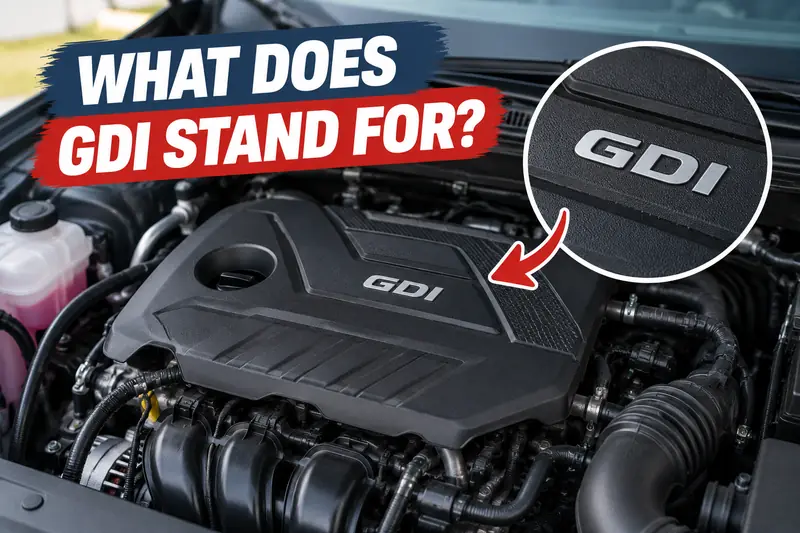
Modern gasoline engines use several technologies to extract more power and efficiency from relatively small engines. One abbreviation that appears frequently on vehicle specifications, engine covers, owner’s manuals, and dealership listings is GDI. So, what does GDI stand for? In automotive terminology, GDI stands for Gasoline Direct Injection.
The name describes how gasoline is delivered to the engine. Instead of injecting fuel into the intake port before the air enters the combustion chamber, a GDI system sprays gasoline directly into each cylinder. This allows the engine computer to control the amount and timing of fuel delivery with considerable precision.
Direct injection has become common across many manufacturers because it can help improve fuel efficiency, power output, emissions performance, and engine response. At the same time, the technology introduces components and maintenance considerations that are different from those found in traditional port-injected engines.
Knowing how GDI works makes it easier to understand common terms such as direct-injection fuel pumps, high-pressure injectors, intake-valve deposits, fuel pressure, and GDI engine maintenance.
What Does GDI Stand For And How Does It Work?
GDI stands for Gasoline Direct Injection. The defining feature is the location where gasoline is injected: directly into the combustion chamber rather than into the intake port.
A conventional port fuel injection system places an injector near the intake valve. The injector sprays fuel into the incoming air stream, and the mixture enters the cylinder when the intake valve opens.
A GDI engine takes a different approach.
The fuel system supplies gasoline to high-pressure injectors installed directly in the cylinder head. Those injectors can operate at pressures far higher than conventional port-injection systems.
The engine control module determines when the injectors should open and how much fuel should be delivered.
That control allows engineers to manipulate the fuel mixture according to engine speed, load, temperature, throttle position, emissions requirements, and other operating conditions.
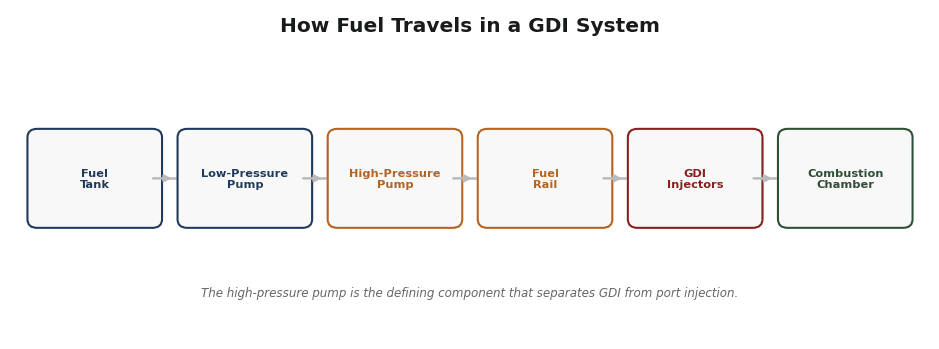
The basic process looks like this:
Fuel Tank → Low-Pressure Fuel Pump → High-Pressure Fuel Pump → Fuel Rail → GDI Injectors → Combustion Chamber
The high-pressure fuel pump is one of the defining components of the system. It takes fuel supplied at relatively low pressure and increases it to the much higher pressure required by the direct injectors.
The injectors then deliver carefully metered fuel directly into the combustion chamber.
| Component | Main Function |
|---|---|
| Fuel Tank | Stores gasoline |
| Low-Pressure Fuel Pump | Sends fuel toward the engine |
| High-Pressure Fuel Pump | Raises fuel pressure for direct injection |
| Fuel Rail | Distributes high-pressure fuel |
| GDI Injectors | Spray fuel directly into cylinders |
| Engine Control Module | Controls injection timing and quantity |
| Pressure Sensor | Monitors fuel-system pressure |
| Intake Valves | Control incoming air |
| Combustion Chamber | Where the air-fuel mixture burns |
The exact system design varies between manufacturers. Some engines combine direct injection with port injection, while others rely entirely on direct injection.
Direct Injection Versus Port Injection
The easiest way to understand GDI is to compare it with port fuel injection.
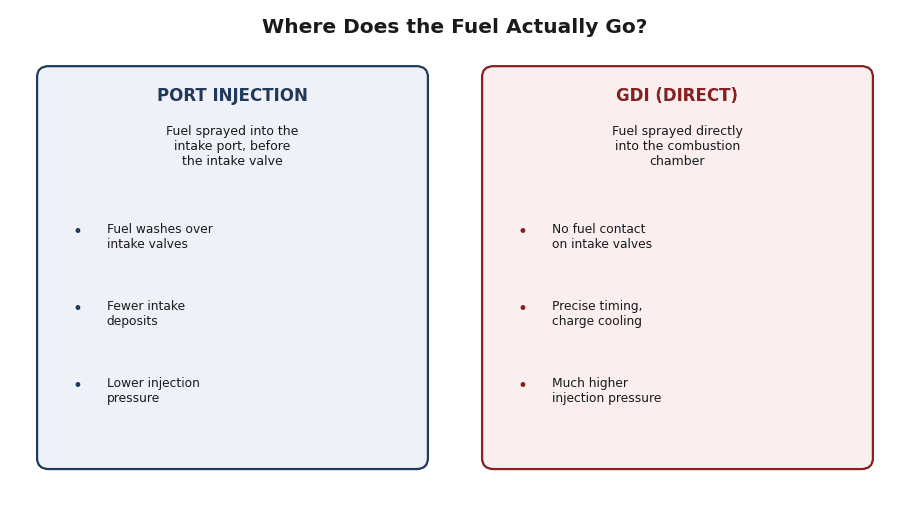
Port injection sprays fuel into the intake port. The fuel mixes with incoming air before entering the cylinder.
Direct injection places the injector inside the cylinder head, allowing gasoline to enter the combustion chamber directly.
That difference creates several engineering opportunities.
Because fuel is injected directly into the cylinder, engineers can use the evaporation of gasoline to cool the incoming charge. Under certain operating conditions, this can help reduce the tendency toward knock and allow higher compression ratios or more aggressive combustion strategies.
Direct injection also provides precise control over fuel delivery.
The engine computer can alter injection timing depending on operating conditions. Some systems can inject fuel more than once during a combustion cycle.
The result is greater control over the combustion process.
However, there is a trade-off.
Port-injected fuel passes over the intake valves, while GDI fuel generally does not. That means the intake valves in a direct-injection engine do not receive the same fuel-washing effect.
Over time, oil vapor from the crankcase ventilation system and exhaust-gas recirculation gases can contribute to deposits on the back side of intake valves.
This is one of the most frequently discussed maintenance differences between GDI and traditional port-injected engines.
Why Automakers Use GDI Engines
The popularity of direct injection is closely related to the industry’s push toward better fuel economy, lower emissions, and more power from smaller engines.
GDI technology gives engineers greater control over the combustion event.
It can support higher compression ratios, turbocharging, precise fuel metering, and sophisticated combustion strategies.
For a manufacturer, that flexibility is valuable because one engine family may need to meet several goals at the same time.
The engine needs to produce enough torque.
It needs to meet emissions requirements.
It needs to deliver competitive fuel economy.
It also needs to work with modern transmissions and increasingly complex vehicle control systems.
Direct injection is not the only technology capable of achieving these objectives, but it has become an important part of the solution.
Some newer engines combine direct injection and port injection. This arrangement is often called dual injection or combined injection.
It allows the engine computer to use either system, or both, depending on operating conditions.
That can provide some of the advantages of direct injection while helping manage intake-valve deposits.
GDI Engine Benefits And The Trade-Offs
The reason GDI became widespread is not simply that manufacturers wanted a different type of fuel injector. Direct injection changes how fuel interacts with the combustion chamber and gives engineers another tool for controlling engine performance.
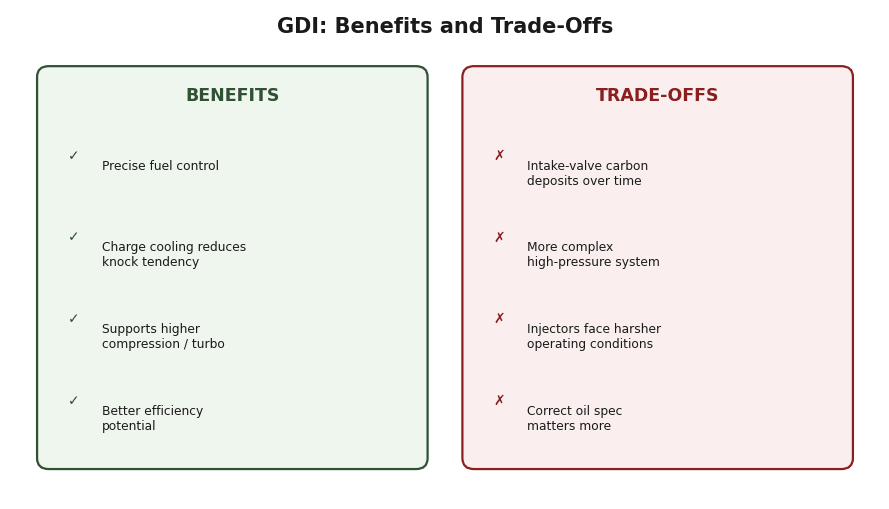
One major advantage is precise fuel delivery.
The injector can deliver a very carefully measured quantity of gasoline directly where combustion occurs. The control system can adjust injection timing and quantity many times per second as operating conditions change.
This precision can contribute to better fuel economy and emissions control.
Another advantage involves charge cooling.
When gasoline is injected directly into the cylinder, the fuel absorbs heat as it vaporizes. This can lower the temperature of the air-fuel charge under certain conditions.
That effect can help reduce knock tendency.
Knock occurs when portions of the air-fuel mixture ignite in an uncontrolled manner rather than following the intended combustion process. Excessive knock can damage an engine, so controlling it is an important part of engine design.
GDI And Fuel Efficiency
Fuel economy depends on many factors, including engine size, vehicle weight, gearing, aerodynamics, calibration, driving conditions, and transmission design.
GDI is only one piece of that system.
Still, direct injection can contribute to efficiency by allowing more precise fuel control.
The engine computer can vary fuel delivery according to load instead of relying on one relatively broad injection strategy.
Under light-load conditions, some direct-injection engines can use specialized combustion strategies to reduce pumping losses and improve efficiency.
Under heavy load, the system can deliver additional fuel as necessary to maintain combustion stability and performance.
The exact strategy varies by engine.
This is important because it prevents an oversimplified conclusion such as “GDI always gets better mileage.”
A GDI engine is not automatically more economical than every port-injected engine.
The complete powertrain determines the result.
GDI And Engine Performance
Direct injection can also support higher specific output.
An engine can produce more power without necessarily increasing displacement because the fuel system and combustion chamber can be designed around precise injection and charge management.
Turbocharged GDI engines are a common example.
Turbocharging forces more air into the engine.
More air allows more fuel to be burned.
Direct injection provides precise control over that fuel delivery.
Together, the technologies can produce substantial power from relatively small displacement engines.
That combination has become common in modern cars, crossovers, SUVs, and pickup trucks.
The technology also helps manufacturers balance performance with fuel-economy requirements.
However, higher output can place greater thermal and mechanical demands on engine components.
That does not mean a turbocharged GDI engine is automatically unreliable. It means maintenance and correct oil specifications become increasingly important as engine designs become more sophisticated.
The Main Trade-Off: Intake-Valve Deposits
One of the best-known GDI concerns is carbon buildup on intake valves.
In a traditional port-injected engine, gasoline travels through the intake port and often contacts the back of the intake valve.
Gasoline has cleaning properties that can help reduce certain deposits.
With GDI, fuel is injected downstream of the intake valve.
The back side of the valve therefore does not receive the same fuel contact.
At the same time, engines naturally produce oil vapor through the crankcase ventilation system.
That vapor can enter the intake system.
Over many miles, deposits may build on the back of the intake valves.
The severity varies dramatically between engines.
Engine design, oil-control characteristics, PCV system design, driving patterns, fuel quality, maintenance, and operating temperature can all influence deposit formation.
Some GDI engines experience relatively little deposit buildup.
Others can develop significant deposits.
That is why intake-valve cleaning is not a universal maintenance requirement at a fixed mileage for every GDI engine.
The correct maintenance interval depends on the specific engine and manufacturer guidance.
Common GDI Problems And Maintenance Requirements
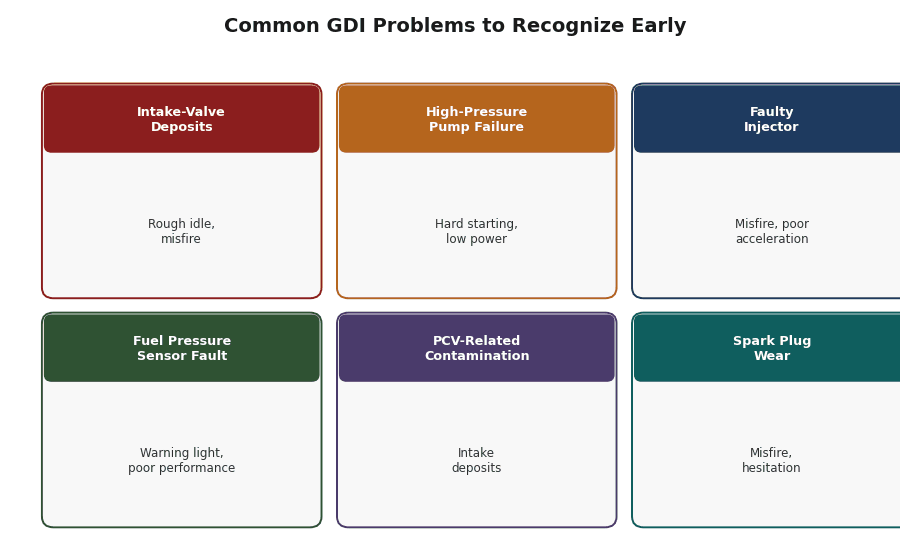
GDI technology itself is not a single component. It is an entire high-pressure fuel-delivery system integrated with the engine’s electronic controls.
When something goes wrong, symptoms can range from difficult starting to rough idle, hesitation, reduced power, misfires, poor fuel economy, or a check-engine light.
Some problems are relatively simple.
Others require specialized diagnostic equipment and high-pressure fuel-system knowledge.
A technician should diagnose the actual fault rather than replacing expensive components based only on a symptom.
| GDI Problem | Possible Symptoms | Typical Diagnostic Direction |
|---|---|---|
| Dirty Or Faulty Injector | Misfire, rough idle, poor acceleration | Injector balance and scan data |
| High-Pressure Pump Problem | Hard starting, low power, fuel-pressure codes | Fuel-pressure testing |
| Intake-Valve Deposits | Rough idle, misfire, reduced airflow | Intake inspection |
| Fuel Pressure Sensor Fault | Warning light, poor performance | Scan data and pressure verification |
| Spark Plug Wear | Misfire, hesitation | Plug and ignition inspection |
| PCV-Related Deposits | Intake contamination | PCV and intake inspection |
| Low-Pressure Pump Issue | Hard starting, stalling | Low-side fuel-pressure test |
| Wiring Problem | Intermittent faults | Electrical testing |
High-Pressure Fuel Pump Problems
The high-pressure fuel pump is one of the most important GDI components.
A conventional fuel system can operate at comparatively low pressure. A direct-injection system needs much higher pressure to deliver fuel directly into the combustion chamber at the correct moment.
When the high-pressure pump begins to fail, the engine may struggle to maintain the fuel pressure required under certain conditions.
Symptoms can include:
- Hard starting
- Long cranking
- Hesitation
- Reduced power
- Engine misfires
- Stalling
- Check-engine light
- Fuel-pressure-related diagnostic codes
The symptoms can overlap with problems elsewhere in the fuel system.
A weak low-pressure fuel pump, restricted fuel supply, faulty pressure sensor, wiring problem, or injector issue can produce similar behavior.
That is why replacing the high-pressure pump solely because the vehicle hesitates is not a reliable diagnostic method.
Proper pressure testing and scan-tool data are much more useful.
GDI Fuel Injector Issues
GDI injectors operate under demanding conditions.
They must deliver precise quantities of fuel directly into a high-temperature combustion environment.
Deposits, electrical faults, mechanical wear, or contamination can interfere with injector performance.
A malfunctioning injector can cause one cylinder to receive too much or too little fuel.
That can result in a misfire.
A misfire may produce rough engine operation, reduced power, increased emissions, or a flashing check-engine light.
A flashing check-engine light should be treated seriously because continued driving under an active misfire condition can damage the catalytic converter.
Injector diagnosis can involve electrical testing, scan data, fuel-pressure analysis, cylinder contribution tests, or specialized injector testing.
The correct method varies by vehicle.
Fuel additives should also not be presented as a guaranteed solution to injector problems. Some additives may help with certain deposits, but they cannot repair an electrically failed injector, mechanically damaged component, or wiring problem.
Intake-Valve Carbon Deposits
Carbon deposits are probably the GDI maintenance issue most associated with direct injection.
The symptoms are not always obvious.
A vehicle may gradually lose smoothness at idle.
Acceleration may become less consistent.
Cold starts may become rougher.
Fuel economy can decline.
Misfires may eventually occur.
However, those symptoms can also be caused by spark plugs, ignition coils, injectors, vacuum leaks, compression problems, or sensor faults.
Therefore, a rough idle should not automatically be blamed on carbon buildup.
When deposits are suspected, a technician can use appropriate inspection methods to determine whether intake-valve contamination is actually present.
If heavy deposits are confirmed, specialized cleaning may be required.
Some shops use media blasting methods designed specifically for intake-valve cleaning. The procedure must be performed correctly to prevent debris from entering areas where it could cause damage.
Oil Quality Matters More On Modern GDI Engines
Oil maintenance has always been important, but modern GDI engines can place significant demands on engine oil.
Turbocharging, high cylinder pressures, tight engine tolerances, and advanced emissions systems all make the correct lubricant specification important.
The best approach is to follow the manufacturer’s recommended oil viscosity and specification.
Do not choose oil based only on the word “synthetic.”
Two synthetic oils can have different additive packages and manufacturer approvals.
The correct specification is the one listed for the engine.
Oil level matters too.
Both low and excessive oil levels can create problems.
A low level reduces the amount of lubricant available for the engine’s moving components. An excessively high level can also cause unwanted crankcase behavior and aeration.
Checking the oil regularly remains one of the simplest forms of preventive maintenance.
How To Maintain A GDI Engine For Long-Term Reliability
A GDI engine does not require mysterious maintenance.
The most important habits are surprisingly familiar: use the correct oil, replace filters according to the manufacturer’s schedule, use appropriate fuel, address warning lights promptly, and investigate unusual engine behavior before a small problem becomes a larger one.
The difference is that GDI systems add a few specialized components that deserve attention.
Fuel pressure should be diagnosed correctly.
Injectors need to remain clean and functional.
The intake system should be inspected when symptoms suggest deposit buildup.
The high-pressure pump should be checked when fuel-pressure problems appear.
And the vehicle’s specific service schedule should take priority over generic internet advice.
Fuel Quality And GDI Engines
GDI engines are designed to operate on fuel that meets the manufacturer’s requirements.
Using the correct octane rating is important, particularly for turbocharged or high-compression engines.
Higher octane fuel does not automatically provide more power in every engine.
If the manufacturer specifies regular gasoline, using premium fuel may not produce a meaningful performance benefit under ordinary conditions.
If premium fuel is required or recommended, following that specification is more important.
Fuel quality also matters because contaminants can damage precision fuel-system components.
Buying fuel from reputable stations and avoiding questionable fuel sources is a sensible habit.
Oil Changes And Service Intervals
Following the manufacturer’s maintenance schedule is one of the strongest ways to reduce avoidable engine problems.
Oil-change intervals should not be extended simply because the vehicle still feels normal.
Engine oil degrades through heat, oxidation, contamination, and additive depletion.
Short-trip driving, frequent idling, heavy loads, towing, extreme temperatures, and other severe operating conditions can affect maintenance requirements.
Some manufacturers use oil-life monitoring systems rather than a fixed mileage interval.
Those systems can be useful, but they do not eliminate the need to follow the owner’s manual.
Oil filters should also meet the required specifications.
A cheap filter that does not meet the engine’s requirements is not necessarily a cost-effective choice.
Recognizing Early GDI Problems
Early diagnosis can prevent secondary damage.
A small hesitation may be caused by something relatively simple.
A persistent misfire can damage the catalytic converter.
A fuel-pressure problem can eventually leave the vehicle unable to start.
A leaking injector can create combustion and oil-related problems.
An intake-valve deposit problem can gradually affect airflow and combustion.
The key is to avoid treating the check-engine light as merely an annoyance.
If a warning light appears, scan the vehicle and identify the actual diagnostic trouble code.
A code is not always a direct statement of which component has failed.
For example, a fuel-pressure code may indicate a pressure problem but not necessarily prove that the high-pressure pump itself is defective.
Professional diagnosis involves checking the entire system.
Final Thoughts On What Does GDI Stand For?
So, what does GDI stand for? In automotive terminology, GDI means Gasoline Direct Injection. It is a fuel-delivery system in which gasoline is injected directly into the engine’s combustion chamber rather than into the intake port.
The technology gives manufacturers precise control over fuel delivery and can support fuel efficiency, emissions control, higher compression ratios, turbocharging, and strong power output.
Its main difference from conventional port injection is where the fuel enters the engine.
That seemingly small change has important consequences.
Because gasoline does not normally wash across the intake valves in a pure GDI system, some engines are more susceptible to intake-valve deposits. The system also relies on components such as a high-pressure fuel pump and specialized direct injectors.
These components require proper diagnosis when problems appear.
GDI should therefore not be viewed as either a miracle technology or an inherently problematic one.
It is an engineering approach with clear benefits and specific trade-offs.
For owners, the practical formula is straightforward: use the manufacturer’s recommended fuel and oil specifications, maintain the engine on schedule, monitor oil level, replace filters as required, respond promptly to warning lights, and have fuel-pressure or misfire problems properly diagnosed.
For buyers researching a used vehicle, knowing that an engine uses GDI is only the beginning. The engine’s specific design, maintenance history, known service campaigns, mileage, oil-consumption behavior, and repair history provide much more useful information than the GDI label alone.
FAQs
What Does GDI Stand For In A Car?
GDI stands for Gasoline Direct Injection. It describes a gasoline fuel-injection system in which fuel is sprayed directly into the engine’s combustion chamber. The engine computer controls injector timing and fuel quantity based on operating conditions. This differs from port fuel injection, where fuel is injected into the intake port before entering the cylinder.
Is GDI Better Than Fuel Injection?
GDI is itself a type of fuel injection. Compared with conventional port injection, it can provide more precise control over fuel delivery and can support efficient combustion and high specific power. However, it also has trade-offs, including the possibility of intake-valve deposits and the use of a more complex high-pressure fuel system. The overall quality of an engine depends on its complete design and maintenance rather than injection type alone.
Do GDI Engines Have More Problems?
GDI engines have different maintenance considerations rather than automatically having more problems. Intake-valve deposits, high-pressure fuel pumps, and direct injectors receive particular attention because of the design. The severity varies considerably among engine families. Proper oil changes, appropriate fuel, timely maintenance, and correct diagnosis can help prevent many avoidable problems.
How Long Do GDI Engines Last?
There is no universal mileage limit for GDI engines. Longevity depends on engine design, maintenance, operating conditions, oil quality, fuel-system condition, and how the vehicle is used. A well-maintained GDI engine can accumulate substantial mileage, while poor maintenance can shorten the life of almost any modern engine regardless of its injection system.
Do GDI Engines Need Special Oil?
GDI engines should use the oil viscosity and specification recommended by the manufacturer. Turbocharged GDI engines can be particularly sensitive to correct lubricant specifications because of their operating temperatures and component demands. The word “synthetic” alone does not determine whether an oil is suitable. Always check the owner’s manual or manufacturer’s service information for the required specification.
How Do I Prevent Carbon Buildup In A GDI Engine?
There is no universal method that completely prevents intake-valve deposits in every GDI engine. Regular maintenance, correct engine oil, a properly functioning crankcase ventilation system, and following the manufacturer’s service recommendations are important. If symptoms such as persistent rough idle, misfires, or reduced performance develop, the intake system can be inspected to determine whether deposits are actually responsible before paying for specialized cleaning.