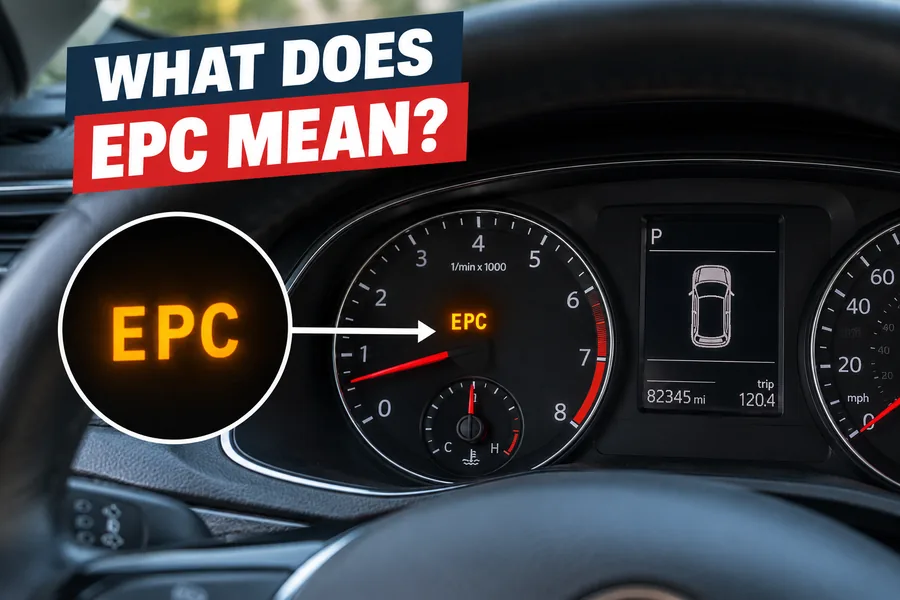
EPC stands for Electronic Power Control, a warning system used on many vehicles, most notably Volkswagen Group models such as Volkswagen, Audi, SEAT, and Škoda. The EPC warning light is connected to the electronic management of the engine and, depending on the vehicle, can involve the accelerator pedal, throttle body, engine sensors, brake-pedal switch, cruise control, traction-related systems, or the engine control module.
The important point is that EPC is not the name of one specific failed part. It is a warning that the vehicle has detected a problem within a system involved in electronic engine or power control. Volkswagen itself identifies the EPC indicator as an engine control malfunction and recommends checking the vehicle’s specific owner’s manual because warning-light meanings can vary by model.
An EPC light may appear by itself, or it may come with reduced power, rough running, poor throttle response, or other warning lights.
Knowing what the light means can help you decide whether the vehicle can be driven carefully or needs immediate attention.
What Does EPC Mean On A Car?
EPC means Electronic Power Control.
Unlike older vehicles that commonly used a mechanical accelerator cable connected directly to the throttle, many modern vehicles use electronic signals to control engine power.
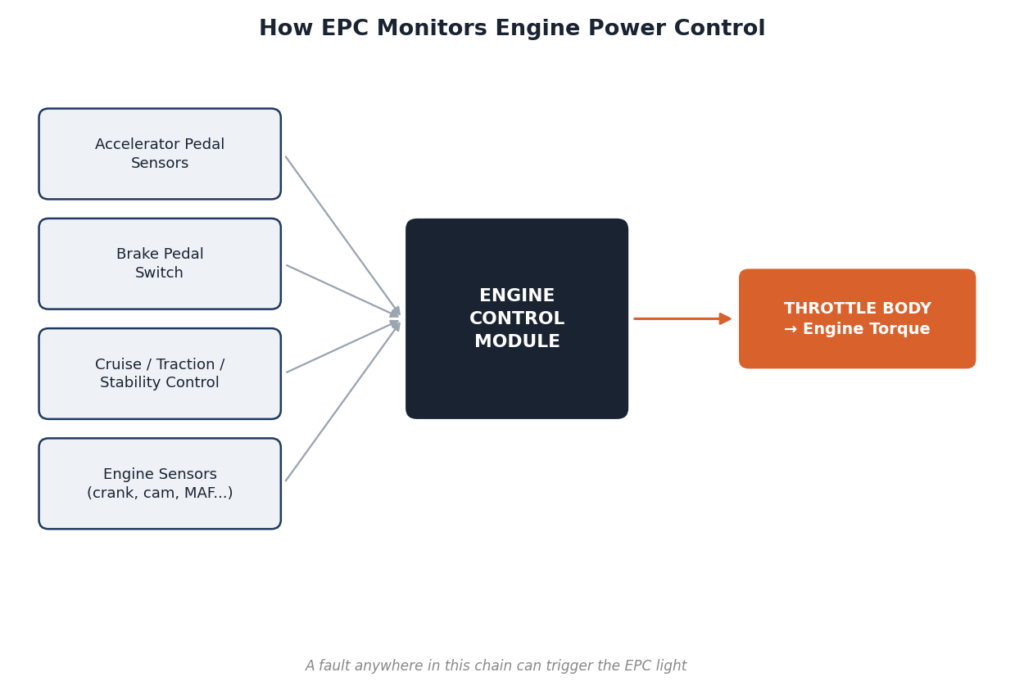
When you press the accelerator pedal, sensors measure the pedal position and send information to the engine control system. The control module then determines how much throttle opening and engine torque are appropriate.
The EPC system monitors parts of this electronic chain.
If the computer detects an abnormal signal, an implausible sensor reading, or a control problem, it can illuminate the EPC warning light.
EPC Is A System Warning, Not A Single Fault
One of the most common misunderstandings about the EPC light is assuming that it identifies one particular defective component.
It does not.
The warning tells you that the electronic power-control system has detected a problem. The actual cause could be a throttle-body issue, accelerator-pedal sensor problem, brake-light switch, ignition fault, wiring problem, engine sensor failure, or another control-system issue.
Volkswagen’s current warning-light information lists the EPC symbol as an engine control malfunction.
That is why replacing the throttle body simply because the EPC light appeared can be an expensive mistake.
The correct diagnosis starts with retrieving the stored diagnostic trouble codes and then testing the affected system.
Why Modern Cars Use Electronic Throttle Control
Electronic throttle control allows the engine computer to control engine torque more precisely.
The accelerator pedal does not necessarily open the throttle plate directly. Instead, pedal-position sensors send electrical signals to the engine control module.
The computer considers that information along with engine speed, airflow, coolant temperature, transmission operation, traction control, brake input, and other parameters.
It then commands the electronic throttle.
This arrangement makes it possible for different systems to communicate with one another.
For example, traction control can request reduced engine torque when wheel slip occurs. Cruise control can request a particular engine output. Stability-control systems can also interact with engine torque management.
The EPC system is therefore connected to a much larger electronic network than the accelerator pedal alone.
EPC Can Be Different Across Vehicle Models
Although EPC commonly means Electronic Power Control, the exact system architecture and diagnostic strategy can vary between vehicles.
A Volkswagen Golf and an Audi SUV may both display EPC, but their sensors, control modules, wiring, software, and diagnostic codes can be different.
Even two model years of the same vehicle can use different components.
Volkswagen specifically advises owners to consult the owner’s manual for model-specific warning-light information.
That is why generic internet instructions should be used as a starting point rather than as a substitute for vehicle-specific service information.
EPC Vs. Check Engine Light
The EPC and Check Engine Light can appear together, but they are not identical warnings.
The Check Engine Light generally relates to the vehicle’s engine or emissions-control diagnostic system.
The EPC warning focuses more specifically on electronic engine-power control.
A problem can trigger both because the systems communicate with one another.
For example, a throttle-position problem could affect engine control and also cause a broader emissions or engine-management fault.
If both lights appear, scanning the vehicle is particularly useful because the stored diagnostic codes can show which system detected the original problem.
| Warning Light | General Meaning |
|---|---|
| EPC | Electronic Power Control / Engine Control Malfunction |
| Check Engine | Engine Or Emissions Control Fault |
| ABS | Anti-Lock Brake System Fault |
| ESC | Electronic Stability Control Fault |
| Battery | Charging System Problem |
| Oil Pressure | Potentially Serious Lubrication Problem |
| Coolant | Cooling System Or Temperature Problem |
Common Causes Of An EPC Warning Light
An EPC warning can have many causes because electronic power control depends on several components working together.
Some problems are relatively simple, while others require detailed electrical or mechanical diagnosis.
The most important thing is not to assume the cause from the dashboard symbol alone.
Faulty Throttle Body
The electronic throttle body is one of the most obvious components associated with EPC problems.
It controls the amount of air entering the engine.
Inside the throttle assembly are electronic components that allow the engine computer to determine and control throttle position.
A dirty throttle plate can sometimes interfere with proper operation, although contamination is not the only possible cause.
The throttle motor, position sensors, wiring, or internal electronics can also fail.
A faulty throttle body may produce symptoms such as:
- Poor throttle response
- Reduced engine power
- Unstable idle
- Hesitation
- Stalling
- EPC warning
- Check Engine Light
Replacing the throttle body without checking the diagnostic code is not recommended.
The fault could instead be caused by wiring, a connector, power supply, or another sensor.
Accelerator Pedal Position Sensor
Modern electronic accelerator pedals typically contain position sensors.
These sensors tell the engine computer how far the accelerator pedal has been pressed.
For safety, many systems use redundant sensor signals.
The computer can compare those signals to determine whether the pedal information is plausible.
If the two signals do not agree as expected, the system can restrict engine power and illuminate the EPC warning.
A failed accelerator pedal sensor can cause:
- Delayed throttle response
- Limited acceleration
- Inconsistent engine response
- Reduced-power operation
- EPC warning
This is one reason an EPC light accompanied by an accelerator pedal that barely responds should be treated seriously.
Brake Light Switch Problems
The brake-pedal switch is an interesting EPC-related component because it does not initially sound like an engine problem.
The vehicle’s electronic systems need to know when the brake pedal is being pressed.
The signal can be used by engine control, cruise control, transmission functions, and other systems.
A defective brake-light switch can therefore create unexpected electronic-control faults.
Possible symptoms include:
- Brake lights behaving incorrectly
- Cruise control not operating
- EPC warning
- Strange engine-control behavior
- Fault codes related to brake-pedal input
If the EPC light appears together with unusual brake-light behavior, inspect the brake-light circuit promptly.
Do not ignore a brake-light problem simply because the vehicle still starts and moves.
Engine Speed Or Position Sensor Problems
The engine control module needs accurate information about engine position and speed.
The crankshaft position sensor and camshaft position sensor provide critical timing information.
If one of these sensors produces an incorrect or intermittent signal, the engine computer may struggle to control ignition, fuel injection, and engine timing correctly.
Depending on the fault, the vehicle may experience:
- Hard starting
- Stalling
- Misfires
- Poor acceleration
- Reduced power
- EPC warning
- Check Engine Light
Sensor problems can be intermittent, making them particularly frustrating.
A diagnostic scan combined with live-data testing can help identify whether the signal is behaving correctly.
Ignition Coil Or Spark Plug Problems
An ignition problem can sometimes trigger EPC and engine-control warnings.
Spark plugs ignite the air-fuel mixture, while ignition coils generate the high voltage needed to produce the spark.
If a coil fails, one cylinder may stop firing correctly.
The result can be a misfire.
Volkswagen’s warning-light information states that a flashing engine-control warning can indicate a misfire, reinforcing the importance of treating severe engine-running problems seriously.
A severe misfire can also damage the catalytic converter because unburned fuel may enter the exhaust system.
If the engine is shaking heavily and the warning light is flashing, continuing to drive can make the repair more expensive.
Wiring And Electrical Connector Problems
Electronic systems depend on good electrical connections.
A damaged wire, loose connector, corroded terminal, poor ground, or voltage problem can create symptoms that look like a failed sensor.
This is especially important in vehicles that have experienced engine-bay repairs, water intrusion, rodent damage, or aftermarket modifications.
A technician should inspect the circuit before replacing expensive electronic components.
Electrical diagnosis often requires checking:
- Battery voltage
- Charging voltage
- Ground connections
- Sensor reference voltage
- Signal voltage
- Continuity
- Connector condition
A replacement sensor will not solve a broken wire.
Low Battery Voltage
A weak battery or charging-system problem can sometimes produce unusual electronic warnings.
Modern vehicles contain many control modules, and they depend on stable electrical voltage.
Low voltage during starting can create communication problems or cause modules to record faults.
If the EPC warning appeared after the vehicle struggled to start, had a dead battery, or received a jump-start, checking battery and alternator performance is worthwhile.
However, do not assume low voltage is responsible without testing it.
A healthy charging system should be checked using appropriate equipment.
Engine Management Sensor Problems
The engine computer receives information from many sensors.
Depending on the vehicle, these can include:
- Mass airflow sensor
- Manifold pressure sensor
- Oxygen sensors
- Coolant-temperature sensor
- Throttle-position sensors
- Accelerator-pedal sensors
- Crankshaft-position sensor
- Camshaft-position sensor
- Boost-pressure sensors
A faulty reading can cause the computer to limit engine power or illuminate a warning.
The specific diagnostic code is therefore much more useful than simply knowing that the EPC light is on.
EPC Warning Light Symptoms And What They Can Mean
The behavior of the vehicle provides valuable diagnostic information.
An EPC light by itself is different from an EPC light accompanied by severe loss of power or engine shaking.
EPC Light With No Noticeable Driving Problem
Sometimes the EPC light appears while the vehicle still feels normal.
That does not necessarily mean the vehicle is safe to ignore.
A stored fault may involve a sensor or control system that has not yet produced an obvious drivability symptom.
The best approach is to scan the vehicle and determine what code was recorded.
If the light remains on, arrange diagnosis rather than repeatedly switching the ignition off and hoping it disappears.
EPC Light With Reduced Power
Reduced engine power is one of the more important symptoms associated with an EPC warning.
The vehicle may enter a protective operating mode, sometimes called limp mode.
The purpose is to prevent the engine or control system from operating under conditions that could cause additional damage.
The driver may notice:
- Slow acceleration
- Limited engine speed
- Weak throttle response
- Difficulty climbing hills
- Automatic transmission behavior changes
If power is significantly reduced, avoid unnecessary driving.
The vehicle may still move, but entering fast traffic or attempting a long journey could be unsafe.
EPC Light And Rough Running
An EPC light accompanied by shaking, hesitation, or severe rough running deserves greater attention.
The underlying problem could be an ignition misfire, throttle problem, fuel issue, sensor failure, or another engine-management fault.
If the engine is vibrating severely, especially with a flashing engine warning light, stop driving when it is safe to do so and arrange appropriate assistance.
Volkswagen advises contacting roadside assistance when an engine/emissions warning is flashing and the vehicle is vibrating or down on power.
EPC Light And Stalling
Stalling can indicate a more serious control problem.
A vehicle that repeatedly shuts off can create an immediate road-safety issue, particularly at intersections or in heavy traffic.
Possible causes include crankshaft sensors, throttle control, electrical power problems, fuel delivery, ignition faults, or engine-management failures.
Do not repeatedly restart the vehicle and continue driving if the problem is severe.
The priority should be identifying why the engine is losing control or shutting down.
EPC Light And Poor Acceleration
Poor acceleration can occur when the ECU deliberately limits engine torque.
It may do this because a critical input does not appear trustworthy.
For example, if the accelerator pedal sends conflicting signals, the computer cannot safely determine the driver’s requested throttle opening.
Restricting power can therefore be a protective strategy.
That is why simply clearing the EPC warning without repairing the underlying fault may cause the problem to return.
How To Diagnose An EPC Warning Correctly
The most useful tool for diagnosing an EPC warning is a suitable diagnostic scanner.
A basic code reader can sometimes identify engine codes, but more advanced Volkswagen Group diagnostics may require equipment capable of accessing manufacturer-specific modules and data.
Start With Diagnostic Trouble Codes
Connect the scanner to the vehicle’s OBD diagnostic connector.
Read the stored and pending fault codes before clearing anything.
Record the codes.
Do not immediately erase them.
Diagnostic information can include valuable clues about the conditions under which the fault occurred.
Depending on the scanner, you may also see freeze-frame information showing engine speed, temperature, load, and other parameters when the fault was recorded.
Do Not Replace Parts Based On A Code Alone
A diagnostic code identifies a detected problem.
It does not always identify the failed component.
For example, a throttle-position-related code does not automatically prove that the throttle body must be replaced.
The problem could involve wiring, power supply, ground, sensor communication, mechanical binding, or another related component.
Professional diagnosis involves testing the circuit and comparing actual sensor values with expected values.
This is especially important for expensive electronic components.
Inspect Simple Things First
Before replacing parts, inspect the basics.
Look for loose connectors, damaged wires, broken intake hoses, disconnected vacuum lines, corroded terminals, and obvious physical damage.
Check whether the issue began immediately after another repair.
Recent maintenance can provide an important clue.
A connector accidentally left unplugged can produce a warning that looks much more complicated than it actually is.
Check Battery And Charging Voltage
If multiple electronic warnings appeared simultaneously, test the vehicle’s battery and charging system.
A weak battery can create low-voltage conditions during engine starting.
A failing alternator can cause voltage to fall while the engine is running.
Electrical problems can create secondary warning lights across several modules.
Do not replace sensors before confirming that the vehicle’s electrical supply is stable.
Check For Manufacturer Service Information
Some EPC-related problems have known technical service procedures or software updates.
Volkswagen provides resources for vehicle software updates and service information, while its recall and service-campaign system allows owners to check applicable campaigns using the vehicle identification number.
A software update may be relevant in some cases.
However, never assume an update is the solution without checking the vehicle’s exact model, year, engine, and fault codes.
How To Fix An EPC Warning Light
There is no single EPC repair.
The correct fix depends entirely on the diagnostic cause.
Cleaning A Dirty Throttle Body
If testing shows that throttle contamination is contributing to the problem, cleaning may be appropriate.
The procedure should follow the manufacturer’s recommendations.
Some electronic throttle bodies should not be forced open manually because the internal mechanism can be damaged.
After cleaning, the vehicle may also require throttle adaptation or relearning.
Do not assume that every throttle body can simply be sprayed with cleaner and wiped aggressively.
Electronic components need appropriate handling.
Replacing A Failed Throttle Body
If the throttle motor or internal position sensor has failed, replacement may be necessary.
The replacement part should match the vehicle’s exact application.
After installation, the vehicle may need an adaptation procedure.
A new throttle body that has not been correctly initialized can sometimes continue to produce warning lights.
Replacing An Accelerator Pedal Assembly
If testing confirms that the pedal-position sensor is faulty and integrated into the accelerator-pedal assembly, the complete assembly may need replacement.
Again, diagnosis should come first.
The pedal is relatively simple mechanically, but its electrical signals are important for engine control.
After replacement, the vehicle may require adaptation depending on its design.
Repairing Wiring Or Connectors
If a sensor is healthy but the electrical circuit is damaged, repairing the wiring can solve the EPC problem.
This can involve:
- Repairing broken wires
- Cleaning corrosion
- Replacing damaged connectors
- Restoring grounds
- Securing loose wiring
- Correcting damaged insulation
Electrical repairs should be made properly.
A temporary twisted-wire repair can create intermittent problems that are difficult to diagnose later.
Replacing Ignition Components
If the EPC warning is caused by a misfire, the repair might involve spark plugs, ignition coils, fuel injectors, or another engine component.
The exact cause should be confirmed through diagnostic testing.
Replacing all ignition coils simply because one cylinder misfired may not be necessary unless the manufacturer’s service procedure recommends it.
Fixing Brake-Pedal Switch Problems
A defective brake-light switch may require replacement or adjustment.
After repair, confirm that the brake lights operate correctly and that the vehicle no longer records the relevant fault.
Because brake lights are a safety feature, this is not a repair that should be postponed indefinitely.
Can You Drive With The EPC Light On?
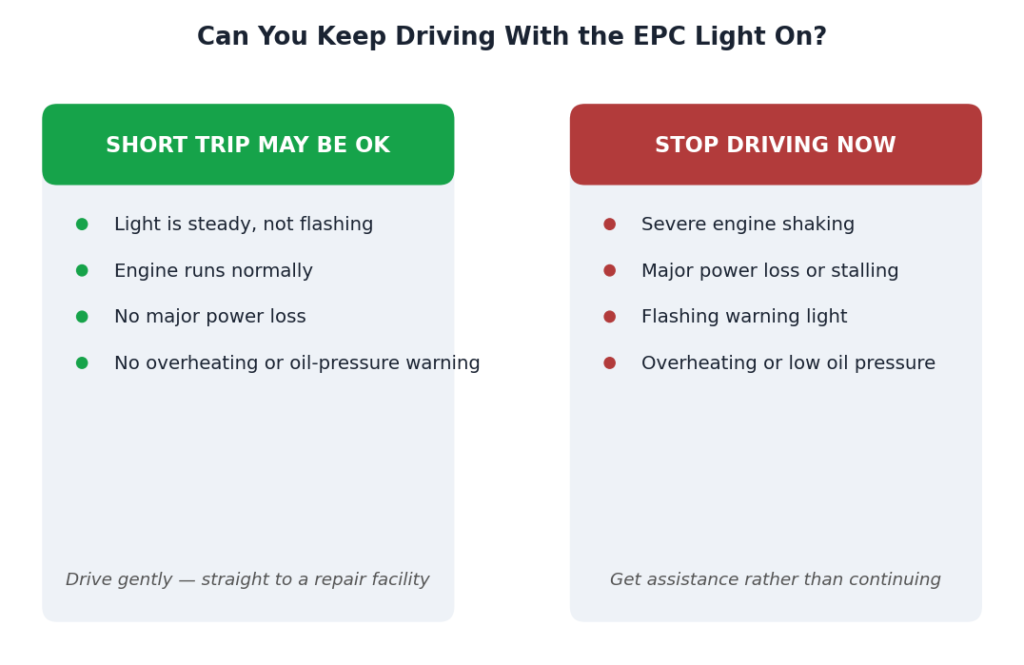
Whether you can continue driving depends on how the vehicle is behaving and what other warning lights are present.
An EPC light with no obvious symptoms may allow limited driving to a repair facility in some cases.
But that does not mean the vehicle should be used normally for days or weeks without diagnosis.
When Short-Distance Driving May Be Reasonable
If the EPC light is steady, the engine runs normally, there is no severe loss of power, no overheating, no oil-pressure warning, and no dangerous drivability problem, a short trip to a repair facility may be reasonable.
Drive gently.
Avoid hard acceleration and unnecessary high engine loads.
Watch the instrument cluster for changes.
If the vehicle begins shaking, loses substantial power, stalls, overheats, or develops another serious warning, stop driving.
When You Should Stop Driving
Do not continue driving simply because the vehicle still moves.
Stop as soon as safely possible if you experience:
- Severe engine shaking
- Major loss of power
- Repeated stalling
- Flashing engine warning light
- Overheating
- Low oil-pressure warning
- Serious brake problems
- Smoke or burning smell
- Unusual mechanical noises
Volkswagen’s warning-light guidance distinguishes between less urgent amber warnings and situations where immediate stopping is required, depending on the specific warning and vehicle behavior.
The EPC symbol itself does not provide enough information to make a universal driving recommendation.
How Much Does An EPC Repair Cost?
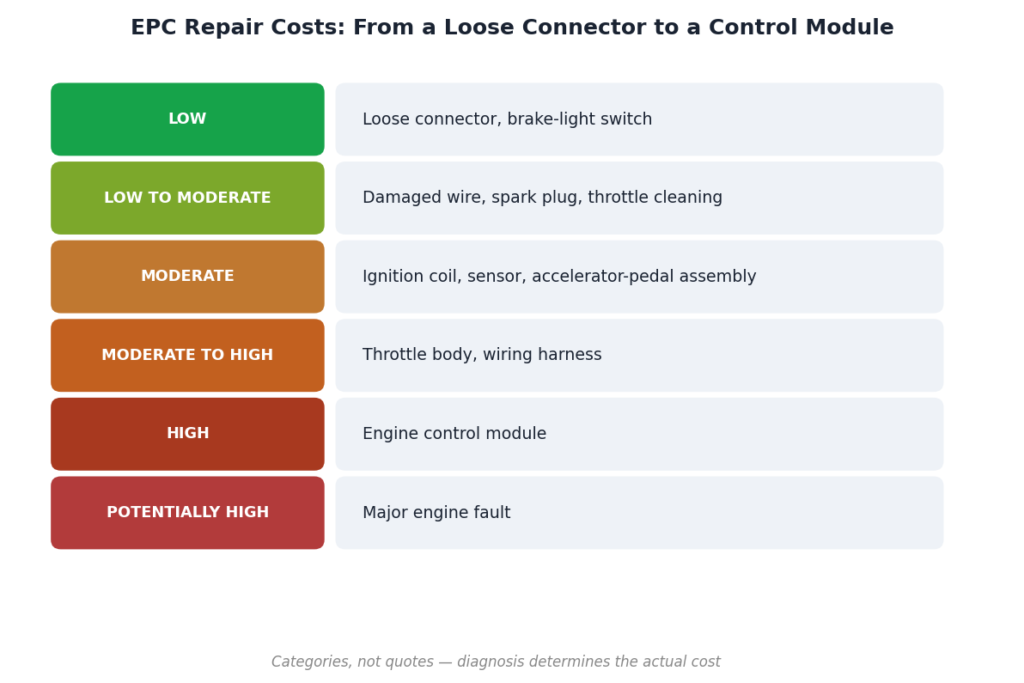
The cost can range from a relatively small electrical repair to a much more expensive electronic or engine-management component.
There is no meaningful single “EPC repair price.”
The diagnosis determines the cost.
| Possible Cause | Typical Repair Category |
|---|---|
| Loose Connector | Low |
| Damaged Wire | Low To Moderate |
| Brake Switch | Low |
| Spark Plug | Low To Moderate |
| Ignition Coil | Moderate |
| Sensor | Moderate |
| Throttle Cleaning | Low To Moderate |
| Throttle Body | Moderate To High |
| Accelerator Pedal Assembly | Moderate |
| Wiring Harness | Moderate To High |
| Engine Control Module | High |
| Major Engine Fault | Potentially High |
These are relative categories rather than guaranteed prices.
Labor rates, vehicle model, engine configuration, part availability, location, and diagnostic complexity can change the final bill substantially.
Why Diagnosis Can Save Money
Suppose an EPC light is caused by a damaged wire.
Replacing a throttle body could cost several times more than repairing the wiring.
Likewise, a low-voltage condition could cause several electronic fault codes.
Replacing individual sensors without checking the battery and charging system would not address the real problem.
Good diagnosis reduces unnecessary parts replacement.
EPC Light After Battery Replacement Or Jump-Starting
Sometimes EPC and other warning lights appear after battery-related work.
This can happen because modern vehicles contain numerous electronic control modules.
A battery disconnect can cause certain systems to lose learned values or require initialization.
Voltage fluctuations during a weak-battery condition can also produce temporary fault codes.
If the EPC warning appeared immediately after battery replacement, first confirm:
- Battery terminals are tight
- Correct battery type is installed
- Battery voltage is normal
- Charging voltage is normal
- Relevant vehicle settings were restored
- Any required adaptations were completed
Do not assume that the battery caused the EPC warning simply because the timing was similar.
A pre-existing problem can become noticeable after a voltage event.
EPC Light After Throttle Body Cleaning
Throttle-body cleaning deserves special attention.
If the throttle plate was cleaned recently and the EPC warning appeared afterward, check whether the electrical connector was properly connected and whether the throttle assembly was disturbed.
Some vehicles require a throttle adaptation procedure after certain repairs or cleaning operations.
The correct process varies by vehicle.
Do not repeatedly press the accelerator or disconnect the battery in an attempt to force the system to relearn.
Use the manufacturer’s procedure whenever possible.
EPC Vs. Limp Mode
EPC and limp mode are related concepts, but they are not the same thing.
EPC is a warning indicating an electronic power-control or engine-control malfunction.
Limp mode is a protective operating strategy that can limit vehicle performance.
An EPC problem can cause reduced-power operation, but not every EPC warning necessarily means the vehicle has entered limp mode.
Likewise, reduced power can occur for reasons that are not directly described by the EPC symbol.
The diagnostic codes are what connect the warning to the underlying problem.
A Practical EPC Troubleshooting Checklist
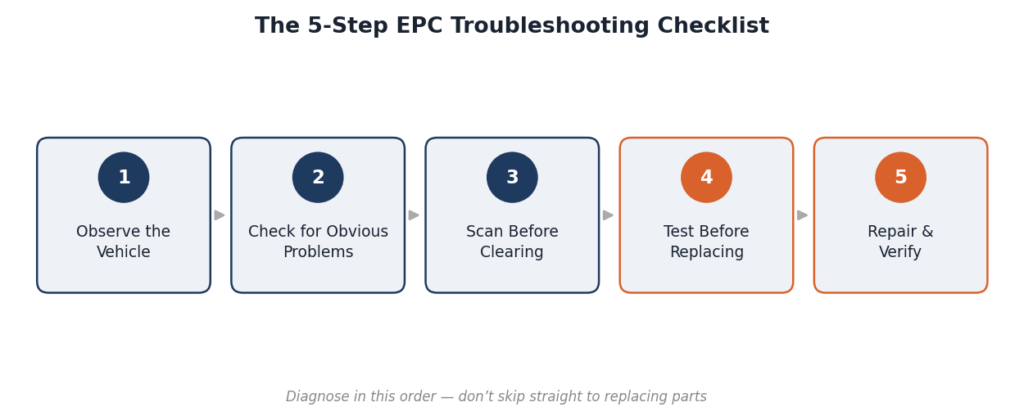
When an EPC warning appears, use a structured process rather than guessing.
First: Observe The Vehicle
Ask:
- Is the engine running smoothly?
- Does the accelerator respond normally?
- Is the vehicle noticeably down on power?
- Is the engine shaking?
- Did the warning appear during startup or while driving?
- Are other warning lights illuminated?
These details help establish the severity.
Second: Check For Obvious Problems
Inspect the engine compartment for:
- Loose connectors
- Disconnected hoses
- Damaged wiring
- Broken intake pipes
- Battery-terminal problems
- Signs of water intrusion
Do not touch hot engine components.
Third: Scan Before Clearing
Read the diagnostic codes.
Write them down.
Do not erase them until they have been documented.
If possible, save freeze-frame information.
Fourth: Test Before Replacing
Use the code as a direction for diagnosis.
Check the associated sensor, circuit, connector, power supply, and mechanical component.
Fifth: Repair And Verify
After repairing the actual cause, clear the relevant codes using appropriate diagnostic equipment if required.
Then perform any necessary adaptations.
Road-test the vehicle carefully and confirm that the fault does not return.
Frequently Asked Questions
What Does EPC Mean On A Car?
EPC means Electronic Power Control. It is a warning associated with electronically controlled engine-power management. Volkswagen identifies the EPC warning as an engine-control malfunction. The exact cause can vary by vehicle and may involve the throttle body, accelerator pedal, brake switch, sensors, wiring, ignition system, or another engine-control component.
Is It Safe To Drive With The EPC Light On?
It depends on the vehicle’s symptoms. If the light is steady and the vehicle runs normally, a short trip for diagnosis may be possible in some circumstances. However, severe power loss, engine shaking, stalling, overheating, or other serious warnings should be treated as reasons to stop driving and seek assistance.
Can A Bad Battery Cause The EPC Light?
A weak battery or charging-system problem can sometimes contribute to electronic warning lights and stored faults because control modules require stable electrical power. However, the EPC warning should not automatically be blamed on the battery. Battery and charging voltage should be tested before replacing other components.
Can I Reset The EPC Light Myself?
You can sometimes clear a stored fault with a suitable diagnostic scanner after repairing the underlying problem. Disconnecting the battery is not a reliable universal EPC reset method. It can also erase useful diagnostic information or cause other vehicle systems to require initialization. Finding and repairing the cause is more important than simply turning the warning off.
Does EPC Mean The Throttle Body Is Bad?
No. A throttle-body fault is one possible cause, but EPC can be triggered by many different problems. Accelerator-pedal sensors, brake switches, engine sensors, ignition faults, wiring, voltage problems, and other control-system issues can also be involved. Diagnostic trouble codes and testing are needed before replacing the throttle body.
How Much Does It Cost To Fix An EPC Light?
There is no standard EPC repair cost because EPC describes a system warning rather than one failed component. A simple brake switch or wiring repair can be relatively inexpensive, while a throttle body, accelerator-pedal assembly, wiring harness, or engine-control module can cost considerably more. The diagnostic result determines the repair.
Final Thoughts
The EPC warning light can look alarming because it is connected to one of the vehicle’s most important electronic control systems.
But the symbol itself does not tell you which component has failed.
EPC means Electronic Power Control, and the warning generally indicates that the vehicle has detected a problem in electronic engine or power management. Volkswagen’s current dashboard guidance specifically identifies the EPC indicator as an engine-control malfunction and emphasizes that warning-light behavior can vary by model.
The most useful response is therefore not to guess at a replacement part.
Start with the vehicle’s symptoms.
Check the battery and obvious electrical connections.
Retrieve the diagnostic trouble codes.
Then test the component or circuit identified by the diagnostic information.
An EPC warning caused by a dirty throttle body requires a different repair from one caused by a failed accelerator-pedal sensor, ignition misfire, damaged wiring, or low system voltage.
That is the key distinction that can save both time and money.
Most importantly, do not treat the EPC light as something that should simply be erased. A warning light is information from the vehicle’s control system. Finding out why it appeared is far more valuable than making the symbol disappear.