A Dodge Charger built in 2027 might not have a firing order at all. That single sentence would have sounded absurd to anyone shopping this nameplate a decade ago, back when a thunderous Hemi V8 defined everything the badge stood for.
Three completely different propulsion architectures now share the Charger name: a legacy V8, a brand-new turbocharged inline-six, and a fully electric powertrain with no combustion cycle whatsoever. Each one answers the firing order question in a completely different way, if it answers it at all.
Every gas and V6 engine this nameplate has used since 2006, the technical story behind Dodge’s dramatic pivot away from the Hemi, and exactly why an electric Charger breaks this entire conversation wide open all get covered here in complete, current detail.
Firing Order Basics And Why The Charger Is Uniquely Complicated
Firing order describes the exact sequence in which an engine ignites fuel inside each cylinder. Engineers space these combustion events out deliberately around crankshaft rotation, a decision baked into the block design rather than something adjustable after the fact.
Most nameplates stick with one or two engine families for their entire history. The Charger has cycled through more fundamentally different propulsion types in the last three years than most vehicles see across multiple decades.
What Firing Order Actually Controls Inside An Engine
Every cylinder fires at a specific point in crankshaft rotation rather than simple numerical order. A V6 completes one firing event every 120 degrees of rotation, an inline-six fires every 120 degrees as well, and a V8 packs a firing event every 90 degrees.
That spacing exists to keep vibration low and distribute mechanical stress evenly across bearings, mounts, and the crankshaft itself. Get this sequence wrong, whether through a genuine mechanical fault or crossed wiring on an older engine, and the result is rough running, wasted fuel, and accelerated wear.
Every gasoline Charger built since 2006 uses coil-on-plug ignition rather than a distributor and plug wires. The engine control module fires each coil individually, timed against crankshaft and camshaft sensor data, which places firing order logic inside software rather than a physical harness that could be crossed by mistake.
Diagnostic trouble codes still follow the classic pattern regardless of engine type. P0301 identifies cylinder one, P0302 identifies cylinder two, and so on through the highest cylinder count present, always referring to physical position rather than firing sequence.
Three Completely Different Propulsion Types Under One Badge
Chargers built from 2006 through 2023 relied on a mix of V6 and Hemi V8 engines, all sharing coil-on-plug ignition and a genuinely traditional combustion approach. That era ended when Dodge discontinued the LX and LD platform Charger after a farewell run of special editions in 2023.
An entirely new Charger arrived shortly after, initially sold exclusively as the all-electric Daytona. Built on a new dedicated platform, this version introduced two-door and four-door body styles for the first time in the nameplate’s modern history, alongside a dual electric motor system producing serious horsepower without a single spark plug involved.
Weak commercial demand for the electric-only lineup pushed Dodge toward a genuine change of plans. A twin-turbocharged inline-six engine, badged Sixpack, joined the Charger lineup for the 2026 model year, giving buyers a gasoline option again for the first time since the old Hemi disappeared.
That three-way split, V8-era history, a brand-new inline-six, and a fully electric option, means a single firing order answer simply doesn’t exist for this nameplate anymore. Confirming exactly which era and engine applies comes before anything else.
V6 And Hemi V8 Firing Order From 2006 Through 2023
The traditional Charger era offered a genuinely wide spread of engine choices across nearly two decades, yet the firing order picture stays remarkably consistent once split into just two families. Every V6 shares one sequence, and every Hemi V8 shares another.
That consistency makes the older Charger a far more approachable research topic than the current, rapidly evolving lineup.
2.7L And 3.5L V6 Firing Order In Early Chargers
The first modern Charger launched for 2006 with a 2.7-liter V6 as the base engine on SE trim, producing a modest 190 horsepower. An upgraded 3.5-liter V6, rated at 250 horsepower, served SXT and other mid-range trims through the 2010 model year.
Both engines share an identical 1-2-3-4-5-6 firing order, part of a broader family of older Chrysler V6 engines that also included 3.0-liter and 3.3-liter minivan variants of the same basic design lineage. Cylinder numbering follows the standard convention for this engine family, with odd numbers on one bank and even numbers on the opposite bank, both running front to rear.
Neither engine carried forward once Chrysler’s all-new Pentastar V6 arrived, and both are now found almost exclusively in early, high-mileage first-generation Chargers still on the road today. Parts availability has narrowed considerably compared to the V6 engines that followed.
Owners of these early V6 Chargers benefit from confirming the exact engine code before ordering ignition components, since visual similarities between the 2.7-liter and 3.5-liter can make casual identification unreliable without checking a build sheet or VIN.
Pentastar V6 Firing Order From 2011 Onward
Chrysler’s all-new 3.6-liter Pentastar V6 replaced both older V6 options starting with the 2011 model year refresh, continuing as the Charger’s standard engine all the way through the final 2023 model year.
This modern, dual-overhead-cam design represented a dramatic technical leap over the engines it replaced.
Its firing order runs 1-2-3-4-5-6, identical numerically to the older 2.7-liter and 3.5-liter engines despite sharing no meaningful architecture with them.
The Pentastar’s 60-degree bank angle makes this simple, sequential pattern possible without the more complex crankshaft counterweighting other V6 designs require.
Cylinder one sits at the front of the passenger-side bank, with cylinders three and five continuing rearward on that same side, while the driver’s side holds cylinders two, four, and six in matching order.
This same engine and firing order pattern powers a remarkably wide range of other Stellantis vehicles built during the same period, from the Jeep Wrangler to the Chrysler Pacifica minivan.
Output climbed modestly over the Pentastar’s long Charger run, eventually reaching around 300 horsepower in its final applications. That consistency across thirteen model years makes this the single most common firing order question for anyone researching a traditional gasoline Charger built after 2010.
Hemi V8 Firing Order Across Every Displacement
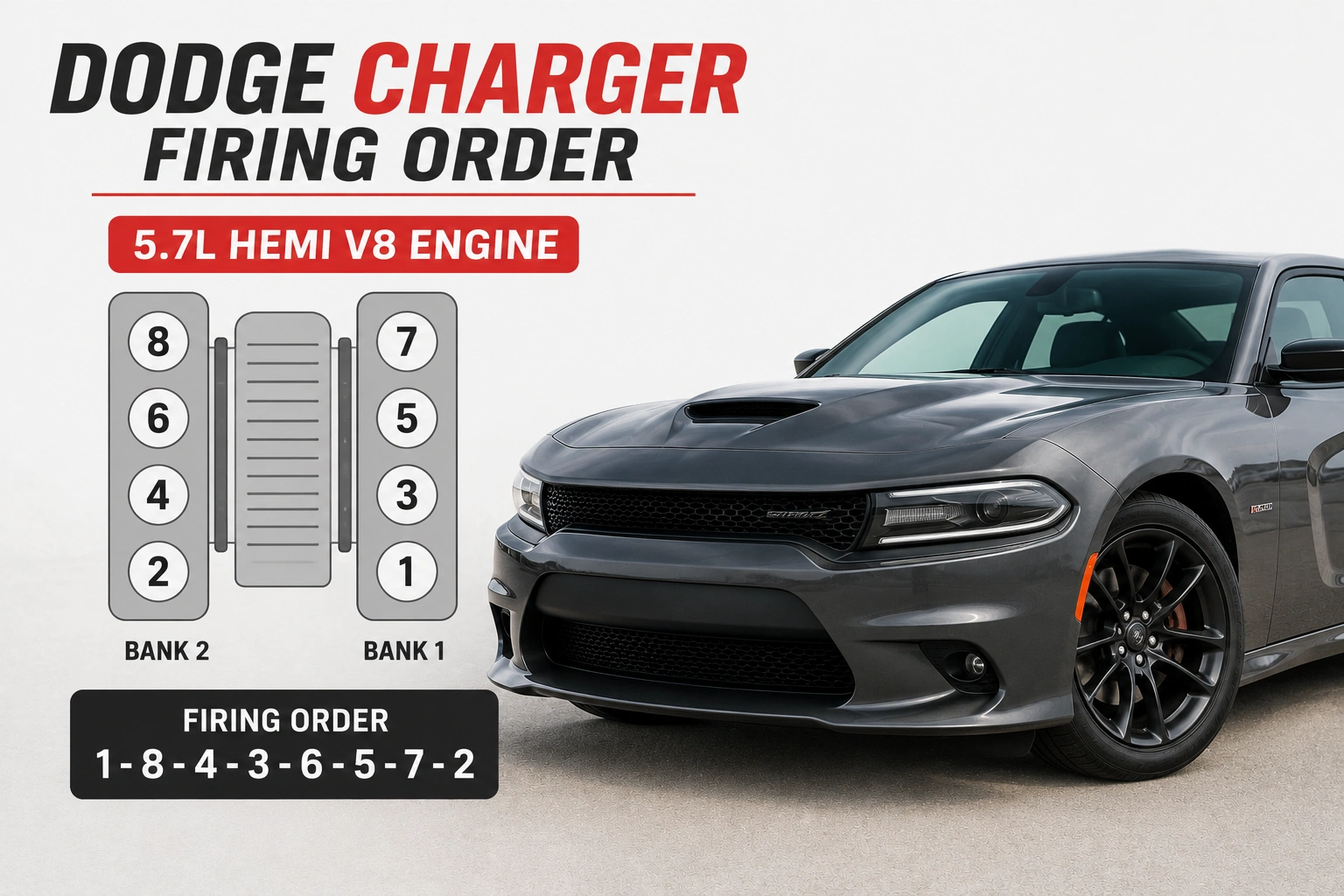
Every Hemi-powered Charger, regardless of displacement or performance tier, shares an identical 1-8-4-3-6-5-7-2 firing order. This includes the 5.7-liter R/T engine offered throughout the entire 2006 through 2023 run, the 6.1-liter SRT8 used from 2006 through 2010, and the 6.4-liter engine, often called the 392, that replaced it starting in 2011.
That sequence traces back to Chrysler’s own long-standing V8 firing order convention, a pattern the company never abandoned even as rival manufacturers revised theirs. General Motors famously changed its small-block V8 firing order when developing the modern LS engine family, but Chrysler’s Hemi kept the traditional sequence throughout its entire modern production run.
Supercharged variants follow the identical pattern despite dramatically higher output. The 6.2-liter Hellcat, introduced for 2015, along with the even more powerful Hellcat Redeye and limited-run special editions that closed out Charger production in 2023, all fire in the same 1-8-4-3-6-5-7-2 sequence as the naturally aspirated 5.7-liter sharing showroom space with them.
Cylinder numbering on every Hemi differs from the Pentastar V6 in a way worth remembering clearly. Cylinder one sits on the driver’s side bank rather than the passenger side, with the passenger side instead holding the even-numbered cylinders, a genuine reversal from the V6 convention covered in the previous section.
Here’s how the traditional-era lineup compares:
| Engine | Model Years | Type | Firing Order |
| 2.7L / 3.5L V6 | 2006-2010 | Base / SXT | 1-2-3-4-5-6 |
| 3.6L Pentastar V6 | 2011-2023 | Base / SXT | 1-2-3-4-5-6 |
| 5.7L Hemi V8 | 2006-2023 | R/T | 1-8-4-3-6-5-7-2 |
| 6.1L / 6.4L Hemi V8 | 2006-2023 | SRT8 / Scat Pack | 1-8-4-3-6-5-7-2 |
| 6.2L Supercharged Hemi | 2015-2023 | Hellcat / Redeye | 1-8-4-3-6-5-7-2 |
The Hurricane Inline-Six And A Genuinely New Firing Order
Nothing in the Charger’s traditional engine lineup prepared owners for what replaced the Hemi. A completely new engine architecture, developed from scratch over more than a decade, introduced a cylinder layout this nameplate had never used before.
Understanding why Dodge made this switch explains the technical details that follow far better than the specifications alone.
Why Dodge Walked Away From The Hemi
Stellantis engineers began developing what became the Hurricane engine as early as 2009, initially conceived as a response to rival turbocharged six-cylinder engines gaining ground against traditional V8s.
The finished design debuted publicly in 2022, first appearing in the Jeep Grand Wagoneer before reaching Ram trucks and, eventually, the Dodge Charger.
Regulatory pressure played a genuine role in this transition alongside pure engineering ambition.
Tightening fuel economy requirements made a smaller, more efficient engine increasingly attractive for a high-volume performance nameplate, even one built around a reputation for big-displacement V8 sound and power.
Dodge initially launched the reborn Charger as an electric-only Daytona model, betting heavily on that single direction.
Commercial reception fell short of expectations, with buyers slower to embrace a fully electric muscle car than Dodge had anticipated, prompting the company to reintroduce gasoline power far sooner than originally planned.
The Hurricane arrived for the Charger in late 2025, badged Sixpack specifically for this application, giving Dodge a genuine gasoline alternative alongside the electric Daytona rather than forcing buyers into a single propulsion choice.
The Hurricane’s 1-5-3-6-2-4 Sequence Explained
The Sixpack-badged Hurricane is a 3.0-liter twin-turbocharged inline-six, sold in two distinct tunes: a standard-output version producing 420 horsepower for the Charger R/T, and a high-output version producing 550 horsepower for the Scat Pack.
Both share the same fundamental architecture, engineered almost entirely from scratch with less than five percent of content borrowed from any prior Stellantis engine.
Its firing order runs 1-5-3-6-2-4, a completely different pattern from anything covered in the V6 or V8 sections above. This sequence is standard across most inline-six engines throughout the automotive industry, chosen because a straight-six’s naturally balanced design allows this particular firing pattern to minimize vibration without needing a V-shaped block’s more complex crankshaft geometry.
Cylinder numbering follows a simple front-to-rear line, since there’s only one bank to consider on an inline engine. Cylinder one sits at the front nearest the drive belt, with numbers two through six following in sequence back toward the transmission, making physical cylinder identification considerably more straightforward than locating cylinders across two separate banks.
Twin turbochargers add mechanical complexity elsewhere in the engine without touching this firing sequence at all.
Each turbo feeds three cylinders independently, a deliberate engineering choice aimed at reducing lag compared to a single larger turbocharger trying to manage all six cylinders at once.
Why The Electric Daytona Has No Firing Order At All
Every section so far has covered an engine that burns fuel and ignites cylinders in a specific order. The Daytona breaks that pattern entirely, and understanding why matters for anyone researching this specific Charger variant.
This isn’t a case of the firing order being unusual or hard to find. It genuinely doesn’t exist in any meaningful sense.
What Replaces Combustion Timing In An Electric Motor
Electric motors generate rotational force through electromagnetic interaction between a stationary stator and a rotating rotor, a process with no cylinders, no combustion, and no ignition sequence of any kind.
There’s simply nothing to fire in a specific order, since the entire concept depends on burning fuel inside enclosed cylinders.
The Daytona uses dual electric motors, one per axle, delivering power through direct electrical control rather than mechanical timing of any kind. A power inverter manages current flow to each motor continuously and smoothly, a completely different engineering discipline from crankshaft-timed ignition sequencing.
Dodge engineered a synthesized exhaust sound system, marketed as Fratzonic, specifically to recreate some of the auditory character a combustion engine naturally produces.
That system exists purely for driver experience and brand identity, with zero connection to how the vehicle actually generates or delivers power.
Anyone searching for a Daytona-specific firing order should understand this isn’t a gap in available information. The question itself doesn’t apply to this particular Charger variant, the same way asking about a bicycle’s firing order wouldn’t make sense either.
Sorting Out Today’s Multi-Energy Charger Lineup
Current Charger shoppers choose between two fundamentally different propulsion philosophies within the same showroom, something almost no other nameplate offers at this scale.
The Daytona delivers up to 670 horsepower through its electric motors, while the gasoline Sixpack tops out at 550 horsepower through its high-output Hurricane engine.
Both share standard all-wheel drive along with a genuinely useful feature: an on-demand rear-wheel-drive mode that sends full power rearward at the push of a button, useful for burnouts and more spirited driving without permanently sacrificing all-wheel traction for daily use. This shared feature set helps unify two otherwise completely different vehicles under one badge.
Firing order research only applies to half of this current lineup, specifically the Sixpack-badged gasoline models using the Hurricane inline-six.
Anyone shopping or researching a Daytona should redirect that specific question entirely, since motor control and battery management replace everything a firing order conversation would normally cover.
Dodge has signaled this multi-energy approach as a deliberate, ongoing strategy rather than a temporary transition phase. Both propulsion types remain available side by side for the 2027 model year, suggesting this split lineup structure will likely continue rather than consolidating back toward a single engine choice anytime soon.
Practical Diagnosis Across Every Charger Era
None of this technical and historical detail matters much until a check engine light appears or an engine starts running rough. Firing order and cylinder position knowledge turns that vague warning into a specific, targeted repair, at least for the gasoline models where the concept applies.
The sections below apply everything covered so far to real diagnostic work across this nameplate’s unusually varied history.
Matching A Misfire Code To The Right Engine Family
A scan tool reading a P0301 through P0308 code identifies a misfiring cylinder by its physical position, never by where that cylinder falls within the firing sequence itself.
Confirming which engine family sits under the hood comes first, since the same cylinder number occupies a completely different physical location depending on whether a V6, V8, or inline-six is involved.
Once that’s settled, matching the engine against the correct chart from earlier sections points straight to the affected coil, plug, or injector. Swapping a suspect coil with a known-good unit from another cylinder remains a reliable confirmation test across every gasoline engine covered in this guide.
Bank-specific codes deserve particular care given how completely the cylinder layout changes between engine families. A Bank 1 designation on a Pentastar V6 corresponds to the passenger side, while the same designation on a Hemi V8 points to the driver’s side instead, a reversal significant enough to send a misdiagnosis in exactly the wrong direction if overlooked.
The Hurricane inline-six simplifies this particular concern considerably, since a single-bank engine has no bank designation confusion to worry about at all.
Every cylinder sits in one straight line, removing an entire category of diagnostic mistake that affects the V6 and V8 engines covered earlier.
Maintenance Habits That Matter Most By Engine Type
Spark plugs and ignition coils on the Pentastar V6 typically last well beyond 60,000 miles under normal conditions, a maintenance interval that has held steady across this engine’s entire Charger production run.
Hemi V8 owners should watch for known rocker arm and lifter concerns on higher-mileage examples, issues that can produce symptoms resembling a firing order problem even though the underlying cause sits elsewhere entirely.
The Hurricane’s twin-turbo design places extra importance on oil quality and change intervals, since turbocharger bearings depend heavily on clean, properly rated synthetic oil to avoid premature wear.
This engine’s high-pressure direct injection system also benefits from periodic intake valve inspection, a concern shared by most modern direct-injected engines regardless of manufacturer.
Daytona owners face an entirely different maintenance conversation centered on battery health, charging habits, and electric motor cooling systems rather than anything resembling traditional ignition service. Comparing maintenance costs or intervals directly between a Daytona and any gasoline Charger requires treating them as genuinely separate vehicles under one shared badge.
Keeping the exact engine type, not just model year, documented in any service record prevents the most common mistake likely to affect this particular nameplate going forward: assuming a repair procedure or parts list from one Charger applies universally to another simply because they share a name.
A quick reference for common symptoms across the gasoline lineup:
| Symptom | Likely Cause | Applies To |
| Rough idle, specific cylinder code | Failing coil, plug, or injector | All gasoline engines |
| Ticking noise from top of engine | Rocker arm or lifter wear | 5.7L, 6.1L, 6.4L Hemi V8 |
| Misfire under boost or load | Turbocharger or intake concern | 3.0L Hurricane inline-six |
| Confusing Bank 1 sensor code | Wrong bank assumption for the engine | Cross-referencing V6 versus V8 |
Frequently Asked Questions
What is the firing order of a Dodge Charger 3.6 Pentastar V6?
The Pentastar fires in a 1-2-3-4-5-6 sequence across every model year it appeared in the Charger, from 2011 through the final 2023 gasoline lineup. Cylinder one sits on the passenger-side bank.
What is the firing order of a Dodge Charger Hemi V8?
Every Hemi, from the base 5.7-liter through the supercharged Hellcat variants, shares an identical 1-8-4-3-6-5-7-2 firing order. Cylinder one sits on the driver’s side bank, opposite the V6 convention.
Does the new Hurricane inline-six use the same firing order as the Hemi?
No, the Hurricane fires in a completely different 1-5-3-6-2-4 sequence, standard for most inline-six engines industry-wide. This reflects its single-bank layout rather than the two-bank arrangement used by any V6 or V8 Charger engine.
Does the electric Charger Daytona have a firing order?
No, electric motors have no cylinders, combustion, or ignition sequence of any kind, so the concept simply doesn’t apply. Any firing order research only concerns the gasoline Sixpack models in the current lineup.
Can I still buy a V8 Dodge Charger?
No, Dodge discontinued the Hemi V8 Charger after the 2023 model year. Current gasoline models use the twin-turbo Hurricane inline-six instead, alongside the separate all-electric Daytona option.
Where can I confirm the exact firing order for my specific Dodge Charger?
A factory service manual matched to the exact model year and engine code remains the most reliable source. Most auto parts stores can also pull a firing order reference free of charge once given the vehicle’s VIN.
Three propulsion architectures, two very different combustion firing patterns, and one increasingly common answer of “not applicable” now all coexist under a single, badge that once meant nothing but a thunderous V8. A Pentastar V6 fires 1-2-3-4-5-6, every Hemi fires 1-8-4-3-6-5-7-2, and the new Hurricane fires 1-5-3-6-2-4.
Confirming which era, and which specific engine, sits under a particular Charger’s hood remains the only real starting point for applying any of this information correctly, especially now that roughly half of every new Charger sold doesn’t use combustion at all.