The Chevrolet Tahoe has spent more than two decades as one of the top-selling full-size SUVs in North America, and a big part of its durability story is the engine lineup it has carried across five distinct generations.
From the iron-block Vortec 4800 that launched the 2000 model to the EcoTec3 V8s and 3.0-liter Duramax diesel powering today’s 2026 version, every generation brought something different under the hood. What has remained remarkably consistent across all of them is the firing sequence.
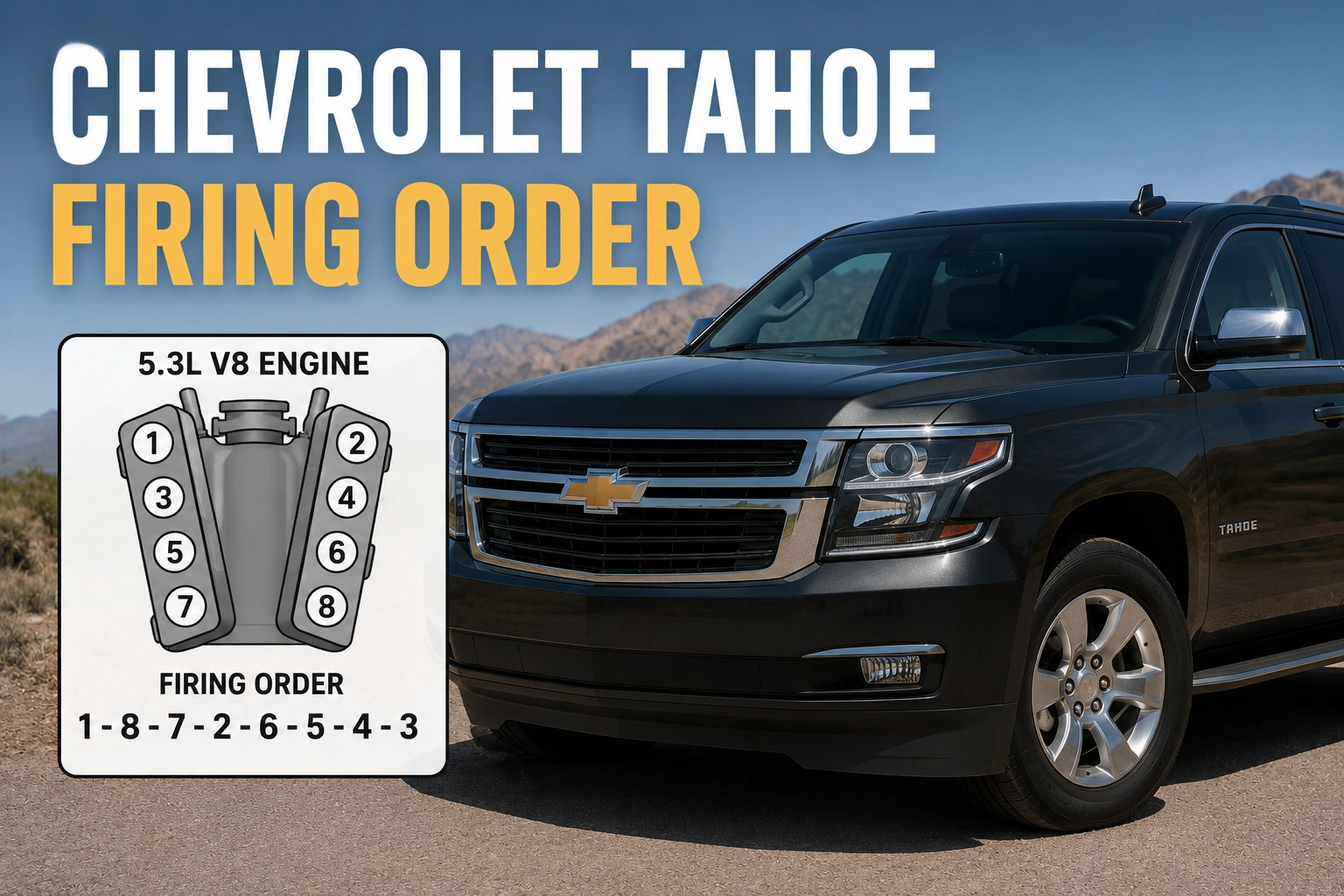
Every gasoline V8 that has ever powered a Tahoe — from the 4.8-liter to the 6.2-liter — uses the same LS-architecture firing order. That consistency is one of the most practically useful facts for anyone servicing one of these trucks.
This guide covers every Tahoe engine from 2000 through 2026, confirming what is the same, what changed with the diesel, and exactly how to read the cylinder layout on any generation.
Why The LS Firing Order Stays Consistent Across Every Tahoe V8
Every V8 engine that General Motors installed in the Chevrolet Tahoe from 2000 onward belongs to the LS engine architecture family — either Gen III, Gen IV, or Gen V depending on the production year.
These three generations of LS engines share the same crankshaft throw arrangement at 90-degree intervals, the same cylinder numbering convention, and the same firing sequence.
The LS firing order of 1-8-7-2-6-5-4-3 was established at the engine family’s launch in 1997. It differs from the older traditional Chevy small-block sequence of 1-8-4-3-6-5-7-2 — a change GM made deliberately when designing the LS crankshaft.
The new sequence distributes combustion events more evenly around the crankshaft, reducing the torque pulse irregularity that contributed to vibration in the earlier small-blocks. GM built this sequence improvement directly into the crank pin geometry, which is why it has remained unchanged across every LS V8 regardless of displacement — 4.8, 5.3, 6.0, or 6.2 liters all fire in exactly the same sequence.
This is genuinely useful information for Tahoe owners. Any technician who has serviced an LS engine in any application — a Silverado, a Suburban, a Corvette, a Camaro — is already working with the same sequence when they open a Tahoe hood. The displacement changes between generations but the firing sequence does not.
The One Exception — The 3.0-Liter Duramax Diesel
Starting with the fifth-generation Tahoe in 2021 and continuing through 2026, GM added an inline-six turbodiesel as an option alongside the two gasoline V8s.
This engine breaks the pattern because it is a completely different architecture — six cylinders in a straight line rather than eight in a V configuration, and diesel combustion rather than spark ignition.
The 3.0-liter Duramax LM2 uses a fuel injector firing sequence of 1-5-3-6-2-4. This is the standard firing pattern for an inline-six engine.
There are no spark plugs in a diesel — the injector sequence is the equivalent term for a diesel engine’s combustion order. Glow plugs are present only for cold-start assist, not for ongoing ignition.
Anyone who has serviced gasoline Tahoe engines and is encountering the diesel for the first time will notice immediately that nothing about the firing sequence, the cylinder layout, or the ignition system concept carries over.
The diesel’s six cylinders run in a straight row from front to rear, numbered 1 through 6. Cylinder 1 is at the front. The 1-5-3-6-2-4 injector sequence ensures no two adjacent cylinders fire consecutively, keeping combustion forces evenly distributed along the crankshaft.
Generation-By-Generation Engine And Firing Order Breakdown
Second Generation (2000–2006) — The Launch Of LS V8 Power In The Tahoe
The 2000 Tahoe moved from the GMT400 platform to the all-new GMT800 and brought the LS engine family with it. Two V8 options were available, both representing a major departure from the outgoing Vortec 5700 small-block.
4.8-Liter LR4 Vortec V8 (2000–2006)
- Firing Order: 1-8-7-2-6-5-4-3
- Engine Architecture: Gen III LS, iron block
- Output: 270–285 hp (increased over production run)
- Ignition System: Coil-near-plug (no distributor)
- Cylinder 1: Front of driver’s side bank
- Driver’s side bank (front to rear): 1, 3, 5, 7
- Passenger’s side bank (front to rear): 2, 4, 6, 8
- Spark Plug Gap: 0.060 inches
The 4.8-liter was the base engine for the 2000–2006 Tahoe. It introduced the coil-near-plug ignition system to the platform — individual coil packs for each cylinder with short plug wires, replacing the distributor of the previous generation entirely.
Each coil serves one cylinder, which means a coil failure produces a single-cylinder misfire rather than the multi-cylinder misfires that plagued distributor systems when their cap or rotor failed.
The LR4 was retired after 2006 for the Tahoe specifically, though it continued in other GM applications for another year. For owners of this generation, knowing that cylinder 1 is at the front left (driver’s side, front of the bank) is the essential anchor point for any ignition service.
5.3-Liter LM7/L59 Vortec V8 (2000–2006)
- Firing Order: 1-8-7-2-6-5-4-3
- Engine Architecture: Gen III LS, iron block (LM7) or flex-fuel capable (L59)
- Output: 285–295 hp depending on year
- Ignition: Coil-near-plug
- Cylinder layout: Identical to LR4
The 5.3-liter LM7 was the more popular engine choice from the start. It delivered the better power-to-efficiency balance that most Tahoe buyers wanted, and its Gen III architecture proved extremely durable. Owners regularly report these engines surpassing 200,000 miles with standard maintenance.
The L59 variant added E85 flex-fuel capability — the hardware is otherwise identical to the LM7, including the firing sequence and cylinder layout.
6.0-Liter LQ4 Vortec V8 (Tahoe SS, 2002–2006)
- Firing Order: 1-8-7-2-6-5-4-3
- Engine Architecture: Gen III LS, iron block
- Output: 345 hp
- Application: Tahoe SS performance model
- Cylinder layout: Identical to 4.8L and 5.3L
The LQ4 appeared in the Tahoe SS, which was a factory performance version produced in limited numbers. The 6.0-liter used the same block architecture and the same 1-8-7-2-6-5-4-3 sequence as the smaller displacements.
The only significant difference is displacement — achieved through a longer stroke — not any change to the ignition sequence or cylinder numbering.
Third Generation (2007–2014) — Gen IV LS Engines And The 6.2-Liter Addition
The 2007 Tahoe moved to the GMT900 platform with comprehensively updated LS engines — all Gen IV, which added Variable Valve Timing and in some cases Active Fuel Management.
4.8-Liter LC9 V8 (2007–2013)
- Firing Order: 1-8-7-2-6-5-4-3
- Architecture: Gen IV, updated over LR4
- VVT: Added for 2007
- No AFM on the 4.8-liter — all cylinders always active
The Gen IV 4.8-liter received VVT (Variable Valve Timing) that the Gen III LR4 lacked. VVT adjusts when the intake valves open relative to the crankshaft, optimizing power delivery at different RPM ranges. The firing sequence remained identical.
5.3-Liter LMG/LC9/LY5 V8 (2007–2013)
- Firing Order: 1-8-7-2-6-5-4-3
- Active Fuel Management available (AFM)
- AFM deactivates cylinders 1, 4, 6, and 7 during light load
- VVT standard
- Cylinder layout: Unchanged from Gen III
Active Fuel Management on the Gen IV 5.3-liter is worth specific attention. When AFM activates at highway cruise speed under light throttle, it deactivates four cylinders by collapsing the lifters on those cylinders’ valves and suspending fuel injection to them.
The firing order does not change — the ECM simply omits those cylinders within the same 1-8-7-2-6-5-4-3 sequence. When AFM is active, only cylinders 2, 3, 5, and 8 fire in their normal positions within the rotation.
This is important for diagnosis. AFM-related misfires — from collapsed lifters, worn AFM solenoids, or degraded oil — show as misfires specifically on cylinders 1, 4, 6, and 7. When all four of these codes appear together, AFM hardware is almost always the cause rather than coil or plug failure.
6.0-Liter L96/LY6 V8 (2007–2014)
- Firing Order: 1-8-7-2-6-5-4-3
- Available in Tahoe Hybrid (LFA variant paired with electric drive)
- VVT standard
- Cylinder layout: Unchanged
The 6.0-liter in the third-generation Tahoe was also the heart of the Two-Mode Hybrid system offered from 2008. In the hybrid application, the 6.0-liter LFA worked alongside two 60kW electric motors integrated into the transmission.
The firing order and cylinder arrangement remained standard LS configuration regardless of hybrid or non-hybrid specification.
6.2-Liter L9H V8 (2009–2014)
- Firing Order: 1-8-7-2-6-5-4-3
- Output: 395–403 hp
- First appearance of 6.2-liter in Tahoe (previously Denali exclusive)
- AFM available on some configurations
- Cylinder layout: Identical to all other Tahoe V8s
The 6.2-liter arrived as a Tahoe LTZ option in 2009 after being exclusive to the Yukon Denali. It is the same firing sequence and cylinder arrangement as every other LS V8 in the platform.
The higher displacement comes from both a larger bore and longer stroke, not from any change to the combustion sequencing.
Fourth Generation (2015–2020) — EcoTec3 Architecture
The 2015 Tahoe moved to the GMT K2XX platform with the new EcoTec3 engine generation. All gasoline engines are Gen V LS architecture, adding Direct Injection (DI) to the existing VVT and AFM capabilities.
5.3-Liter L83/L82 EcoTec3 V8 (2015–2020)
- Firing Order: 1-8-7-2-6-5-4-3
- DI + VVT + AFM
- Output: 355 hp / 383 lb-ft
- Ignition: Coil-on-plug (fully integrated, no separate wire)
- Cylinder layout: Unchanged — driver’s side odds, passenger’s side evens
The EcoTec3 5.3-liter changed the ignition hardware from coil-near-plug (used through 2014) to true coil-on-plug. Each coil now sits directly on the spark plug with no wire between them.
The difference for diagnosis is that a coil failure on a coil-on-plug engine produces zero electrical leakage — either the coil fires fully or it does not. There is no intermediate state from wire insulation breakdown.
Direct injection on the EcoTec3 also introduced the intake valve carbon deposit issue common to all GDI engines. Because fuel is injected directly into the cylinder rather than through the intake port, the intake valves receive no fuel washing on each intake stroke.
Oil vapors from the PCV system deposit on the valve backs without being cleaned away. On high-mileage EcoTec3 engines — typically above 80,000 to 100,000 miles — these deposits begin affecting combustion quality, producing rough idle and hesitation that looks like a misfire but does not generate consistent cylinder-specific codes.
6.2-Liter L86 EcoTec3 V8 (2015–2020)
- Firing Order: 1-8-7-2-6-5-4-3
- Output: 420 hp / 460 lb-ft
- DI + VVT + AFM
- 8-speed automatic transmission paired
- Cylinder layout: Identical to all Tahoe V8s
Fifth Generation (2021–2026) — Three Engine Options Including Diesel
The fifth-generation Tahoe arrived for 2021 on the T1 platform with independent rear suspension (a first for the model) and expanded engine options. For 2021 through 2026, three powertrains are available.
5.3-Liter L84 EcoTec3 V8 (2021–2026)
- Firing Order: 1-8-7-2-6-5-4-3
- Output: 355 hp / 383 lb-ft
- Dynamic Fuel Management (DFM) replaces AFM
- DFM can deactivate any combination of cylinders, not just the fixed AFM pattern
- Coil-on-plug ignition
- Cylinder layout: Unchanged from all previous LS V8s
DFM on the fifth-generation 5.3-liter is a more sophisticated deactivation system than AFM. Where AFM could only deactivate the fixed set of cylinders 1, 4, 6, and 7, DFM can run the engine on any combination from 1 to 7 active cylinders depending on the exact load demand. This flexibility improves efficiency but also changes how DFM-related misfires present — they do not always show the same four-cylinder pattern that made AFM problems identifiable.
6.2-Liter L87 EcoTec3 V8 (2021–2026)
- Firing Order: 1-8-7-2-6-5-4-3
- Output: 420 hp / 460 lb-ft
- DFM + VVT + DI
- 10-speed automatic transmission standard
- Cylinder layout: Identical to all previous Tahoe V8s
3.0-Liter LM2/LZ0 Duramax Diesel (2021–2026)
- Fuel Injector Firing Sequence: 1-5-3-6-2-4
- Engine Architecture: Turbocharged DOHC inline-six diesel
- Output: 277–305 hp depending on year; 460–495 lb-ft torque
- Cylinder Layout: Six cylinders in a straight row, front to rear
- Cylinder 1: Frontmost, closest to the accessory belt
- No spark plugs — diesel compression ignition
- Glow plugs for cold-start assist only
- Injection Pressure: Up to 36,260 psi (2,500 bar) common rail
The LM2 was updated to LZ0 for 2023, bringing power to 305 hp and 495 lb-ft of torque. The firing sequence remained 1-5-3-6-2-4 through the update.
Complete Reference Table — All Tahoe Engines 2000–2026
| Generation | Model Years | Engine | Displacement | Firing Order | Ignition | Cylinder 1 Location |
| 2nd Gen GMT800 | 2000–2006 | LR4 Vortec | 4.8L V8 | 1-8-7-2-6-5-4-3 | Coil-near-plug | Front, driver’s side |
| 2nd Gen GMT800 | 2000–2006 | LM7/L59 Vortec | 5.3L V8 | 1-8-7-2-6-5-4-3 | Coil-near-plug | Front, driver’s side |
| 2nd Gen GMT800 | 2002–2006 | LQ4 Vortec | 6.0L V8 | 1-8-7-2-6-5-4-3 | Coil-near-plug | Front, driver’s side |
| 3rd Gen GMT900 | 2007–2013 | LC9 Vortec | 4.8L V8 | 1-8-7-2-6-5-4-3 | Coil-near-plug | Front, driver’s side |
| 3rd Gen GMT900 | 2007–2013 | LMG/LC9 Vortec | 5.3L V8 | 1-8-7-2-6-5-4-3 | Coil-near-plug | Front, driver’s side |
| 3rd Gen GMT900 | 2007–2014 | LY6/L96 Vortec | 6.0L V8 | 1-8-7-2-6-5-4-3 | Coil-near-plug | Front, driver’s side |
| 3rd Gen GMT900 | 2009–2014 | L9H | 6.2L V8 | 1-8-7-2-6-5-4-3 | Coil-near-plug | Front, driver’s side |
| 4th Gen K2XX | 2015–2020 | L83/L82 EcoTec3 | 5.3L V8 | 1-8-7-2-6-5-4-3 | Coil-on-plug | Front, driver’s side |
| 4th Gen K2XX | 2015–2020 | L86 EcoTec3 | 6.2L V8 | 1-8-7-2-6-5-4-3 | Coil-on-plug | Front, driver’s side |
| 5th Gen T1 | 2021–2026 | L84 EcoTec3 | 5.3L V8 | 1-8-7-2-6-5-4-3 | Coil-on-plug | Front, driver’s side |
| 5th Gen T1 | 2021–2026 | L87 EcoTec3 | 6.2L V8 | 1-8-7-2-6-5-4-3 | Coil-on-plug | Front, driver’s side |
| 5th Gen T1 | 2021–2026 | LM2/LZ0 Duramax | 3.0L I6 diesel | 1-5-3-6-2-4 | Diesel injection | Front, inline |
Cylinder Layout — Confirmed For Every Tahoe V8
The cylinder numbering on every LS-based Tahoe V8 follows this layout without exception across all generations from 2000 through 2026.
Driver’s Side Bank (Bank 1 — odd cylinders):
- Cylinder 1 — front of engine
- Cylinder 3 — second position back
- Cylinder 5 — third position back
- Cylinder 7 — rear of this bank
Passenger’s Side Bank (Bank 2 — even cylinders):
- Cylinder 2 — front of engine
- Cylinder 4 — second position back
- Cylinder 6 — third position back
- Cylinder 8 — rear of this bank
This layout means OBD-II misfire codes map directly to physical locations. P0301 = cylinder 1, front driver’s side. P0308 = cylinder 8, rear passenger’s side. No calculation needed once the layout is memorized.
Spark Plug Specifications By Generation
| Engine | Code | Gap | OEM Plug | Torque | Interval |
| 4.8L Vortec Gen III | LR4 | 0.060 in | ACDelco 41-985 | 11–15 ft-lb | 30,000 mi |
| 5.3L Vortec Gen III | LM7/L59 | 0.060 in | ACDelco 41-985 | 11–15 ft-lb | 30,000 mi |
| 6.0L Vortec Gen III | LQ4 | 0.060 in | ACDelco 41-985 | 11–15 ft-lb | 30,000 mi |
| 4.8L Vortec Gen IV | LC9 | 0.040 in | ACDelco 41-985 | 11–15 ft-lb | 100,000 mi |
| 5.3L Vortec Gen IV | LMG/LC9 | 0.040 in | ACDelco 41-985 | 11–15 ft-lb | 100,000 mi |
| 6.0L Vortec Gen IV | LY6 | 0.040 in | ACDelco 41-985 | 11–15 ft-lb | 100,000 mi |
| 6.2L V8 Gen IV | L9H | 0.040 in | ACDelco 41-985 | 11–15 ft-lb | 100,000 mi |
| 5.3L EcoTec3 Gen V | L83/L82/L84 | Pre-gapped | ACDelco 41-110 | 11 ft-lb | 97,500 mi |
| 6.2L EcoTec3 Gen V | L86/L87 | Pre-gapped | ACDelco 41-110 | 11 ft-lb | 97,500 mi |
| 3.0L Duramax | LM2/LZ0 | N/A (diesel) | Glow plugs only | — | Per service schedule |
Never regap iridium plugs used in the EcoTec3 generation. The center electrode is fragile. An improperly bent electrode can fracture internally and send fragments into the combustion chamber.
Frequently Asked Questions
What is the firing order for a 2005 Chevrolet Tahoe?
The 2005 Tahoe with either the 4.8-liter or 5.3-liter V8 uses a firing order of 1-8-7-2-6-5-4-3. Cylinder 1 is at the front of the driver’s side bank. Driver’s side cylinders run 1, 3, 5, 7 from front to rear. Passenger’s side cylinders run 2, 4, 6, 8 from front to rear. The ignition system is coil-near-plug with one coil per cylinder and a short plug wire.
Is the firing order the same for the 5.3L and 6.2L Tahoe?
Yes. Every LS-based gasoline V8 ever installed in the Chevrolet Tahoe uses the same firing order of 1-8-7-2-6-5-4-3. This applies to all displacements — 4.8, 5.3, 6.0, and 6.2 liters — across all generations from 2000 through 2026. The cylinder numbering layout is also identical: driver’s side houses odd cylinders 1, 3, 5, 7 and passenger’s side houses even cylinders 2, 4, 6, 8.
Does the Tahoe diesel use the same firing order as the V8?
No. The 3.0-liter Duramax diesel available from 2021 onward is an inline-six diesel engine with a completely different configuration and a different firing sequence of 1-5-3-6-2-4. Diesel engines do not have spark plugs or ignition coils — the sequence refers to the order in which fuel injectors fire. Cylinders are numbered 1 through 6 front to rear in a straight row.
Why does my Tahoe have misfires on cylinders 1, 4, 6, and 7 at the same time?
That specific four-cylinder pattern on a 5.3-liter Gen IV Tahoe (2007–2014) is the signature of Active Fuel Management (AFM) hardware failure. Cylinders 1, 4, 6, and 7 are the four cylinders that AFM deactivates. When the AFM lifters collapse unexpectedly, stick in the deactivated position, or the AFM solenoids fail, those four cylinders stop contributing to combustion even when the engine is not in AFM mode. Checking oil condition, oil pressure, and AFM solenoid function are the correct first steps before any coil or plug replacement.
What changed between coil-near-plug and coil-on-plug in Tahoe ignition systems?
Coil-near-plug was used from 2000 through 2014. It mounted each coil near the cylinder valve cover with a short plug wire connecting the coil to the spark plug. Coil-on-plug, introduced with the EcoTec3 generation from 2015 onward, mounts each coil directly on the spark plug with no wire. This eliminates wire degradation as a misfire source entirely. On coil-on-plug systems, a misfire is caused by coil failure, plug fouling or wear, or injector issues — wire problems are no longer part of the diagnostic checklist.
How do I identify which cylinder is misfiring on a Tahoe without a scan tool?
With the engine running at idle, pull each ignition coil connector one at a time. When you disconnect a coil on a healthy cylinder, the engine’s idle quality noticeably worsens — the cylinder stops contributing. When you disconnect a coil on an already-misfiring cylinder, idle quality does not change further because that cylinder was already contributing nothing. The cylinder whose disconnection produces no change is the misfiring one. This test works on both coil-near-plug and coil-on-plug Tahoe engines and requires no tools beyond a careful hand near the coil connector.