The flying car has been promised since before the first moon landing. For most of that time, the promise stayed safely in the future — always ten years away, always just another prototype video, always ending with a “more updates coming soon.” People stopped trusting it the same way they stopped trusting perpetual motion machines.
Something different started happening in 2025 and has accelerated sharply into 2026. Real aircraft flew real routes over real cities. Regulatory agencies issued real certification stages. Serious airlines wrote real checks. The distinction between what is genuinely happening and what is still wishful thinking has never been more important — or more blurred in media coverage that mixes confirmed milestones with decade-old renderings without telling readers which is which.
The goal here is simple: separate the real from the concept, using verified data from FAA records, company filings, aviation press, and confirmed flight demonstrations. No speculation dressed as fact. No hype. Just what is actually happening right now and what the honest timeline looks like.
Note
Specifications, certification stages, and commercial timelines referenced in this piece are sourced from FAA public records, company investor filings, Altitudes Magazine, Aircraft Insider, CNBC aviation coverage, New Atlas, and CarEdge, reflecting data current as of June 2026. Certification timelines are subject to change based on FAA review outcomes.
What “Flying Car” Actually Means In 2026 — Two Very Different Categories
Before getting into the specific vehicles, it helps to understand that “flying car” in 2026 covers two fundamentally different technologies that get lumped together constantly in headlines, and confusing them leads to completely wrong expectations.
The first category is the eVTOL air taxi — an electric vertical takeoff and landing aircraft that operates more like a small helicopter than a car. These don’t drive on roads. They take off and land vertically from vertiports, fly passengers between city locations, and are piloted by licensed aviators. Joby Aviation’s S4 and Archer Aviation’s Midnight are the leading examples. They are real aircraft that are close to commercial certification.
The second category is the roadable aircraft — a vehicle that genuinely functions as both a car on public roads and an airplane at an airstrip, transforming between the two modes. Klein Vision’s AirCar is the leading example. These require a runway to take off and land, a pilot’s license to fly, and registration as both a motor vehicle and an aircraft.
Both categories are often called “flying cars” in popular media. They are not the same thing, and their timelines, use cases, price points, and regulatory pathways are entirely different. Keeping that distinction clear is the foundation of any honest assessment of where the industry stands in 2026.
| Category | Example | Takes Off Vertically? | Road Legal? | Runway Needed? | Status (2026) |
| eVTOL Air Taxi | Joby S4 | Yes | No | No | FAA Stage 4 complete |
| eVTOL Air Taxi | Archer Midnight | Yes | No | No | FAA Stage 3 complete |
| Roadable Aircraft | Klein Vision AirCar | No | Yes | Yes | Airworthiness certified, sales 2026 |
| Autonomous eVTOL | Wisk Gen 6 | Yes | No | No | Test flights ongoing |
1. Joby Aviation S4
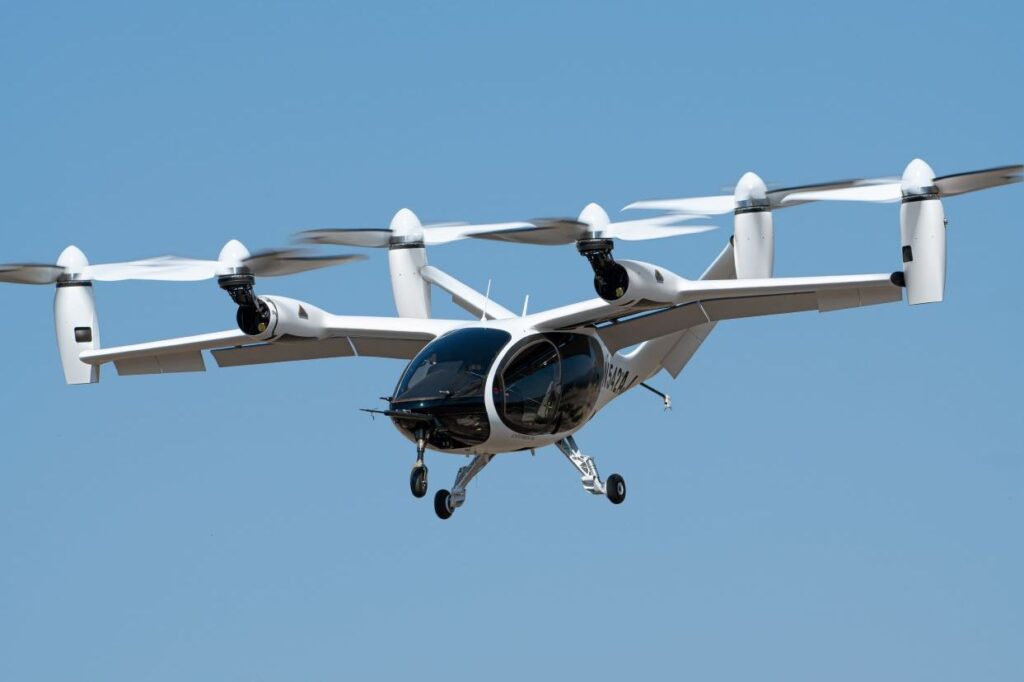
If one company has a credible claim to being the first commercial flying taxi in American skies, it’s Joby Aviation. The milestone that changed the whole conversation happened in late March 2026: the FAA confirmed that Joby completed Stage 4 of its five-stage type certification process — the critical airworthiness conformity review that validates the physical hardware matches the certified design documentation exactly.
No other eVTOL manufacturer has reached this stage with the FAA — not Archer, not Wisk. That lead is significant in a field where every certification stage represents months of testing, thousands of compliance findings, and direct FAA oversight.
The S4 itself is a purpose-built air taxi, not a concept vehicle. It seats one pilot and four passengers, cruises at 200 mph, and carries a range of around 150 miles. Its takeoff noise measures 65 dBA — roughly the level of a two-person conversation — which puts it well below a conventional helicopter.
Between April 27 and May 5, 2026, Joby flew point-to-point routes in New York City for the first time. The S4 connected JFK Airport to Manhattan heliports in under 10 minutes — a trip that can take 45 minutes or more by car. No paying passengers were on board, but the flights mark the closest the US has come to a working urban air taxi network.
Joby S4 — Specifications At A Glance
- Aircraft type: eVTOL (electric vertical takeoff and landing)
- Seats: 1 pilot + 4 passengers
- Top speed: 200 mph (322 km/h)
- Range per charge: ~150 miles (240 km)
- Charge time: Under 20 minutes
- Battery: 150–180 kWh
- Noise at takeoff: 65 dBA
- Propulsion: Six tilt-rotor electric motors
- FAA certification stage: Stage 4 complete (Stage 5 pending as of June 2026)
- Commercial launch target: Late 2026 (Joby’s stated goal)
- Independent analyst projection: Mid-to-late 2027 (SMG Consulting)
- Launch partners: Delta Air Lines, Uber
- Initial markets: New York City, Los Angeles
- Estimated initial fare: $150–$300 per trip (analyst estimates; Joby has not announced official pricing)
What Stage 4 Completion Actually Means
The certification process for eVTOL aircraft under the FAA’s powered-lift SFAR (Special Federal Aviation Regulation) runs through five stages. Each stage narrows the gap between a promising prototype and a legally certifiable aircraft. Stage 4 is where things get real — it moves from design documents to hardware, with every structure, subsystem, flight mode, and failure case tested under FAA oversight and logged as a compliance finding.
Joby and Archer Aviation are the two most capitalized U.S.-based contenders still actively pursuing FAA certification. The broader eVTOL field has thinned considerably since 2022. At least six eVTOL manufacturers have ceased operations or entered insolvency proceedings since 2023, including Lilium and Volocopter. The shakeout has concentrated FAA certification resources and investor capital around a smaller group of surviving contenders.
Joby has previously targeted late 2026 for commercial launch in New York and Los Angeles. SMG Consulting, which tracks eVTOL developers’ production and service-entry progress, has projected entry into service closer to mid-to-late 2027. The FAA has stated publicly that certification schedules depend on applicant performance and the resolution of open compliance findings — meaning no external timeline is guaranteed. The honest read is that commercial Joby flights are likely in 2026 or 2027, with no certainty on which side of that line the final certificate lands.
Industry analysts have estimated initial fares could run between $150 and $300 per trip before manufacturing scale brings costs down. The long-term target is price parity with ride-hailing services, but that’s a 2030s story, not a 2026 one.
2. Archer Aviation Midnight
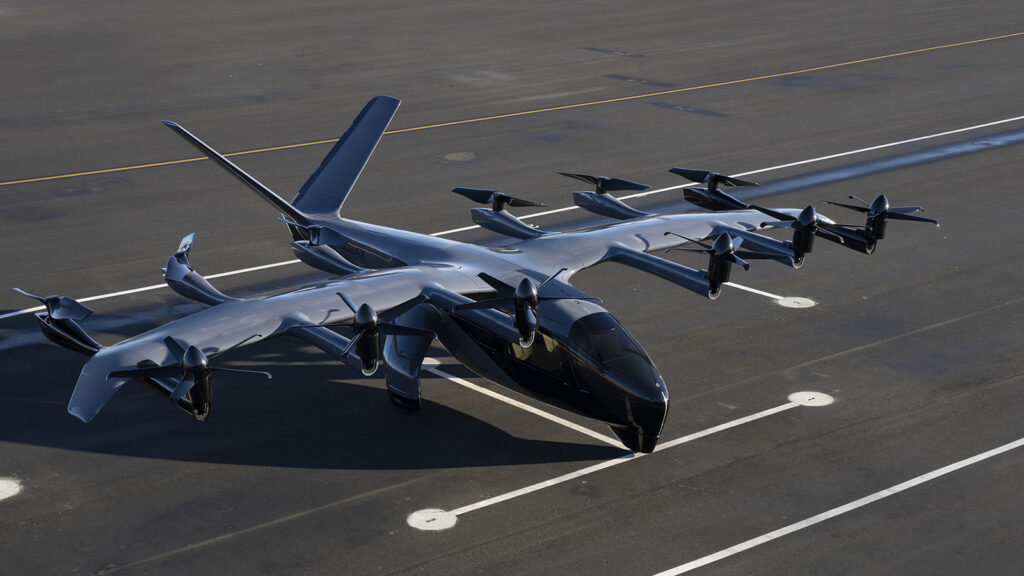
Archer Aviation occupies a distinct position from Joby — further back in the FAA process, but better positioned on commercial infrastructure and manufacturing. Archer Aviation, which has a manufacturing partnership with Stellantis and a launch agreement with United Airlines, confirmed to investors in its most recent quarterly filing that it remains in Stage 3 of the FAA type certification process for its Midnight aircraft.
Stage 3 versus Stage 4 is a meaningful gap. In practical terms, Joby is likely 12–18 months ahead of Archer on the US certification timeline. But Archer has been smart about not waiting for the FAA. UAE Launch Edition generates early revenue ($20–30M over 18–24 months) through Abu Dhabi partnerships, bypassing US regulatory delays. Archer has been flying Midnight in the UAE, conducting in-country flight test campaigns and developing pilot training programs with Etihad Aviation Training.
Archer Midnight — Specifications At A Glance
- Aircraft type: eVTOL (12-tilt-6 rotor configuration)
- Seats: 1 pilot + 4 passengers
- Top speed: 150 mph (241 km/h)
- Range per charge: ~60 miles (100 km) back-to-back trips
- Noise at cruise: 45 dBA
- Airframe: Carbon fiber composite
- FAA certification stage: Stage 3 complete, Stage 4 in progress (as of June 2026)
- Aircraft unit price: ~$5 million (fleet sale basis)
- Passenger fare target: $4–$5 per mile (operational target)
- Estimated 10-min Manhattan–Newark fare: ~$100
- Launch markets: UAE (active), US pending certification
- Key partnerships: United Airlines ($1B order for 200 aircraft), Stellantis (manufacturing), Etihad Aviation Training
The United Airlines Partnership And What It Changes
United Airlines announced a $1 billion USD order for Archer’s eVTOL aircraft, with an option to purchase additional aircraft. United Airlines wants to start with at least 200 aircraft to operate an air taxi service, flying people to and from airports.
That commitment is not a letter of intent or a promotional agreement — it’s a purchase order with a deposit. For an industry that has accumulated substantial skepticism from analysts and investors, an airline of United’s scale making a billion-dollar bet on a specific eVTOL platform carries real weight. It signals that at least one major commercial aviation operator believes the technology and timeline are credible enough to deploy real capital.
The Midnight eVTOL will cost between $4 and $5 per passenger mile with no fuel cost. The long-term goal is to get that down to $1 per passenger mile. In comparison, helicopters cost about $10 per passenger mile. A 10-minute flight from downtown Manhattan to Newark Liberty International Airport is estimated to cost around $100 per passenger.
The $100 per trip estimate for Manhattan to Newark is the number that matters most for mainstream accessibility conversations. At that price point, air taxi service is not public transit — it’s a premium commuter product that competes with black car services and time-stressed professionals, not the average subway rider.
3. Klein Vision AirCar
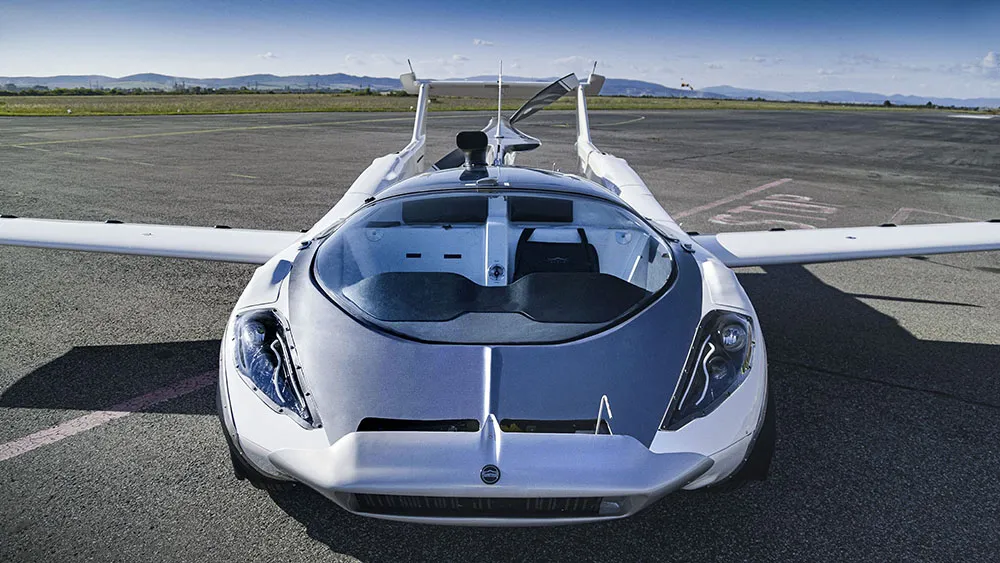
The Klein Vision AirCar is the vehicle that most closely matches what people imagine when they say “flying car.” It has four wheels. It drives on public roads. It transforms into an airplane. And unlike most vehicles people describe this way, it’s not a concept — it has already received type certification from the Slovak Transport Authority and logged over 500 test flights.
More than 30 years in the making, this long-range, high-speed, flight-tested, two-seat flying car is slated to be certified, with customer deliveries beginning in early 2026.
The company plans roughly 100 units a year at $800,000–$1 million each. At rest, the six-meter AirCar looks like a sleek coupé no wider than an SUV. Tap a dashboard button and, in 80 seconds, wings and tail unfold while a 280-horsepower V-6 shifts from the wheels to a rear propeller.
Klein Vision AirCar — Specifications At A Glance
- Vehicle type: Roadable aircraft (car + fixed-wing airplane)
- Seats: 2 passengers
- Road speed: 124 mph
- Air speed: 155 mph
- Flight range: ~620 miles (1,000 km)
- Service ceiling: 10,000 feet
- Engine: 280 hp V-6 (gasoline)
- Transformation time: Under 2 minutes (button-press automated)
- Certification: Slovak Transport Authority (airworthiness certificate, 2022)
- Test flights completed: 500+ takeoffs and landings, 170+ flight hours
- Price range: $800,000–$1 million
- Production plan: ~100 units per year
- Required to fly: Pilot’s license + airport runway access
- Availability: Sales commenced early 2026
The Honest Limitations Nobody Mentions
The AirCar is a genuine engineering achievement, and its transformation from concept to certified product over three decades is remarkable. But several practical limitations shape who can actually use it and how.
Owners who wish to fly the AirCar will need to drive it to an airport and take off from a runway. At this stage, its use is limited to airport-to-airport travel. This means the AirCar does not solve urban congestion in any direct way — you still need to reach an airport, navigate ground traffic to get there, and land at another airport at your destination. The compelling use case is actually rural mobility: covering large distances between smaller towns with private airstrips, without the scheduling constraints of commercial aviation.
The pilot’s license requirement is a further practical filter. Obtaining a Private Pilot License in the US requires a minimum of 40 flight hours, written examinations, and a checkride with an FAA examiner — a process that typically takes 6–12 months and costs $8,000–$15,000. At a $1 million vehicle price point, that’s a modest additional cost, but it’s a meaningful time investment that narrows the realistic buyer pool considerably.
The AirCar is a gas-powered, road-legal sports car that transforms into a fixed-wing aircraft. That gasoline powertrain is worth noting in a sector largely marketing itself on zero emissions. The AirCar’s V-6 engine consumes regular unleaded fuel and produces conventional combustion emissions — not a disqualifying factor, but a distinction from the electrified air taxi narrative that dominates the industry conversation.
What Is Still Firmly In The Concept Stage
The honest assessment of the broader “flying car” landscape in 2026 is that for every vehicle approaching commercial reality, there are a dozen more that remain promises, renders, and early-stage prototypes. Understanding which category a headline is describing requires reading carefully.
Wisk Aero (Gen 6) — Wisk, backed by Boeing, is pursuing the most ambitious regulatory path of any eVTOL manufacturer: full autonomous passenger flight without an onboard pilot. In December 2025, Wisk Aero successfully completed the historic first flight of its Generation 6 aircraft at its test facility in Hollister, California. The Gen 6 uses logic-driven algorithms to avoid AI/ML-based decision systems, specifically to enable deterministic certification. However, no certification basis currently exists for autonomous passenger aircraft without an onboard pilot, meaning Wisk’s commercial timeline extends well beyond what Joby or Archer are targeting. Genuinely interesting technology. Not a 2026 product.
Alef Aeronautics Model A — Described as the “only flying automobile with street-legal driving and vertical-takeoff abilities,” the Alef Model A received a Special Airworthiness Certificate from the FAA in 2023 — a limited testing authorization, not a commercial certification. The vehicle is listed at $300,000 with a large pre-order list, but no production timeline has been confirmed and no conforming production prototype has been publicly demonstrated. Concept stage in practical terms.
Xpeng AeroHT X2 / X3 — Chinese manufacturer Xpeng’s flying car division has conducted public demonstrations and announced production plans, but neither vehicle has received FAA or EASA commercial certification. The X2 is a two-seat eVTOL demonstrator; the X3 is a roadable aircraft concept. Active development, early stage.
PAL-V Liberty — The Dutch PAL-V Liberty is a three-wheeled gyrocopter-based vehicle that has been in development for over a decade and received EASA airworthiness certification in 2021. It is road-legal in Europe and can be ordered now, but commercial delivery volumes remain very small and the vehicle requires both a car driving license and a gyroplane pilot license. Real product, extremely niche.
| Company | Model | Status | Commercial Timeline |
| Joby Aviation | S4 | FAA Stage 4 complete | Late 2026–2027 |
| Archer Aviation | Midnight | FAA Stage 3 complete | 2027+ (US); UAE earlier |
| Klein Vision | AirCar | Slovak-certified, sales open | 2026 (very limited volume) |
| Wisk Aero | Gen 6 | Test flights only | 2028–2029 (autonomous) |
| Alef Aeronautics | Model A | FAA special airworthiness only | Unconfirmed |
| PAL-V | Liberty | EASA certified, niche sales | Available, limited |
| Xpeng AeroHT | X2 / X3 | Demo stage | Unconfirmed |
The Real Barriers That Headlines Keep Skipping
Every honest assessment of flying cars in 2026 has to address the structural challenges that go beyond certification. The aircraft may eventually get certified. The harder problems are infrastructure, regulation at the operations level, and economics.
Vertiport infrastructure is the unglamorous bottleneck nobody talks about enough. Joby and Archer’s air taxis need purpose-built landing and charging facilities in urban areas. These require planning permission, construction, grid-level electrical connections, and coordination with city authorities — a process that in dense cities like New York can take years regardless of how fast the aircraft gets certified. Archer has been working with United Airlines and Abu Dhabi to develop vertiport networks, and New York City has designated locations. But the number of operational vertiports as of mid-2026 remains in single digits globally.
Airspace management at scale is an unsolved problem. A handful of eVTOL aircraft flying preset routes under FAA oversight is one thing. Hundreds of vehicles flying different routes across a city’s airspace simultaneously requires automated traffic management systems that don’t fully exist yet. The FAA’s eVTOL Integration Pilot Program is explicitly designed to develop this capability in parallel with vehicle certification, but it’s a multi-year process.
Pilot supply is a constraint for the near term. Both Joby and Archer’s initial aircraft require licensed pilots onboard. There are not enough trained powered-lift pilots to staff even a moderately scaled air taxi network immediately. Training programs are in development, but building a qualified pilot workforce takes years, not months.
Economics at scale remain unproven. The $4–$5 per passenger mile target that Archer quotes assumes high aircraft utilization, low maintenance costs, and volume production. In early commercial operations, none of those assumptions will fully hold. Initial fares will be premium prices for premium early adopters. The path to mainstream price accessibility runs through a manufacturing scale that won’t be reached in 2026 by any operator.
Frequently Asked Questions
Can you buy a flying car in 2026?
Yes, technically — but with significant caveats. Klein Vision’s AirCar is now in commercial sale with deliveries beginning in 2026. It’s priced between $800,000 and $1 million, requires a pilot’s license to fly, needs an airport runway for takeoff and landing, and production is limited to roughly 100 units per year. You can order one. You cannot use it to skip traffic on your morning commute. eVTOL air taxis from Joby and Archer are not available for personal purchase — they operate as a service, similar to a ride-hailing platform, and commercial service has not yet launched in the US as of mid-2026.
When will Joby Aviation start flying paying passengers?
Joby has targeted late 2026 for its commercial launch in New York and Los Angeles, in partnership with Delta Air Lines. The company completed FAA Stage 4 certification in late March 2026 and demonstrated flights over New York City in late April and early May 2026. One more FAA certification stage plus an air carrier certificate is still required before revenue service can begin. Independent analysts at SMG Consulting project entry into service closer to mid-to-late 2027. The FAA has not committed to any external timeline.
What is the difference between an eVTOL and a flying car?
An eVTOL (electric vertical takeoff and landing aircraft) takes off and lands vertically using electric motors, operates as an air taxi service, does not drive on public roads, and requires vertiport infrastructure. A flying car (or roadable aircraft) like the Klein Vision AirCar drives on public roads, transforms into a fixed-wing aircraft, and requires a conventional runway for takeoff and landing. Both are often described as “flying cars” in popular coverage, but they serve different purposes, use different technology, and have entirely different price points and regulatory pathways.
How much will an air taxi ride cost?
Archer Aviation’s chief commercial officer has stated a target of $4–$5 per passenger mile during early commercial operations, with a long-term goal of $1 per mile. For context, helicopters currently cost around $10 per mile. A 10-minute Manhattan to Newark route is estimated at roughly $100 per passenger. Industry analysts have estimated Joby’s initial fares at $150–$300 per trip before manufacturing scale reduces costs. Neither company has announced official public pricing as of June 2026.
Which flying car companies have gone out of business?
Several prominent eVTOL developers have ceased operations since 2023. Lilium, the German eVTOL startup, filed for insolvency in November 2024 after failing to secure EASA approval in time. Volocopter, another German operator, was restructured after financial difficulties. AeroMobil, a Slovakian flying car pioneer, shut down in 2023 after 12 years and $27 million in investment. Supernal paused operations after its CEO and CTO departed in late 2025. The industry has undergone significant consolidation, leaving Joby and Archer as the best-capitalized surviving US contenders.
Do you need a pilot’s license to use an air taxi?
No. As a passenger on an eVTOL air taxi operated by Joby, Archer, or a similar service, you need no license — you are a passenger in a licensed, piloted aircraft, the same as on a commercial airplane. However, if you purchase a Klein Vision AirCar and wish to fly it yourself, you must hold a valid pilot’s license. Wisk Aero is developing an autonomous eVTOL that would eventually not require an onboard pilot, but that technology is years away from commercial certification.
Is the flying car market actually viable long-term?
The urban air mobility market is projected to grow substantially — estimates range from $90 billion to over $1.5 trillion by 2040 depending on the assumptions used. The more conservative projections account for infrastructure build time, regulatory constraints, pilot supply, and public acceptance. The optimistic projections assume rapid scaling once initial certification is secured. What’s clear from 2026 data is that the technology is real and progressing, that at least two companies are within reach of commercial certification in the US, and that the economics at mass scale remain unproven. The short answer: viable for premium urban mobility, meaningful scale by the early 2030s.