Ten. That’s roughly how many examples remain today of a fully electric Dodge minivan built decades before anyone associated Chrysler with battery power. The Caravan EPIC came and went as a fleet-only experiment in the late 1990s, crushed by the hundreds once its leases expired.
Every other engine this nameplate ever used tells a far less dramatic story, and that’s actually the point. Five generations, two and a half decades of production, and five completely different V6 engines from two entirely separate manufacturers all landed on the exact same firing sequence, with one genuinely sneaky exception buried in how a distributor cap gets installed.
Every engine option the Grand Caravan offered between 1996 and 2020, along with the one detail that trips up more DIY mechanics than anything else on this list, gets covered here in complete detail.
Firing Order Basics And A Surprisingly Consistent Minivan
Firing order describes the exact sequence in which an engine ignites fuel inside each cylinder. Engineers space these combustion events out deliberately around crankshaft rotation, a fixed design decision baked into the block itself.
Most vehicles with a quarter-century production history cycle through wildly different engine architectures along the way. The Grand Caravan took a genuinely different path, and understanding why makes this one of the more approachable firing order topics in the minivan segment.
What Firing Order Actually Controls Inside An Engine
Every cylinder fires at a specific point in crankshaft rotation rather than simple numerical order. A four-cylinder engine completes one firing event every 180 degrees of rotation, while a V6 fires every 120 degrees, spacing power strokes evenly across a full combustion cycle.
That even spacing keeps vibration low and distributes mechanical stress evenly across bearings, mounts, and the crankshaft itself. Getting this sequence wrong, whether through a genuine mechanical fault or crossed wiring on an older engine, produces rough running, wasted fuel, and accelerated wear over time.
Early Grand Caravans relied on a physical distributor and plug wires to route spark to each cylinder in order, making a wiring mistake an immediate, obvious problem. Later models, starting in the mid-2000s, switched to coil-on-plug ignition instead, with the engine control module firing each coil individually based on sensor data.
Diagnostic trouble codes follow the same predictable pattern regardless of ignition type or model year. P0301 identifies cylinder one, P0302 identifies cylinder two, and the pattern continues through the highest cylinder count present, always referring to physical position rather than firing sequence.
Five Generations, One Repeating Number
The Grand Caravan nameplate covers three distinct body generations across the range this piece focuses on: the 1996-2000 models built on the Chrysler S platform, the 2001-2007 redesign on the newer RS platform, and the long-running 2008-2020 generation that carried the nameplate through its final model year.
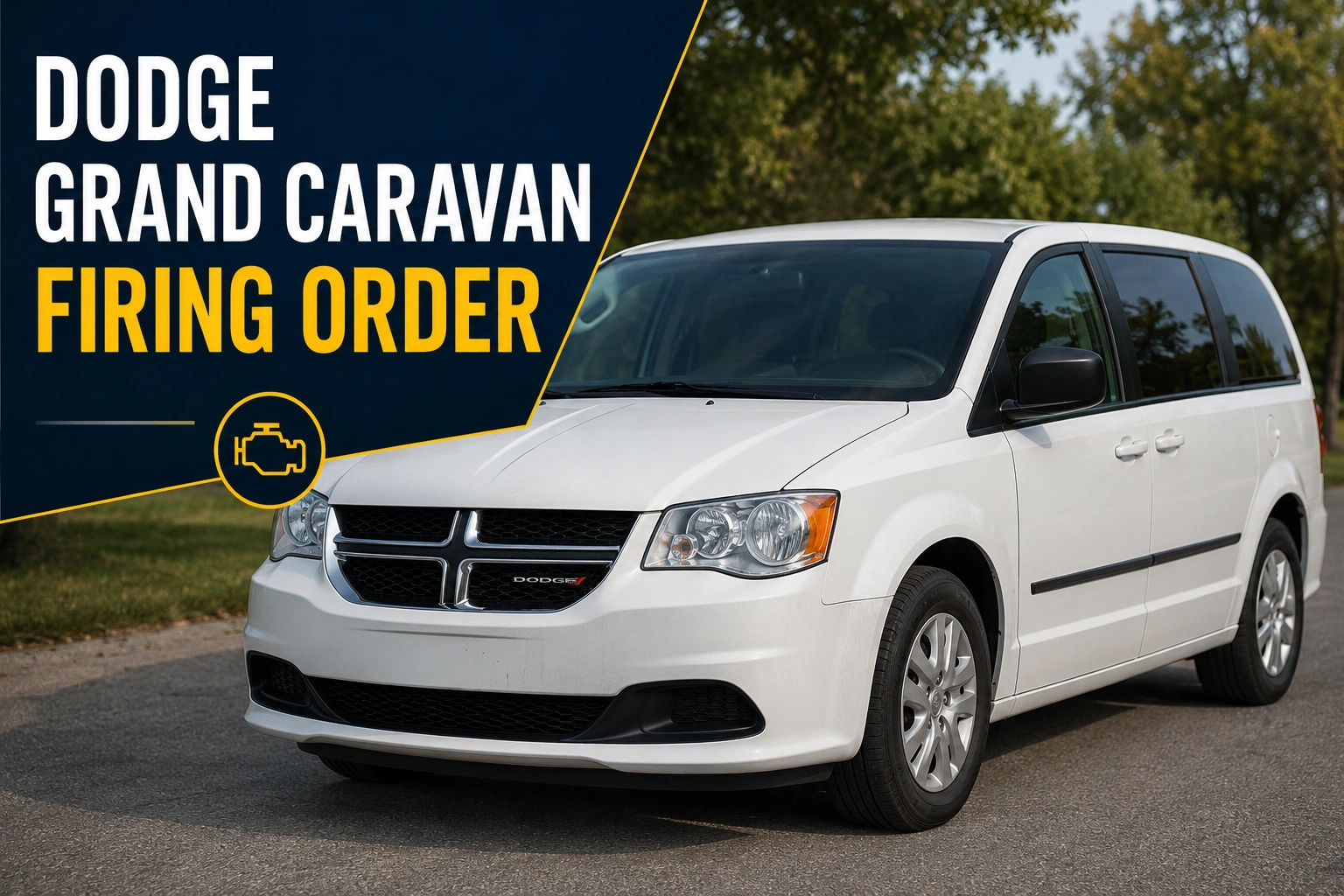
Despite riding on three separate platforms across nearly a quarter century, every V6 engine this minivan ever offered shares an identical 1-2-3-4-5-6 firing order.
That includes a Mitsubishi-sourced engine used only in the earliest years, three distinct Chrysler-designed V6 engines spanning the middle era, and the modern Pentastar that closed out production.
Only the four-cylinder engine breaks from this pattern, using the standard sequence common to most inline engines rather than the V6 convention. That leaves just two numbers to remember for the vast majority of Grand Caravans ever built, a genuinely rare level of simplicity for a vehicle with this much history behind it.
This consistency doesn’t mean every engine behaves identically in practice, though. Cylinder bank placement, physical access, and one particularly sneaky wiring detail still vary enough between engine families to matter for anyone doing hands-on repair work.
Four-Cylinder And Mitsubishi V6 Firing Order From 1996 To 2000
Third-generation Grand Caravans, sold from 1996 through 2000, offered a genuinely interesting spread of engines given how young the platform still was at the time. Two of these options came from completely different corners of the automotive world.
Sorting out which applies to a specific van starts with understanding why Chrysler sourced part of its lineup from Mitsubishi in the first place.
2.4L Firing Order For Base Trim Models
A 2.4-liter four-cylinder served as the entry-level engine throughout the entire third generation, a Chrysler-designed unit that predates the later World Engine and Tigershark families used in other Chrysler products.
This engine prioritized affordability and simplicity over outright performance, appealing to budget-focused fleet and family buyers.
Its firing order runs 1-3-4-2, the standard pattern shared by the overwhelming majority of inline-four engines across the industry regardless of manufacturer. Cylinder one sits at the front of the engine nearest the drive belt, with numbers two, three, and four following in a straight line back toward the firewall.
Buyers cross-shopping this base engine against the available V6 options generally found the four-cylinder adequate for light use but noticeably strained once a minivan reached full passenger and cargo capacity.
That performance gap pushed a meaningful share of buyers toward one of the six-cylinder alternatives covered next.
Surviving examples of this specific engine have grown increasingly rare given the third generation’s age, now approaching thirty years for the earliest models. Parts availability has narrowed considerably compared to the V6 options that dominated this era’s production numbers.
The Mitsubishi-Sourced 3.0L And Its Distributor Cap Trap
Chrysler sourced a 3.0-liter V6, internally known as the 6G72, directly from Mitsubishi for the base V6 option across most of the third generation. This engine wasn’t available in several northeastern states due to emissions certification gaps, where the Chrysler-designed 3.3-liter served as the substitute instead.
Its firing order runs 1-2-3-4-5-6, identical numerically to every Chrysler-designed V6 this nameplate would go on to use for the next two decades. That numerical match, though, hides a genuinely practical complication worth knowing about before attempting any distributor work on this specific engine.
Two different distributor cap designs exist for this Mitsubishi-sourced engine, one following Chrysler’s typical terminal layout and one following Mitsubishi’s own convention, and the two are interchangeable without adjustment. Installing a Mitsubishi-style cap while wiring plugs according to a Chrysler-style diagram redirects spark to the wrong terminals entirely, despite both caps technically supporting the same underlying 1-2-3-4-5-6 sequence.
This mismatch has confused enough DIY mechanics over the years to generate genuine, documented confusion in online repair forums, since the symptom looks identical to a simple wiring mistake rather than a parts compatibility issue.
Confirming which specific cap style is actually installed before wiring plugs prevents an afternoon of troubleshooting a problem that isn’t really about firing order at all.
Here’s how the third-generation lineup compares:
| Engine | Availability | Origin | Firing Order |
| 2.4L I4 | All markets, base trim | Chrysler | 1-3-4-2 |
| 3.0L V6 (6G72) | Most states, base V6 | Mitsubishi | 1-2-3-4-5-6 |
| 3.3L V6 | Where 3.0L unavailable, all trims | Chrysler | 1-2-3-4-5-6 |
| 3.8L V6 | Upper trims | Chrysler | 1-2-3-4-5-6 |
Chrysler’s Own V6 Firing Order From 1996 Through 2010
Three Chrysler-designed V6 engines carried this nameplate through its middle era, spanning the tail end of the third generation all the way through the pre-Pentastar years of the fifth. All three share the identical firing order established by the very first Chrysler V6 this minivan ever used.
That consistency makes this stretch of Grand Caravan history considerably easier to research than the varied third-generation lineup covered previously.
3.3L And 3.8L Firing Order Across Three Generations
The 3.3-liter V6 served continuously across all three body generations covered here, from 1996 through 2010, making it the single longest-running engine in Grand Caravan history.
It started as an alternative to the Mitsubishi 3.0-liter in certain markets before becoming the standard V6 nationwide once the Mitsubishi engine disappeared from the lineup entirely.
The 3.8-liter V6 served as the upgraded, more powerful option throughout this same stretch, climbing from 166 horsepower in the earliest 1996 and 1997 models to 197 horsepower by the final pre-Pentastar applications.
Both engines share an identical 1-2-3-4-5-6 firing order, with cylinder one sitting at the front of one bank and continuing rearward alongside cylinders three and five.
Factory service documentation and independent repair references consistently confirm this firing order across every model year either engine appeared in, without exception or regional variation.
A chart confirmed for a 1998 3.3-liter applies without modification to a 2010 example of the same engine, despite over a decade separating their production dates.
Coil pack wiring on later, distributorless versions of these engines occasionally generates its own confusion among owners, with online discussions showing genuine disagreement over the exact physical order coils should be arranged in in certain service situations.
This represents a wiring or component-layout question rather than any actual change to the underlying firing sequence itself.
The 4.0L’s Brief, Powerful Run
Chrysler introduced an all-new 4.0-liter V6 alongside the redesigned 2008 Grand Caravan, offering it as the range-topping engine choice for buyers wanting genuinely stronger performance than the 3.3-liter or 3.8-liter could provide.
Producing 251 horsepower, this engine represented a meaningful step up and arrived paired with a modern six-speed automatic transmission.
Despite being the newest and largest V6 this nameplate had used up to that point, it shares the identical 1-2-3-4-5-6 firing order and fundamental cylinder layout as every Chrysler V6 that came before it.
This engine was built on the same core architecture as the 3.3-liter and 3.8-liter, simply enlarged rather than fundamentally redesigned from scratch.
Its production run proved remarkably brief in the context of this nameplate’s overall history, lasting only from 2008 through 2010 before the all-new Pentastar V6 replaced every prior engine option simultaneously for 2011.
That short window makes the 4.0-liter one of the rarer Grand Caravan engines on the road today relative to its more common 3.3-liter and 3.8-liter siblings.
Owners of a 2008 through 2010 Grand Caravan benefit from confirming exactly which of these three V6 options sits under their specific van’s hood, since all three shared engine bay space across the same body style and could be easily confused without checking a build sheet or VIN directly.
Pentastar Era Firing Order From 2011 To The Final Model Year
Every Grand Caravan built from 2011 onward relied on a single engine, ending decades of multiple simultaneous V6 options in one dramatic simplification. This final chapter also happens to be the longest unchanged mechanical stretch in the nameplate’s entire history.
Understanding why Chrysler kept this same basic setup for a full decade explains a great deal about this minivan’s eventual place in the market.
3.6L Pentastar Firing Order And Cylinder Layout
Chrysler’s all-new 3.6-liter Pentastar V6 became the Grand Caravan’s sole engine starting with the 2011 model year, replacing the 3.3-liter, 3.8-liter, and 4.0-liter simultaneously.
This modern, dual-overhead-cam design represented a genuine technical leap over every engine it replaced, initially producing around 283 horsepower before later refinements pushed output closer to 290.
Its firing order runs 1-2-3-4-5-6, continuing the exact same numerical sequence every V6 this nameplate had used going back to the original 1996 Mitsubishi-sourced engine. The Pentastar’s 60-degree bank angle makes this simple pattern possible without the more complex crankshaft counterweighting other V6 designs require.
Cylinder one sits at the front of the passenger-side bank on this engine, with cylinders three and five continuing rearward on that same side, while the driver’s side holds cylinders two, four, and six.
This same engine and firing order pattern powers a remarkably wide range of other Stellantis vehicles from the same era, including the Jeep Wrangler and Chrysler 300.
A minor internal update arrived for 2016, improving variable valve timing and raising the compression ratio for better efficiency, though flex-fuel capability was dropped in the process on most applications.
None of these changes touched the underlying firing order, which remained fixed from the Pentastar’s 2011 debut through the Grand Caravan’s final 2020 model year.
Why This Minivan Kept The Same Chassis For 13 Years
Chrysler introduced the Pacifica minivan for 2017 as its modern, technologically advanced offering, yet the Grand Caravan continued production alongside it for three more full model years rather than being retired immediately.
This overlap reflected a deliberate value-focused strategy, keeping an older, fully depreciated platform available at a considerably lower price point than the new Pacifica could match.
Fleet buyers, rental companies, and budget-conscious families kept the aging Grand Caravan commercially viable well past the point most competitors would have discontinued a design this old.
The 2020 model year finally closed out production, ending a body architecture that had underpinned this nameplate since 2008 without a fundamental redesign.
None of this business strategy affected the underlying mechanical specifications covered throughout this piece.
A 2011 Grand Caravan and a 2020 Grand Caravan share the identical Pentastar engine, identical firing order, and nearly identical cylinder layout, differing mainly in minor trim and technology updates rather than anything touching combustion sequence.
That extended production run means the Pentastar-powered Grand Caravan remains one of the most commonly used minivans on the road today, giving this specific firing order question genuine ongoing relevance for a large population of owners years after the nameplate’s official retirement.
Practical Diagnosis Across Every Grand Caravan Generation
None of this technical and historical detail matters much until a check engine light appears or an engine starts running rough. Firing order and cylinder position knowledge turns that vague warning into a specific, targeted repair.
The sections below apply everything covered so far to real diagnostic work across every generation this nameplate produced.
Matching A Misfire Code To The Right Engine
A scan tool reading a P0301 through P0306 code identifies a misfiring cylinder by its physical position, never by where that cylinder falls within the firing sequence itself.
Confirming the exact engine, not just generation or model year, comes first, since three different V6 options often shared the same body style during the fifth generation’s early years.
Once that’s settled, matching the engine against the correct chart from earlier sections points straight to the affected coil, plug, or injector. Swapping a suspect coil or plug wire with a known-good unit from another cylinder remains a reliable confirmation test across nearly every engine covered here.
The 3.0-liter Mitsubishi engine deserves special attention during any distributor-related diagnostic work, given the documented cap compatibility issue covered earlier. Confirming which cap style is actually installed before assuming a wiring mistake saves considerable troubleshooting time on this specific engine.
A VIN decode remains the fastest way to confirm exactly which engine sits under a specific van’s hood, particularly useful for anyone shopping a used third-generation or early fifth-generation example where multiple engines shared the same body style. Most auto parts stores can pull this information within minutes at no charge.
Maintenance Habits That Matter Most By Era
Spark plugs and coils on the Pentastar-equipped final generation typically last well beyond 60,000 miles under normal conditions, a maintenance interval that held steady across this engine’s entire decade-long Grand Caravan run.
Earlier distributor-equipped engines from the third and fourth generation benefit from periodic cap, rotor, and wire inspection instead, components that simply don’t exist on the later coil-on-plug applications.
Transmission and engine mount health deserves particular attention on the 3.3-liter and 3.8-liter era specifically, since worn mounts on these higher-mileage vans can produce vibration symptoms that feel remarkably similar to a genuine misfire without actually involving the firing order at all. Ruling out mount wear before chasing ignition components saves real diagnostic time.
Timing chain or belt service varies meaningfully by engine family and deserves specific attention, since the third-generation 3.0-liter and early four-cylinder engines used a timing belt requiring scheduled replacement, while later Chrysler-designed V6 engines switched to a timing chain with different maintenance expectations entirely.
Keeping the exact engine code, not just body generation, documented in any service record prevents the most common mistake likely to affect a vehicle with this many overlapping engine options across a single body style.
A quick reference for common symptoms across this lineup:
| Symptom | Likely Cause | Applies To |
| Rough idle, specific cylinder code | Failing coil, plug, or injector | All engines, every generation |
| Backfire despite correct wire routing | Mismatched distributor cap style | 3.0L Mitsubishi engine only |
| Vibration resembling a misfire | Worn engine or transmission mount | 3.3L and 3.8L, higher mileage |
| Rough running near timing service interval | Stretched belt or chain | Engine-specific, check service type |
Frequently Asked Questions
What is the firing order of a Dodge Grand Caravan 3.3 or 3.8 V6?
Both engines fire in a 1-2-3-4-5-6 sequence across every model year they appeared in, from 1996 through 2010. This applies regardless of trim level or which specific years a particular van was built in.
What is the firing order of the 3.0L Mitsubishi engine in early Grand Caravans?
The Mitsubishi-sourced 6G72 also fires 1-2-3-4-5-6, matching every Chrysler-designed V6 this nameplate used later. Distributor cap compatibility, not firing order, is the detail most likely to cause confusion on this specific engine.
What is the firing order of the 3.6 Pentastar V6 in later Grand Caravans?
The Pentastar fires in the same 1-2-3-4-5-6 sequence used by every V6 this minivan has ever offered, continuing from its 2011 debut through the final 2020 model year.
Does the 2.4L four-cylinder use a different firing order than the V6 engines?
Yes, the four-cylinder fires 1-3-4-2, the standard pattern for most inline-four engines, completely different from the 1-2-3-4-5-6 sequence shared by every V6 this nameplate has used.
Why did the Grand Caravan continue production after the Pacifica launched?
Chrysler kept the older, fully depreciated platform available as a lower-priced alternative for fleet and budget-conscious buyers, continuing production through 2020 alongside the newer Pacifica minivan.
Where can I confirm the exact firing order for my specific Grand Caravan?
A factory service manual matched to the exact model year and engine code remains the most reliable source. Most auto parts stores can also pull a firing order reference free of charge once given the vehicle’s VIN.
Five body generations, two different manufacturers behind the V6 options, and nearly twenty-five years of production still resolve into two simple numbers once the correct engine gets identified. Every V6 this nameplate has ever used fires 1-2-3-4-5-6, while the four-cylinder fires 1-3-4-2.
The real complexity hides not in the firing order itself, but in details like distributor cap compatibility and confirming exactly which of several similar-looking V6 options sits under a specific hood. Getting that identification right remains the only real prerequisite for everything else falling into place.