Dodge changed its mind about the Durango’s base engine three separate times within roughly eighteen months. A V6 option got cancelled, brought back by popular demand, then cancelled again, all while the nameplate’s various V8 engines quietly kept firing in the exact same sequence they always had.
That kind of whiplash rarely shows up in a firing order conversation, yet it explains why checking the specific model year matters more on this particular SUV than almost any other vehicle on the road today.
Nearly three decades of Durango production have cycled through body-on-frame trucks, a unibody redesign, and enough engine reshuffling to confuse even longtime owners.
Every V6 and V8 this nameplate has used since 1997, along with the full story behind its most recent engine drama, gets sorted out here in complete, accurate detail.
Firing Order Basics And A 27-Year Engine Story
Firing order describes the exact sequence in which an engine ignites fuel inside each cylinder. Engineers space these combustion events out deliberately around crankshaft rotation, a fixed design decision rather than something that shifts with trim level or model year.
Few midsize SUVs have carried as much engine variety under one nameplate as the Durango. That variety, paired with a genuinely chaotic recent product history, makes this an unusually layered research topic.
What Firing Order Actually Controls Inside An Engine
Every cylinder fires at a specific point in crankshaft rotation rather than simple numerical order. A V6 completes one firing event every 120 degrees of rotation, while a V8 packs a firing event into every 90 degrees, spacing power strokes evenly across a full combustion cycle.
That even spacing exists for a real mechanical reason. Consistent intervals between power strokes keep vibration low and distribute stress evenly across bearings, mounts, and the crankshaft itself, extending engine life considerably over hundreds of thousands of miles.
Early Durango engines relied on a physical distributor and plug wires to route spark to each cylinder in the correct order, making a wiring mistake an immediate, obvious problem.
Every Durango built from the mid-2000s onward switched to coil-on-plug ignition instead, with the engine control module firing each coil individually based on crankshaft and camshaft sensor data.
Diagnostic trouble codes follow the same predictable pattern regardless of ignition type or engine generation. P0301 identifies cylinder one, P0302 identifies cylinder two, and the pattern continues through the highest cylinder count present, always referring to physical position rather than the order cylinders actually fire in.
Three Body Architectures, One Consistent Numbering Logic
The first-generation Durango launched in 1997 for the 1998 model year, built on a shortened version of the Dodge Dakota pickup platform with genuine body-on-frame construction. A second generation followed for 2004, larger and more refined but still riding on that same truck-based foundation through 2009.
Everything changed for the third generation, introduced for 2011. Dodge moved the Durango onto a unibody platform shared with the Jeep Grand Cherokee, a fundamentally different approach to construction that brought car-like handling to a vehicle still marketed as a genuine tow-rated SUV.
Despite these major structural shifts, cylinder numbering conventions stayed remarkably consistent across all three generations for any given engine family. A V8’s cylinder layout logic carried forward essentially unchanged from the original 1998 model through the newest examples rolling off the line today.
Towing capability climbed steadily across this same span, from roughly 7,500 pounds on the original truck-based model to figures exceeding 8,700 pounds on properly equipped modern V8 versions.
None of that capability growth traces back to firing order changes, since towing capacity depends far more on cooling, transmission gearing, and chassis reinforcement than on how cylinders happen to be sequenced.
That consistency matters enormously for anyone researching parts or diagnostics across a wide range of model years. Confirming the specific engine, rather than assuming based on generation or body style alone, remains the one genuine prerequisite before anything else.
First And Second Generation Firing Order From 1998 Through 2009
Body-on-frame Durangos offered a genuinely wide spread of V6 and V8 engines across their combined twelve-year production run. Every one of them, despite the variety, sorts cleanly into just two firing order families.
That simplicity makes the earlier Durango a far more approachable research topic than its recent engine history might suggest.
3.9L And 3.7L V6 Firing Order Across Two Generations
A 3.9-liter Magnum V6, producing a modest 175 horsepower, served as an available base engine starting in 1999, though relatively few buyers actually chose it over the standard V8 options. This engine disappeared after the 2000 model year, leaving V8 power as the only choice for the remainder of the first generation.
Its firing order runs 1-6-5-4-3-2, a distinctive sequence developed specifically by Chrysler rather than borrowed from another manufacturer’s design. Cylinder one sits at the front of the driver’s side bank, with cylinders three and five continuing rearward on that same side, while the passenger side holds cylinders two, four, and six in matching order.
The second generation reintroduced V6 power in 2004 with an all-new 3.7-liter engine, sharing core architecture with the Jeep and Ram truck lineup of the same era. This engine shares the identical 1-6-5-4-3-2 firing order and cylinder layout as the earlier 3.9-liter, despite being a genuinely updated design with improved output and refinement.
Neither V6 option proved especially popular among Durango buyers during either generation, with V8 power remaining the dominant choice throughout the truck-based era. Surviving examples with either six-cylinder engine are comparatively uncommon today relative to their V8-powered counterparts.
A genuinely obscure footnote from this era deserves mention for anyone researching an unusual first-generation find. Dodge partnered with Carroll Shelby’s shop to build a supercharged S.P.360 special edition for 1999 and 2000, based on the 5.9-liter Magnum V8 but tuned to 360 horsepower with unique Viper Blue paint and racing stripes.
Despite the forced induction and dramatic output bump, this rare variant shares the identical firing order as every other Magnum V8 covered in the next section.
Every Magnum And PowerTech V8 Shares One Sequence
The original 1998 Durango launched with a 5.2-liter Magnum V8 as its standard engine, producing 230 horsepower and serving as the workhorse choice for most early buyers. A 5.9-liter Magnum V8 sat above it, standard on R/T and higher trims, while a genuinely rare supercharged version of that same 5.9-liter powered a limited-run Shelby-tuned S.P.360 special edition in 1999 and 2000.
The 4.7-liter PowerTech V8 replaced the 5.2-liter as the standard engine starting in 2000, continuing through the end of first-generation production and into the second generation as well.
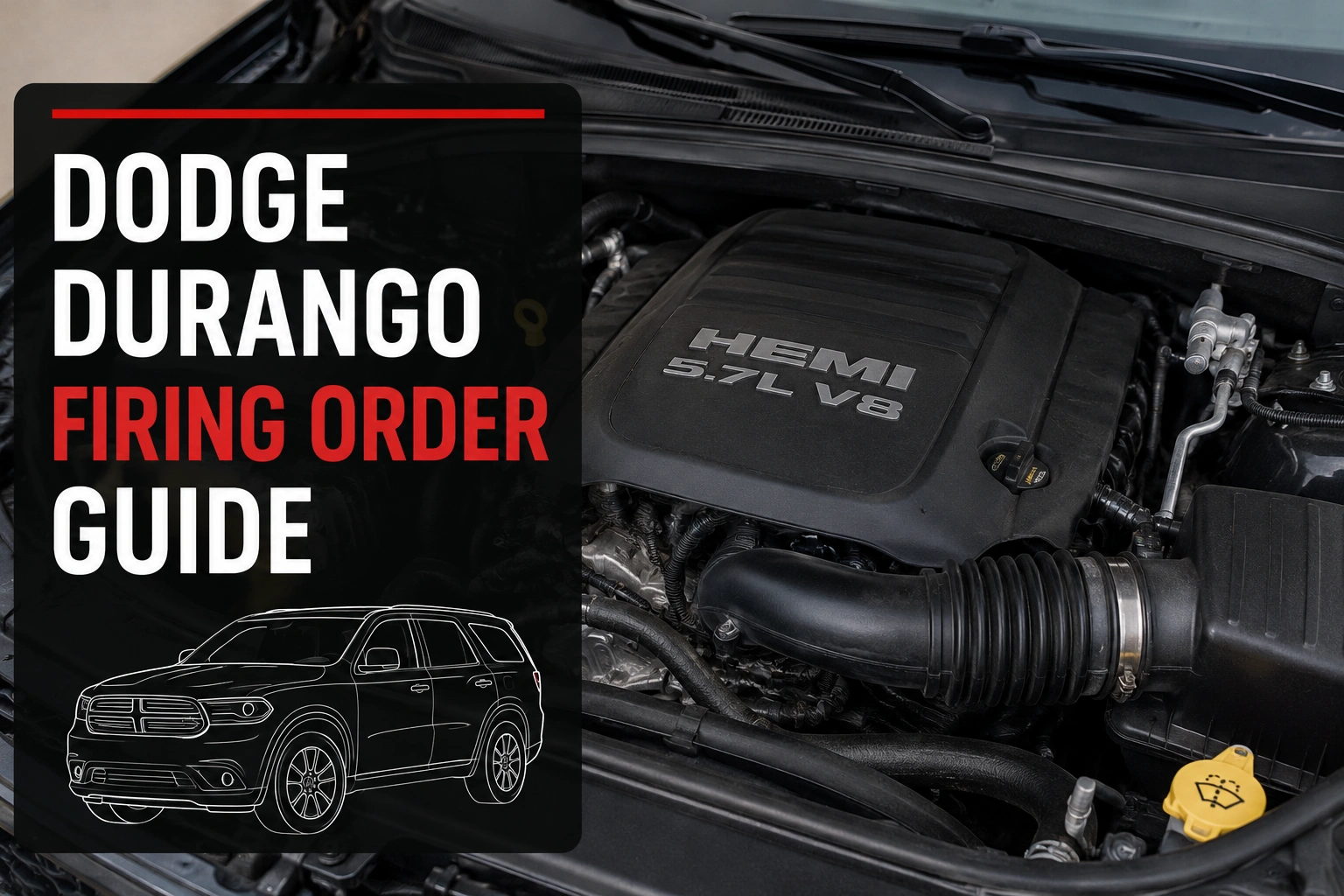
Chrysler introduced the modern 5.7-liter Hemi V8 alongside the 4.7-liter for the redesigned 2004 model, eventually becoming the more popular of the two options as buyers gravitated toward its stronger performance.
Every single one of these V8 engines, the 5.2-liter, 5.9-liter, supercharged 5.9-liter, 4.7-liter, and 5.7-liter Hemi alike, shares an identical 1-8-4-3-6-5-7-2 firing order.
Cylinder one sits on the driver’s side bank alongside cylinders three, five, and seven, while the passenger side holds the even-numbered cylinders in matching front-to-rear order.
That consistency traces back to Chrysler’s long-standing V8 firing order convention, one the company never revised even as engine displacement, fuel delivery, and valvetrain technology changed dramatically across this period.
A firing order chart confirmed for a 1998 5.2-liter applies without modification to a 2009 5.7-liter Hemi, despite over a decade separating their production dates.
Two lesser-known chapters closed out the second generation before the 2011 redesign arrived. Chrysler sold a badge-engineered twin of the Durango called the Aspen from 2007 through 2009, sharing every engine and firing order covered here under a different nameplate entirely.
A genuine gas-electric hybrid version of the Durango also appeared briefly for 2009, using a two-mode hybrid system paired with the 5.7-liter Hemi before the entire second generation wound down.
Here’s how the truck-based era lineup compares:
| Engine | Model Years | Type | Firing Order |
| 3.9L / 3.7L V6 | 1999-2000, 2004-2009 | Base | 1-6-5-4-3-2 |
| 5.2L Magnum V8 | 1998-2000 | Standard | 1-8-4-3-6-5-7-2 |
| 5.9L Magnum V8 | 1998-2003 | R/T, upper trims | 1-8-4-3-6-5-7-2 |
| 4.7L PowerTech V8 | 2000-2009 | Standard | 1-8-4-3-6-5-7-2 |
| 5.7L Hemi V8 | 2004-2009 | Upgrade | 1-8-4-3-6-5-7-2 |
Third Generation Firing Order And The Pentastar Era
Everything about the Durango changed with its 2011 unibody redesign, yet the firing order story stayed genuinely simple through most of this generation’s run. Two core engine families, one V6 and a family of related V8s, covered the vast majority of production for well over a decade.
That simplicity would eventually give way to the genuinely unusual engine drama covered in the next section.
3.6L Pentastar V6 Firing Order And Cylinder Layout
Chrysler’s all-new 3.6-liter Pentastar V6 became the Durango’s standard engine starting with the 2011 redesign, replacing the older 3.7-liter entirely. This modern, dual-overhead-cam design represented a dramatic technical improvement over the engine it replaced, eventually settling around 295 horsepower in recent tune.
Its firing order runs 1-2-3-4-5-6, numerically identical to the older V6 engines despite sharing no meaningful architecture with them. The Pentastar’s 60-degree bank angle allows this simple, sequential pattern without the more complex crankshaft counterweighting other V6 designs require to run smoothly.
Cylinder one sits at the front of the passenger-side bank on this engine, a genuine reversal from where cylinder one sits on the older 3.9-liter and 3.7-liter V6 engines covered in the previous section.
Cylinders three and five continue rearward on that same passenger side, while the driver’s side holds cylinders two, four, and six.
This same engine and firing order pattern powers a remarkably wide range of other Stellantis vehicles built during the same period, from the Jeep Wrangler to the Chrysler Pacifica minivan.
A technician comfortable with any Pentastar-equipped vehicle can apply identical cylinder logic to a third-generation Durango without hesitation.
5.7L, 6.4L, And Supercharged Hemi V8 Firing Order
Third-generation Durangos continued offering the 5.7-liter Hemi as an upgrade over the Pentastar V6, eventually joined by a 6.4-liter version, often called the 392, reserved for SRT-badged performance trims.
A supercharged 6.2-liter Hemi, shared with the Hellcat-badged Charger and Challenger of the same era, arrived as the range-topping option, eventually producing an enormous 710 horsepower.
Every one of these engines shares the identical 1-8-4-3-6-5-7-2 firing order established decades earlier with the original Magnum V8 family. Cylinder one sits on the driver’s side bank across all three displacements, consistent with every Hemi and Magnum V8 this nameplate has ever offered going back to 1998.
That consistency held true regardless of naturally aspirated or supercharged operation. Forced induction changes airflow, boost pressure, and mechanical stress on internal components considerably, but it has no bearing whatsoever on the underlying combustion sequence programmed into the engine control module.
A technician diagnosing a misfire on a 710-horsepower Hellcat-powered Durango uses the exact same cylinder map as one working on a base 5.7-liter model from over a decade earlier.
Few vehicles offer this level of firing order consistency across such a dramatic spread in output and performance capability.
Dodge recently expanded Hellcat availability to all fifty states after years of emissions-related restrictions limited sales in certain markets, putting this supercharged firing order question in front of a considerably wider audience than in previous model years.
That broader availability changes nothing about the underlying 1-8-4-3-6-5-7-2 sequence itself, though it does mean more owners than ever are now researching this specific engine’s cylinder layout for the first time.
The Wild Ride Of The 2026 And 2027 Engine Lineup
A firing order guide covering a range extending into the near future only stays useful if it reflects what actually happened rather than outdated assumptions. This particular nameplate has seen genuinely unusual, rapid change worth addressing directly and accurately.
Few vehicles in recent memory have had their engine lineup reshuffled as many times in as short a window as the Durango just experienced.
How The V6 Disappeared, Returned, And Disappeared Again
Dodge announced in August 2025 that every 2026 Durango, across GT, R/T, and SRT Hellcat trims alike, would come standard with a Hemi V8, eliminating the Pentastar V6 entirely from the lineup.
The entry-level GT moved to the 5.7-liter Hemi, the R/T upgraded to the 6.4-liter 392, and the Hellcat continued with its supercharged 6.2-liter engine.
That all-V8 approach lasted only a few months. By November 2025, Dodge reversed course and brought the V6 back for the GT trim specifically, citing improving Hemi engine supply as the reason, offering buyers a genuine choice between the returning six-cylinder and the pricier V8 once again.
The reversal itself proved short-lived as well. Reporting on the 2027 lineup confirms the V6 disappeared again, this time alongside the previously available rear-wheel-drive configuration, leaving Durango buyers with an all-V8, all-all-wheel-drive lineup across GT, R/T, and SRT Hellcat trims for the 2027 model year.
Three major lineup changes within roughly eighteen months represents an unusually turbulent stretch even by the standards of an industry known for frequent mid-cycle adjustments.
Anyone researching a Durango GT specifically needs to confirm the exact build date or VIN rather than assuming based on model year alone, since a 2026 GT could plausibly carry a V6, a 5.7-liter V8, or nothing but the confirmed 2027 all-V8 arrangement depending on exactly when it left the factory.
Why None Of This Actually Changes The Firing Order Itself
Despite all that lineup turbulence, the actual firing order information stayed completely fixed and never wavered even slightly. Every Pentastar V6, whenever it happened to be available, continued firing 1-2-3-4-5-6 exactly as it always had, and every Hemi V8, regardless of displacement or which trim carried it in a given month, kept firing 1-8-4-3-6-5-7-2 without exception.
This distinction matters for anyone feeling overwhelmed by the recent trim-level chaos. Firing order lives at the engine architecture level, completely insulated from marketing decisions about which trim gets which engine or how many times a manufacturer changes its mind within a single model year.
A mechanic diagnosing a misfire doesn’t need to track Dodge’s shifting product strategy at all. Confirming the actual engine code stamped on the block or listed on a build sheet settles the question immediately, regardless of how confusing the broader availability story might have been at the time that specific vehicle was ordered.
This whole episode offers a genuinely useful lesson for researching any vehicle with a complicated recent history. Marketing and availability details change constantly, sometimes within the same model year, while the underlying mechanical specifications that actually matter for a repair stay fixed and dependable.
Practical Diagnosis Across Nearly Three Decades Of Durangos
None of this technical and historical detail matters much until a check engine light appears or an engine starts running rough. Firing order and cylinder position knowledge turns that vague warning into a specific, targeted repair.
The sections below apply everything covered so far to real diagnostic work across nearly thirty years of production.
Matching A Misfire Code To The Right Engine Family
A scan tool reading a P0301 through P0308 code identifies a misfiring cylinder by its physical position, never by where that cylinder falls within the firing sequence itself.
Confirming which engine family sits under the hood comes first, since the same cylinder number occupies a different physical location depending on whether a V6 or V8 is involved.
Once that’s settled, matching the engine against the correct chart from earlier sections points straight to the affected coil, plug, or injector. Swapping a suspect coil with a known-good unit from another cylinder remains a reliable confirmation test across every engine covered here, regardless of generation.
A VIN decode remains the fastest way to confirm exactly which engine sits under a specific Durango’s hood, particularly valuable given how many times the GT trim alone has switched engines over just the past two model years. Most auto parts stores can pull this information within minutes at no charge.
Bank-specific codes deserve particular care given how cylinder one’s location flips between the older V6 engines and the modern Pentastar. A Bank 1 designation on a 3.9-liter or 3.7-liter points toward the driver’s side, while the same designation on a 3.6-liter Pentastar points toward the passenger side instead, a reversal worth double-checking before ordering a replacement sensor.
Surviving first-generation Durangos, now approaching thirty years old in the earliest cases, occasionally present symptoms tied more to aging ignition components and deteriorated wiring than any genuine firing order confusion.
Age-related wear deserves consideration alongside the more straightforward cylinder-mapping questions covered throughout this section.
Maintenance Habits That Matter Most By Era
Spark plugs and coils on the modern Pentastar and Hemi engines typically last well beyond 60,000 miles under normal conditions, a maintenance interval that has held steady across the entire third-generation production run.
Earlier distributor-equipped engines from the first and early second generation benefit from periodic cap, rotor, and wire inspection, components that simply don’t exist on newer coil-on-plug applications.
Multi-displacement or cylinder deactivation systems, found on many Hemi V8 applications across this nameplate’s history, occasionally produce symptoms resembling a misfire when a lifter or solenoid begins failing.
This concern sits entirely separate from firing order itself, since deactivation only pauses combustion in specific cylinders under light load rather than altering the sequence in which active cylinders fire.
Supercharged Hellcat models place additional demands on cooling and lubrication systems given their dramatically higher output. Owners of these high-performance variants benefit from closer attention to fluid condition and change intervals than a base V6 or naturally aspirated V8 model typically requires.
Cooling system health deserves attention across every generation covered here, since overheating events on high-mileage examples have occasionally been linked to accelerated wear on surrounding ignition and sensor components.
A properly functioning cooling system protects the crankshaft and camshaft position sensors that keep modern coil-on-plug firing order execution accurate in the first place.
Keeping the exact engine code, not just trim level or model year, documented in any service record prevents the single most relevant mistake given this nameplate’s recent history: assuming a specific Durango’s engine based on assumptions that turned out to change multiple times within the very same model year.
A quick reference for common symptoms across this lineup:
| Symptom | Likely Cause | Applies To |
| Rough idle, specific cylinder code | Failing coil, plug, or injector | All engines, every generation |
| Backfire after ignition work | Plug wires out of sequence | Pre-2004 distributor-equipped engines |
| Misfire tied to cylinder deactivation | Lifter or solenoid wear | Hemi V8 with multi-displacement system |
| Confusing Bank 1 sensor code | Wrong bank assumption for the engine | Older V6 versus Pentastar V6 |
Frequently Asked Questions
What is the firing order of a Dodge Durango 5.7 Hemi V8?
The 5.7-liter Hemi fires in a 1-8-4-3-6-5-7-2 sequence, the same pattern shared by every Magnum and Hemi V8 this nameplate has used since 1998. Cylinder one sits on the driver’s side bank.
What is the firing order of a Dodge Durango 3.6 Pentastar V6?
The Pentastar fires in a 1-2-3-4-5-6 sequence across every model year it was available, from 2011 through its final on-again, off-again appearances in the 2026 lineup. Cylinder one sits on the passenger-side bank.
Does the Durango still offer a V6 engine?
No, current reporting confirms the 2027 lineup dropped the V6 entirely in favor of an all-V8, all-wheel-drive arrangement across every trim. The V6 had briefly returned for part of the 2026 model year before disappearing again.
Is the firing order different between the 6.4-liter and supercharged 6.2-liter Hemi?
No, both engines share the identical 1-8-4-3-6-5-7-2 firing order used across every Hemi and Magnum V8 in Durango history. Supercharging changes boost and output, not the underlying combustion sequence.
Did the older 3.9-liter V6 use the same firing order as the newer Pentastar?
No, the older 3.9-liter and 3.7-liter V6 engines fire 1-6-5-4-3-2, a genuinely different sequence from the modern Pentastar’s 1-2-3-4-5-6. The two families also place cylinder one on opposite sides of the engine.
Where can I confirm the exact firing order for my specific Dodge Durango?
A factory service manual matched to the exact model year and engine code remains the most reliable source. Most auto parts stores can also pull a firing order reference free of charge once given the vehicle’s VIN.
Nearly three decades, three body architectures, and a genuinely chaotic recent product history still resolve into a short, dependable list once the correct engine gets identified.
Every older V6 fires 1-6-5-4-3-2, the modern Pentastar fires 1-2-3-4-5-6, and every V8 this nameplate has ever offered fires 1-8-4-3-6-5-7-2.
Confirming the exact engine code, rather than trusting trim level or model year alone, remains the only real starting point for applying any of this information correctly on a vehicle with this much history behind it.
Whatever Dodge decides to do with the Durango’s engine lineup next, that same underlying logic will almost certainly still hold true.